TARGET Services: a family, not a machine
TARGET Services joins three settlement services and a collateral service behind shared access and reference data. Each settlement service keeps its own accounts.
L1–L4 are part of the Pro pass
L0 Explain simply
Picture a railway station that grew one platform at a time. First there was a single line. Then a second line was added for a different kind of train, and later a third that runs through the night. Each line keeps its own timetable and its own track. Travellers still walk in through one entrance, buy tickets in one hall, and read one departures board.
Why build it that way instead of as three separate stations? Because the trains have little in common. Different speeds, different destinations, different hours. Forcing them onto one timetable would serve none of them well. What they can usefully share is the way people get in, and the list of where the trains go.
A can organise its settlement services the same way. Settlement is the moment money genuinely moves between banks, and one central bank may run several services that each settle something different. is the Eurosystem's name for the whole station rather than for any one line. The name is an acronym for a mouthful — Trans-European Automated Real-time Gross settlement Express Transfer — and the useful half of it is the last word, because a transfer is what every line in this station is for.
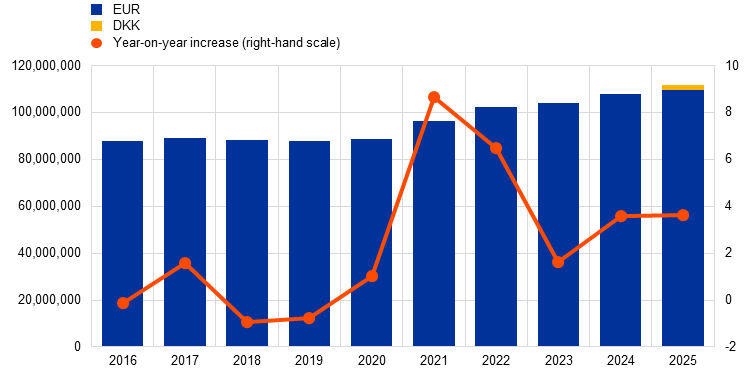
Read the diagram as text
- Read the currency key: The blue bars show euro payments. Danish krone settlement became available in T2 in April 2025 and appears as a small amber segment on the final bar.
- Separate count from growth: The orange year-on-year series uses the right-hand percentage scale. The bar height uses the left-hand transaction count scale.
Read the actual 2025 evidence in the ECB chart.
Read the original at full size here
Use touch, a trackpad, or the arrow keys in the image area.
A fourth service manages collateral: the assets banks pledge to support central bank credit. It belongs to the same family, but it is not another payment line.
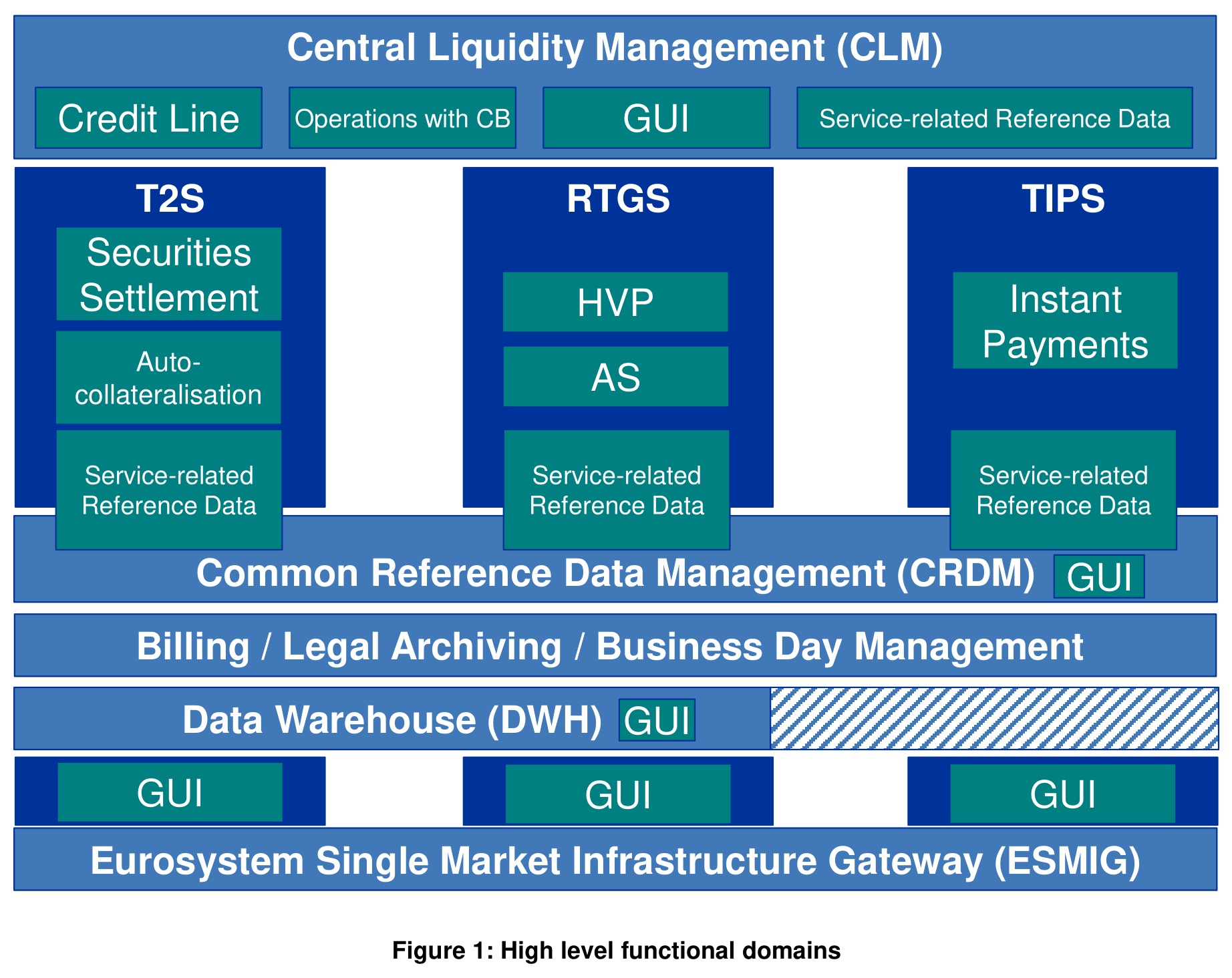
Read the diagram as text
- Find the shared gateway: The bottom band is the Eurosystem Single Market Infrastructure Gateway, or ESMIG. The graphical user interfaces and the services sit above it.
- Find common reference data: Common Reference Data Management, or CRDM, is shown as a common component. The three service columns also have service-related reference data.
- Compare the settlement jobs: T2S handles securities settlement. RTGS includes high-value payments and ancillary-system settlement. TIPS handles instant payments.
- Identify the credit line: The upper central liquidity management band includes the credit line and central bank operations. These serve a different function from the settlement columns below.
Follow the ECB figure step by step.
Read the original at full size here
Use touch, a trackpad, or the arrow keys in the image area.
Knowing that saves a great deal of confusion later. A reader who hears the name and pictures one machine goes looking for one rulebook, one account and one queue, and finds none of them. A reader who pictures a station asks a better question first: which line am I standing on?
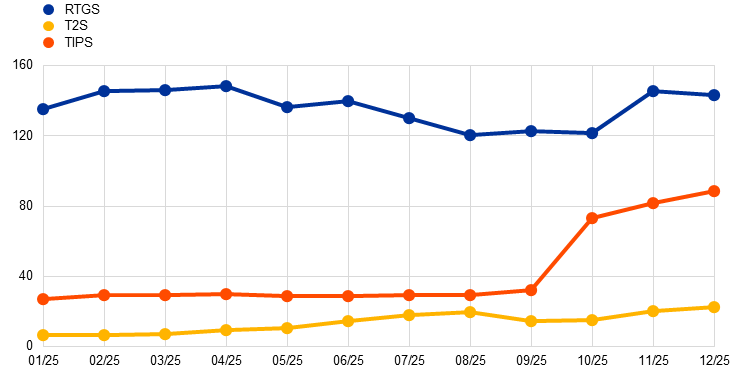
Read the diagram as text
- Read the three-service key: The chart tracks RTGS, T2S and TIPS separately. The account baskets differ, so read the ECB chart notes when you compare them.
- Find the TIPS balance change: The orange series rises in the fourth quarter. This shows the overnight position in TIPS while the instant service continues operating.
Read the actual 2025 evidence in the ECB chart.
Read the original at full size here
Use touch, a trackpad, or the arrow keys in the image area.
The rest of this topic answers three things. Which lines exist. What the station shares between them. And why the shared parts change where you go to look something up.
PLAIN WORDS · 1 in this section
- acronym
- a short name made from first letters
PICTURE IT
A workshop building with one front desk
Picture a building with three workshops. One makes metal parts, one sorts parcels, and one stays open all night. Each workshop has its own cash box, and its own staff count its own coins.
Everyone who comes in uses the same front desk. A visitor signs in once and gets one pass. A single register at the desk lists every member, and all three workshops read from it.
If a member has plenty of coins in the metal workshop's cash box, the parcel workshop still cannot use them. Someone must carry coins from one box to the other on purpose.
THE REAL JOB One can run several settlement services, and banks still use one entrance and one set of .
- One gateway to get in
- One store of reference data
- Three services, each with its own accounts
- Moving money between them is deliberate
HOW THE PICTURE MAPS
| In the picture | In the payment |
|---|---|
| The building as a whole | TARGET (Trans-European Automated Real-time Gross settlement Express Transfer) Services, the Eurosystem family |
| The workshop for large, urgent jobs | T2, which settles high-value euro payments in central bank money |
| The workshop that sorts parcels | T2S, the Eurosystem securities service, which settles securities against cash |
| The workshop open all night | TIPS (Instant Payment Settlement), which settles instant payments around the clock |
| The one front desk and pass | ESMIG (Eurosystem Single Market Infrastructure Gateway), the single gateway every participant connects through |
| The single member register at the desk | CRDM (Common Reference Data Management), the shared store of parties, accounts and routing rules |
| A separate cash box in each workshop | Each service holds its own accounts |
| Carrying coins from one box to another on purpose | A bank moves its own money between services deliberately |
WHERE THIS PICTURE STOPS
- A building has one owner and one management, so the picture hides how the family is governed. The services do not share a single queue or a single balance, even though the desk and the register are shared.
- In the picture the three workshops are all the building has. The topic's own source also lists ECMS (Eurosystem Collateral Management System), the collateral management service, which settles nothing on its own. The picture leaves it out.
- Carrying coins sounds slow and manual. The picture cannot show how a bank moves money between services in practice. That is the next topic, so do not read speed or cost into the carrying.
HOOK
One gate, one register, three settlement services; ECMS manages collateral.
REMEMBER IT THIS WAY
A contrast: two neighbours told apart by one test.
Shared access is not shared cash: check the service account that must fund the payment.
| In the trick | What it stands for |
|---|---|
| Shared access | the services share a gateway and reference data |
| Separate cash | each service has its own settlement accounts |
| Fund the right account | a balance on another service is not automatically available for this payment |
TELL A FRIEND
is a family with three settlement services and for collateral. The banks share one gateway and one store of reference data, but each service keeps its own accounts.
OFTEN MIXED UP WITH Two components, one service: liquidity and settlement (T2, CLM, RTGS). (Trans-European Automated Real-time Gross settlement Express Transfer) is the whole family and names no single machine. T2 is only one service in it, the one for high-value euro payments. When a document says , ask which line it means.
Sources & standards — 1 source
- Scheme-specific rule
TARGET Services Annual Report 2025 ↗ — European Central Bank · TARGET Services annual report 2025: three settlement services and ECMS, launched 16 June 2025; checked 6 November 2026
Read as a search excerpt.
The T2 figures and the figures for the instant payment service were seen as search excerpts on 18 October 2026, and the page was not opened. The report is dated June 2026. It gives values in each currency, so currencies are not added together here. The 2024 report gave an average payment of EUR 4.3 million and a median of EUR 6,532.
CURRENT AS CHECKED
1 FIGURE
Eurosystem TARGET Services — the T2 RTGS service
is the Eurosystem's real-time gross settlement service for high-value euro payments; it replaced TARGET2 on 20 March 2023, consolidating the with central liquidity management behind the shared ESMIG gateway. TARGET2 is the retired name and should not be used for the system operating today. TARGET2-Securities (T2S) is unaffected and keeps its name.
CHECKED 2026-07-29RECHECK BY 2027-07-29
Sources & standards — 1 source
- Official requirement
TARGET Services ↗ — European Central Bank · TARGET Services — T2 RTGS and central liquidity management, live 20 March 2023
T2 replaced TARGET2 on 20 March 2023. Detailed user functional specifications are published separately in the ECB's professional-use documents section.
Widened on the access date, because the previous applicability named only T2 and central liquidity management and an interview question was written from it that enumerated all four. The enumeration is corroborated from independent web-search excerpts including the Eurosystem's own T2 page and its TARGET Services annual report; the publisher's index page timed out on the day, so nothing is quoted from it directly.
The fourth service went live during the life of this registry rather than existing all along, which is why an older three-service description is a stale fact rather than a wrong one. Cite the live page before relying on the membership of the family.
The index page still does not publish the ECMS go-live date. That date is on
ecb-ecms-launch-press-2025.
SEE THE PAYMENT MOVE
PICTURE THE JOURNEY
A village store with a back shed, a front rack and one keeperOpen to read the picture, how it matches the payment and where it stops.
PICTURE IT
A village store with a back shed, a front rack and one keeper
Picture a village where households settle debts in fuel logs. The council keeps a shared store. Each household has a back shed and a front rack there. Moving logs between these places is a separate action. The back shed also serves other village needs.
One household owes another a load. It gives the keeper a note. The note asks for a transfer; it does not move logs. The keeper checks the note, available stock and other controls. Some stock may be reserved. Some notes have higher priority or limits.
An eligible transfer moves the full load between racks. Several notes can also pass together if their combined movements meet the controls. Each debt is still settled in full. This differs from replacing several debts with one net debt.
A note that passes validation may wait when settlement conditions fail. More stock can help, but its arrival does not guarantee release. The keeper may fetch back-shed stock only under the agreed arrangements. Some eligible notes can trigger a set-up transfer; others cannot.
A household can ask to withdraw a waiting note where the rules allow. It checks the answer before sending a replacement. Removing an undebited note does not create new logs. A note still waiting at its applicable closing point is returned unsettled in this example. The household investigates the confirmed result before deciding what comes next. (SYNTHETIC / TRAINING ONLY: the village and households are invented.)
THE REAL JOB The Eurosystem's T2 real-time gross settlement service settles eligible euro payment obligations in full, using central-bank money and applicable settlement controls.
HOW THE PICTURE MAPS
| In the picture | In the payment |
|---|---|
| A household that owes a large load and has a place in the store | Bank Alfa, the sending bank, has a large euro payment to make to NordbankWho: Bank Alfa |
| The household that is owed the load, with its own front rack | Nordbank, the receiving bank, whose settlement account is creditedWho: Nordbank |
| The note given to the keeper at the hatch; no log has moved | The pacs.009 payment message: an instruction only, nothing has moved yet |
| The keeper checks the note, stock and other controls | T2 checks the instruction and settlement conditions, including available liquidity |
| The council runs the store and keeps the household records | Eurosystem central banks hold the settlement accounts; T2 provides the service |
| The front rack, including stock subject to controls | The RTGS dedicated cash account, with liquidity affected by reservations and limits |
| The back shed also serves other village needs | The main cash account in Central Liquidity Management, separate from the RTGS account |
| Moving logs forward under agreed arrangements | A permitted liquidity transfer from the main cash account to the RTGS account |
| The keeper checks usable stock and other controls | The settlement check: available liquidity, priorities, reservations, limits and applicable windows |
| The full debt is discharged, including within an eligible combined movement | Gross obligations settle in full; eligible offsetting can reduce the extra funding needed |
| Logs once set down belong to the other household for good | Settlement is final the instant it happens |
| The receiving household confirms its own records separately | Nordbank reconciles the settled interbank transfer; no customer credit is established hereWho: Nordbank |
| A validated note waits when settlement conditions fail | This selected QUEUED instruction is unsettled; liquidity is not the only possible queue condition |
| Eligible notes move together under the controls | The selected GRIDLOCK recovery uses eligible offsetting while preserving full payment obligations |
| The household asks to remove a waiting note and checks the answer | A permitted pre-settlement withdrawal needs confirmed status before a replacement is considered |
| A note reaches its applicable closing point still unsettled | The selected CUTOFF instruction is rejected unsettled; no automatic next-day resend follows |
| The keeper refuses a note that fails validation | An invalid receiver is one rejection example; it is not the only validation failure |
WHERE THIS PICTURE STOPS
- Logs are physical objects. Real settlement changes central-bank account balances. Final settlement of this interbank leg does not erase every underlying claim or prove a customer credit.
- The Eurosystem operates the service and its central banks hold the accounts. The picture separates these functions to explain them, not to invent an independent settlement agency.
- The main cash account serves wider liquidity needs. Its visible balance is not automatically available in the RTGS dedicated cash account. Transfers have their own conditions.
- The production
R2026.JUNrules include transfers triggered by certain eligible urgent, ancillary-system or high-priority queues. This is not an automatic unlimited transfer for every normal payment. - An eligible offsetting set can settle full payment obligations with less extra funding. The picture does not establish that every queued set is eligible or that gross means no offsetting.
- Queue handling also depends on reservations, limits, priority and time. Funding alone does not guarantee release. A validation failure can cause rejection before settlement.
- This selected closing branch rejects the unsettled instruction. The exact applicable window and confirmed outcome must be checked before any replacement. An unanswered request is not proof of cancellation.
- Withdrawal is conditional and pre-settlement. Removing an instruction does not release cash that was never debited or guarantee that another payment will settle.
- The chosen
pacs.009is an interbank transfer message example. Local branch words are teaching labels, not certified ISO reason codes. The complete current message profile is not reproduced. - An unknown or suspended receiver needs investigation under the actual access rules. Do not bypass a suspension by trying another route.
HOOK
Check conditions, distinguish queued from final, and confirm the outcome before replacing.
REMEMBER IT THIS WAY
A sequence: the real steps, in order.
Separate the request, the release conditions and the final account movement.
| In the trick | What it stands for |
|---|---|
| Check | Validate the instruction and test usable liquidity plus other settlement controls |
| Settle | Discharge the full gross obligation, possibly within an eligible offsetting set |
| Deliver | Reconcile the confirmed interbank outcome without inferring customer credit |
TELL A FRIEND
T2 settles full payment obligations in central-bank money when the controls permit. A queue may involve liquidity or other conditions; eligible offsetting can help.
OFTEN MIXED UP WITH Two components, one service: liquidity and settlement (T2, CLM, RTGS). The and account serve different roles; transferring liquidity between them is separate from settling this payment.
OTHER JOURNEYS ON THIS TOPIC
PRACTISE AND KEEP
Sources for this topic — 5 sources
- Scheme-specific rule
TARGET Services ↗ — European Central Bank · TARGET Services — T2, T2S and TIPS
T2 replaced TARGET2 on 20 March 2023. Detailed user functional specifications are published separately in the ECB's professional-use documents section.
Widened on the access date, because the previous applicability named only T2 and central liquidity management and an interview question was written from it that enumerated all four. The enumeration is corroborated from independent web-search excerpts including the Eurosystem's own T2 page and its TARGET Services annual report; the publisher's index page timed out on the day, so nothing is quoted from it directly.
The fourth service went live during the life of this registry rather than existing all along, which is why an older three-service description is a stale fact rather than a wrong one. Cite the live page before relying on the membership of the family.
The index page still does not publish the ECMS go-live date. That date is on
ecb-ecms-launch-press-2025. - Official requirementR2026.JUN
T2 professional-use documents, binding XSDs and validation rules ↗ — European Central Bank · T2 professional-use documents and business validation rules
The ECB publishes multiple release lines on the same page; implementations must select the release effective for their test and go-live window.
- Simplified educational illustration
Payments Signal editorial teaching models — Payments Signal
What this simplifies: The station analogy focuses on three settlement lines, each with its own accounts and queue. ECMS is the fourth TARGET Service; it manages collateral rather than settling payments. Shared access and reference data do not create one pooled cash balance. The history lists selected milestones rather than every functional change.
Used wherever diagrams, scenarios, figures, or example values are didactic constructions rather than sourced facts; every such use carries a simplifications disclosure. All people, companies, banks, and list entries in examples are fictional.
- Scheme-specific rule
What is TIPS? (TARGET Instant Payment Settlement) ↗ — European Central Bank · the operator's description of TIPS — instant settlement in central bank money and the accounts it uses
TIPS also settles instant payments in Swedish krona and Danish krone. This page names the currencies and does not publish their go-live dates. The Danish-krone date and the statement that the Swedish krona was onboarded in 2024 are cited from
ecb-dkk-target-press-2025. Detailed user documentation is published separately by the ECB. - Scheme-specific rule
TARGET Services Annual Report 2025 ↗ — European Central Bank · TARGET Services annual report 2025: three settlement services and ECMS, launched 16 June 2025; checked 6 November 2026
Read as a search excerpt.
The T2 figures and the figures for the instant payment service were seen as search excerpts on 18 October 2026, and the page was not opened. The report is dated June 2026. It gives values in each currency, so currencies are not added together here. The 2024 report gave an average payment of EUR 4.3 million and a median of EUR 6,532.
Deepest material on this page: L4 — Standards & sources. Where a topic stops short of implementation depth, that is a deliberate coverage decision, not an oversight — see coverage.