Getting liquidity in and out of an instant account
Money does not reach an instant settlement account by itself. Three directions, four cash-management messages and a transit account explain how it gets there and back.
L1–L4 are part of the Pro pass
L0 Explain simply
Getting fuel into a car before a long drive is a decision with a direction attached. Fuel in the tank of the car you are actually taking is the only fuel that helps. A full can left in the garage is not.
Somebody has to move it, and moving it is a deliberate act with a start and an end. Nobody expects the can to empty itself into the tank.
Money inside a settlement service behaves the same way. Each service holds its own accounts, so a balance sitting in the daytime wholesale system settles nothing once that system has closed for the night. Getting it onto the account the will draw on is an instruction somebody has to send.
The timing is the part that bites. Funding from the daytime service has an opening window. Inside the instant service, however, some transfers remain possible through the weekend. A closed wholesale window is not the same as every route being closed.
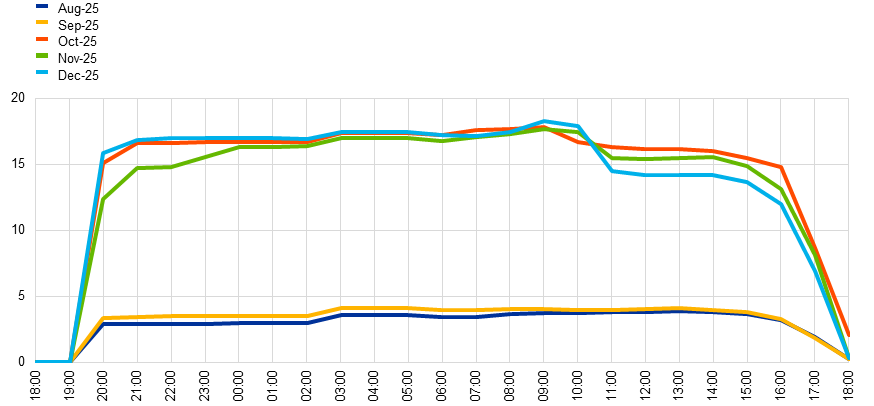
Read the diagram as text
- Read the opening flow: The curves jump after the T2 opening at 19:30 CET. A positive value means a net flow into dedicated cash accounts in TIPS.
- Read the closing flow: The cumulative amounts decline late in the T2 day as participants send funds back. Use the end-of-day balances alongside this chart to see the remaining liquidity.
Based on official sources
Read the actual 2025 evidence in the ECB chart.
Read the original at full size here
Use touch, a trackpad, or the arrow keys in the image area.
Put people in it and the shape is easier to hold. On Friday afternoon Maya Chen, who works in payments operations at Bank Alfa, settles how much the bank's instant should be carrying. On Saturday evening Riya sends money from her Bank Alfa account. (SYNTHETIC / TRAINING ONLY — every person and firm named in this topic is invented.)
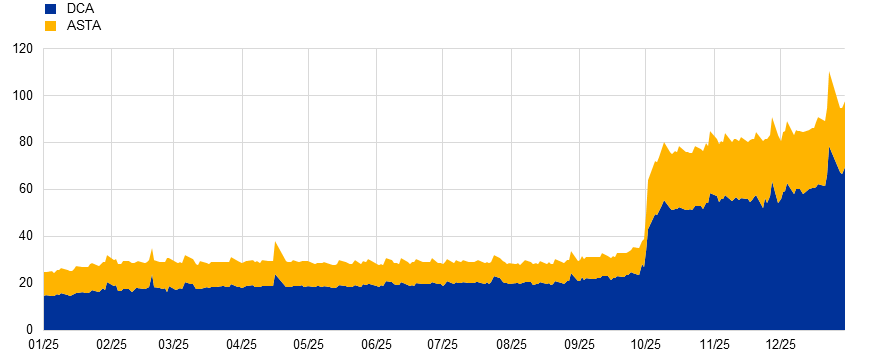
Read the diagram as text
- Read the two account categories: Blue shows dedicated cash accounts. Amber shows ancillary-system technical accounts. The top of the stack combines both balances.
- Compare the January baseline: In January the average amount the report observes at this snapshot was €26.9 billion. That is an average across the month.
- Spot the October step change: The report connects the growth to the October implementation milestone of the Instant Payments Regulation. The average reached €73.4 billion in October and €88.8 billion in December.
Based on official sources
Follow the ECB chart step by step.
Read the original at full size here
Use touch, a trackpad, or the arrow keys in the image area.
Nothing joins those two moments except a balance. The bank keeps watching that balance. Incoming payments or permitted transfers may change it on Saturday, even though Riya does not see that work. That is why the decision, rather than the payment, is what this topic is really about.
So it answers three questions in order. In which directions can money move? What carries the instruction? And what happens when nobody sends one?
PICTURE IT
Two warehouses and a shared loading bay
Picture two warehouses owned by the same company. The first opens on working days only. It holds most of the stock. The second is a small shop store that serves customers all week, including weekends.
A customer at the shop can only be served from the shop store's shelves. Stock in the weekday warehouse helps nobody on Saturday. So someone must order a delivery from the weekday warehouse to the shop store. The order is sent to the warehouse that holds the goods, because only that warehouse can release them.
The goods do not teleport. They pass through a loading bay that both warehouses write in. The bay log gives each warehouse a matching entry, so both stock books still add up. Staff never give orders to the bay. It only keeps the record.
A signed receipt comes back to say whether the delivery was accepted or refused. A shelf alarm warns the shop manager when stock falls below a minimum or rises above a maximum. A standing delivery order can be set up once. So a delivery arrives at the agreed point each time without a new order.
THE REAL JOB A puts a bank's own on the account that the next payments will draw on.
- Decide the balance to carry
- Order the service that holds the money
- Transit account records the counterpart
- Instant account is credited
- Outcome comes back, not silence
HOW THE PICTURE MAPS
| In the picture | In the payment |
|---|---|
| The weekday warehouse that holds most of the stock | The wholesale service, which keeps business hours |
| The shop store that serves customers all week | The instant service and its dedicated cash account |
| The delivery order sent to the warehouse that holds the goods | camt.050, the transfer instruction, sent to the service holding the money |
| The loading bay log with a matching entry for each warehouse | The transit account, which no participant gives orders to |
| The signed receipt, accepted or refused | camt.025, the outcome of the transfer |
| The shelf alarm at a minimum or a maximum | camt.004, the report when a floor or ceiling is crossed |
| The standing delivery that arrives at the agreed point | A standing order, defined once in reference data |
WHERE THIS PICTURE STOPS
- A delivery moves goods that belong to the company. This example moves one bank’s money between its own accounts; eligible TIPS DCA–ASTA transfers can involve different account holders. It is settled and reported that way, not as a payment owed to anybody.
- The bay log is only bookkeeping that happens by itself. The picture cannot show why it matters: so that two sets of books still reconcile after money leaves one and arrives on the other.
- A shop manager can phone the warehouse and ask for a rush delivery on Saturday. An external service may be closed at the weekend, so that particular funding route is unavailable. Incoming payments and eligible intra-TIPS DCA–ASTA transfers remain possible; the picture omits them. The picture has no clock.
HOOK
Tell the service that holds the money to let it go.
REMEMBER IT THIS WAY
A rule of thumb: if you see this, think that.
Send the order to the service the money is leaving. The service receiving it is not the one you tell.
| In the trick | What it stands for |
|---|---|
| Where the money is leaving from | the service that keeps the account being debited, with its balance and rules |
| The service receiving it is not told | an inbound transfer is instructed on the wholesale side, not in the instant service |
| Never tell the middle | no participant orders the transit account |
A standing order, or a rule set up in advance, moves money with no instruction that day.
TELL A FRIEND
Money in the wholesale system settles nothing for until someone orders a move onto the instant account. The instruction goes to the service that holds the money, and a receipt says if it worked.
OFTEN MIXED UP WITH Who holds the account, and who may speak for it. That topic explains who holds the accounts in the instant service. This topic explains how money gets onto and off those accounts, and which message carries each step.
Sources & standards — 2 sources
- Scheme-specific ruleR2026.JUN clean 24 November 2025
TARGET Instant Payment Settlement User Detailed Functional Specifications, R2026.JUN ↗ — European Central Bank · R2026.JUN §§1.5.3.1–6: inbound/outbound, DCA–ASTA, automatic floor/ceiling pull/push and window restrictions; §3.3.2.2.2 camt.004.001.10. Full PDF opened 6 November 2026
Full primary PDF opened; selected full §§1.3.2–1.5.4 read 6 November 2026. Accounts/CMB/headroom, rejected payments, directional blocks, reservation outcomes and rule-based pull/push. Production June 2026 reference; November deployment remains a separate dated line.
- Scheme-specific ruleR2026.JUN, June2026
Information Guide for TARGET participants, Part3 – TIPS, R2026.JUN ↗ — European Central Bank / Eurosystem · Part 3 TIPS, June 2026 §§3.1.1–3.1.2 pp11–19:24/7 intra-service DCA–ASTA; other transfer windows; no DCA–DCA liquidity transfers
Full51pagePDF opened6November2026. Guide expressly says it is not legally binding. §§3.1.1–3.1.2 pp11–19.
SEE THE PAYMENT MOVE
PICTURE THE JOURNEY
A canal lock that never closes and passes one boat at a timeOpen to read the picture, how it matches the payment and where it stops.
PICTURE IT
A canal lock that never closes and passes one boat at a time
Picture a canal between two small docks. In the middle stands a lock, which is two gates with a short stretch of water between them. This lock never closes, day or night, and it lets through one boat at a time.
Riya lives by the upper dock and Arjun lives by the lower dock. Late on a Sunday night, Riya hands a crate for Arjun to the upper dock office. The office checks the label and who is sending it. Then it writes in its book that the crate is set aside. The crate is still Riya's. (SYNTHETIC / TRAINING ONLY: Riya and Arjun are invented.)
The upper dock office now asks the lock to take a cargo boat. It may send only a boat that was loaded earlier, because the lock never lends cargo. The lock-keeper checks the boat's papers, lets it into the lock and shuts the gate behind it. The boat is held there. It still belongs to the upper dock.
The lower dock office checks that Arjun can receive the crate, then shows a green or a red lamp. On green, the keeper opens the far gate and the boat goes through. The gate closes behind it, and the boat cannot come back up through the lock. The upper dock office crosses the crate off Riya's page. The lower dock office hands the crate to Arjun, who can use it at once.
On red, the keeper opens the near gate again and the boat goes home, with nothing lost. If the lamp stays dark until the keeper's timer ends, the keeper does the same and sends a note that says so. If the upper dock has no loaded boat, the keeper turns the request away at once, and nothing waits in a line. Asking for the crate back later is only a request to the lower dock office, and Arjun decides.
THE REAL JOB The Eurosystem's instant settlement service () moves money between two banks' accounts, one payment at a time, and each move is final.
HOW THE PICTURE MAPS
| In the picture | In the payment |
|---|---|
| Riya hands a crate to the upper dock office | Riya asks Bank Alfa for an instant payment, late on a Sunday nightWho: Riya |
| The office checks the label and writes the crate as set aside | Bank Alfa checks the request and puts a hold on Riya's balanceWho: Bank Alfa |
| The office asks the lock to take a loaded cargo boat | Bank Alfa sends the payment message pacs.008 to the Eurosystem's instant settlement service (TIPS)Who: Bank Alfa |
| The boat was loaded earlier; the lock lends no cargo | Money already placed on Bank Alfa's dedicated cash account, with no credit from the service |
| The keeper checks the papers, admits the boat and shuts the gate behind it | The settlement service accepts the payment and reserves the amount on that account |
| The lower dock office shows a green or a red lamp | Nordbank answers with a positive or negative pacs.002 status messageWho: Nordbank |
| On green, the far gate opens and the boat goes through | The service settles the payment in central bank money, and the move is final |
| The upper dock office crosses the crate off Riya's page | Bank Alfa turns the hold into a booked debit on Riya's accountWho: Bank Alfa |
| The lower dock office hands the crate over | Nordbank credits Arjun's account once settlement is doneWho: Nordbank |
| Arjun uses the crate at once | Arjun can spend the money immediately, with no settlement risk left to unwindWho: Arjun |
| No loaded boat: the keeper turns the request away, with no waiting line | The account cannot cover it (NOLIQ): refused at once, never queued; the hold is released |
| A red lamp: the keeper opens the near gate and the boat goes home | Nordbank sends a negative pacs.002 status message, RJCT: the reservation and Riya's hold are released |
| The lamp stays dark until the keeper's timer ends; the boat goes home | The service expires the payment and tells Bank Alfa that no settlement took place |
| Asking for the crate back is only a request to the lower dock office | Bank Alfa sends a recall request, camt.056; Nordbank asks Arjun, then answers (camt.029) |
WHERE THIS PICTURE STOPS
- In the picture, a gate stops the boat coming back. In payments, finality is a rule, not a gate. Once the money has settled, no party can undo the move. A recall is only a request, and Arjun's bank may refuse it.
- The cargo boat is only a load. The picture cannot show the settlement asset. The money moves in central bank money, which the banks hold at the central bank, and the transfer there is final. Final settlement does not protect Riya from fraud, or from paying the wrong person.
- The picture gives the timer no length. How long the service waits for an answer is a scheme rule, so check the current rules, not the picture.
- The lamp, the timer and the one-boat rule are our own additions, to make the order easy to see. A real lock needs none of them. The one-boat rule stands for something real: each payment settles on its own, not in a batch.
- The loaded boat hides how a bank plans its funding. The picture cannot show when a bank can move money onto its account, or how it sets the level for a quiet night. The service gives no credit, so a short account means a refusal, not a wait.
HOOK
Set aside, ask, then move once. Afterwards, you can only ask.
REMEMBER IT THIS WAY
A rule of thumb: if you see this, think that.
Name the ending by its signal: no cover is an instant refusal, a red lamp is a rejection, a dark lamp is an expiry.
| In the trick | What it stands for |
|---|---|
NOLIQ | the account cannot cover it: refused at once, never queued; the hold is released |
RJCT | Nordbank sends a negative pacs.002 status message and the reservation and hold are released |
| Expiry | the service expires the payment and tells Bank Alfa that no settlement took place |
Once the payment has settled, none of these endings applies; only a recall request is left, and Arjun decides the outcome.
TELL A FRIEND
, the Eurosystem's instant settlement service, sets the money aside, waits for the 's yes, then moves it once, and the move is final. If the answer is no, or the time runs out, the money is simply released.
OFTEN MIXED UP WITH SCT Inst: instant payments. That topic is the customer scheme: what the promises and how fast each step must be. This journey follows only the settlement between two bank accounts: set aside, ask, move once.
PRACTISE AND KEEP
IMPLEMENTATION RESOURCES
27 RESOURCES
EVIDENCE AT ARM'S REACH
Apply the base message definition first, then the scheme or infrastructure profile that governs this topic.
An XSD checks XML structure. A usage guideline adds profile rules, conditional fields, code restrictions, and business controls. XSD-valid does not mean scheme-compliant.
OPEN OFFICIAL SOURCE
CBPR+ usage guidelines
PMPG correspondent-payment and reporting market practice
T2 functional specifications, validation rules, and binding XSDs
camt.050 liquidity credit transfer — raw XML
camt.025 receipt — liquidity transfer refused — raw XML
camt.004 return account — the balances behind the refusal — raw XML
camt.054 debit notification — raw XML
Corporate MX positive lifecycle — ZIP pack
MT900 → camt.054 implementation mapping
MT910 → camt.054 implementation mapping
camt.054 field matrix
camt.050 field matrix
camt.025 field matrix
camt.004 field matrix
Payment lifecycle test cases
T2 RTGS implementation pack field and process matrix
T2 RTGS implementation pack test cases
T2 RTGS implementation pack BA checklist
T2 RTGS implementation pack acceptance criteria
T2 RTGS implementation pack migration notes
T2 RTGS implementation pack restricted and release-specific gaps
CBPR+ implementation pack
SEPA credit-transfer implementation pack
SEPA direct-debit implementation pack
High-value payments implementation pack
T2 RTGS implementation pack
Sources for this topic — 9 sources
- Official requirementR2026.JUN
TIPS professional-use documents, release specifications and message examples ↗ — European Central Bank · TIPS UDFS — liquidity transfers, transit accounts and standing orders
R2026.JUN is the current production release at the review date. R2026.NOV is published for review and scheduled later; implementations must select the release effective for their test and go-live window.
- Official requirementR2026.JUN
T2 professional-use documents, binding XSDs and validation rules ↗ — European Central Bank · T2 UDFS — CLM liquidity management and transit accounts
The ECB publishes multiple release lines on the same page; implementations must select the release effective for their test and go-live window.
- Scheme-specific rule
What is TIPS? (TARGET Instant Payment Settlement) ↗ — European Central Bank · TIPS service description — the dedicated cash account these transfers fund
TIPS also settles instant payments in Swedish krona and Danish krone. This page names the currencies and does not publish their go-live dates. The Danish-krone date and the statement that the Swedish krona was onboarded in 2024 are cited from
ecb-dkk-target-press-2025. Detailed user documentation is published separately by the ECB. - Official requirement
ISO 20022 Catalogue of messages ↗ — ISO 20022 Registration Authority · camt message definitions for liquidity transfer, receipt, notification and account report
Each message set is described by a Message Definition Report; earlier versions remain available in the ISO 20022 messages archive.
- Official requirement
ISO 20022 message XSD schemas ↗ — ISO 20022 Registration Authority · the camt.004.001.10 schema, read in full by script from public mirrors: the report-or-error choice, the account report, the account identification, the account-or-business-error choice, the repeating balance block, the current limit block, the standing order block, the operational error and the query name
Each Message Definition Report links its published XSD; download it directly rather than relying on a third-party mirror.
- Market practice
Prowide pw-iso20022 SRU2025-10.4.0: Java sources of the ISO 20022 message classes, with ISO component and code list definitions ↗ — Prowide Software · the ReturnAccount message scope text in the open-source library's V10 class: the report answers a query (pull) or is sent by the service on its own (push), including as a warning
Opened on 2026-10-25 from Maven Central (pw-iso20022 SRU2025-10.4.0 sources jar), unpacked in its own directory, and the single files named above were read. The classes carry component and code descriptions but no element-level definitions: the charge included flag has no definition there, and field-level definitions for the mandate block are not in it. It is an implementation of the definitions, not the ISO text.
- Simplified educational illustration
Payments Signal editorial teaching models — Payments Signal
What this simplifies: The fuel analogy carries the direction of the movement and nothing about the cost of holding liquidity. The attached flow is the instant payment journey this account funds, not a separate liquidity animation. Message families introduce the roles. Exact versions and current release are stated where the primary specification was checked.
Used wherever diagrams, scenarios, figures, or example values are didactic constructions rather than sourced facts; every such use carries a simplifications disclosure. All people, companies, banks, and list entries in examples are fictional.
- Scheme-specific ruleR2026.JUN clean 24 November 2025
TARGET Instant Payment Settlement User Detailed Functional Specifications, R2026.JUN ↗ — European Central Bank · R2026.JUN §§1.5.3.1–6: inbound/outbound, DCA–ASTA, automatic floor/ceiling pull/push and window restrictions; §3.3.2.2.2 camt.004.001.10. Full PDF opened 6 November 2026
Full primary PDF opened; selected full §§1.3.2–1.5.4 read 6 November 2026. Accounts/CMB/headroom, rejected payments, directional blocks, reservation outcomes and rule-based pull/push. Production June 2026 reference; November deployment remains a separate dated line.
- Scheme-specific ruleR2026.JUN, June2026
Information Guide for TARGET participants, Part3 – TIPS, R2026.JUN ↗ — European Central Bank / Eurosystem · Part 3 TIPS, June 2026 §§3.1.1–3.1.2 pp11–19:24/7 intra-service DCA–ASTA; other transfer windows; no DCA–DCA liquidity transfers
Full51pagePDF opened6November2026. Guide expressly says it is not legally binding. §§3.1.1–3.1.2 pp11–19.
Deepest material on this page: L4 — Standards & sources. Where a topic stops short of implementation depth, that is a deliberate coverage decision, not an oversight — see coverage.