Three addresses on one message
A payment inside a settlement system carries more than one address: one for the network, one for the bank meant to read it, and one for the account that actually moves.
L1–L4 are part of the Pro pass
L0 Explain simply
A parcel usually carries more than one address, even though it is going to one place. There is the depot it is routed through. There is the street address printed on the label. And there is the name of the person who signs for it.
Most of the time those belong to the same household, so nobody notices there is any difference at all. The distinction only becomes visible on the day they disagree — when a parcel sits in a depot because the label and the signature name different people.
Payments inside a settlement system work the same way. The system is where money actually moves between banks, and the message asking for that carries several addresses at once. The business recipient and account holder often match, which can hide that they answer different questions.
Bank Alfa sends one payment towards Meridian Bank, and that single message carries all three: a network address, the bank the message is meant for, and the account that is going to move. For a payment, the network delivers the inbound message to the settlement system. The business recipient and account holder may both be Meridian Bank. Those two names matching does not make them one field. (SYNTHETIC / TRAINING ONLY — every firm named in this topic is invented.)
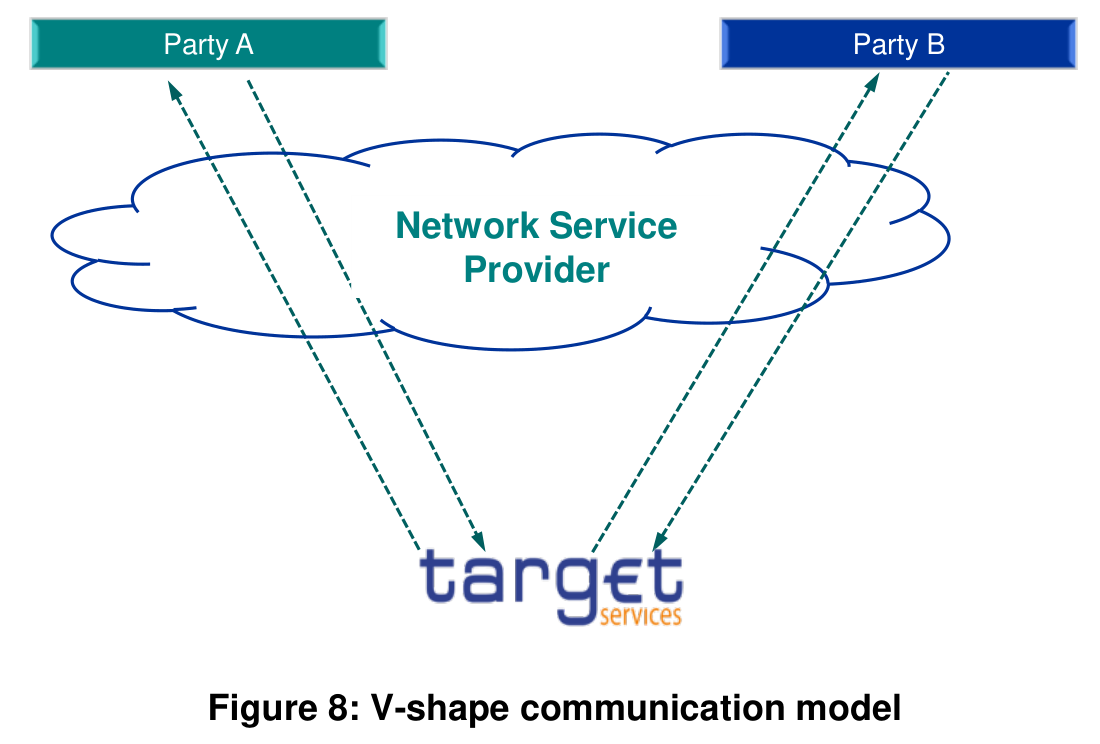
Read the diagram as text
- Start with Party A: Party A is one endpoint in the official picture. For the lesson’s selected forwardable order it submits a message through the network.
- Follow the network link: The network service provider provides connectivity. Its cloud sits along the lines connecting the two parties and the TARGET service.
- Find the TARGET service: The V’s lower point is TARGET Services. For a T2 payment the network delivers the incoming instruction to the settlement system.
- Find the other business endpoint: Party B is the other endpoint. For the successful forwardable order in the lesson, the service generates onward communication using the applicable business address and routing setup.
Based on official sources
Follow the ECB figure step by step.
Read the original at full size here
Use touch, a trackpad, or the arrow keys in the image area.
The invisibility has a cost worth naming early. Because the addresses agree in the ordinary case, almost every other lesson on this site can speak of "the bank's address" as though a payment had only one. That is a fair simplification and it holds up nearly always.
When it stops holding, though, knowing which address does which job is the whole problem. So this topic takes the single address apart into the three questions it was quietly answering all along.
PLAIN WORDS · 2 in this section
- invisibility
- being impossible to see
- simplification
- making something easier by leaving details out
PICTURE IT
A company mail room, an attention line and a cost sheet
Picture a large company that shares one mail room. A supplier checks the company's staff list to see who can be reached, then posts a letter to the company. The mail room reads only the outside of the envelope, enough to deliver it to the right building.
On the envelope an attention line names the team that should open the letter. Inside, a cost sheet names the budget that will pay the invoice. The team and the budget often belong to the same department, so nobody thinks of them as separate things.
They can differ. A small team may open its own letters but charge every bill to a head office budget. The letter is then correct, with two different names on it.
THE REAL JOB Three addresses let the network deliver a message, the right bank read it and the right account move, each answering its own question.
- Search the directory for the bank to reach
- Read the addressee value for the header
- Read the account value for the payment
- Network delivers using the technical address
- System checks the two belong together
HOW THE PICTURE MAPS
| In the picture | In the payment |
|---|---|
| The mail room that receives the post | The settlement system itself, reached by a distinguished name (DN), the network's technical address |
| The attention line on the envelope | The addressee Business Identifier Code (BIC) in the message header, naming who reads the message |
| The cost sheet inside the letter | The account code in the payment, naming whose account moves |
| The company staff list the sender checks | The published list of who can be reached, the real-time gross settlement directory |
| Copying the team name onto the cost sheet | Copying the code you searched with, instead of reading both values from the entry |
| A small team that charges bills to head office | A multi-addressee, such as a group branch: the reader and the account holder differ |
WHERE THIS PICTURE STOPS
- A company can fix a wrong cost sheet with a phone call. The settlement system checks that the header and the payment belong together, and it rejects a payment whose parts do not match, before settling. The sender gets a status report with a reason code, not a quiet correction.
- A mail room only moves paper. In settlement the account named in the payment is debited or credited, one payment at a time and at once. The picture shows nobody paying anything, so it cannot show that a settled payment is final.
- A staff list is advice and can be out of date without penalty. In the settlement system the directory is reference data and the business validation rules are enforced by the platform. The picture does not carry the exact rules or reason codes, which belong to one release and must be looked up each time.
- The picture makes every small team look like the head office case. A bank reached through another is a different arrangement: its entry names the direct participant in both the addressee and the account field.
HOOK
Where it goes, who reads it, whose money moves.
REMEMBER IT THIS WAY
A rule of thumb: if you see this, think that.
Search with one code, send with two. Read the header value and the account value off the entry, not from what you typed.
| In the trick | What it stands for |
|---|---|
| Search with one code | The code searched with only finds the right directory entry |
| Send with two | The addressee value goes in the header and the account value goes in the payment |
| Off the entry | The directory entry decides both values, not judgement |
For a direct participant all the values are the same code, so copying the searched one works by coincidence and hides the habit.
TELL A FRIEND
A payment has three addresses: one to deliver it, one for the bank that reads it, and one for the account that moves. They usually match, which hides that they are three different questions.
OFTEN MIXED UP WITH The ISO 20022 message model. The message model teaches that a header and a payment are separate layers of one message. This topic teaches what each layer carries for addressing in a settlement system. It also shows why the two answers can name different banks.
SEE THE PAYMENT MOVE
PICTURE THE JOURNEY
A village reading room with no page in the county bookOpen to read the picture, how it matches the payment and where it stops.
PICTURE IT
A village reading room with no page in the county book
Picture a town library that runs a small reading room in a village hall. The reading room has a librarian, a phone and its own stamp. It may send and receive notices in its own name. It holds no money of its own. The county keeps one page for the whole town library service in its accounts book, and that page belongs to the town library.
A reading circle in a nearby district wants to pay a share of costs to the town library. The circle has no page in the county book, so it asks the district library, which has one. The district library does not reuse the name it searched for. It looks the reading room up in the county directory. The entry gives three answers: the name searched, the room that reads the notice and the page that changes. Here the reading room reads, and the town library's page changes.
So the district library writes two names on one form. The send-to line names the reading room, because that is where the notice is read. The charge-to line names the town library, because only it has a page. Both lines are correct.
The district library hands the form to the county accounts office, not to the reading room. The office checks that the two names are a pair its directory holds together. Then it changes the pages: less on the district library's page, more on the town library's page. Once written, the entry stands. Only then does the office make its own copy of the notice and send it to the reading room. The librarian cannot touch a page. She notes a claim on the town library and keeps the amount aside in a waiting tray until it is used.
Three turns are possible. First, if the two names are not a pair the directory holds, the office hands the form back before it changes any page. The district library then looks the room up again.
Second, the reading room later sends a payment of its own, charged to the town library's page. The receiving side has to send it back. A clerk addresses that return from the charge-to line alone. The money goes back to the right page, but the notice lands on the town library's front desk, where nobody knows the payment.
Third, the reading room passes a matter on to a library in the next county. The form names only one of the two libraries that handled it. That library cannot say who really sent it. (SYNTHETIC / TRAINING ONLY: the libraries, the circle and the office are invented.)
THE REAL JOB It lets a branch with no account send and receive payment messages, while the money moves on its head office's account.
HOW THE PICTURE MAPS
| In the picture | In the payment |
|---|---|
| A reading circle with no page in the county book | Bank Alfa cannot reach the euro settlement system, so it passes the payment onWho: Bank Alfa |
| The district library, which has a page and takes the circle's request | Meridian Bank, a direct participant, sends the pacs.009 bank-to-bank payment messageWho: Meridian Bank |
| A county directory entry listing name searched, reading room and page that changes | Meridian Bank looks the institution up; the entry gives the addressee and the accountWho: Meridian Bank |
| The send-to line names the reading room, where the notice is read | The business header To names the branch, because the branch receives the message |
| The charge-to line names the town library, the only holder of a page | The instructed agent in the payment names Cassia Bank, which holds the accountWho: Cassia Bank |
| The county accounts office, which keeps the pages and writes entries that stand | The euro settlement system settles in central bank money, and each entry is final |
| The office checks that the two names are a pair it holds together | The system checks the header addressee is registered against the account in the payment |
| Less on the district library's page, more on the town library's page | Debit Meridian Bank's dedicated cash account, credit Cassia Bank's, at the central bank |
| The office sends its own copy of the notice to the reading room | The system forwards its own pacs.009 payment message to the branch |
| The librarian notes a claim on the town library and holds the amount aside | The branch books a claim on head office and holds the funds in suspense |
| A library in the next county, handed the matter to carry on | Nordbank receives the onward leg and has to trace the agents behind itWho: Nordbank |
| No such pair: the office hands the form back before any page changes | A pacs.002 status report rejects the payment before settlement; nothing moves |
| A return built from the charge-to line alone reaches the town library's front desk | A pacs.004 return built from the account field reaches Cassia Bank, not the branch |
| The form passed on names only one of the two libraries that handled it | The onward leg records one previous instructing agent, so the chain is one short |
WHERE THIS PICTURE STOPS
- The picture's accounts office is an ordinary county office whose book could be corrected. In the journey the settlement system books central bank money, and an entry is final the moment it settles. A return is a new payment, never an undo.
- The picture makes the reading room's right to receive notices look natural. In the journey that right exists only because the directory entry says so, and the settlement service publishes the directory.
- The picture makes the put in the wrong place return and the short chain look like clerks' slips. In the journey, the parties agree how a return is addressed and how many agents a continuing chain carries. These are market practice, not platform rules. The system raises no error for either.
- The picture has one reading room and one hop on each side. Real chains carry more agents, and a group may run several branches of this kind on one account. The network address the system delivers to is left out.
HOOK
Who reads it, and whose account moves, are separate questions.
REMEMBER IT THIS WAY
A contrast: two neighbours told apart by one test.
Two lines, two jobs: the header addressee receives the message, and the holds the account.
| In the trick | What it stands for |
|---|---|
| Header addressee | names the branch, because the branch receives the message |
| Instructed agent | names Cassia Bank, which holds the account |
TELL A FRIEND
One payment can carry two names, and both are right. The header names the branch that reads it, the payment names the head office whose account moves, and the system checks they belong together.
OFTEN MIXED UP WITH Who can reach a settlement system (direct and indirect participation). That topic sorts institutions by two yes-or-no questions: does it hold an account, and does it act for itself. An answers no to both. This journey follows one payment to a branch that acts but holds no account.
PRACTISE AND KEEP
IMPLEMENTATION RESOURCES
66 RESOURCES
EVIDENCE AT ARM'S REACH
Apply the base message definition first, then the scheme or infrastructure profile that governs this topic.
An XSD checks XML structure. A usage guideline adds profile rules, conditional fields, code restrictions, and business controls. XSD-valid does not mean scheme-compliant.
OPEN OFFICIAL SOURCE
CBPR+ usage guidelines
HVPS+ usage guidelines
PMPG correspondent-payment and reporting market practice
SEPA Credit Transfer rulebook
SEPA Credit Transfer implementation guidelines
SEPA Instant Credit Transfer rulebook
SEPA Instant Credit Transfer implementation guidelines and XSDs
T2 functional specifications, validation rules, and binding XSDs
TIPS release specifications and professional-use documentation
CHAPS and RTGS ISO 20022 handbook and schema access
Fedwire Funds Service ISO 20022 implementation and technical documents
CHIPS ISO 20022 usage-guideline resources and rules
pacs.009 COV financial institution transfer — raw XML
camt.056 payment cancellation request — raw XML
MX cancellation, return, reversal, and investigation lifecycle — ZIP pack
MT202 → pacs.009 implementation mapping
MT202 COV → pacs.009 COV implementation mapping
MT200 → pacs.009 implementation mapping
MT205 → pacs.009 implementation mapping
MT192 → camt.056 implementation mapping
MT292 → camt.056 implementation mapping
MT201 → N × pacs.009 (batch decomposition) implementation mapping
MT203 → N × pacs.009 (batch decomposition) implementation mapping
pacs.009 field matrix
camt.056 field matrix
Payment lifecycle test cases
MT to MX migration notes
T2 RTGS implementation pack field and process matrix
T2 RTGS implementation pack test cases
T2 RTGS implementation pack BA checklist
T2 RTGS implementation pack acceptance criteria
T2 RTGS implementation pack migration notes
T2 RTGS implementation pack restricted and release-specific gaps
TIPS instant-settlement implementation pack field and process matrix
TIPS instant-settlement implementation pack test cases
TIPS instant-settlement implementation pack BA checklist
TIPS instant-settlement implementation pack acceptance criteria
TIPS instant-settlement implementation pack migration notes
TIPS instant-settlement implementation pack restricted and release-specific gaps
CHAPS RTGS implementation pack field and process matrix
CHAPS RTGS implementation pack test cases
CHAPS RTGS implementation pack BA checklist
CHAPS RTGS implementation pack acceptance criteria
CHAPS RTGS implementation pack migration notes
CHAPS RTGS implementation pack restricted and release-specific gaps
Fedwire Funds Service implementation pack field and process matrix
Fedwire Funds Service implementation pack test cases
Fedwire Funds Service implementation pack BA checklist
Fedwire Funds Service implementation pack acceptance criteria
Fedwire Funds Service implementation pack migration notes
Fedwire Funds Service implementation pack restricted and release-specific gaps
CHIPS implementation pack field and process matrix
CHIPS implementation pack test cases
CHIPS implementation pack BA checklist
CHIPS implementation pack acceptance criteria
CHIPS implementation pack migration notes
CHIPS implementation pack restricted and release-specific gaps
CBPR+ implementation pack
SEPA credit-transfer implementation pack
High-value payments implementation pack
T2 RTGS implementation pack
TIPS instant-settlement implementation pack
CHAPS RTGS implementation pack
Fedwire Funds Service implementation pack
CHIPS implementation pack
Sources for this topic — 3 sources
- Official requirementR2026.JUN
T2 professional-use documents, binding XSDs and validation rules ↗ — European Central Bank · RTGS and CRDM UDFS; business validation rules
The ECB publishes multiple release lines on the same page; implementations must select the release effective for their test and go-live window.
- Official requirement
Business application header (BAH) ↗ — ISO 20022 Registration Authority · head.001 Business Application Header
Several BAH versions exist (head.001.001.01 through .03); each usage community, such as CBPR+, spells out which version applies.
- Simplified educational illustration
Payments Signal editorial teaching models — Payments Signal
What this simplifies: The parcel analogy compresses three addressing layers into one picture and does not carry the network's own authentication. Validation rule identifiers, reason codes and directory extracts are deliberately not quoted: they are release-specific and sit behind the ECB's release lines and MyStandards, so a copy here would date without notice.
Used wherever diagrams, scenarios, figures, or example values are didactic constructions rather than sourced facts; every such use carries a simplifications disclosure. All people, companies, banks, and list entries in examples are fictional.
Deepest material on this page: L4 — Standards & sources. Where a topic stops short of implementation depth, that is a deliberate coverage decision, not an oversight — see coverage.