Settling instantly, at four in the morning (TIPS)
A service that never closes cannot borrow from a central bank at three in the morning. That single constraint shapes how instant settlement funds itself and how a payment is held.
L1–L4 are part of the Pro pass
L0 Explain simply
A shop that opens only on weekdays can order more stock whenever it runs low, because its suppliers are open too. A vending machine cannot. Once it is filled, it works with whatever is inside it until somebody comes back to refill it.
That difference changes how you stock the thing. The shop stocks for the next hour. The machine has to be stocked for the whole weekend, and stocked before the weekend begins.
Settling payments instantly, at any hour of any day, creates the same problem for a bank. The wholesale systems it would normally draw money from keep business hours. It must plan for the hours those systems cannot fund it. Incoming payments and transfers within the instant service can still change its .
Picture the hour in the title. Riya sends money to Arjun at four in the morning and it arrives before she has put her phone down. The routine payment runs without a person handling it. Each bank still needs monitoring and people who can respond when something goes wrong. (the Eurosystem's settlement service) itself provides no intraday credit. (SYNTHETIC / TRAINING ONLY — every person and firm named in this topic is invented.)
Read the diagram as text
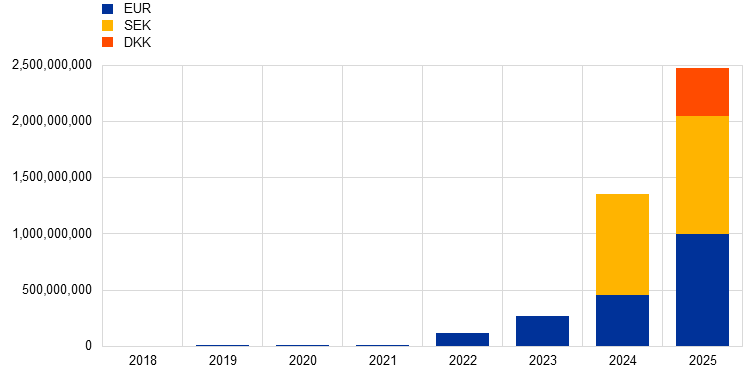
- Identify the currencies: The colour key separates the euro, Swedish krona and Danish krone. A stack adds up transaction counts across currencies.
- Read the 2025 change: The last stack has three parts. The short top section shows Danish krone traffic after the April 2025 migration.
Based on official sources
Read the actual 2025 evidence in the ECB chart.
Read the original at full size here
Use touch, a trackpad, or the arrow keys in the image area.
Everything that made her payment possible had been arranged in advance by people who had long since gone home. That is the real difficulty of a service that never closes. The payments happen at any hour; funding plans made earlier must be watched as the position changes.
Read the diagram as text
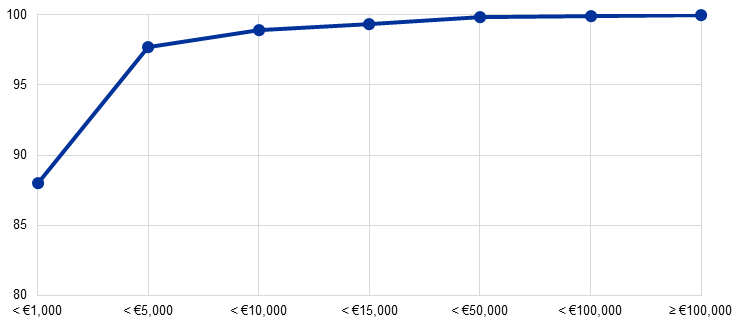
- Read the first point: The first point says that 88.0% of euro payments were below €1,000. It measures the share by payment count.
- Carry smaller payments forward: The point at €15,000 includes all the payments already counted at lower cutoffs. The ECB reports that 99.4% of euro payments fell below €15,000.
Based on official sources
Follow the ECB chart step by step.
Read the original at full size here
Use touch, a trackpad, or the arrow keys in the image area.
There is no dramatic failure when the machine runs out, either. It simply stops selling, one customer at a time, while looking exactly as it did when it was full. Hold on to that image, because it is what an under-funded instant account looks like from the outside.
Read the diagram as text
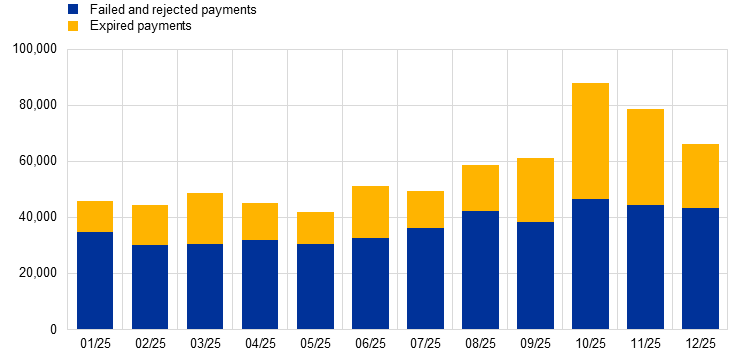
- Find failed and rejected payments: The blue segment combines failures and rejections. A failure can arise from insufficient funds. A rejection can arise if the receiving party declines the payment.
- Find expiries: The amber segment counts payments that expire. In the report’s example, this happens if the receiving party does not accept by the deadline.
Based on official sources
Read the actual 2025 evidence in the ECB chart.
Read the original at full size here
Use touch, a trackpad, or the arrow keys in the image area.
Two design decisions follow from never closing, and they are what the rest of this topic explains: where the money has to come from, and what happens to a payment while the is still deciding.
PLAIN WORDS · 3 in this section
- weekdays
- Monday to Friday
- vending
- selling goods from a machine
- refill
- fill up again
PICTURE IT
A vending machine filled before the weekend, with a hold slot
Picture a vending machine in a building that nobody visits from Friday evening until Monday morning. The shop next door can order more stock whenever it runs low, because its suppliers are open too. The machine cannot. It sells only what was loaded into it before the weekend began.
Now add one feature of our own. When a customer presses a button, the machine does not drop the snack at once. It moves the snack to a hold slot and waits for a second machine at the customer's end to answer yes or no. Only on a yes does the snack drop. The slot keeps the same snack from being promised twice.
When the machine runs short, it does not break. It simply stops selling, one customer at a time, and it looks the same as when it was full.
THE REAL JOB The Eurosystem's instant settlement service () settles euro payments at any hour, in , from funds already placed.
- Money is stocked on the account before closing time
- The sending bank submits the payment
- The service sets the amount aside
- The receiving bank answers yes or no
- On yes the money moves; on no or silence it is released
HOW THE PICTURE MAPS
| In the picture | In the payment |
|---|---|
| The machine's stock, loaded before the weekend | Funds placed beforehand on the bank's dedicated cash account (DCA) |
| Shop suppliers who close at night | Central bank operations that give intraday credit but keep business hours |
| Snack moved to the hold slot | A reservation: the amount is set aside while the receiving bank decides |
| The second machine's yes or no | The receiving bank's answer, which completes the payment or releases the amount |
| The snack dropping on a yes | Settlement: the money moves and the payee is paid |
| A machine that quietly stops selling | An under-funded account that declines good payments one by one |
WHERE THIS PICTURE STOPS
- A real vending machine has no hold slot or second machine. The reservation and the answer from the receiving bank are our own additions. So the picture cannot show how long the service waits. That time is set by the scheme rules, so look it up each time.
- Stock in a machine is used up by selling. A bank's money is not lost when a payment settles: it moves to the receiving bank. The picture also cannot show that on a release the amount stays with the sending bank, because nothing has left it.
- A machine owner can walk over and fill it again. TIPS provides no intraday credit. When an external service is closed, that funding route is unavailable, but incoming payments and eligible intra-TIPS DCA–ASTA transfers can still change the balance. Configured warnings and on-call action matter; the picture omits them.
- The picture has one machine, one owner and one kind of stock. It cannot show that a reachable party settles on somebody else's account, or that a limit stops one party using all of it.
HOOK
A service that never closes settles only from stocked money.
REMEMBER IT THIS WAY
A rule of thumb: if you see this, think that.
When an does not complete, ask whether the account was short or the was silent.
| In the trick | What it stands for |
|---|---|
| Short | nothing to reserve, a funding decision made earlier by the sending bank |
| Silent | no answer from the receiving bank, so the amount is released |
It covers only the two outcomes this topic teaches, so a payment rejected on other grounds needs the exception topics.
TELL A FRIEND
The Eurosystem's instant settlement service () settles euro payments in , so banks must stock their account before the weekend. The service sets each amount aside until the receiving bank answers, and releases it if no answer comes.
OFTEN MIXED UP WITH SCT Inst: instant payments. The Single Euro Payments Area () Instant is the scheme: the shared rules and the time allowed for each step. The Eurosystem's instant settlement service (TIPS) is a platform that settles payments made under those rules. A question about what a bank promised its customer is a scheme question. A question about why an amount was reserved and then released is a platform question.
Sources & standards — 1 source
- Scheme-specific ruleR2026.JUN clean 24 November 2025
TARGET Instant Payment Settlement User Detailed Functional Specifications, R2026.JUN ↗ — European Central Bank · R2026.JUN: cash balances, liquidity transfers and explicit expiry; live monitoring and intra-service funding remain possible
Full primary PDF opened; selected full §§1.3.2–1.5.4 read 6 November 2026. Accounts/CMB/headroom, rejected payments, directional blocks, reservation outcomes and rule-based pull/push. Production June 2026 reference; November deployment remains a separate dated line.
CURRENT AS CHECKED
1 FIGURE
Eurosystem instant payment service release of November 2026: user-testing and production dates, and its address-format content
The reported on 23 November 2026 that the first part of the November release rolling upgrade had started. Message-schema updates were still pending. During this stage participants could send either old or new formats, and TIPS sent only the old format.
The Deutsche Bundesbank’s R2026.NOV information pack (updated after Swift’s 2026 deferral) gives user testing from 9 October to 11 November 2026 and production deployment from 23 to 28 November 2026. It describes activation of the new message versions after the 27 November change of business day, between about 18:20 and 18:35. The Eurosystem TIPS main-milestones sheet matches that testing window, lists 11 November 2026 for MIB production approval, deployment start 23 November 2026, and “live in production” on 27 November 2026 with the outbound schema switch completed by 18:35.
A separate ECB news item of 4 September 2026 confirmed the wider R2026.NOV package with deployment shifted to 28 November 2026. That package date is context; do not erase the TIPS-specific 27 November activation wording without reading both sources.
The ECB status bulletin confirms that deployment started. The 27 November outbound schema change remains a published milestone as of this check. Consult the operator status for the completed switch.
The Bundesbank pack also lists removal of unstructured postal addresses in release content and separately excludes , , camt.056, pacs.004, camt.029 and pacs.028 from the ISO maintenance-version upgrade. Address rules and message-version upgrades must not be treated as one condition. Read the final message-specific TIPS usage guidelines; an EPC scheme timetable change does not by itself change every operator profile.
CHECKED 2026-11-23RECHECK BY 2026-11-29
Sources & standards — 4 sources
- Regulatory guidance
TIPS operational status — November 2026 rolling upgrade started ↗ — European Central Bank · TIPS operational status, 23 November 2026 15:20 Frankfurt time. First phase started without message-schema updates. Inbound old or new format, outbound old format.
- Regulatory guidance
Trans-European Automated Real-time Gross settlement Express Transfer (TARGET) Services: information on the instant payment service release of November 2026 (September 2026 update) ↗ — Deutsche Bundesbank · Bundesbank R2026.NOV pack re-checked 12 November 2026: UTEST 9 Oct–11 Nov; PROD deployment 23–28 Nov; activation after 27 Nov CoB ~18:20–18:35; address vs MR upgrade scope kept separate.
Re-opened via web search 12 November 2026. Records planned deployment milestones, not observed live cutover.
Second-pass 12 November 2026: production deployment window still 23–28 November; not observed live.
- Regulatory guidance
Main Milestones TIPS Release R2026.NOV ↗ — European Central Bank / Eurosystem · TIPS main milestones PDF: UTEST end 11 Nov 2026; MIB PROD approval 11 Nov; deployment start 23 Nov; live in production 27 Nov with outbound schema switch by 18:35.
PDF opened via web search 12 November 2026. Planned milestones, not confirmation of completed production cutover.
Second-pass 12 November 2026: still planned milestones only; no separate public MIB-approval notice found beyond the milestone sheet listing 11 November.
- Regulatory guidance
November 2026 TARGET Services releases confirmed with deployment shifted to 28 November 2026 ↗ — European Central Bank · ECB news 4 September 2026: TARGET Services R2026.NOV package deployment shifted to 28 November 2026; user testing from 9 October 2026.
Opened 12 November 2026. Package-level schedule context for T2/T2S/TIPS/ECMS.
SEE THE PAYMENT MOVE
PICTURE THE JOURNEY
A canal lock that never closes and passes one boat at a timeOpen to read the picture, how it matches the payment and where it stops.
PICTURE IT
A canal lock that never closes and passes one boat at a time
Picture a canal between two small docks. In the middle stands a lock, which is two gates with a short stretch of water between them. This lock never closes, day or night, and it lets through one boat at a time.
Riya lives by the upper dock and Arjun lives by the lower dock. Late on a Sunday night, Riya hands a crate for Arjun to the upper dock office. The office checks the label and who is sending it. Then it writes in its book that the crate is set aside. The crate is still Riya's. (SYNTHETIC / TRAINING ONLY: Riya and Arjun are invented.)
The upper dock office now asks the lock to take a cargo boat. It may send only a boat that was loaded earlier, because the lock never lends cargo. The lock-keeper checks the boat's papers, lets it into the lock and shuts the gate behind it. The boat is held there. It still belongs to the upper dock.
The lower dock office checks that Arjun can receive the crate, then shows a green or a red lamp. On green, the keeper opens the far gate and the boat goes through. The gate closes behind it, and the boat cannot come back up through the lock. The upper dock office crosses the crate off Riya's page. The lower dock office hands the crate to Arjun, who can use it at once.
On red, the keeper opens the near gate again and the boat goes home, with nothing lost. If the lamp stays dark until the keeper's timer ends, the keeper does the same and sends a note that says so. If the upper dock has no loaded boat, the keeper turns the request away at once, and nothing waits in a line. Asking for the crate back later is only a request to the lower dock office, and Arjun decides.
THE REAL JOB The Eurosystem's instant settlement service () moves money between two banks' accounts, one payment at a time, and each move is final.
HOW THE PICTURE MAPS
| In the picture | In the payment |
|---|---|
| Riya hands a crate to the upper dock office | Riya asks Bank Alfa for an instant payment, late on a Sunday nightWho: Riya |
| The office checks the label and writes the crate as set aside | Bank Alfa checks the request and puts a hold on Riya's balanceWho: Bank Alfa |
| The office asks the lock to take a loaded cargo boat | Bank Alfa sends the payment message pacs.008 to the Eurosystem's instant settlement service (TIPS)Who: Bank Alfa |
| The boat was loaded earlier; the lock lends no cargo | Money already placed on Bank Alfa's dedicated cash account, with no credit from the service |
| The keeper checks the papers, admits the boat and shuts the gate behind it | The settlement service accepts the payment and reserves the amount on that account |
| The lower dock office shows a green or a red lamp | Nordbank answers with a positive or negative pacs.002 status messageWho: Nordbank |
| On green, the far gate opens and the boat goes through | The service settles the payment in central bank money, and the move is final |
| The upper dock office crosses the crate off Riya's page | Bank Alfa turns the hold into a booked debit on Riya's accountWho: Bank Alfa |
| The lower dock office hands the crate over | Nordbank credits Arjun's account once settlement is doneWho: Nordbank |
| Arjun uses the crate at once | Arjun can spend the money immediately, with no settlement risk left to unwindWho: Arjun |
| No loaded boat: the keeper turns the request away, with no waiting line | The account cannot cover it (NOLIQ): refused at once, never queued; the hold is released |
| A red lamp: the keeper opens the near gate and the boat goes home | Nordbank sends a negative pacs.002 status message, RJCT: the reservation and Riya's hold are released |
| The lamp stays dark until the keeper's timer ends; the boat goes home | The service expires the payment and tells Bank Alfa that no settlement took place |
| Asking for the crate back is only a request to the lower dock office | Bank Alfa sends a recall request, camt.056; Nordbank asks Arjun, then answers (camt.029) |
WHERE THIS PICTURE STOPS
- In the picture, a gate stops the boat coming back. In payments, finality is a rule, not a gate. Once the money has settled, no party can undo the move. A recall is only a request, and Arjun's bank may refuse it.
- The cargo boat is only a load. The picture cannot show the settlement asset. The money moves in central bank money, which the banks hold at the central bank, and the transfer there is final. Final settlement does not protect Riya from fraud, or from paying the wrong person.
- The picture gives the timer no length. How long the service waits for an answer is a scheme rule, so check the current rules, not the picture.
- The lamp, the timer and the one-boat rule are our own additions, to make the order easy to see. A real lock needs none of them. The one-boat rule stands for something real: each payment settles on its own, not in a batch.
- The loaded boat hides how a bank plans its funding. The picture cannot show when a bank can move money onto its account, or how it sets the level for a quiet night. The service gives no credit, so a short account means a refusal, not a wait.
HOOK
Set aside, ask, then move once. Afterwards, you can only ask.
REMEMBER IT THIS WAY
A rule of thumb: if you see this, think that.
Name the ending by its signal: no cover is an instant refusal, a red lamp is a rejection, a dark lamp is an expiry.
| In the trick | What it stands for |
|---|---|
NOLIQ | the account cannot cover it: refused at once, never queued; the hold is released |
RJCT | Nordbank sends a negative pacs.002 status message and the reservation and hold are released |
| Expiry | the service expires the payment and tells Bank Alfa that no settlement took place |
Once the payment has settled, none of these endings applies; only a recall request is left, and Arjun decides the outcome.
TELL A FRIEND
, the Eurosystem's instant settlement service, sets the money aside, waits for the 's yes, then moves it once, and the move is final. If the answer is no, or the time runs out, the money is simply released.
OFTEN MIXED UP WITH SCT Inst: instant payments. That topic is the customer scheme: what the promises and how fast each step must be. This journey follows only the settlement between two bank accounts: set aside, ask, move once.
PRACTISE AND KEEP
IMPLEMENTATION RESOURCES
68 RESOURCES
EVIDENCE AT ARM'S REACH
Apply the base message definition first, then the scheme or infrastructure profile that governs this topic.
An XSD checks XML structure. A usage guideline adds profile rules, conditional fields, code restrictions, and business controls. XSD-valid does not mean scheme-compliant.
OPEN OFFICIAL SOURCE
CBPR+ usage guidelines
HVPS+ usage guidelines
PMPG correspondent-payment and reporting market practice
SEPA Credit Transfer rulebook
SEPA Credit Transfer implementation guidelines
SEPA Instant Credit Transfer rulebook
SEPA Instant Credit Transfer implementation guidelines and XSDs
SEPA Direct Debit Core rulebook
SEPA Direct Debit Core implementation guidelines and XSDs
SEPA Direct Debit B2B rulebook
SEPA Direct Debit B2B implementation guidelines and XSDs
T2 functional specifications, validation rules, and binding XSDs
TIPS release specifications and professional-use documentation
CHAPS and RTGS ISO 20022 handbook and schema access
Fedwire Funds Service ISO 20022 implementation and technical documents
CHIPS ISO 20022 usage-guideline resources and rules
pacs.008 FI-to-FI credit transfer — raw XML
pacs.002 payment status — raw XML
pacs.008 cover announcement — COVE — raw XML
pacs.002 payment status — rejection — raw XML
Corporate MX positive lifecycle — ZIP pack
MT103 → pacs.008 implementation mapping
MT103 /REJT/ convention → pacs.002 implementation mapping
MT102 → N × pacs.008 (batch decomposition) implementation mapping
pacs.008 field matrix
pacs.002 field matrix
Payment lifecycle test cases
MT to MX migration notes
T2 RTGS implementation pack field and process matrix
T2 RTGS implementation pack test cases
T2 RTGS implementation pack BA checklist
T2 RTGS implementation pack acceptance criteria
T2 RTGS implementation pack migration notes
T2 RTGS implementation pack restricted and release-specific gaps
TIPS instant-settlement implementation pack field and process matrix
TIPS instant-settlement implementation pack test cases
TIPS instant-settlement implementation pack BA checklist
TIPS instant-settlement implementation pack acceptance criteria
TIPS instant-settlement implementation pack migration notes
TIPS instant-settlement implementation pack restricted and release-specific gaps
CHAPS RTGS implementation pack field and process matrix
CHAPS RTGS implementation pack test cases
CHAPS RTGS implementation pack BA checklist
CHAPS RTGS implementation pack acceptance criteria
CHAPS RTGS implementation pack migration notes
CHAPS RTGS implementation pack restricted and release-specific gaps
Fedwire Funds Service implementation pack field and process matrix
Fedwire Funds Service implementation pack test cases
Fedwire Funds Service implementation pack BA checklist
Fedwire Funds Service implementation pack acceptance criteria
Fedwire Funds Service implementation pack migration notes
Fedwire Funds Service implementation pack restricted and release-specific gaps
CHIPS implementation pack field and process matrix
CHIPS implementation pack test cases
CHIPS implementation pack BA checklist
CHIPS implementation pack acceptance criteria
CHIPS implementation pack migration notes
CHIPS implementation pack restricted and release-specific gaps
CBPR+ implementation pack
SEPA credit-transfer implementation pack
SEPA direct-debit implementation pack
High-value payments implementation pack
T2 RTGS implementation pack
TIPS instant-settlement implementation pack
CHAPS RTGS implementation pack
Fedwire Funds Service implementation pack
CHIPS implementation pack
Sources for this topic — 7 sources
- Scheme-specific rule
What is TIPS? (TARGET Instant Payment Settlement) ↗ — European Central Bank · TIPS service description
TIPS also settles instant payments in Swedish krona and Danish krone. This page names the currencies and does not publish their go-live dates. The Danish-krone date and the statement that the Swedish krona was onboarded in 2024 are cited from
ecb-dkk-target-press-2025. Detailed user documentation is published separately by the ECB. - Official requirementR2026.JUN
TIPS professional-use documents, release specifications and message examples ↗ — European Central Bank · TIPS user detailed functional specifications
R2026.JUN is the current production release at the review date. R2026.NOV is published for review and scheduled later; implementations must select the release effective for their test and go-live window.
- Scheme-specific rule2025 version 1.2 (EPC004-16)
2025 SEPA Instant Credit Transfer rulebook version 1.2 (EPC004-16) ↗ — European Payments Council · SEPA Instant Credit Transfer scheme rulebook
Version 1.2 formally replaced version 1.1 at its publication on 30 September 2026 (the European Payments Council's wording, seen as a search excerpt; the page was not opened). The change is limited to address-message elements and delays the previously planned end date for unstructured addresses. The EPC states that no other business or operational rules changed compared with version 1.1.
Selected primary follow-up7November2026: actual EPC004-16 2025v1.2 PDF, issued/effective30September2026, operative4.2.1–3A–D/fn14,4.3.1 and4.3.2.1–4 read. Successful checks require reservation; formal debit follows Originator PSP receipt of positive confirmation; beneficiary availability follows certainty of delivery to its CSM. Restoration lifts the reservation while settlement certainty continues until confirmation; late-positive notice is required and further action is outside the Scheme.
Recall and RFRO have distinct grounds and authorisation rules. Not all142pages, AnnexIII, licensed implementation guidelines, private CSM profiles or reproduction permission. Prior search-only release-history note remains historical.
Re-checked 12 November 2026: 2025 SCT Inst rulebook version 1.2 remains the edition in effect; published/effective 30 September 2026; unstructured-address end date removed with no replacement yet.
- Simplified educational illustration
Payments Signal editorial teaching models — Payments Signal
What this simplifies: The vending machine analogy carries the funding constraint and nothing about how a weekend position is sized. Prices, throughput figures, timing limits and the list of settlement currencies are deliberately not quoted because each changes on its own schedule. Party and account types are named at the level needed to explain payment capacity, not exhaustively.
Used wherever diagrams, scenarios, figures, or example values are didactic constructions rather than sourced facts; every such use carries a simplifications disclosure. All people, companies, banks, and list entries in examples are fictional.
- Scheme-specific ruleR2026.JUN clean 24 November 2025
TARGET Instant Payment Settlement User Detailed Functional Specifications, R2026.JUN ↗ — European Central Bank · R2026.JUN: cash balances, liquidity transfers and explicit expiry; live monitoring and intra-service funding remain possible
Full primary PDF opened; selected full §§1.3.2–1.5.4 read 6 November 2026. Accounts/CMB/headroom, rejected payments, directional blocks, reservation outcomes and rule-based pull/push. Production June 2026 reference; November deployment remains a separate dated line.
- Scheme-specific ruleECB/2026/11, adopted4May2026
Guideline(EU)2026/1473 amending the TARGET Guideline ↗ — European Central Bank / European Union · Guideline(EU)2026/1473: OCT Inst extension applies14 November 2026, future at6 November 2026 review. Official search excerpt
Official search excerpts checked6November2026. Web open returned robot challenge, not document text. TIPS automatictransfer mechanism separately confirmed in full current UDFS and Infoguide.
- Scheme-specific rule
November 2026 TARGET Services releases confirmed with deployment shifted to 28 November 2026 ↗ — European Central Bank / Eurosystem (TARGET Services) · ECB 4 September 2026 announcement opened 6 November 2026: November TARGET package deployment shifted14 to 28 November 2026; technical schedule distinct from earlier legal application date
Corroborated against the Eurosystem's own 28 August 2026 'Reassessment of timeline for November 2026 TARGET Services releases' notice (ecb.mipnews260828), also on ecb.europa.eu.
Not opened: ecb.europa.eu could not be reached, the same limitation already recorded on other entries in this registry.
Verified from web-search excerpts of the ECB's own press pages, cross-checked across those two dated notices. Both converge on the same 28 November 2026 date, the same coordinated-release rationale for the shift, and the same description of the temporary unstructured-address measure and its readiness rationale.
The underlying User Requirements Document for the temporary measure is dated 3 September 2026 (ecb.t2cr260903_T2-0188-SYS-Allow-fully-unstructured-postal-address-format-in-RTGS-messages).
This entry does not corroborate any causal link to Swift's or the Federal Reserve's own deferral decisions. Those are separate, independently sourced items in this registry; this notice is cited only for the ECB's own confirmed date, reasoning and measure.
Second-pass web recheck 12 November 2026: package deployment still described as 28 November 2026; service-specific milestone sheets give different TIPS/T2 instants.
Deepest material on this page: L4 — Standards & sources. Where a topic stops short of implementation depth, that is a deliberate coverage decision, not an oversight — see coverage.