Two components, one service: liquidity and settlement (T2, CLM, RTGS)
T2 splits a bank's dealings with its central bank from its payments to other banks, gives each its own account, and makes moving money between them an explicit instruction.
L1–L4 are part of the Pro pass
L0 Explain simply
Most people keep money in more than one place on purpose. A current account pays the bills. A savings account holds what is not needed today. Moving money from one to the other is a deliberate act, and that is the point of the arrangement rather than a nuisance in it.
Ask why anyone bothers. The bank would happily hold one balance. The reason to split it is that a single number cannot answer two questions at once: what am I keeping, and what can I spend this afternoon? Two pots answer both at a glance.
A bank does something similar at its . One account holds its dealings with the central bank itself, such as borrowing for the day. Another account holds the money set aside for paying other banks.
Keeping them apart means a bank can see, without doing arithmetic, how much is genuinely available to settle payments right now. It also means money in the wrong pot settles nothing at all, which is the part that surprises people.
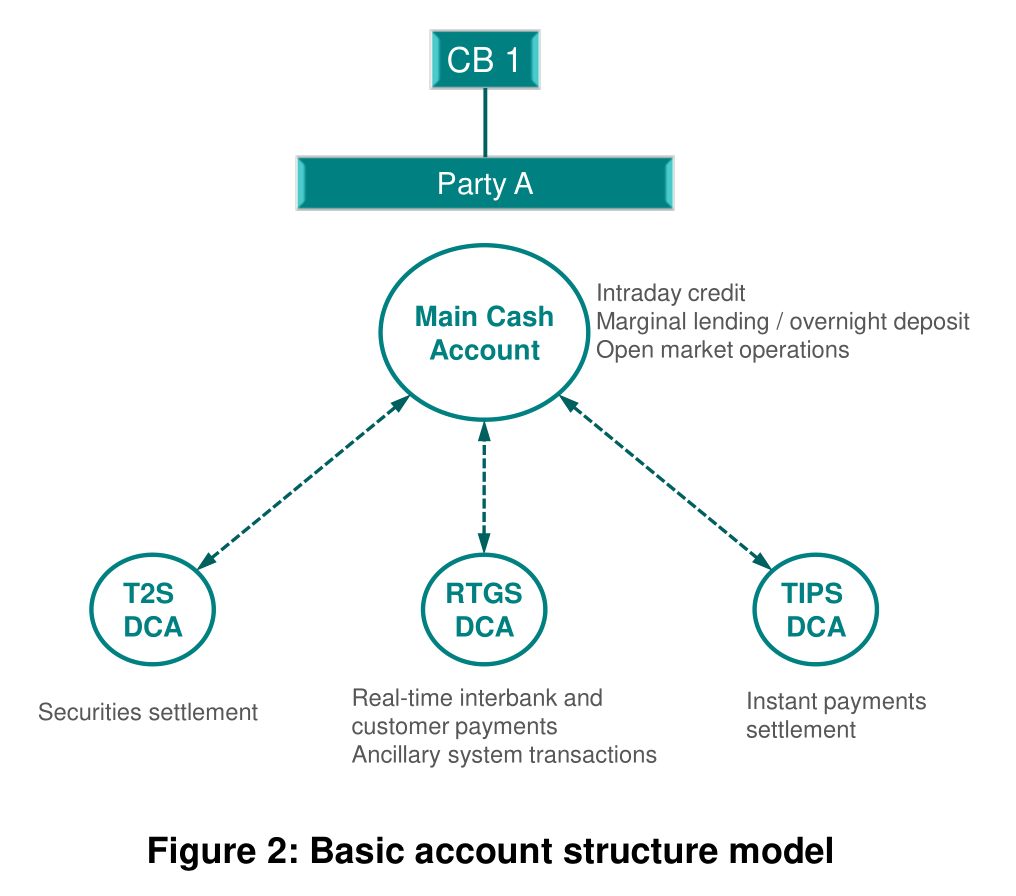
Read the diagram as text
- Identify the central bank relationship: Party A is shown under CB 1, the central bank. The main cash account sits below the party.
- Find the main cash account: The labels beside the main cash account show intraday credit, marginal lending or overnight deposits, and open market operations.
- Find the RTGS account: The centre dedicated cash account supports real-time interbank and customer payments and ancillary-system transactions in this model.
- Find the other settlement accounts: T2S has a dedicated account for the cash leg of securities settlement. TIPS has a separate dedicated account for instant-payment settlement.
Based on official sources
Follow the ECB figure step by step.
Read the original at full size here
Use touch, a trackpad, or the arrow keys in the image area.
Maya Chen, who works in payments operations at Bank Alfa, opens both balances on one screen every morning. The number that decides how her day will go is not the larger of the two. It is the one on the account the payments will actually be drawn from. (SYNTHETIC / TRAINING ONLY — every person and firm named in this topic is invented.)
That is a strange thing to have to say about money at a central bank, and it is the whole reason this topic exists. A bank can be comfortably funded and still unable to pay anybody, because being funded and being funded in the right place are not the same condition.
This topic is about that split: what sits in each half, what moves money between them, and what a payment does while the money it needs has not arrived yet.
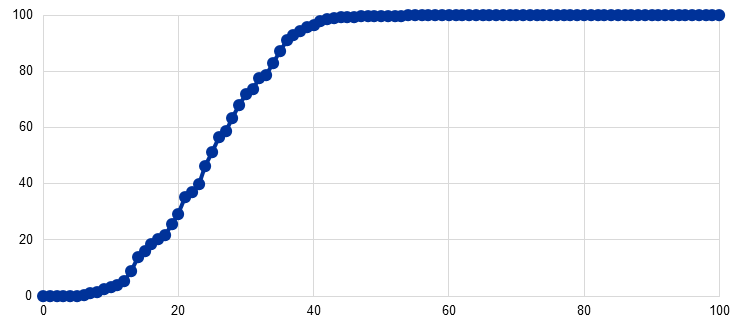
Read the diagram as text
- Find the share settled within 25 seconds: The ECB reports that 51.2% of payments were settled within 25 seconds that day. Read 25 seconds across the bottom and the cumulative share on the vertical scale.
- Move along the same curve to 36 seconds: By 36 seconds, the cumulative share was 91.1%. This includes transactions already counted at 25 seconds.
Based on official sources
Follow the ECB chart step by step.
Read the original at full size here
Use touch, a trackpad, or the arrow keys in the image area.
PICTURE IT
A cellar tank, a roof tank and a pump
Picture an apartment building with two water tanks. The cellar tank holds the building's main supply, and no tap draws from it. The roof tank feeds the taps on every floor, and nothing else does.
One morning the cellar tank is full and the roof tank is empty. The building has plenty of water, but no tap can run. Each tap is open and waiting. Nothing is wrong with the taps, and replacing them changes nothing.
The fix is to run the pump that lifts water from the cellar to the roof. That is a deliberate act, and the pump log records whether the pump ran. As soon as the water arrives, the waiting taps run. The caretaker learns to look at the roof tank first, not at the cellar.
The building may also have a timer that runs the pump each morning. It may have a level switch that starts the pump when the roof tank runs low. Both work only if someone fitted and set them first.
THE REAL JOB T2 keeps a bank's dealings with its apart from its payments to other banks, so available money is easy to see.
- Bank Alfa sends a payment to the real-time gross settlement (RTGS) part of
T2 - The dedicated cash account (DCA) is short, so the payment queues
- Bank Alfa sends a liquidity transfer from its main cash account to its dedicated cash account
- The transfer receives an answer
- The dedicated cash account is funded and the queued payment settles
T2, the European central bank payment service. The money moves between the bank's own accounts first.HOW THE PICTURE MAPS
| In the picture | In the payment |
|---|---|
| The cellar tank: the main supply, which no tap draws from | Main cash account (MCA) in central liquidity management (CLM): dealings with the central bank |
| The roof tank, which alone feeds the taps | Dedicated cash account (DCA) in real-time gross settlement (RTGS): where payments are drawn from |
| Taps left open, waiting for water | The bank's payments to other banks, queued because their account is short |
| Both tanks belong to one building | Both accounts belong to one bank and hold central bank money |
| The pump that lifts water from cellar to roof | A liquidity transfer, the instruction camt.050, between the bank's own accounts |
| The pump log, saying whether the pump ran | The answer to the transfer: a receipt, camt.025 |
| A timer that runs the pump each morning | A standing order: a set amount moved at the start of each day |
| A level switch that starts the pump when the roof tank runs low | A top-up rule: money added when a balance falls below a set floor |
WHERE THIS PICTURE STOPS
- In the picture a timer or level switch is easy to take for granted. In
T2a standing order or top-up rule works only if somebody set it up first. A rule nobody has set up is not a safety net. - The picture cannot say how long a payment may wait or what becomes of one queued at day end. The platform applies written rules for that, and the sending bank does not decide them. So do not assume the payment is simply sent the next day.
- The pump log is a record, not water. The receipt can report that the transfer was rejected, for example when the main cash account is short too. In the flow taught here, a transfer that has been carried out is final the instant it happens.
- A cellar tank only stores water. The main cash account is where central bank operations happen, including intraday credit. Intraday credit is credit given during the business day. The picture has no central bank. In
T2both accounts hold the bank's own money at the same central bank. So a transfer changes where the money can be used, not how much the bank holds. - The picture is one building with one set of taps. It cannot show that in
T2the sender addresses a payment to the system. The system settles it, then sends its own message to the receiver. A later level of this topic covers that.
HOOK
Full cellar, empty roof tank: the taps wait.
TELL A FRIEND
A bank in T2 keeps one account for its dealings with the and another for paying other banks. If the second is short, payments wait until money is moved there.
OFTEN MIXED UP WITH TARGET Services: a family, not a machine. is the whole group of settlement services. T2 is one of those services, and it has two components, each with its own account. This topic is about those two accounts. The other topic is about which service you are standing on, and each service holds its own accounts.
SEE THE PAYMENT MOVE
PICTURE THE JOURNEY
A village store with a back shed, a front rack and one keeperOpen to read the picture, how it matches the payment and where it stops.
PICTURE IT
A village store with a back shed, a front rack and one keeper
Picture a village where households settle debts in fuel logs. The council keeps a shared store. Each household has a back shed and a front rack there. Moving logs between these places is a separate action. The back shed also serves other village needs.
One household owes another a load. It gives the keeper a note. The note asks for a transfer; it does not move logs. The keeper checks the note, available stock and other controls. Some stock may be reserved. Some notes have higher priority or limits.
An eligible transfer moves the full load between racks. Several notes can also pass together if their combined movements meet the controls. Each debt is still settled in full. This differs from replacing several debts with one net debt.
A note that passes validation may wait when settlement conditions fail. More stock can help, but its arrival does not guarantee release. The keeper may fetch back-shed stock only under the agreed arrangements. Some eligible notes can trigger a set-up transfer; others cannot.
A household can ask to withdraw a waiting note where the rules allow. It checks the answer before sending a replacement. Removing an undebited note does not create new logs. A note still waiting at its applicable closing point is returned unsettled in this example. The household investigates the confirmed result before deciding what comes next. (SYNTHETIC / TRAINING ONLY: the village and households are invented.)
THE REAL JOB The Eurosystem's T2 real-time gross settlement service settles eligible euro payment obligations in full, using central-bank money and applicable settlement controls.
HOW THE PICTURE MAPS
| In the picture | In the payment |
|---|---|
| A household that owes a large load and has a place in the store | Bank Alfa, the sending bank, has a large euro payment to make to NordbankWho: Bank Alfa |
| The household that is owed the load, with its own front rack | Nordbank, the receiving bank, whose settlement account is creditedWho: Nordbank |
| The note given to the keeper at the hatch; no log has moved | The pacs.009 payment message: an instruction only, nothing has moved yet |
| The keeper checks the note, stock and other controls | T2 checks the instruction and settlement conditions, including available liquidity |
| The council runs the store and keeps the household records | Eurosystem central banks hold the settlement accounts; T2 provides the service |
| The front rack, including stock subject to controls | The RTGS dedicated cash account, with liquidity affected by reservations and limits |
| The back shed also serves other village needs | The main cash account in Central Liquidity Management, separate from the RTGS account |
| Moving logs forward under agreed arrangements | A permitted liquidity transfer from the main cash account to the RTGS account |
| The keeper checks usable stock and other controls | The settlement check: available liquidity, priorities, reservations, limits and applicable windows |
| The full debt is discharged, including within an eligible combined movement | Gross obligations settle in full; eligible offsetting can reduce the extra funding needed |
| Logs once set down belong to the other household for good | Settlement is final the instant it happens |
| The receiving household confirms its own records separately | Nordbank reconciles the settled interbank transfer; no customer credit is established hereWho: Nordbank |
| A validated note waits when settlement conditions fail | This selected QUEUED instruction is unsettled; liquidity is not the only possible queue condition |
| Eligible notes move together under the controls | The selected GRIDLOCK recovery uses eligible offsetting while preserving full payment obligations |
| The household asks to remove a waiting note and checks the answer | A permitted pre-settlement withdrawal needs confirmed status before a replacement is considered |
| A note reaches its applicable closing point still unsettled | The selected CUTOFF instruction is rejected unsettled; no automatic next-day resend follows |
| The keeper refuses a note that fails validation | An invalid receiver is one rejection example; it is not the only validation failure |
WHERE THIS PICTURE STOPS
- Logs are physical objects. Real settlement changes central-bank account balances. Final settlement of this interbank leg does not erase every underlying claim or prove a customer credit.
- The Eurosystem operates the service and its central banks hold the accounts. The picture separates these functions to explain them, not to invent an independent settlement agency.
- The main cash account serves wider liquidity needs. Its visible balance is not automatically available in the RTGS dedicated cash account. Transfers have their own conditions.
- The production
R2026.JUNrules include transfers triggered by certain eligible urgent, ancillary-system or high-priority queues. This is not an automatic unlimited transfer for every normal payment. - An eligible offsetting set can settle full payment obligations with less extra funding. The picture does not establish that every queued set is eligible or that gross means no offsetting.
- Queue handling also depends on reservations, limits, priority and time. Funding alone does not guarantee release. A validation failure can cause rejection before settlement.
- This selected closing branch rejects the unsettled instruction. The exact applicable window and confirmed outcome must be checked before any replacement. An unanswered request is not proof of cancellation.
- Withdrawal is conditional and pre-settlement. Removing an instruction does not release cash that was never debited or guarantee that another payment will settle.
- The chosen
pacs.009is an interbank transfer message example. Local branch words are teaching labels, not certified ISO reason codes. The complete current message profile is not reproduced. - An unknown or suspended receiver needs investigation under the actual access rules. Do not bypass a suspension by trying another route.
HOOK
Check conditions, distinguish queued from final, and confirm the outcome before replacing.
REMEMBER IT THIS WAY
A sequence: the real steps, in order.
Separate the request, the release conditions and the final account movement.
| In the trick | What it stands for |
|---|---|
| Check | Validate the instruction and test usable liquidity plus other settlement controls |
| Settle | Discharge the full gross obligation, possibly within an eligible offsetting set |
| Deliver | Reconcile the confirmed interbank outcome without inferring customer credit |
TELL A FRIEND
T2 settles full payment obligations in central-bank money when the controls permit. A queue may involve liquidity or other conditions; eligible offsetting can help.
OFTEN MIXED UP WITH Two components, one service: liquidity and settlement (T2, CLM, RTGS). The and account serve different roles; transferring liquidity between them is separate from settling this payment.
OTHER JOURNEYS ON THIS TOPIC
PRACTISE AND KEEP
IMPLEMENTATION RESOURCES
51 RESOURCES
EVIDENCE AT ARM'S REACH
Apply the base message definition first, then the scheme or infrastructure profile that governs this topic.
An XSD checks XML structure. A usage guideline adds profile rules, conditional fields, code restrictions, and business controls. XSD-valid does not mean scheme-compliant.
OPEN OFFICIAL SOURCE
CBPR+ usage guidelines
HVPS+ usage guidelines
PMPG correspondent-payment and reporting market practice
T2 functional specifications, validation rules, and binding XSDs
CHAPS and RTGS ISO 20022 handbook and schema access
Fedwire Funds Service ISO 20022 implementation and technical documents
CHIPS ISO 20022 usage-guideline resources and rules
pacs.009 COV financial institution transfer — raw XML
camt.050 liquidity credit transfer — raw XML
camt.025 receipt — liquidity transfer refused — raw XML
MT202 → pacs.009 implementation mapping
MT202 COV → pacs.009 COV implementation mapping
MT200 → pacs.009 implementation mapping
MT205 → pacs.009 implementation mapping
MT201 → N × pacs.009 (batch decomposition) implementation mapping
MT203 → N × pacs.009 (batch decomposition) implementation mapping
pacs.009 field matrix
camt.050 field matrix
camt.025 field matrix
MT to MX migration notes
T2 RTGS implementation pack field and process matrix
T2 RTGS implementation pack test cases
T2 RTGS implementation pack BA checklist
T2 RTGS implementation pack acceptance criteria
T2 RTGS implementation pack migration notes
T2 RTGS implementation pack restricted and release-specific gaps
CHAPS RTGS implementation pack field and process matrix
CHAPS RTGS implementation pack test cases
CHAPS RTGS implementation pack BA checklist
CHAPS RTGS implementation pack acceptance criteria
CHAPS RTGS implementation pack migration notes
CHAPS RTGS implementation pack restricted and release-specific gaps
Fedwire Funds Service implementation pack field and process matrix
Fedwire Funds Service implementation pack test cases
Fedwire Funds Service implementation pack BA checklist
Fedwire Funds Service implementation pack acceptance criteria
Fedwire Funds Service implementation pack migration notes
Fedwire Funds Service implementation pack restricted and release-specific gaps
CHIPS implementation pack field and process matrix
CHIPS implementation pack test cases
CHIPS implementation pack BA checklist
CHIPS implementation pack acceptance criteria
CHIPS implementation pack migration notes
CHIPS implementation pack restricted and release-specific gaps
CBPR+ implementation pack
High-value payments implementation pack
T2 RTGS implementation pack
CHAPS RTGS implementation pack
Fedwire Funds Service implementation pack
CHIPS implementation pack
Sources for this topic — 6 sources
- Official requirementR2026.JUN
T2 professional-use documents, binding XSDs and validation rules ↗ — European Central Bank · T2 UDFS — CLM and RTGS components
The ECB publishes multiple release lines on the same page; implementations must select the release effective for their test and go-live window.
- Scheme-specific rule
TARGET Services ↗ — European Central Bank · T2 service description — central liquidity management and RTGS
T2 replaced TARGET2 on 20 March 2023. Detailed user functional specifications are published separately in the ECB's professional-use documents section.
Widened on the access date, because the previous applicability named only T2 and central liquidity management and an interview question was written from it that enumerated all four. The enumeration is corroborated from independent web-search excerpts including the Eurosystem's own T2 page and its TARGET Services annual report; the publisher's index page timed out on the day, so nothing is quoted from it directly.
The fourth service went live during the life of this registry rather than existing all along, which is why an older three-service description is a stale fact rather than a wrong one. Cite the live page before relying on the membership of the family.
The index page still does not publish the ECMS go-live date. That date is on
ecb-ecms-launch-press-2025. - Market practice
Swift Inform Copy ↗ — Swift · Y-copy holds the original at Swift, copies it in full to the authorising party and delivers only if approved; T-copy delivers as usual with an information-only copy; the service was called FIN Copy and is now Inform Copy. search excerpt, page not opened
Current Swift product page opened 6 November 2026: Inform/Copy distinguishes T-copy real-time duplication from Y-copy controlled delivery. This is a provider product description, not a scheme rulebook. Copy payload is separately configurable: official current Swift glossary search text describes full or partial copies, but the glossary PDF redirected to login and was not read in full. Historical TARGET2 UDFS Book1 v12.01 (26 October 2018) documents its full-copy Y configuration; that is not a universal definition of Y-copy or current T2 routing.
- Simplified educational illustration
Payments Signal editorial teaching models — Payments Signal
What this simplifies: The current-account and savings-account analogy is a teaching device: a main cash account is not a savings product and carries obligations an ordinary account does not. Ancillary system settlement procedures are named but not described. No amounts, limits, cut-off times or release identifiers are quoted, because those are release-specific and would date.
Used wherever diagrams, scenarios, figures, or example values are didactic constructions rather than sourced facts; every such use carries a simplifications disclosure. All people, companies, banks, and list entries in examples are fictional.
- Scheme-specific ruleR2026.JUN clean 22 January 2026
T2 RTGS User Detailed Functional Specifications, release R2026.JUN ↗ — European Central Bank · R2026.JUN: liquidity transfer functionality, standing and rule-based transfers; current production reference checked 6 November 2026
Full primary PDF opened; selected sections read 6 November 2026: account/participation/queue and AS rules, receipt/liquidity-transfer usage, §12.4.3.3 p774 permits only 1 transaction in pacs.008.001.08. This is the clean R2026.JUN edition, not the older revised endpoint. Other releases remain separate.
Re-checked 12 November 2026: production teaching still uses R2026.JUN; Bundesbank T2 R2026.NOV pack schedules production deployment 28 November 2026.
- Scheme-specific ruleR2026.JUN clean 22 January 2026
T2 RTGS User Detailed Functional Specifications, release R2026.JUN ↗ — European Central Bank · R2026.JUN clean 22 January 2026: selected full RTGS specification sections read 6 November 2026; account/queue rules, liquidity-transfer outcomes and §12.4.3.3 p774 single-transaction pacs.008.001.08
Full primary PDF opened; selected sections read 6 November 2026: account/participation/queue and AS rules, receipt/liquidity-transfer usage, §12.4.3.3 p774 permits only 1 transaction in pacs.008.001.08. This is the clean R2026.JUN edition, not the older revised endpoint. Other releases remain separate.
Re-checked 12 November 2026: production teaching still uses R2026.JUN; Bundesbank T2 R2026.NOV pack schedules production deployment 28 November 2026.
Deepest material on this page: L4 — Standards & sources. Where a topic stops short of implementation depth, that is a deliberate coverage decision, not an oversight — see coverage.