When cash and securities must move together (T2S)
Settling a securities trade means two deliveries that must both happen or neither. Meeting that requirement is why this securities platform holds cash accounts at all.
L1–L4 are part of the Pro pass
L0 Explain simply
Riya agrees a trade: her bicycle, for cash, with somebody she has never met. One awkward question decides how the afternoon goes: who goes first? Hand over the bicycle and the buyer might not pay. Take the money first and the bicycle might never appear. (SYNTHETIC / TRAINING ONLY — every person and firm named in this topic is invented.)
Neither of them is dishonest, and that is the part worth noticing. The problem is not character; it is order. Whoever moves first is exposed for as long as the other side has not moved, and no amount of good faith closes that gap.
Meeting at a counter where the bicycle and the cash change hands in the same movement removes the problem entirely. Look closely at how it removes it. Not by making either party more trustworthy, and not by adding a promise — but by making the two halves of the exchange inseparable, so that neither one can happen alone.
Securities settlement has exactly this problem, at enormous scale and between institutions that will never meet. It solves it the same way. The delivery of the security and the payment for it are bound into a single event that either completes for both sides or completes for neither.
Read the diagram as text
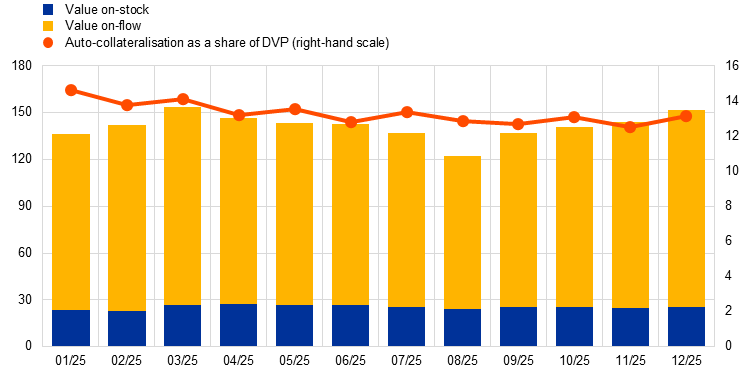
- Find both collateral sources: On-flow uses the securities being purchased. On-stock uses other eligible securities already held. The stacked bars distinguish the two.
- Read the share of settlement value: The orange series uses the right percentage scale. The ECB reports a 13.3% share of delivery-versus-payment value for 2025.
Read the actual 2025 evidence in the ECB chart.
Read the original at full size here
Use touch, a trackpad, or the arrow keys in the image area.
That is an unusual thing to build, and it explains something that otherwise looks odd. A platform for settling securities holds cash accounts. It is not drifting into banking; it settles both halves of the trade itself, so it needs the books for both.
Read the diagram as text
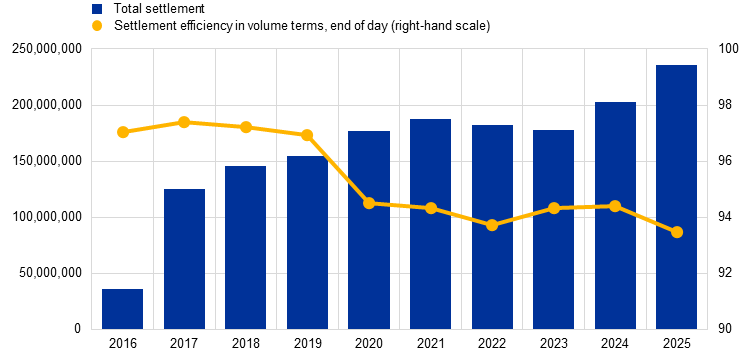
- Identify the two scales: Read the bars as transaction counts. Read the amber series as the percentage settled by end of day in volume terms.
- Compare the latest columns: The 2025 column is taller than 2024. The amber point is lower. These changes can occur together because a count and a percentage answer different questions.
Read the actual 2025 evidence in the ECB chart.
Read the original at full size here
Use touch, a trackpad, or the arrow keys in the image area.
Three questions follow, and the rest of this topic answers them in order. What ties the two halves together so that one cannot happen without the other? Whose accounts are they, given that cash and securities are looked after by different kinds of institution? And what does a bank have to do before a trade it has already agreed can settle at all?
Read the diagram as text
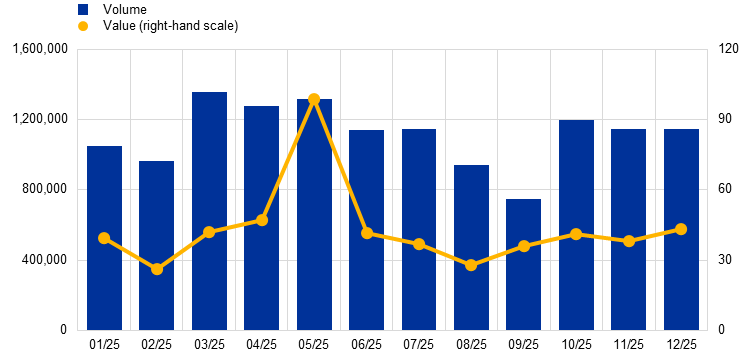
- Use a different scale for each series: Read the blue bars against the left scale for the number of penalties. Use the right scale, in millions of euros, for the amber line.
- Find the month with the most penalties: March had the highest number of penalties. The ECB reports 1,358,348.
- Find the month with the largest amount: The total amount was largest in May, at €98.7 million. A different month leads on each measure.
Follow the ECB chart step by step.
Read the original at full size here
Use touch, a trackpad, or the arrow keys in the image area.
PLAIN WORDS · 1 in this section
- inseparable
- joined so one cannot happen without the other
PICTURE IT
A turning hatch between two rooms
Picture a shop with two rooms and a round hatch in the wall between them. The hatch has two trays, one facing each room. A seller stands in one room and a buyer in the other. The seller puts the bicycle on one tray. The buyer puts the cash on the other.
The hatch turns only once, and one turn moves both trays together. The buyer gets the bicycle and the seller gets the cash in the same movement. If one tray is empty, the hatch stays still and nothing moves.
Two different keepers look after the two rooms. One keeps the goods room and one keeps the cash room. The hatch sits in the wall between them, so both trays are in one building.
THE REAL JOB lets a buyer and a seller of a security exchange it for cash so that neither is left exposed.
- Trade is agreed between two parties
- A depository holds the security on the securities account
- The bank funds its dedicated cash account
- The platform checks both legs
- Both legs settle in one step
- If a leg is not ready, neither moves
HOW THE PICTURE MAPS
| In the picture | In the payment |
|---|---|
| The bicycle tray | The security leg, the delivery of the security |
| The cash tray | The cash leg, the payment for the security |
| One turn moves both trays | Delivery versus payment: the security moves if and only if the cash moves |
| A hatch with an empty tray stays still | If one leg cannot settle, neither leg settles |
| The goods room and its keeper | A securities account kept by a central securities depository |
| The cash room and its keeper | A dedicated cash account opened by a central bank |
| Both rooms and the hatch in one building | One Eurosystem securities platform that holds both kinds of account |
WHERE THIS PICTURE STOPS
- The hatch turns whenever both trays are full. A real bank must also fund its dedicated cash account before settlement. A trade can be agreed and still not settle because the cash sits on another account. The picture shows no funding step.
- A turning hatch hides who owns what. A central bank provides the cash account and a CSD provides the securities account; their holders can be participating institutions. So two legal frameworks run over one trade. The euro cash accounts fall inside the legal scope of TARGET, the family of settlement services run by the Eurosystem, the group of central banks. The securities accounts do not. The picture cannot show that split.
- A hatch is one way to link two legs. Delivery versus payment can also be reached by linking a securities system to a separate cash system. The picture shows only the design with both legs on one platform. Delivery versus payment is also a risk-management idea set at international level, not a Eurosystem invention.
- The picture covers the exchange only. It leaves out matching, settlement cycles, partial settlement and auto-collateralisation. The lesson teaches these separately; the changed-fact question assumes a whole instruction with no eligible partial settlement or secured-credit provision.
HOOK
Both legs move in one turn, or neither moves.
REMEMBER IT THIS WAY
A rule of thumb: if you see this, think that.
When a trade will not settle, ask three questions: are the legs bound, who owns each account, is the cash account funded?
| In the trick | What it stands for |
|---|---|
| Are the legs bound? | delivery versus payment ties the two legs so one cannot happen without the other |
| Who owns each account? | a depository keeps the securities account and a central bank opens the cash account |
| Is the cash account funded? | a bank funds the dedicated cash account before settlement |
These are three questions and not three steps in time, since the cash account is funded before settlement and the first two describe the platform.
TELL A FRIEND
A security trade has two legs, the security and the cash. The Eurosystem securities platform links them, so both settle in one step or neither does, and the cash is paid in .
OFTEN MIXED UP WITH Settlement risk, finality, and CLS. This topic links a security with cash. Settlement risk shows the same idea for two currency payments, called payment versus payment. Ask what the two legs are: a security and cash means . Two currencies means payment versus payment.
SEE THE PAYMENT MOVE
PICTURE THE JOURNEY
A field sale, a registered agent and a clerk who compares two formsOpen to read the picture, how it matches the payment and where it stops.
PICTURE IT
A field sale, a registered agent and a clerk who compares two forms
Riya wants to buy a small field from Arjun. She has never filed anything at the land office, and only registered agents may do that. So she hires an agent who is registered there. The land office puts the field in the agent's name in its owners' register. The agent keeps Riya's ownership in a file of its own.
Each side files a transfer form, and each form describes the same sale from its own side. Riya's agent files a form to receive the field against payment. Arjun files a form to hand the field over against payment. Each form names the field, the price, the day and the other side.
A clerk lays the two forms side by side before opening any book. If the field, the price, the day and the names agree, the pair is matched. The agent then gives Riya a slip saying the forms matched and the sale waits for its day. The slip reports progress. It does not say the field is hers.
On the day, the clerk closes the sale as one act. The field moves in the owners' register, and the price moves in the deposit book. The price comes from the deposit Riya's side keeps there in advance, not from the agent's own money. Both books change together, or neither changes. Arjun's deposit grows by the price. The agent then writes the field into Riya's file, and the sale is done.
Two things can go differently. If the forms disagree, for example on the price or the day, the clerk opens neither book. Both sides are told, and they must fix the difference and file again. Suppose the forms match, but the deposit is too small. Or the field is not yet Arjun's to give in the register. Either way the clerk holds the whole sale. Nothing moves, and nothing is returned. When the short side tops up, the same forms go through as they would have the first time. (SYNTHETIC / TRAINING ONLY: Riya and Arjun are invented.)
THE REAL JOB T2S, the Eurosystem's TARGET2-Securities platform, checks that both sides of a trade agree, then moves the security and the cash together.
HOW THE PICTURE MAPS
| In the picture | In the payment |
|---|---|
| Riya, who wants to buy the field | Bank Alfa, the buyer of the securityWho: Bank Alfa |
| Riya's agent, the one registered at the land office | The custodian, which reaches T2S through a central securities depository (CSD), acting for Bank Alfa |
| Riya hires the agent to buy for her | Bank Alfa instructs its custodian to receive the security against payment |
| The agent's own place in the owners' register | The custodian's own securities account on the platform, credited for Bank Alfa |
| Arjun, who sells the field | Nordbank, the seller of the securityWho: Nordbank |
| The land office and its clerk | T2S, the platform that matches the instructions and settles the trade |
| Riya's form to receive the field against payment | The custodian's receive-against-payment instruction, a sese.023 |
| Arjun's form to hand the field over against payment | Nordbank's matching deliver-against-payment instruction, a sese.023 |
| The clerk laying the two forms side by side | Matching: the security, amount, settlement date and counterparty must agree on both sides |
| Forms that disagree, so the clerk opens neither book | Unmatched (MISMATCH): neither instruction proceeds toward settlement until both sides resubmit |
| The slip telling Riya the forms matched | The custodian's MT548 status advice: matched and pending settlement, not an outcome |
| The owners' register | The securities accounts, where the security leg is recorded |
| The deposit book | The cash accounts at the central bank, where the cash leg is recorded |
| The clerk closing the sale as one act on both books | Delivery versus payment (DvP): the security and the cash move together or not at all |
| The price paid from Riya's own deposit, made in advance | Bank Alfa's cash account at the central bank, funded ahead of settlement |
| Arjun's deposit grows by the price | Nordbank's central-bank cash account receives the cash |
| The agent writes the field into Riya's file | The custodian credits Bank Alfa's securities position, and the trade is done |
| Matched forms, but the deposit is too small or the field is not Arjun's yet | Held (INSUFFICIENT): one account lacks what the trade needs, so the whole instruction waits |
| The short side tops up, and the same forms go through | The short side funds its position, and the held instruction then settles |
WHERE THIS PICTURE STOPS
- The picture cannot show what makes the exchange final, or what the cash is paid in. In the real flow the cash leg is central-bank money. The platform's rules and the law decide when a settlement is final. That point is called settlement finality.
- One clerk keeps both books in the picture. In the real flow a central securities depository (CSD) keeps the securities accounts and a central bank opens the cash accounts. One platform joins them.
- The picture has no clock. Which days and hours the platform accepts and settles instructions, and in which currencies, come from its current documentation, so none is quoted here.
- The held sale is this flow's own illustration. It assumes the instruction is handled as a whole. The real platform can settle part of an instruction when it allows that. It also tries unsettled instructions again later. So do not read the picture as a rule.
- The slip is a status, not proof that anything moved. A matched sale can still be held for lack of cash or securities. The confirmation messages
MT544toMT547, which report an outcome, are not drawn. - A field is one object, and Riya and Arjun are people. In the real flow the buyer and the seller are banks, and both the security and the cash are entries in books.
- The picture has one agent. Most banks reach the platform this way, but a direct participant would file for itself and skip that step.
HOOK
Matched is not settled: agree first, then both legs move together.
REMEMBER IT THIS WAY
A contrast: two neighbours told apart by one test.
Keep two words apart: matched means both instructions agree, while settled means the security and the cash have both moved.
| In the trick | What it stands for |
|---|---|
| Matched | the security, amount, settlement date and counterparty agree on both sides; a status advice, not an outcome |
| Settled | the security and the cash move together or not at all |
TELL A FRIEND
Bank Alfa buys a security from Nordbank through its custodian. The platform T2S first checks that both instructions agree, then moves the security and the cash together, or holds both.
OFTEN MIXED UP WITH Settlement risk, finality, and CLS. That topic shows the same both-or-neither idea for two currency payments, called payment versus payment. Here the two legs are a security and cash, so the arrangement is .
PRACTISE AND KEEP
Sources for this topic — 6 sources
- Scheme-specific rule
TARGET Services ↗ — European Central Bank · T2S service description
T2 replaced TARGET2 on 20 March 2023. Detailed user functional specifications are published separately in the ECB's professional-use documents section.
Widened on the access date, because the previous applicability named only T2 and central liquidity management and an interview question was written from it that enumerated all four. The enumeration is corroborated from independent web-search excerpts including the Eurosystem's own T2 page and its TARGET Services annual report; the publisher's index page timed out on the day, so nothing is quoted from it directly.
The fourth service went live during the life of this registry rather than existing all along, which is why an older three-service description is a stale fact rather than a wrong one. Cite the live page before relying on the membership of the family.
The index page still does not publish the ECMS go-live date. That date is on
ecb-ecms-launch-press-2025. - Official requirement
Principles for financial market infrastructures ↗ — CPMI and IOSCO (Bank for International Settlements) · Exchange-of-value settlement systems
V40 actual primary PDF read at https://www.bis.org/publications/principles-financial-market-infrastructures.pdf :complete3.4.1–3.4.7,3.8.1–3.8.8 and AnnexD payment designs through liquidity-saving discussion (printed38–40,64–66,148–149). Cover/title verified;not full188page reading. Specific credit/liquidity/finality/design statements here use these sections. Earlier registry scope/history:Published by the CPSS (now CPMI) and IOSCO; contains 24 principles plus responsibilities for authorities. This site uses it only for high-level concepts such as settlement finality.
- Simplified educational illustration
Payments Signal editorial teaching models — Payments Signal
What this simplifies: The counter-exchange analogy carries the linkage and nothing about custody chains or corporate actions. This topic teaches the design in which both legs sit on one platform, because that is the design the Eurosystem built; delivery versus payment is also achieved by linking a securities system to a separate cash system, and that arrangement is named here rather than taught. Securities mechanics — matching, settlement cycles, partial settlement and auto-collateralisation — are out of scope; this topic covers the cash leg because that is what connects to the payments material.
Used wherever diagrams, scenarios, figures, or example values are didactic constructions rather than sourced facts; every such use carries a simplifications disclosure. All people, companies, banks, and list entries in examples are fictional.
- Scheme-specific rule
What is T2S? — account access and settlement features ↗ — European Central Bank · ECB What is T2S?, live service page opened 6 November 2026: accounts with CSD/NCB; partial settlement and auto-collateralisation. Not a full eligibility algorithm
Fully opened6November2026. Does not reproduce detailed release-specific eligibility or algorithm rules.
- Scheme-specific rule
T2S auto-collateralisation using cost-free intraday credit in central bank money ↗ — European Central Bank · December2025 brochure: secured intraday credit for eligible participants, checked against ECB service description6 November 2026
Seen only as WebSearch excerpts on the access date; the page was not opened.
- Scheme-specific ruleR2026.JUN in revision marks, 22 January 2026
T2S User Detailed Functional Specifications R2026.JUN, revision marks, 22 January 2026 ↗ — European Central Bank / 4CB · R2026.JUN clean 22 January 2026 §1.6.1.9.3 pp342–343 footnote 224: partial settlement of instructions triggers on securities shortage, with or without cash shortage, not cash-only; indexed primary PDF section opened 6 November 2026
Official R2026.JUN in-revision PDF opened 22 November 2026 and checked at the named section. It replaces an unavailable clean-edition document link. Settlement restrictions and liquidity transfers are separate. Internal source evidence only, no figure reproduction grant.
Deepest material on this page: L4 — Standards & sources. Where a topic stops short of implementation depth, that is a deliberate coverage decision, not an oversight — see coverage.