How a clearing house settles in T2: the ancillary system transfer message
A clearing house cannot settle its net totals by itself. It sends one batch message to T2, and a chosen procedure decides how the debits and credits are booked.
L1–L4 are part of the Pro pass
L0 Explain simply
A collects thousands of payments from its members during the day. (SYNTHETIC / TRAINING ONLY: Clearing System Delta, Bank Alfa, Nordbank and Omega are invented here.) It does not pay each one out. It adds them up, so that every member ends with one amount to pay or to receive.
But adding up is not the same as moving money. The members still need their central bank accounts to be debited or credited by those net amounts.
That is where comes in. T2 is the euro system run by the central banks for large payments. A clearing house, or similar system, that settles its members' net totals there is called an .
The ancillary system sends one message to T2 that says who pays and who receives. It is a batch. T2 books the transfers by a procedure the ancillary system has chosen, and sends back a status.
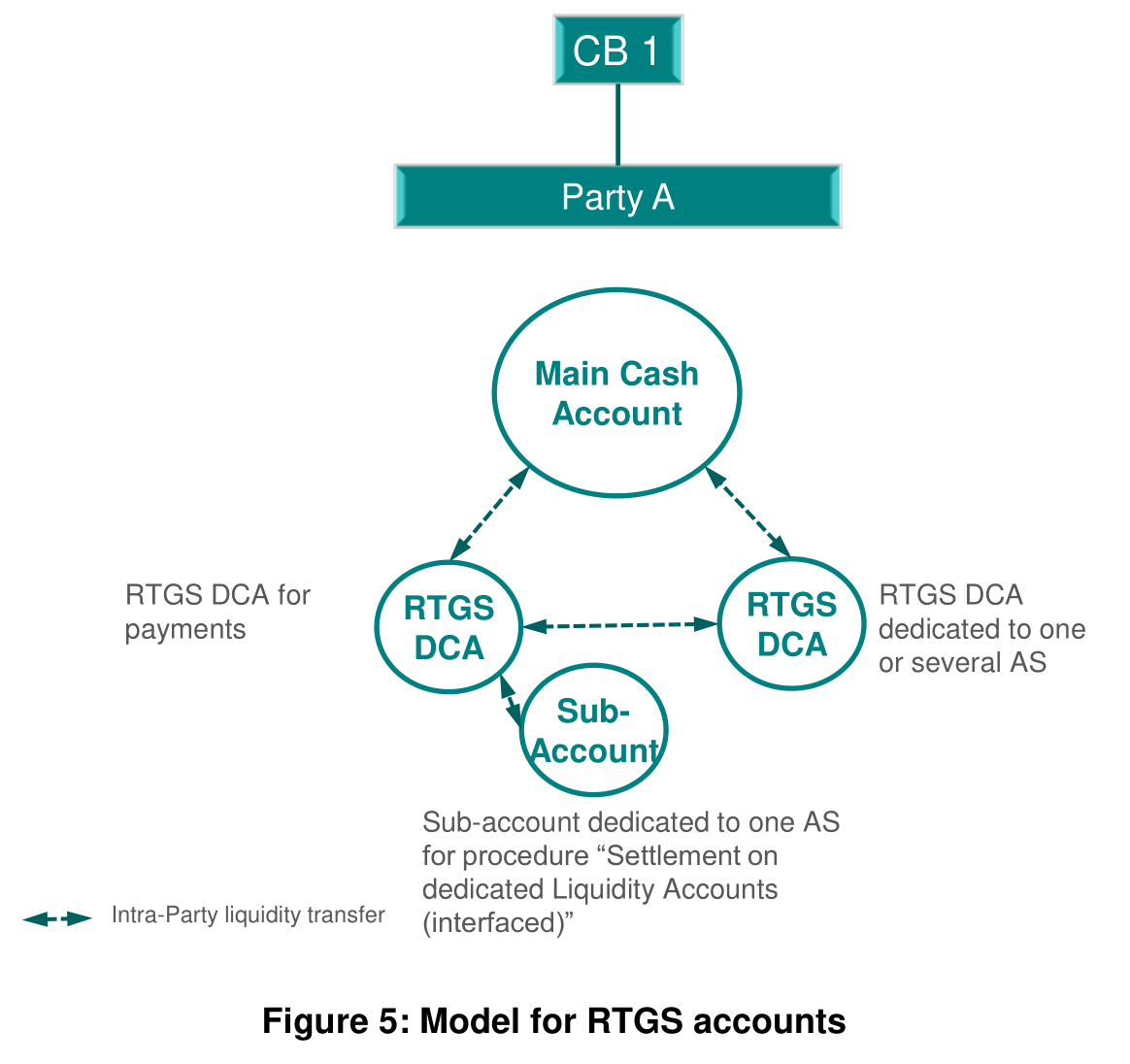
Read the diagram as text
- Locate the main cash account: Party A’s main cash account sits under its central bank relationship. Liquidity can move to the party’s dedicated RTGS cash accounts along the indicated links.
- Identify the account for payments: The left RTGS dedicated cash account is labelled for payments. The figure’s dotted arrows are explained by its original legend for transfers within the party.
- Identify the account dedicated to ancillary systems: The right RTGS dedicated cash account is labelled for one or several ancillary systems. It remains part of the account arrangement shown for Party A.
- Find the dedicated sub-account: The ECB shows a separate sub-account dedicated to one ancillary system. The lesson compares this procedure with other ways of settling a clearing batch.
Follow the ECB figure step by step.
Read the original at full size here
Use touch, a trackpad, or the arrow keys in the image area.
This lesson covers the batch message and three of the booking procedures. It keeps the money flows simple, and shows why the order of debits and credits matters.
Disclosure: this is a simplified, fully funded example. The T2 real-time gross settlement specification for release R2026.JUN (that is, the 2026 release (R2026) of June (JUN)) governs the full procedure.
PICTURE IT
A school trip paying one coach company
Picture a school trip. The teacher collects what each family owes, adds it up, and pays the coach company once. The head teacher's office can book the payments in different ways. It can take all the money from the families first and only then pay the coach company. It can ask families to put money in a trip envelope the week before. Or it can settle each pair of families that swapped costs, one pair at a time. The teacher's list is the message. The way the office books it is the procedure.
THE REAL JOB Knowing how a settles in T2 shows an analyst which message to watch and where the cover sits.
- Members' totals are added up
- Ancillary system sends its batch
- Chosen procedure books the transfers
T2sends back the status- Members' accounts show the result
T2HOW THE PICTURE MAPS
| In the picture | In the payment |
|---|---|
| The teacher's list of who pays and who gets paid | The ancillary system (AS) transfer initiation message |
| The office's reply about what was booked | The ancillary system (AS) initiation status |
| Taking all the money first, then paying out | Procedure A, debits first |
| The trip envelope filled the week before | Procedure D, prefunded technical account |
| Settling one pair of families at a time | Procedure E, bilateral settlement |
WHERE THIS PICTURE STOPS
- A school trip has one office and one teacher.
T2is run by central banks for many systems. - The picture shows the order and the cover. It has no rules for a family that cannot pay.
- The picture covers only three procedures. Other documents list more.
HOOK
The list asks. The procedure books. The status answers.
REMEMBER IT THIS WAY
A chunk: a long list grouped so it is easier to hold.
A is debits first, D is deposit first, E is each pair alone.
| In the trick | What it stands for |
|---|---|
| A is debits first | procedure A books all debits before any credit |
| D is deposit first | procedure D settles from money prefunded into a technical account |
| E is each pair alone | procedure E settles each bilateral transfer on its own |
TELL A FRIEND
A sends T2 one batch. The procedure it picked decides how debits and credits are booked, and a status message comes back.
OFTEN MIXED UP WITH Two components, one service: liquidity and settlement (T2, CLM, RTGS). The earlier lesson explains the two components and the ordinary liquidity transfers. This lesson covers how a settles its members through a batch message and a procedure.
Sources & standards — 4 sources
- Scheme-specific ruleR2026.JUN clean 22 January 2026
T2 RTGS User Detailed Functional Specifications, release R2026.JUN ↗ — European Central Bank · The T2 RTGS user detailed functional specifications describe the ancillary system (AS) Transfer Initiation, pain.998 Ancillary System Transfer Initiation (ASTI), sent by an ancillary system, and the AS Initiation Status, pain.998 Ancillary System Initiation Status (ASIS), sent back (R2026.JUN edition; search excerpt, page not opened)
Full primary PDF opened; selected sections read 6 November 2026: account/participation/queue and AS rules, receipt/liquidity-transfer usage, §12.4.3.3 p774 permits only 1 transaction in pacs.008.001.08. This is the clean R2026.JUN edition, not the older revised endpoint. Other releases remain separate.
Re-checked 12 November 2026: production teaching still uses R2026.JUN; Bundesbank T2 R2026.NOV pack schedules production deployment 28 November 2026.
- Scheme-specific ruleR2026.JUN
T2 professional-use documents, binding XSDs and validation rules ↗ — European Central Bank · The T2 glossary describes the ASTransferInitiation message, pain.998, as sent by an ancillary system (search excerpt, page not opened)
The ECB publishes multiple release lines on the same page; implementations must select the release effective for their test and go-live window.
- Simplified educational illustration
Payments Signal editorial teaching models — Payments Signal
What this simplifies: Clearing System Delta and the members are invented. The message and procedures are described in outline.
Used wherever diagrams, scenarios, figures, or example values are didactic constructions rather than sourced facts; every such use carries a simplifications disclosure. All people, companies, banks, and list entries in examples are fictional.
- Scheme-specific ruleR2026.JUN clean 22 January 2026
T2 RTGS User Detailed Functional Specifications, release R2026.JUN ↗ — European Central Bank · R2026.JUN clean 22 January 2026, §5.4 ancillary system settlement pp145–180; full primary PDF opened 6 November 2026
Full primary PDF opened; selected sections read 6 November 2026: account/participation/queue and AS rules, receipt/liquidity-transfer usage, §12.4.3.3 p774 permits only 1 transaction in pacs.008.001.08. This is the clean R2026.JUN edition, not the older revised endpoint. Other releases remain separate.
Re-checked 12 November 2026: production teaching still uses R2026.JUN; Bundesbank T2 R2026.NOV pack schedules production deployment 28 November 2026.
PRACTISE AND KEEP
Sources for this topic — 11 sources
- Scheme-specific ruleR2026.JUN clean 22 January 2026
T2 RTGS User Detailed Functional Specifications, release R2026.JUN ↗ — European Central Bank · The T2 RTGS user detailed functional specifications describe the ancillary system (AS) Transfer Initiation, pain.998 Ancillary System Transfer Initiation (ASTI), sent by an ancillary system, and the AS Initiation Status, pain.998 Ancillary System Initiation Status (ASIS), sent back (R2026.JUN edition; search excerpt, page not opened)
Full primary PDF opened; selected sections read 6 November 2026: account/participation/queue and AS rules, receipt/liquidity-transfer usage, §12.4.3.3 p774 permits only 1 transaction in pacs.008.001.08. This is the clean R2026.JUN edition, not the older revised endpoint. Other releases remain separate.
Re-checked 12 November 2026: production teaching still uses R2026.JUN; Bundesbank T2 R2026.NOV pack schedules production deployment 28 November 2026.
- Scheme-specific ruleR2026.JUN
T2 professional-use documents, binding XSDs and validation rules ↗ — European Central Bank · The T2 glossary describes the ASTransferInitiation message, pain.998, as sent by an ancillary system (search excerpt, page not opened)
The ECB publishes multiple release lines on the same page; implementations must select the release effective for their test and go-live window.
- Simplified educational illustration
Payments Signal editorial teaching models — Payments Signal
What this simplifies: Clearing System Delta and the members are invented. The message and procedures are described in outline.
Used wherever diagrams, scenarios, figures, or example values are didactic constructions rather than sourced facts; every such use carries a simplifications disclosure. All people, companies, banks, and list entries in examples are fictional.
- Scheme-specific ruleR2026.JUN
T2 professional-use documents, binding XSDs and validation rules ↗ — European Central Bank · Procedure A: an ancillary system can send its debit and credit transactions together in batch mode in dedicated ancillary system (AS) files; the RTGS service settles all debits before settling the credits (ECB documents, search excerpt, page not opened)
The ECB publishes multiple release lines on the same page; implementations must select the release effective for their test and go-live window.
- Scheme-specific ruleR2026.JUN
T2 professional-use documents, binding XSDs and validation rules ↗ — European Central Bank · Procedure D: a settlement bank, or the ancillary system on its behalf, can transfer liquidity from its RTGS dedicated cash account to an ancillary system (AS) technical account; the ancillary system reflects this liquidity on the settlement bank's account held within the AS (ECB documents, search excerpt, page not opened)
The ECB publishes multiple release lines on the same page; implementations must select the release effective for their test and go-live window.
- Scheme-specific ruleR2026.JUN
T2 professional-use documents, binding XSDs and validation rules ↗ — European Central Bank · Procedure E: an ancillary system can send bilateral settlements, and the settlement of each transaction is independent; older documents call it the former Bilateral Settlement procedure (ECB documents, search excerpt, page not opened)
The ECB publishes multiple release lines on the same page; implementations must select the release effective for their test and go-live window.
- Scheme-specific ruleR2026.JUN
T2 professional-use documents, binding XSDs and validation rules ↗ — European Central Bank · Some European Central Bank (ECB) documents also list Procedure B, where all debit and credit ancillary system (AS) transfer orders settle simultaneously or not at all, and Procedure C with a designated sub-account per ancillary system; the ECB glossary, a 2025 ECB test-case list and the Bundesbank list all five procedures A to E as available (search excerpts, pages not opened)
The ECB publishes multiple release lines on the same page; implementations must select the release effective for their test and go-live window.
- Simplified educational illustration
Payments Signal editorial teaching models — Payments Signal
What this simplifies: T2 has five procedures, A to E; only A, D and E are taught in detail.
Used wherever diagrams, scenarios, figures, or example values are didactic constructions rather than sourced facts; every such use carries a simplifications disclosure. All people, companies, banks, and list entries in examples are fictional.
- Simplified educational illustration
Payments Signal editorial teaching models — Payments Signal
What this simplifies: Cover gaps, queueing and cut-off times are not covered. Amounts are invented.
Used wherever diagrams, scenarios, figures, or example values are didactic constructions rather than sourced facts; every such use carries a simplifications disclosure. All people, companies, banks, and list entries in examples are fictional.
- Simplified educational illustration
Payments Signal editorial teaching models — Payments Signal
What this simplifies: The comparison of procedures is an educational explanation. All five procedures A to E were confirmed in the R2026.JUN RTGS specification.
Used wherever diagrams, scenarios, figures, or example values are didactic constructions rather than sourced facts; every such use carries a simplifications disclosure. All people, companies, banks, and list entries in examples are fictional.
- Simplified educational illustration
Payments Signal editorial teaching models — Payments Signal
What this simplifies: Cut-offs, gap rules, field detail and message versions are outside this lesson. Procedures B and C get only one line each.
Used wherever diagrams, scenarios, figures, or example values are didactic constructions rather than sourced facts; every such use carries a simplifications disclosure. All people, companies, banks, and list entries in examples are fictional.
Deepest material on this page: L4 — Standards & sources. Where a topic stops short of implementation depth, that is a deliberate coverage decision, not an oversight — see coverage.