ECMS: the Eurosystem's single system for collateral
See what the Eurosystem Collateral Management System does, who uses it, and how it links collateral to the credit a bank can draw in T2.
L1–L4 are part of the Pro pass
L0 Explain simply
Maya Chen at Bank Alfa needs cash from the for a few days. The central bank will lend, but it wants something valuable in return. Everything in this story is SYNTHETIC / TRAINING ONLY.
That valuable thing is called collateral. It is an asset the lender can keep if the borrower cannot repay. Bonds are a common example.
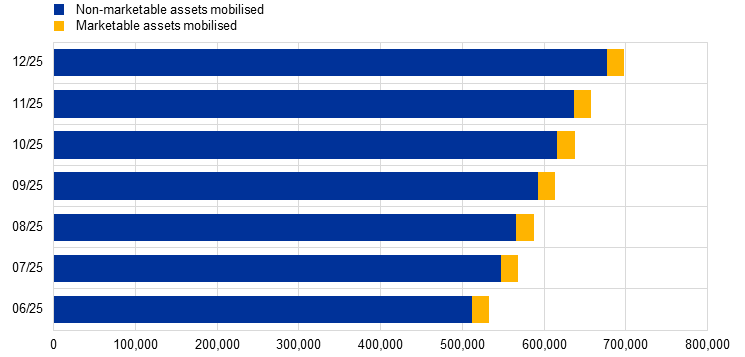
Read the diagram as text
- Read the two categories: Marketable assets can be traded, like the bonds in the lesson. In this chart the non-marketable group includes only credit claims, such as loans pledged as collateral.
- Compare June and December: The ECB reports about 512,000 credit claim positions in June and about 677,000 in December. Read position counts on the horizontal scale. The next chart in the lesson compares euro values.
Follow the ECB chart step by step.
Read the original at full size here
Use touch, a trackpad, or the arrow keys in the image area.
Somebody has to keep track of which assets Bank Alfa has pledged, what they are worth, and how much credit they support. In the euro area that job is done by one computer system, the , or ECMS.
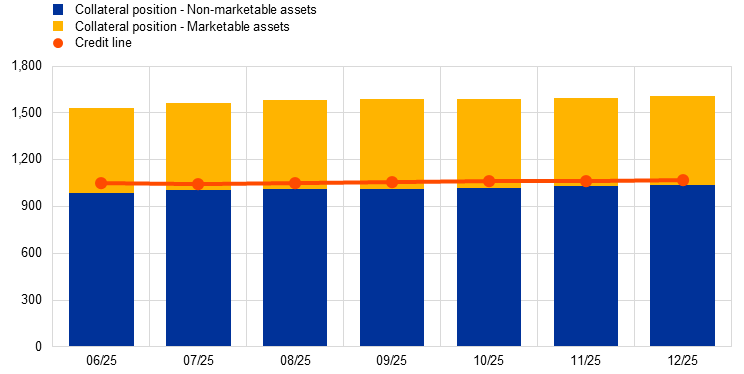
Read the diagram as text
- Read the size of the collateral pool: The column height adds the pledged marketable and non-marketable positions. Both can help secure central bank operations when eligible.
- Read the credit line: The orange line shows a different measure. The ECB describes the available line after deductions for outstanding monetary operations and credit-freezing positions.
Read the actual 2025 evidence in the ECB chart.
Read the original at full size here
Use touch, a trackpad, or the arrow keys in the image area.
Before June 2025, each national central bank ran its own such system. Now there is one. This lesson shows what the system does, who uses it, and how it connects to the payments system called .
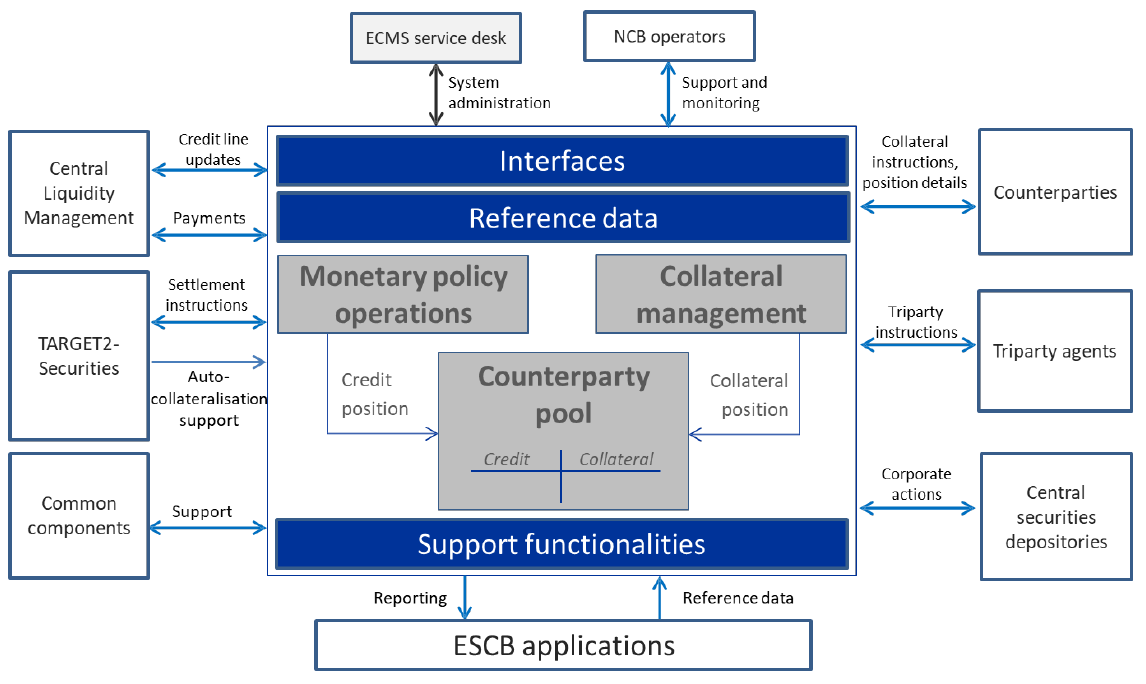
Read the diagram as text
- Inside the ECMS: Interfaces, Reference data, Monetary policy operations, Collateral management, Counterparty pool, and Support functionalities are distinct components.
- Credit and collateral: Monetary policy operations sends the Credit position into the Counterparty pool. Collateral management sends the Collateral position into the same pool. Its two headings are Credit and Collateral.
- Operations: ECMS service desk exchanges System administration with the ECMS. NCB operators exchange Support and monitoring.
- Central Liquidity Management: Two separate arrows in both directions carry Credit line updates and Payments between CLM and ECMS.
- TARGET2-Securities and common components: TARGET2-Securities and ECMS exchange Settlement instructions. The Auto-collateralisation support arrow runs from TARGET2-Securities into ECMS. Common components exchanges Support with ECMS.
- External participants: Counterparties exchange Collateral instructions and position details. Triparty agents exchange Triparty instructions. Central securities depositories exchange Corporate actions. Each is bidirectional.
- ESCB applications: The Reporting arrow runs from ECMS to ESCB applications. Reference data runs from ESCB applications back into ECMS.
Trace the ECB overview’s left and right interfaces without treating ECMS as the cash or securities settlement platform.
PICTURE IT
A pawn ticket book kept at one counter
A person borrows money and leaves a watch as security. The shop writes each watch, its value and the loan in one ticket book. If the watch loses value, the shop asks for more security. Before, every branch kept its own book.
THE REAL JOB A lends against assets, and someone must keep one reliable record of what backs each loan.
- Asset is eligible
- Asset is mobilised
- Credit line is worked out
- The bank can use the credit
- Margin call if value falls
HOW THE PICTURE MAPS
| In the picture | In the payment |
|---|---|
| The watch | A bond or credit claim used as collateral |
| The ticket book | The Eurosystem Collateral Management System (ECMS) |
| Leaving the watch | Mobilising the asset |
| Asking for more security | A margin call |
| One book for all branches | One system for the euro area |
WHERE THIS PICTURE STOPS
- The shop owner values the watch alone. The Eurosystem applies published eligibility rules.
- A pawn shop is private. The Eurosystem Collateral Management System (ECMS) records loans of national central banks and does not change who is legally the lender.
HOOK
One book for every branch.
TELL A FRIEND
The (ECMS) is the one record of which assets back the 's loans in the euro area.
OFTEN MIXED UP WITH Borrowing for the day: intraday credit and daylight overdrafts. That lesson explains why banks need credit during the day. This one shows the system that tracks the collateral behind it.
CURRENT AS CHECKED
2 FIGURES
ECMS users
From 1 January 2026, 21 euro area national use the , after Bulgaria joined the euro.
CHECKED 2026-10-12RECHECK BY 2027-04-12
Sources & standards — 1 source
- Scheme-specific rule
TARGET Services Annual Report 2025 ↗ — European Central Bank · Serving 21 national central banks since Bulgaria joined the euro on 1 January 2026 search excerpt, page not opened
Read as a search excerpt.
The T2 figures and the figures for the instant payment service were seen as search excerpts on 18 October 2026, and the page was not opened. The report is dated June 2026. It gives values in each currency, so currencies are not added together here. The 2024 report gave an average payment of EUR 4.3 million and a median of EUR 6,532.
Eurosystem TARGET Services — ECMS
The (ECMS) launched on 16 June 2025 after a 13–15 June migration weekend, becoming the fourth Service.
CHECKED 2026-08-25RECHECK BY 2027-06-16
Sources & standards — 1 source
- Market practice
Eurosystem launches single collateral management system ↗ — European Central Bank · Eurosystem launches single collateral management system — 16 June 2025 go-live
Verified from the publisher's own press page on the access date. A 16 May 2025 Governing Council confirmation of the same go-live sits at a different news URL and is not this entry.
PRACTISE AND KEEP
Sources for this topic — 9 sources
- Scheme-specific rule
Eurosystem launches single collateral management system ↗ — European Central Bank · Eurosystem launches single collateral management system search excerpt, page not opened
Verified from the publisher's own press page on the access date. A 16 May 2025 Governing Council confirmation of the same go-live sits at a different news URL and is not this entry.
- Scheme-specific rule
What is the ECMS? ↗ — European Central Bank · What is the ECMS search excerpt, page not opened
Read as a search excerpt.
- Scheme-specific rule
Information pack: Eurosystem Collateral Management System (introduction to the ECMS) ↗ — European Central Bank · Information pack: Eurosystem Collateral Management System search excerpt, page not opened
Read as a search excerpt. Detailed rules are in the business description document and the collateral framework.
- Scheme-specific rule
TARGET Services Annual Report 2025 ↗ — European Central Bank · TARGET Services annual report 2025 search excerpt, page not opened
Read as a search excerpt.
The T2 figures and the figures for the instant payment service were seen as search excerpts on 18 October 2026, and the page was not opened. The report is dated June 2026. It gives values in each currency, so currencies are not added together here. The 2024 report gave an average payment of EUR 4.3 million and a median of EUR 6,532.
- Scheme-specific rule
Eurosystem collateral management system to launch on 16 June 2025 ↗ — European Central Bank · Launch date rescheduled search excerpt, page not opened
Read as a search excerpt.
- Scheme-specific rule
Marketable assets (Eurosystem collateral framework) ↗ — European Central Bank · The list of eligible marketable assets is updated every business day search excerpt, page not opened
Read as a search excerpt.
- Scheme-specific rule
Business Description Document for the ECMS ↗ — European Central Bank · Counterparties are responsible for submitting only eligible assets; an asset that becomes ineligible stays in the pool until demobilised search excerpt, page not opened
Read as a search excerpt.
- Simplified educational illustration
Payments Signal editorial teaching models — Payments Signal · Maya Chen and Bank Alfa are invented.
What this simplifies: Eligibility is introduced; haircut and available credit are explained without quoting a live percentage.
Used wherever diagrams, scenarios, figures, or example values are didactic constructions rather than sourced facts; every such use carries a simplifications disclosure. All people, companies, banks, and list entries in examples are fictional.
- Scheme-specific ruleECB/2024/22, consolidated30March2026
Guideline(EU)2024/3129 on collateral management in Eurosystem credit operations ↗ — European Central Bank / European Union · Guideline(EU)2024/3129, consolidated30March2026: domestic credit claims may be managed outside ECMS; available collateral and credit-line cap. Official search excerpts checked 6 November 2026
Official search excerpts checked6November2026; consolidated document was not opened. ECBJanuary2026 collateral information and BundesbankJuly2025 account independently corroborate mechanism.
Deepest material on this page: L4 — Standards & sources. Where a topic stops short of implementation depth, that is a deliberate coverage decision, not an oversight — see coverage.