Borrowing for the day: intraday credit and daylight overdrafts
A bank can need to pay before it is paid. Central banks lend for the day and want it back by the close. The Federal Reserve and the Bank of England do it differently.
L1–L4 are part of the Pro pass
L0 Explain simply
A shop owner has to pay a supplier at nine in the morning. The day's takings only arrive in the afternoon. A friend lends the money for the day, on one condition: it comes back before the shop closes.
Banks have the same gap. A bank must send payments early, but the payments owed to it often arrive later. If every bank waited to be paid first, nobody would pay anyone.
So a , which holds the accounts that banks use to pay each other, will lend for the day. This is . The loan starts and ends inside one business day. In the United States the same idea is called a daylight overdraft. The bank's account at the Federal Reserve goes below zero during the day. The loan is paid back by the close.
Read the diagram as text
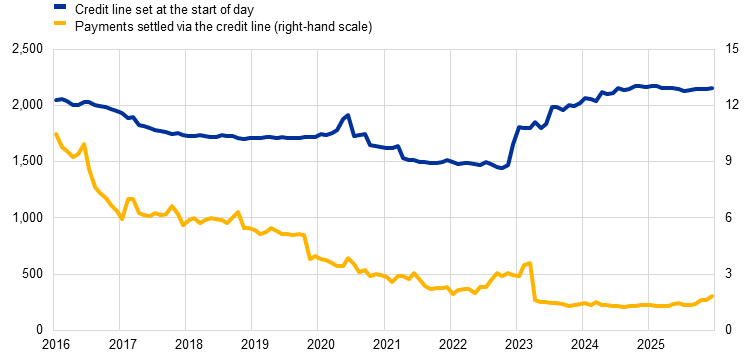
- Identify the capacity measure: The blue series adds start-of-day credit lines. The left scale shows billions of euros.
- Identify the use measure: The amber series uses the right-hand percentage scale. It measures the share of payment value settled via intraday credit.
Read the actual 2025 evidence in the ECB chart.
Read the original at full size here
Use touch, a trackpad, or the arrow keys in the image area.
Here is the idea in one morning. Maya Chen works in payments operations at Bank Alfa. Asha Traders asks for a large payment to leave early. The account that Bank Alfa pays from, at Central Bank Omega, holds less than the payment needs. Payments owed to Bank Alfa are due after lunch. Central Bank Omega can cover the gap for the day. (SYNTHETIC / TRAINING ONLY — Maya Chen, Bank Alfa, Asha Traders and Central Bank Omega are invented.)
Nothing is broken in that story. The loan is a control that keeps payments moving while the bank waits for its own money. Many central banks ask for collateral, which means assets the bank pledges as security. Some also set a limit on the loan or charge a fee.
Read the diagram as text
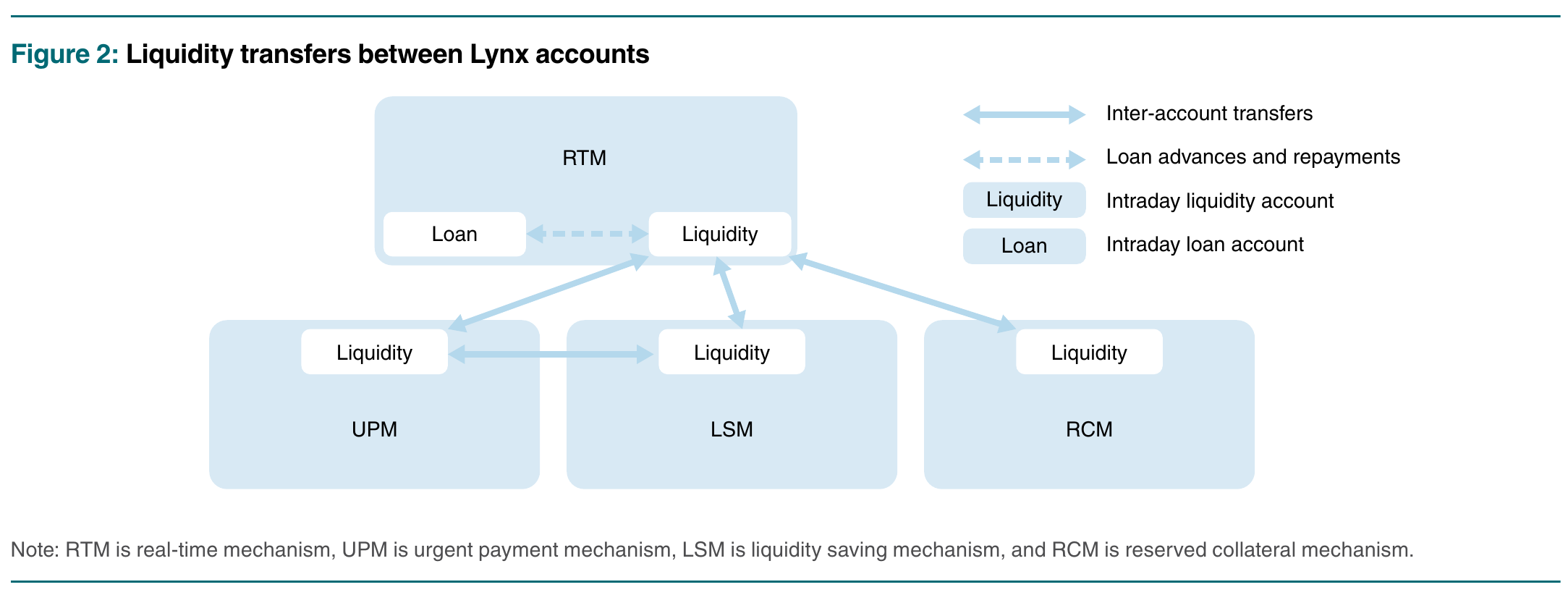
- Find the loan account: The real-time mechanism includes an intraday loan account and an intraday liquidity account. The dashed link identifies loan advances and repayments.
- Follow liquidity across accounts: The solid blue links represent inter-account transfers. The drawing distinguishes that movement of settlement liquidity from taking or repaying a loan.
- Read the separate settlement mechanisms: The lower boxes show liquidity accounts for urgent payments, the liquidity-saving mechanism and reserved collateral. Where money sits can matter for which payments can use it.
Follow the published figure step by step.
Read the original at full size here
Use touch, a trackpad, or the arrow keys in the image area.
Rules differ by central bank. This topic compares two designs, the and the , and points to where the Eurosystem writes its own rule. It does not quote rates or limits, because those change.
PLAIN WORDS · 1 in this section
- overdraft
- spending more than the account holds, a short loan
PICTURE IT
A ladder borrowed for the day
Picture a hardware shop that lends out a tall ladder for the day. A builder needs it at eight, before the day's pay arrives. The shop keeps the builder's watch at the counter while the ladder is out. The builder must bring the ladder back before the shop closes, and then takes the watch home.
The shop does not lend to everyone in the same way. One shop sets a limit on how many ladders a builder may have out. Another looks only at what the builder leaves at the counter. A third charges a small fee when the builder leaves nothing.
If the builder is late and does not return the ladder, the shop keeps the watch. That is why it was safe to lend.
If the shop is out of ladders, the builder waits. Nobody has done anything wrong.
THE REAL JOB lets a bank make a payment now, before the money owed to it arrives, and gives it back by the close.
- A payment is due and the balance is short
- The central bank lends for the day
- The payment is made in full
- Incoming payments arrive
- The loan is repaid before the close
HOW THE PICTURE MAPS
| In the picture | In the payment |
|---|---|
| The ladder for the day | The named facility’s intraday credit, repayable within its defined business day |
| The builder's watch left at the counter | Collateral, assets pledged as security |
| The shop closing time | The close of the business day, when the credit must be paid backWho: Central Bank Omega |
| A limit on ladders per builder | A cap on how far the account may go below zero |
| A fee when nothing is left at the counter | A fee on credit that has no collateral behind it, in some designs |
| The builder who needs the ladder at eight | A bank that must pay early, before incoming payments arriveWho: Bank Alfa |
WHERE THIS PICTURE STOPS
- A balance is not a physical ladder. Intraday credit can be an authorised account overdraft or a separate loan/credit operation, depending on the arrangement; it need not always make the settlement account negative.
- The shop sets its own rules. The picture cannot show how large a limit is, which assets count, or what the fee is. Each central bank sets those, and they change.
- One shop has all three rules at once. Real central banks mix them differently, and some do not use a cap or a fee at all.
- The picture hides the order of payments in a busy day, where many banks borrow and repay at the same time.
- This picture focuses on central-bank facilities. Intraday lending can also be provided commercially, and an always-open settlement service may have its own accounting-day and credit arrangements. Eligibility, approved capacity and repayment rules still apply.
HOOK
Borrowed in the morning, paid back by closing time.
REMEMBER IT THIS WAY
A sequence: the real steps, in order.
Short, borrow, pay, repay: four steps from a short balance to the close.
| In the trick | What it stands for |
|---|---|
| Short | the balance is too low for a payment due now |
| Borrow | the central bank lends for the day, often against collateral |
| Pay | the payment can leave early |
| Repay | the credit is repaid before the close |
On a busy day the four steps overlap, and real systems differ in how the credit is drawn.
TELL A FRIEND
A bank sometimes has to pay before it is paid, so the lends it money for the day. The loan is paid back by the close, and the rules on how much, against what, and at what price differ by central bank.
OFTEN MIXED UP WITH Intraday liquidity and queues. is the whole question of having usable money during the day. is one source of it. It is a loan from the central bank, paid back by the close. Rules on limits, collateral and fees shape it.
Sources & standards — 2 sources
- Regulatory guidance
Federal Reserve Policy on Payment System Risk ↗ — Board of Governors of the Federal Reserve System · daylight overdrafts — intraday credit that an institution may incur in its Federal Reserve account, within limits the policy sets
Read in full from the publisher's own domain on the access date: federalreserve.gov returns the policy PDF, so nothing here rests on a search excerpt.
No cap multiple, fee rate or capital figure is quoted on this site from it. Those are changeable numbers on a policy the Board amends, and a figure that rots belongs in the dated facts registry rather than in prose. The structural rule — cap multiple times capital measure — is what is cited.
It is United States policy on access to a United States central bank's intraday credit. The idea of a cap on a participant's debit position is general; this document's authority is not.
- Simplified educational illustration
Payments Signal editorial teaching models — Payments Signal
What this simplifies: The opening is a story: real central banks differ in who may borrow, how much, against what, and at what price. Nothing in it is a rule of any one central bank.
Used wherever diagrams, scenarios, figures, or example values are didactic constructions rather than sourced facts; every such use carries a simplifications disclosure. All people, companies, banks, and list entries in examples are fictional.
CURRENT AS CHECKED
3 FIGURES
Basel Committee on Banking Supervision — intraday liquidity monitoring tools (BCBS 248)
The 's monitoring tools have been reported to supervisors monthly since 1 January 2015, a start date chosen to coincide with Liquidity Coverage Ratio reporting.
They are monitoring tools rather than a required outcome: internationally active banks apply them, and each national supervisor decides how far they reach the banks it supervises that are not internationally active.
CHECKED 2026-08-13RECHECK BY 2027-02-13
Sources & standards — 1 source
- Regulatory guidance
Monitoring tools for intraday liquidity management (BCBS 248) ↗ — Basel Committee on Banking Supervision, Bank for International Settlements · The reporting regime: monthly reporting of the monitoring tools from 1 January 2015, coinciding with LCR reporting; the tools applied by internationally active banks, with national supervisors deciding their reach beyond those
These are monitoring tools rather than a standard with a required outcome. The framework states that they are introduced for monitoring purposes only, that internationally active banks are required to apply them, and that each national supervisor determines how far they reach the banks it supervises that are not internationally active. Citations to it therefore carry the regulatory-guidance label rather than a binding one.
No threshold, ratio or per-tool calculation rule is quoted verbatim on this site from it. The tool names used here were confirmed across independent excerpts; the calculation rules behind them were not read.
Read in full from bis.org on 2026-08-19, which now serves the framework PDF. An earlier access recorded here relied on web-search excerpts because it did not; that limit no longer applies to this document.
V11 primary recheck: Opened canonical SRP50 inforce/published15December2019 at https://www.bis.org/committees/bcbs/basel-framework/standard/srp/50/inforce/2019-12-15/published/2019-12-15 §§50.63–86. Correct gross sent AND received, peak cumulative settled net debit, value-based throughput and stress.
Federal Reserve Board — Policy on Payment System Risk, structure of net debit caps and capacity backed by collateral (no rate or multiple stated)
Under the Board's Policy on Risk, a daylight overdraft is intraday credit in an institution's Federal Reserve account. An institution's net debit cap is its cap multiple times its capital measure, and its cap category sets the multiple.
Pledging collateral to a Reserve Bank does not itself raise the cap. With the Reserve Bank's approval, capacity backed by collateral may be available beyond the cap. No fee rate is stated.
CHECKED 2026-10-11RECHECK BY 2027-04-11
Sources & standards — 2 sources
- Regulatory guidance
Federal Reserve Policy on Payment System Risk ↗ — Board of Governors of the Federal Reserve System · net debit caps: cap category and capital measure determine the size of the cap; cap is cap multiple times capital measure; pledging collateral does not itself increase the cap although additional collateralised capacity may be available beyond it
Read in full from the publisher's own domain on the access date: federalreserve.gov returns the policy PDF, so nothing here rests on a search excerpt.
No cap multiple, fee rate or capital figure is quoted on this site from it. Those are changeable numbers on a policy the Board amends, and a figure that rots belongs in the dated facts registry rather than in prose. The structural rule — cap multiple times capital measure — is what is cited.
It is United States policy on access to a United States central bank's intraday credit. The idea of a cap on a participant's debit position is general; this document's authority is not.
- Scheme-specific ruleSuperseded — see Federal Reserve Policy on Payment System Risk
Guide to the Federal Reserve's Payment System Risk Policy (2011 edition) ↗ — Board of Governors of the Federal Reserve System · search excerpt, page not opened: certain institutions may pledge collateral to secure daylight overdraft capacity in excess of their net debit caps, subject to Reserve Bank approval
Known from web-search excerpts on the access date (a search limited to federalreserve.gov); the page was not opened, and a direct fetch of federalreserve.gov was refused by this environment's proxy. The excerpt described the 2008 revisions effective 24 March 2011. The same search returned a later guide,
psr_guide.pdf, whose text was not seen, and a note that a 2022 Federal Register item exists; the current fee schedule was therefore not confirmed. Recorded at scheme-specific-rule at most. Open the current guide before quoting any rate.
Bank of England — intraday liquidity in real-time gross settlement (RTGS), as stated in the 2021 and 2022 editions of its self-assessment against the Principles for Financial Market Infrastructures (the 2023 edition's wording was not checked)
The 's self-assessment of its Real-Time Gross Settlement and (CHAPS) services says it lends intraday liquidity against the highest-quality collateral, which it calls Level A, with prudent margins. It says there is no value limit on intraday liquidity generation, and that the credit is limited by the value of Level A collateral each participant holds.
CHECKED 2026-10-11RECHECK BY 2027-04-11
Sources & standards — 1 source
- Scheme-specific rule
Self-assessment of the Bank of England's Real-Time Gross Settlement and CHAPS services against the Principles for Financial Market Infrastructures ↗ — Bank of England · search excerpt, page not opened (Bank of England 2023 PFMI self-assessment): there is no value limit on intraday liquidity generation, limited by the value of Level A collateral each participant holds, subject to appropriate haircuts
Editions are published periodically rather than annually and each names its own point of assessment, so a rating read from one edition belongs to that date and not to today. The Bank's statement that it assesses the services in its capacity as operator is the clearest available published expression of the separation between operating a system and supervising one.
A self-assessment is an operator describing its own system against a published standard, which is why it is filed with the scheme rulebooks rather than with commentary. It is still a disclosure and not the rules, so a citation of it takes scheme-specific-rule and never official-requirement.
Search excerpts only, page not opened: verified from two independent web-search excerpts on the access date.
PRACTISE AND KEEP
Sources for this topic — 9 sources
- Regulatory guidance
Federal Reserve Policy on Payment System Risk ↗ — Board of Governors of the Federal Reserve System · Policy on Payment System Risk — daylight overdrafts, net debit caps, collateralised capacity
Read in full from the publisher's own domain on the access date: federalreserve.gov returns the policy PDF, so nothing here rests on a search excerpt.
No cap multiple, fee rate or capital figure is quoted on this site from it. Those are changeable numbers on a policy the Board amends, and a figure that rots belongs in the dated facts registry rather than in prose. The structural rule — cap multiple times capital measure — is what is cited.
It is United States policy on access to a United States central bank's intraday credit. The idea of a cap on a participant's debit position is general; this document's authority is not.
- Scheme-specific ruleSuperseded — see Federal Reserve Policy on Payment System Risk
Guide to the Federal Reserve's Payment System Risk Policy (2011 edition) ↗ — Board of Governors of the Federal Reserve System · search excerpt, page not opened (federalreserve.gov 2011 PSR overview/guide): collateralized daylight overdrafts are charged a zero fee and uncollateralized ones a fee (50 basis points a year in the 2011 policy); historical, the current schedule was not confirmed
Known from web-search excerpts on the access date (a search limited to federalreserve.gov); the page was not opened, and a direct fetch of federalreserve.gov was refused by this environment's proxy. The excerpt described the 2008 revisions effective 24 March 2011. The same search returned a later guide,
psr_guide.pdf, whose text was not seen, and a note that a 2022 Federal Register item exists; the current fee schedule was therefore not confirmed. Recorded at scheme-specific-rule at most. Open the current guide before quoting any rate. - Scheme-specific rule
Self-assessment of the Bank of England's Real-Time Gross Settlement and CHAPS services against the Principles for Financial Market Infrastructures ↗ — Bank of England · search excerpt, page not opened (Bank of England 2023 PFMI self-assessment): there is no value limit on intraday liquidity generation, limited by the value of Level A collateral each participant holds, subject to appropriate haircuts
Editions are published periodically rather than annually and each names its own point of assessment, so a rating read from one edition belongs to that date and not to today. The Bank's statement that it assesses the services in its capacity as operator is the clearest available published expression of the separation between operating a system and supervising one.
A self-assessment is an operator describing its own system against a published standard, which is why it is filed with the scheme rulebooks rather than with commentary. It is still a disclosure and not the rules, so a citation of it takes scheme-specific-rule and never official-requirement.
Search excerpts only, page not opened: verified from two independent web-search excerpts on the access date.
- Scheme-specific rule
Guideline (EU) 2022/912 of the European Central Bank on a new-generation TARGET (Trans-European Automated Real-time Gross settlement Express Transfer) payment system ↗ — European Central Bank · search excerpt, page not opened: contents list shows an article headed 'Intraday credit — auto-collateralisation'
Known from web-search excerpts on the access date; the page was not opened. The excerpts showed EUR-Lex listing the act as in force with a consolidated version dated 6 October 2025, and a copy of its table of contents. The text of the article was not seen. An earlier draft cited Article 2, point (35), Annex III and Guideline (EU) 2024/3129; none of that was found by search and it was removed. Recorded at scheme-specific-rule at most. The binding text is the guideline in the Official Journal.
- Scheme-specific rule
NPS 01— Policy on intraday funding of settlement accounts in SAMOS (South African Multiple Option Settlement) ↗ — South African Reserve Bank · search excerpt, page not opened (resbank.co.za NPS 01): intraday SAMOS loans must be fully secured by collateral; participants repay them by the end of the dayKnown from a web-search excerpt on the access date; the PDF was not opened. The excerpt said collateral requirements follow the Reserve Bank's monetary policy operational notice as amended. The claim of an automatic loan that refuses settlement only when funds and collateral both fall short was not found by search and is not made. Recorded at regulatory-guidance at most.
- Scheme-specific rule
Principles for financial market infrastructures ↗ — CPMI and IOSCO (Bank for International Settlements) · search excerpt, page not opened (bis.org PFMI overview): Principle 7 covers liquidity risk
V40 actual primary PDF read at https://www.bis.org/publications/principles-financial-market-infrastructures.pdf :complete3.4.1–3.4.7,3.8.1–3.8.8 and AnnexD payment designs through liquidity-saving discussion (printed38–40,64–66,148–149). Cover/title verified;not full188page reading. Specific credit/liquidity/finality/design statements here use these sections. Earlier registry scope/history:Published by the CPSS (now CPMI) and IOSCO; contains 24 principles plus responsibilities for authorities. This site uses it only for high-level concepts such as settlement finality.
- Regulatory guidance
Monitoring tools for intraday liquidity management (BCBS 248) ↗ — Basel Committee on Banking Supervision, Bank for International Settlements · monitoring tools for intraday liquidity risk, including daily maximum intraday liquidity usage
These are monitoring tools rather than a standard with a required outcome. The framework states that they are introduced for monitoring purposes only, that internationally active banks are required to apply them, and that each national supervisor determines how far they reach the banks it supervises that are not internationally active. Citations to it therefore carry the regulatory-guidance label rather than a binding one.
No threshold, ratio or per-tool calculation rule is quoted verbatim on this site from it. The tool names used here were confirmed across independent excerpts; the calculation rules behind them were not read.
Read in full from bis.org on 2026-08-19, which now serves the framework PDF. An earlier access recorded here relied on web-search excerpts because it did not; that limit no longer applies to this document.
V11 primary recheck: Opened canonical SRP50 inforce/published15December2019 at https://www.bis.org/committees/bcbs/basel-framework/standard/srp/50/inforce/2019-12-15/published/2019-12-15 §§50.63–86. Correct gross sent AND received, peak cumulative settled net debit, value-based throughput and stress.
- Market practice
T2S auto-collateralisation using cost-free intraday credit in central bank money ↗ — European Central Bank · T2S auto-collateralisation: credit triggered when a cash account lacks funds, secured first by the securities being bought and then by other eligible holdings, interest-free and repaid before end of day, with unpaid remainder converted to ordinary intraday credit. search excerpt, page not opened
Seen only as WebSearch excerpts on the access date; the page was not opened.
- Simplified educational illustration
Payments Signal editorial teaching models — Payments Signal
What this simplifies: Practice differs by central bank. This topic teaches the shape of two designs, points to the Eurosystem's legal text, and quotes no fee, cap multiple or collateral list; a dated fact carries each structure that can change.
Used wherever diagrams, scenarios, figures, or example values are didactic constructions rather than sourced facts; every such use carries a simplifications disclosure. All people, companies, banks, and list entries in examples are fictional.
Deepest material on this page: L4 — Standards & sources. Where a topic stops short of implementation depth, that is a deliberate coverage decision, not an oversight — see coverage.