Waiting in line: RTGS queues, priorities, limits and liquidity saving
How a settlement system holds payments that cannot yet settle, who goes first, how limits cap what one bank can take, and how matching releases queues.
L1–L4 are part of the Pro pass
L0 Explain simply
Bank Alfa has a payment to send to Northwind Bank for EUR 5 million. At this moment its account at the holds less than that. (SYNTHETIC / TRAINING ONLY. Bank Alfa, Northwind Bank and Maya Chen are invented.)
The settlement system does not reject the payment. It puts it in a queue and waits. Maya Chen, a payments operations analyst at Bank Alfa, can see it waiting.
A queue is a waiting line for payments. Money arriving from other banks may fill the account. When it does, the payment is released.
Not every payment is equally pressing. A bank can mark one as urgent so that it goes before the others. The marker is called a priority.
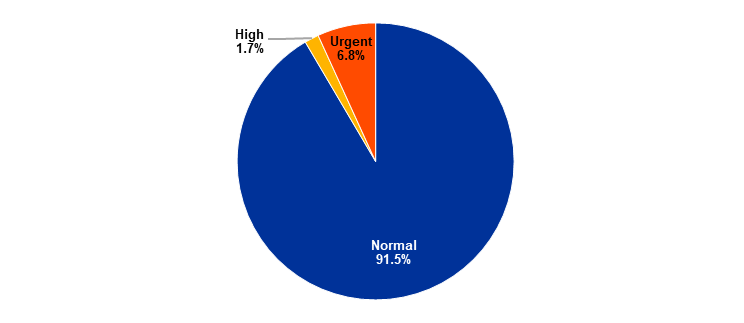
Read the diagram as text
- Read the common priority: Normal was the largest category by number of payments. Read the label inside the blue portion.
- Read the urgent share: Urgent was 6.8% of transaction count. The ECB separately reports that urgent payments made up more than a fifth of value.
Read the actual 2025 evidence in the ECB chart.
Read the original at full size here
Use touch, a trackpad, or the arrow keys in the image area.
A bank can also protect itself. It can say that it will send no more than a set amount to one other bank until that bank pays something back. That cap is called a limit.
Sometimes two banks wait for each other. Bank Alfa waits for Northwind's payment, and Northwind waits for Alfa's. The system can spot this and settle both at the same moment. Each payment still settles in full. The two account changes offset each other, so less starting money is needed.
None of this is a failure. A queue is the control working. It lets a payment wait for money instead of failing.
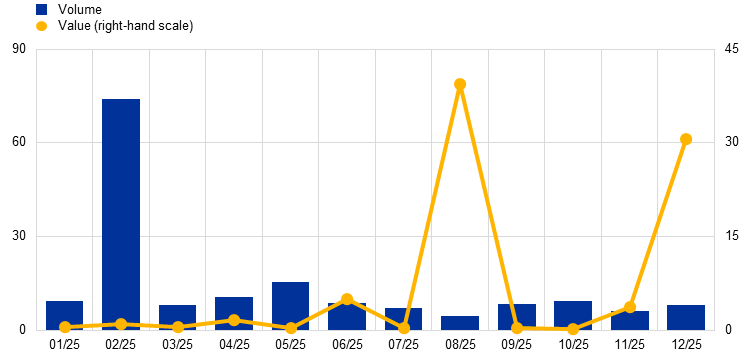
Read the diagram as text
- Find the February count spike: The bar series uses the left-hand scale. February had the highest daily average count of rejected payments. The ECB attributes it to an incident on 27 February.
- Find a later spike in value: The amber series uses the right-hand scale. August has a pronounced value spike alongside a small count bar.
Read the actual 2025 evidence in the ECB chart.
Read the original at full size here
Use touch, a trackpad, or the arrow keys in the image area.
PICTURE IT
A one-lane bridge with a passing place
Picture a river crossing with a single lane. A lorry may enter only when the far end is clear enough for it to get through. Lorries that cannot enter wait in a line at the bank.
An ambulance has a lane of its own at the front. A haulage firm can keep a space reserved for its own urgent loads. Sometimes two lorries meet nose to nose at the bridge. Each waits for the other to back off. The keeper at the bridge waves both through at the same moment, using the passing place.
THE REAL JOB A queue, priorities, reservations and limits keep payments in order when money is short, and matching releases payments that wait on each other.
- Payment lacks funds
- It joins the queue
- Rank and limits apply
- Matching or new money arrives
- The payment settles
HOW THE PICTURE MAPS
| In the picture | In the payment |
|---|---|
| The one-lane bridge | The settlement system |
| The line of lorries at the bank | The queue of waiting payments |
| The ambulance lane | The urgent priority class |
| A space kept for urgent loads | A liquidity reservation |
| A cap on lorries from one firm | A counterparty limit |
| The keeper waving two lorries through together | Matching that settles offsetting paymentsWho: Bank Alfa |
WHERE THIS PICTURE STOPS
- A bridge has physical space. A settlement account has money, and money can arrive from other payments during the day.
- A lorry that cannot enter wastes nothing. A queued payment ties up planning and may have a cut-off.
- Real queue rules differ between systems, and the picture shows only the ideas.
- The keeper stands for an algorithm in the system, not a person.
HOOK
Short of money? Wait in order.
REMEMBER IT THIS WAY
A chunk: a long list grouped so it is easier to hold.
Queue, rank, cap, match.
| In the trick | What it stands for |
|---|---|
| queue | an unsettled instruction held under the selected service’s conditions |
| rank | priority class and arrival order decide who goes first |
| cap | reservations and counterparty limits protect and restrain |
| match | offsetting payments settle together |
The four words leave out cut-offs, and the rules differ in every system.
TELL A FRIEND
In a queueing service, an unsettled order can wait because of funds, limits, reservations or execution times. Priority and optimisation rules determine which qualifying orders can settle; other services may reject an unfunded instruction.
OFTEN MIXED UP WITH Intraday liquidity and queues. The topic explains why a bank needs money during the day and what queues and gridlock are. This topic is about the rules that order a queue and the tools that release it.
CURRENT AS CHECKED
3 FIGURES
T2 RTGS production R2026.JUN: selected priorities, queues, reservations and normal-payment net-use limits; checked before the November release
As checked on 12 November 2026, this teaching uses the production UDFS release R2026.JUN, clean version dated 22 January 2026. It defines Urgent, High and Normal priorities; an order without a selected class is Normal. Queued orders can be processed through the specified entry and optimisation algorithms; acceptance is not settlement.
Urgent and high reservations protect allocations of available liquidity; they do not create funds. Normal payments cannot consume those reservations. Bilateral and multilateral limits constrain outgoing normal-priority net liquidity use, taking incoming payments of all priorities into account. Release still depends on other settlement conditions.
The Bundesbank’s T2 R2026.NOV information pack schedules production deployment for 28 November 2026. Until that cutover is observed, R2026.NOV requirements are not treated as the current production specification here. Check the applicable release and actual configuration before changing a production rule.
CHECKED 2026-11-12RECHECK BY 2026-11-28
Sources & standards — 2 sources
- Scheme-specific ruleR2026.JUN clean 22 January 2026
T2 RTGS User Detailed Functional Specifications, release R2026.JUN ↗ — European Central Bank · Actual full sections 5.3.8 and 5.3.9.1–3; selected 5.5.3 reservation/limit sections and tables 77/80 from clean 22 January 2026 R2026.JUN UDFS. Re-confirmed as production baseline on 12 November 2026.
Full primary PDF opened; selected sections read 6 November 2026: account/participation/queue and AS rules, receipt/liquidity-transfer usage, §12.4.3.3 p774 permits only 1 transaction in pacs.008.001.08. This is the clean R2026.JUN edition, not the older revised endpoint. Other releases remain separate.
Re-checked 12 November 2026: production teaching still uses R2026.JUN; Bundesbank T2 R2026.NOV pack schedules production deployment 28 November 2026.
- Regulatory guidance
TARGET Service T2 Information on T2 R2026.NOV Release ↗ — Deutsche Bundesbank · T2 R2026.NOV pack: UTEST ended 11 November 2026; production deployment planned 28 November 2026 — not yet production as of 12 November 2026.
Opened via web search 12 November 2026. Planned schedule, not observed cutover.
Second-pass 12 November 2026: T2 production deployment still planned 28 November 2026.
Bank of England RTGS and CHAPS: the liquidity saving mechanism, its go-live date and the matching interval
The 's for CHAPS was introduced into RTGS in
April 2013. Participants choose an urgent or a non-urgent stream. The Bank's February 2021 user guide and research on CHAPS give a2minute period between matching cycles. The Bank's roadmap mentions improved matching algorithms in the renewed RTGS service, so cycle lengths may differ now.Check the current Bank of England guide before quoting a cycle length.
CHECKED 2026-10-11RECHECK BY 2027-03-31
Sources & standards — 2 sources
- Scheme-specific rule
Liquidity Saving Mechanism User Guide (CHAPS), February 2021 ↗ — Bank of England · Bank of England CHAPS Liquidity Saving Mechanism user guide (February 2021): participants choose an urgent or a non-urgent stream; non-urgent payments queue and are matched in cycles, with urgent processing paused briefly about every two minutes; settling offsetting payments together is gross simultaneous settlement, legally different from net settlement but needing the same liquidity as netting (search excerpts, page not opened)
Known only from a web-search excerpt on 2026-10-11 (page not opened).
- Market practice
How has the Liquidity Saving Mechanism reduced banks' intraday liquidity costs in CHAPS? ↗ — Bank of England · Bank of England Quarterly Bulletin 2014, how the LSM reduced banks' intraday liquidity costs in CHAPS: urgent payments settle one at a time; a pause between matching cycles lets non-urgent payments accumulate; the LSM was introduced in April 2013 (search excerpts, page not opened)
Operational parameters in it may have changed. Seen as WebSearch excerpts on the access date; the page was not opened.
Bank of England renewal of real-time gross settlement: planned changes to the liquidity saving mechanism, including forward-dated payments, with delivery not confirmed
The 's renewal of its real-time gross settlement service has carried plans for a better (LSM) since a
2018consultation. The Bank's February 2021 LSM user guide lists forward-dated payments, an improved offsetting algorithm, simpler urgency categories, better real-time data and a test environment as the proposals. The Bank's 2022 roadmap says it plans to enhance the LSM in the new core settlement engine, with improved matching and forward-dated payment submission.The renewed service, known as (the Bank's new real-time gross settlement service), went live on
28 April 2025. The search excerpts read for this fact do not say which of those LSM features are in service, so this site does not present them as live.Longer operating hours are a separate decision with their own dated fact.
CHECKED 2026-10-12RECHECK BY 2027-09-30
Sources & standards — 3 sources
- Scheme-specific rule
Liquidity Saving Mechanism User Guide (CHAPS), February 2021 ↗ — Bank of England · February 2021 guide: in 2018 the Bank consulted on improving the liquidity saving mechanism. The proposals were forward-dated payments, a better offsetting algorithm, simpler urgency categories, better real-time data and a test environment (search excerpt, page not opened)
Known only from a web-search excerpt on 2026-10-11 (page not opened).
- Scheme-specific rule
Roadmap for the Real-Time Gross Settlement service beyond 2024 ↗ — Bank of England · 2022 roadmap: improvements to the liquidity saving mechanism, including better matching and forward-dated payment submission, planned for the new core settlement engine (search excerpt, page not opened)
Seen only as WebSearch excerpts on the access date; the page was not opened. The excerpts say later Bank pages moved the new core ledger and settlement engine from spring 2024 to spring 2025, so the roadmap's own dates are not current.
- Scheme-specific rule
RT2 — the renewed RTGS service ↗ — Bank of England · The renewed service went live on 28 April 2025
A correction, recorded rather than quietly replaced. The previous note said a full-page fetch was unavailable. The real fault was a dead address.
The registered URL sat under /payment-and-settlement/, a path the Bank has since retired in favour of /payments/. It answers HTTP 404 and redirects to the Bank's error page. The Internet Archive's copy of that same URL, taken on 24 July 2026, is already the 404 page. So the link was broken five days before the access date the entry carried, and the caveat hid that for twenty-five days. The equivalent live page is registered above and answers HTTP 200.
The landing page itself renders its body in the browser, so its own prose could not be read from a plain fetch. The text above is read from its child page on the renewed service's key benefits. That page is served whole at HTTP 200 and 100,971 bytes, and carries the sentence "The renewed RTGS service, RT2, went live on 28 April 2025."
One figure is dropped rather than carried forward. The previous note reported over 9.4 million transactions worth GBP 35.2 trillion in RT2's first three months. Neither number appears anywhere on these pages, so this entry no longer offers it. The Bank also warns on the page that it will shortly archive some of the renewal-programme material, so a link into this section should be expected to move again.
V44 actual programme page updated21July2026 read6November2026: Transition plan separately dates CHAPS messaging19June2023 and RT2 core ledger/settlement engine28April2025. Retained older proposal/governance language is not used as proof of current future-service status.
PRACTISE AND KEEP
Sources for this topic — 11 sources
- Scheme-specific rule
User Requirements Document for T2 - RTGS component, R2026.NOV ↗ — European Central Bank · User requirements for the T2 RTGS component, release R2026.NOV: priority classes Urgent, High and Normal; an order with no class is Normal; queued orders in one class are ordered by submission time; normal payments may bypass earlier normal ones; reservations for Urgent and High payments; bilateral and multilateral limits apply to normal payments and are measured on a net basis (search excerpts, page not opened)
Known only from a web-search excerpt on 2026-10-11 (page not opened).
- Scheme-specific rule
Decision (EU) 2022/911 of the ECB on the terms and conditions of TARGET-ECB ↗ — European Central Bank · ECB Decision (EU) 2022/911 on the terms and conditions of TARGET-ECB, the conditions the ECB applies to its own T2 accounts: queued orders are processed by priority and first in, first out applies within each category; a payer may change the priority of its orders other than urgent ones (search excerpt, page not opened; the harmonised guideline is a separate instrument numbered 2022/912)
Only a listing excerpt was seen. Seen as WebSearch excerpts on the access date; the page was not opened.
- Market practice
Real-time gross settlement systems ↗ — Bank for International Settlements (CPSS) · CPSS report on real-time gross settlement systems: queues usually build when a sending bank lacks funds; queuing holds orders in a set order to avoid breaching limits or to manage liquidity; priority levels with first-in first-out inside each level (search excerpts, page not opened; the report date was not confirmed)
Older report. The date was not confirmed from the excerpt. Seen as WebSearch excerpts on the access date; the page was not opened.
- Scheme-specific rule
Liquidity Saving Mechanism User Guide (CHAPS), February 2021 ↗ — Bank of England · Bank of England CHAPS Liquidity Saving Mechanism user guide (February 2021): participants choose an urgent or a non-urgent stream; non-urgent payments queue and are matched in cycles, with urgent processing paused briefly about every two minutes; settling offsetting payments together is gross simultaneous settlement, legally different from net settlement but needing the same liquidity as netting (search excerpts, page not opened)
Known only from a web-search excerpt on 2026-10-11 (page not opened).
- Market practice
How has the Liquidity Saving Mechanism reduced banks' intraday liquidity costs in CHAPS? ↗ — Bank of England · Bank of England Quarterly Bulletin 2014, how the LSM reduced banks' intraday liquidity costs in CHAPS: urgent payments settle one at a time; a pause between matching cycles lets non-urgent payments accumulate; the LSM was introduced in April 2013 (search excerpts, page not opened)
Operational parameters in it may have changed. Seen as WebSearch excerpts on the access date; the page was not opened.
- Market practice
Gridlock resolution in interbank payment systems ↗ — Bank of Finland · Bech and Soramaki, Bank of Finland discussion paper 2001, Gridlock resolution in interbank payment systems: gridlock means payments each wait for the settlement of others; simulations on Danish and Finnish RTGS payments found a resolution algorithm effective, especially when intraday liquidity is scarce (search excerpts, page not opened)
The full algorithm specification was not seen. Seen as WebSearch excerpts on the access date; the page was not opened.
- Market practice
T2/T2S consolidation user requirements document for future RTGS, version 1.1.1 ↗ — European Central Bank · ECB draft requirements for the future RTGS (2017): entry disposition, settlement and queue management are handled together; the queue is dissolved by new incoming liquidity, cancellation or amendment, or a time-based rejection; orders can be warehoused (search excerpts, page not opened)
A draft. Class names differ from the current text. Seen as WebSearch excerpts on the access date; the page was not opened.
- Official requirement
Principles for financial market infrastructures ↗ — CPMI and IOSCO (Bank for International Settlements) · Principle 7 (Liquidity risk), as cited on the existing intraday liquidity topic; this topic does not restate its text
V40 actual primary PDF read at https://www.bis.org/publications/principles-financial-market-infrastructures.pdf :complete3.4.1–3.4.7,3.8.1–3.8.8 and AnnexD payment designs through liquidity-saving discussion (printed38–40,64–66,148–149). Cover/title verified;not full188page reading. Specific credit/liquidity/finality/design statements here use these sections. Earlier registry scope/history:Published by the CPSS (now CPMI) and IOSCO; contains 24 principles plus responsibilities for authorities. This site uses it only for high-level concepts such as settlement finality.
- Market practice
Roadmap for the Real-Time Gross Settlement service beyond 2024 ↗ — Bank of England · The 2022 roadmap plans CHAPS LSM enhancements, including forward-dated payment submission search excerpt, page not opened
Seen only as WebSearch excerpts on the access date; the page was not opened. The excerpts say later Bank pages moved the new core ledger and settlement engine from spring 2024 to spring 2025, so the roadmap's own dates are not current.
- Simplified educational illustration
Payments Signal editorial teaching models — Payments Signal
What this simplifies: Bank Alfa, Northwind Bank and Maya Chen are invented. The amounts are illustrations. T2 is used as the worked example, and other systems differ. Every source was read as a search excerpt and no page was opened. The five questions at level 4 are this site's reasoning.
Used wherever diagrams, scenarios, figures, or example values are didactic constructions rather than sourced facts; every such use carries a simplifications disclosure. All people, companies, banks, and list entries in examples are fictional.
- Scheme-specific rule
Guideline (EU) 2022/912 of the European Central Bank on the Trans-European Automated Real-time Gross Settlement Express Transfer (TARGET) system (consolidated text) ↗ — European Central Bank (published on EUR-Lex) · Annex I, Part III, limits on use of available liquidity; normal outgoing versus all-priority incoming payments
Known from web-search excerpts only, on the access date, with the page not opened (eur-lex.europa.eu was blocked from this environment). The excerpts came from EUR-Lex itself and listed consolidated versions dated 21 November 2022, 20 November 2023, 1 December 2024 and 6 October 2025, so the text is amended from time to time. The title is shortened here. Read the consolidated text before quoting an article number. Label no higher than scheme-specific-rule until it is read.
Deepest material on this page: L4 — Standards & sources. Where a topic stops short of implementation depth, that is a deliberate coverage decision, not an oversight — see coverage.