Settling a share or a bond: depositories, delivery versus payment and the settlement cycle
Who keeps the record of who owns a bond, how delivery versus payment ties the bond to the cash in three ways, and what the days between trade and settlement mean.
L1–L4 are part of the Pro pass
L0 Explain simply
Bank Alfa has agreed to sell a government bond to Nordbank. (SYNTHETIC / TRAINING ONLY. Bank Alfa, Nordbank and Omega are invented.) Two things must now move. The bond goes from Bank Alfa to Nordbank. The money goes the other way.
Nobody carries a paper bond. The bond is an entry in a record kept by an institution called a . In this direct-account example, the depository debits Bank Alfa's securities account and credits Nordbank's. In other markets, banks hold accounts for investors. The depository may then record those intermediaries rather than each final investor. Central Bank Omega changes its books so that Nordbank's money moves to Bank Alfa.
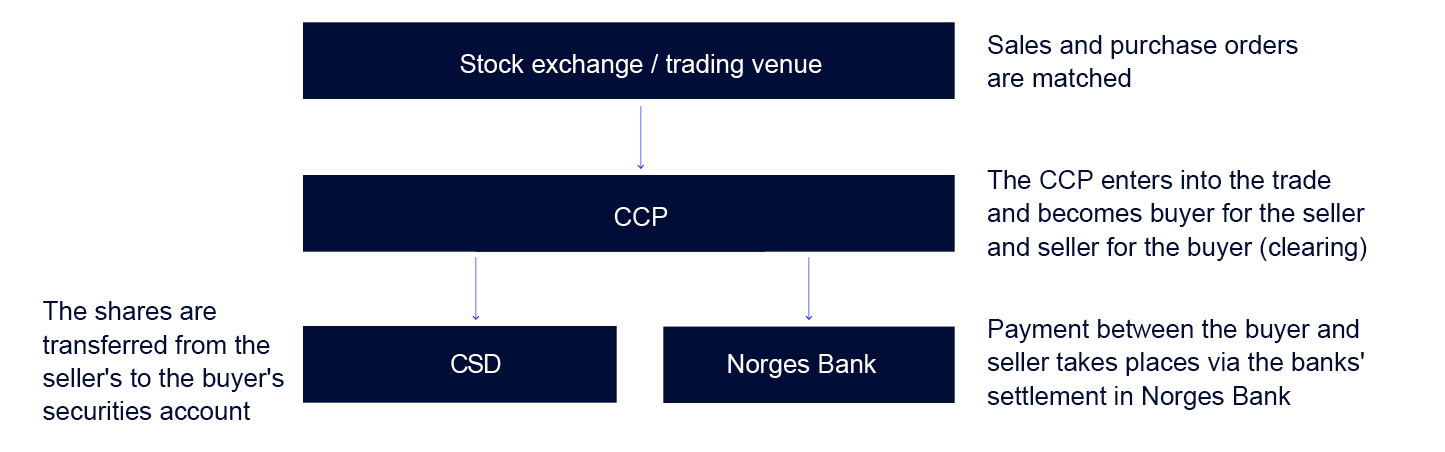
Read the diagram as text
- Match the orders: The exchange or trading venue matches a purchase order with a sale order.
- Clear through a central counterparty: The central counterparty, or CCP, becomes the buyer to the original seller and the seller to the original buyer.
- Move the shares: The central securities depository records the shares moving from the seller’s securities account to the buyer’s securities account.
- Settle the cash leg: The cash leg settles through banks’ accounts at Norges Bank. The original puts both legs side by side so you can identify which institution records each movement.
Follow the Norges Bank diagram step by step.
Read the original at full size here
Use touch, a trackpad, or the arrow keys in the image area.
The danger is the gap between the two moves. Suppose the bond moved first and the money never came. Bank Alfa would lose the whole value of the bond. So the two moves are tied together. The bond moves only if the money moves. This tie is called .
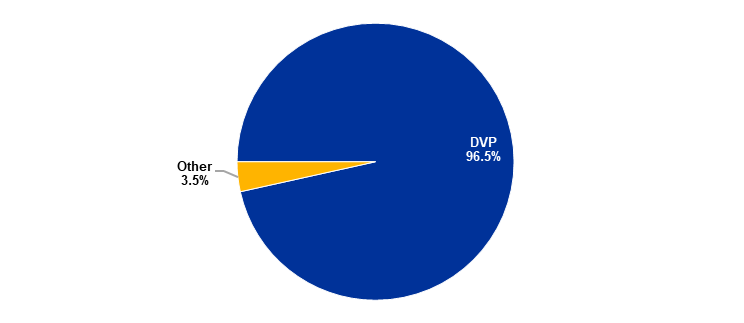
Read the diagram as text
- Read the delivery-versus-payment share: Delivery versus payment, shown as DVP, accounts for 96.5% of the cash value. In a delivery-versus-payment transaction, the security and cash move together.
- Identify the remaining cash value: The amber slice is labelled Other. It represents 3.5% of cash value. The report includes cash and securities moving in the same direction, and cash payments without securities delivery.
Follow the ECB chart step by step.
Read the original at full size here
Use touch, a trackpad, or the arrow keys in the image area.
A payment between two accounts moves one thing, which is money. A securities trade moves two things, so it needs a tie between them. This topic shows who keeps the records, three ways the tie can work, and why the days between the trade and the settlement matter.
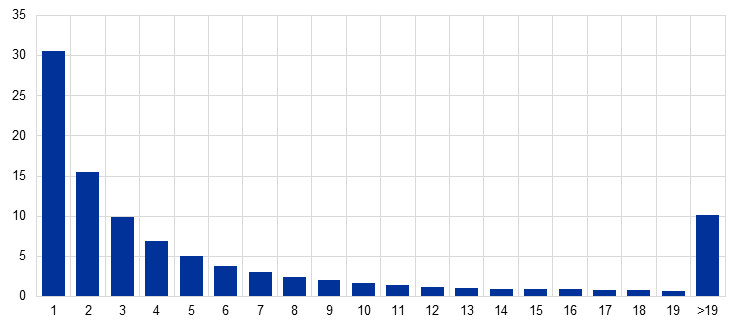
Read the diagram as text
- Find the first retry day: The first bar is about 30.6%. It shows the share of the reported unsettled transactions that settled on the first recycling day.
- Find the grouped tail: The last bar groups transactions still unsettled after 19 recycling days. It is a group across later days. Treat it differently from a single numbered day.
Read the actual 2025 evidence in the ECB chart.
Read the original at full size here
Use touch, a trackpad, or the arrow keys in the image area.
PLAIN WORDS · 1 in this section
- intermediaries
- go-between people or firms
PICTURE IT
Two keys in one lock box
A seller keeps a deed in a locked box and the buyer keeps the cash in another. A clerk holds both boxes. The clerk opens neither unless both can be opened together, and then hands over the deed and the cash in one move. If either box fails to open, nothing leaves either box. This is a teaching picture of conditional completion, not a claim that all system operations occur at the same instant.
THE REAL JOB A provides securities accounts and safeguards issue integrity; DvP links final delivery and payment to eliminate .
- Trade agreed
- Securities accounts and conditions checked
- Linked final settlement conditions met
- Settled holdings recorded
HOW THE PICTURE MAPS
| In the picture | In the payment |
|---|---|
| The deed in the box | Book-entry security, dematerialised or represented by immobilised physical certificates |
| The cash in the other box | The money leg, settled in central bank money or at a commercial bank |
| The clerk who holds both boxes | Securities settlement arrangements; a CSD may operate them while another entity maintains definitive ownership records |
| Open both together or neither | DvP: final delivery is conditional on final payment; identical timing is not required |
WHERE THIS PICTURE STOPS
- The picture is an against-payment exchange. Some transfers are free of payment, such as collateral repositioning, and are not this cash-exchange case.
- DvP does not require simultaneous technical steps. Gross/gross, gross-securities/net-cash and net/net models differ in both legs and finality timing.
- A CSD is not necessarily the definitive legal-ownership registrar. Direct and indirect holding systems and relevant law determine the records; investor holdings may be maintained through intermediaries.
- DvP addresses principal risk, not every liquidity, replacement-cost, custody or operational risk. The applicable legal and system rules still matter.
HOOK
Link final delivery to final payment.
TELL A FRIEND
A maintains securities accounts and supports issue integrity; DvP links final securities delivery and payment in against-payment exchanges. This need not be simultaneous, and the CSD need not keep every ultimate investor’s definitive ownership record.
OFTEN MIXED UP WITH Settlement risk, finality, and CLS. That lesson names the kinds of settlement risk. This one shows how a depository ties the securities leg to the money leg so the biggest of them is removed.
CURRENT AS CHECKED
1 FIGURE
EU primary legal status updated from Regulation2025/2075; US/UK/Swiss milestones retain their separately cited earlier source scope
The EU move to T+1 is adopted legislation, not merely an unconfirmed proposal. Regulation (EU) 2025/2075 was adopted on 8 October 2025 and published in the Official Journal on 14 October 2025. It entered into force on 3 November 2025 and its T+1 amendment applies from 11 October 2027 to the transactions within its scope, subject to its exceptions.
The United States compliance date of 28 May 2024 for most covered securities transactions, and the previously announced 11 October 2027 UK and Swiss milestones, are carried from their separately cited sources. The EU regulation does not set those jurisdictions’ legal requirements. Check the relevant national scope and instruments rather than treating a common target date as one universal rule.
The adopted EU date is established by the main amending regulation itself.
CHECKED 2026-11-07RECHECK BY 2026-12-15
Sources & standards — 4 sources
- Scheme-specific rule
Frequently asked questions on the T+1 standard settlement cycle (US Securities and Exchange Commission) ↗ — US Securities and Exchange Commission · compliance date of 28 May 2024 for the amendments that moved the standard cycle to T+1 (search excerpt of the SEC FAQ, page not opened)
Known from WebSearch excerpts on the access date (search excerpt, page not opened). The final rules were adopted on 15 February 2023. The compliance date is a dated fact on this site.
- Market practice
ESMA recommends EU to move to T+1 settlement cycle by October 2027 (Investment Week) ↗ — Investment Week · ESMA final report of 18 November 2024 recommended 11 October 2027; the United Kingdom and Switzerland announced the same date (trade-press search excerpts, page not opened)
Known from WebSearch excerpts on the access date (search excerpt, page not opened). Secondary reporting. ESMA's own page was not opened.
- Official requirementAdopted8October2025; OJ14October2025
Regulation(EU)2025/2075 — adopted EU move to T+1 securities settlement ↗ — European Union, Official Journal / EUR-Lex · Actual full substantive recitals1–10, Articles1–2, signature and footnotes read. OJ14October2025; adoption8October; entry20days after publication; application11October2027 within stated scope/exceptions.
Actual complete substantive text recitals1–10, Articles1–2, signature and footnotes read7November2026 and banked before implementation. Distinguish adopted/in-force main amendment from application date and separate settlement-discipline technical acts. Not all instruments, private trades, national transposition or later amendments certified. No source figures reproduced.
- Market practice
Delegated and implementing regulations under CSDR published in the Official Journal (A&O Shearman FinReg) ↗ — A&O Shearman · Delegated Regulation (EU) 2026/1536 published 14 October 2026, supporting the move to T+1 on 11 October 2027 (law-firm search excerpt, page not opened)
Known from WebSearch excerpts on the access date (search excerpt, page not opened). A law-firm summary, not the Official Journal. The status of the main amending regulation was not given.
PRACTISE AND KEEP
Sources for this topic — 10 sources
- Official requirementApril 2012
Principles for financial market infrastructures — selected CSD/DvP sections ↗ — CPSS and IOSCO; Bank for International Settlements · Actual CPSS–IOSCO PFMI April 2012, Principle 11 and §3.11.4, printed 73–74/notes 103–106: immobilised physical certificates can transfer by book entry; dematerialisation eliminates certificates. Selected Principles 11/12 also previously read. Scoped international standards, not a universal statute or whole-PDF review.
International standards for relevant FMIs; application through local law/standards matters. Not a global statute, not entire PDF read. CSD need not be the official registrar, securities can be immobilised/dematerialised, and linked final settlement need not be simultaneous. No source artwork copied.
- Official requirementConsolidation 17 January 2026
CSDR Regulation (EU)No909/2014 — selected current consolidated definitions/core services ↗ — European Union; EUR-Lex · Actual EUR-Lex consolidation 17 January 2026, Annex Section A core services, selected in the prior direct read; EU legal scope. Not all CSDR or a statement of every jurisdiction’s custody/ownership law.
EU scope. Consolidation is a documentation tool; the underlying regulation/amendments are authoritative. Original adopted Annex A XML compared separately; not silently treating UK-retained text as current EU law. No entire regulation or unrelated jurisdiction claimed reviewed.
- Scheme-specific rule
Delivery versus payment in securities settlement systems (Committee on Payment and Settlement Systems, September 1992) ↗ — Committee on Payment and Settlement Systems (now CPMI), Bank for International Settlements · the 1992 report on delivery versus payment in securities settlement systems; its table of contents lists Model 3 as simultaneous net settlement of securities and funds transfers (search excerpt, page not opened)
Known from WebSearch excerpts on the access date (search excerpt, page not opened). The report's own model descriptions were not seen. They were confirmed through the Reserve Bank of Australia's restatement of the models (rba-fss-securities-settlement-standard-10) and a table of contents listing Model 3 as simultaneous net settlement of securities and funds transfers. Later standards, the PFMI, build on this report.
- Scheme-specific rule
Financial Stability Standards for Securities Settlement Facilities, Standard 10: Exchange-of-value settlements (Reserve Bank of Australia, 2012) ↗ — Reserve Bank of Australia · restates the three models: Model 1, final securities and funds transfers occur contemporaneously and trade by trade in real time; Model 2, final securities transfers trade by trade in real time with final funds transfers net at the end of the processing cycle; Model 3, both net at the end of the cycle (search excerpt, page not opened)
Known from WebSearch excerpts on the access date (search excerpt, page not opened). It is Australian regulation for Australian facilities and is used here only for its restatement of the BIS models.
- Market practice
Fedwire Securities Service ↗ — Federal Reserve Financial Services · the Fedwire Securities Service is a central securities depository for Treasury and agency securities held as book entries; it works as a real-time delivery-versus-payment Model 1 system; payments settle on the books of the Reserve Banks; transfers can also be made free of payment (search excerpts of the Federal Reserve Financial Services pages and disclosure, page not opened)
Known from WebSearch excerpts on the access date (search excerpt, page not opened). The Federal Reserve's Fedwire Securities PFMI disclosure and compliance assessment say the same. Volume shares and limits in those documents are dated and are not quoted.
- Scheme-specific rule
Frequently asked questions on the T+1 standard settlement cycle (US Securities and Exchange Commission) ↗ — US Securities and Exchange Commission · compliance date of 28 May 2024 for the amendments moving the standard US settlement cycle for most securities transactions to T+1 (search excerpt, page not opened)
Known from WebSearch excerpts on the access date (search excerpt, page not opened). The final rules were adopted on 15 February 2023. The compliance date is a dated fact on this site.
- Scheme-specific rule
T+1 settlement: Commission proposal to shorten the settlement cycle for EU securities (12 February 2025) ↗ — European Commission · Commission proposal of 12 February 2025 to move EU securities to a one-day cycle on 11 October 2027 (search excerpt, page not opened)
Known from WebSearch excerpts on the access date (search excerpt, page not opened). A proposal, then a political agreement of June 2025. A&O Shearman reported on 14 October 2026 that a delegated regulation supporting the move was published in the Official Journal. Official Journal publication of the main amending regulation was not confirmed in the excerpts.
- Market practice
Update on the potential change to CLSSettlement timelines following the move to T+1 securities settlement ↗ — CLS Group · CLS published an update on possible changes to CLSSettlement timelines after the move to T+1 securities settlement (search excerpt, page not opened)
Read as a search excerpt. It describes CLS's plans at its date, not a current rule.
- Simplified educational illustration
Payments Signal editorial teaching models — Payments Signal
What this simplifies: Bank Alfa, Nordbank and Central Bank Omega are invented, and no real depository rulebook is reviewed. The narrow direct read covers selected PFMI 11/12 and EU core-service provisions, identified by their references. The 1992 DvP report, Australian model restatement, relative liquidity rankings and detailed Model 2 timing are not re-certified; other source locators retain their access limits. No securities payment journey is drawn.
Used wherever diagrams, scenarios, figures, or example values are didactic constructions rather than sourced facts; every such use carries a simplifications disclosure. All people, companies, banks, and list entries in examples are fictional.
- Scheme-specific rule
Fedwire Funds Service ↗ — Federal Reserve Financial Services · The operator's or issuer's own description of the system or rule named in this text; cited so a reader can check it there (search excerpt, page not opened)
The Fedwire Funds Service completed its ISO 20022 implementation on 14 July 2025.
Deepest material on this page: L4 — Standards & sources. Where a topic stops short of implementation depth, that is a deliberate coverage decision, not an oversight — see coverage.