Closed doors: operating hours, time zones and the liquidity to wait
Why a payment can wait for a system to open, what the CPMI proposes to do about it, and how liquidity bridges and payment versus payment fit in.
L1–L4 are part of the Pro pass
L0 Explain simply
Asha Traders pays a supplier abroad late on a Friday. Bank Alfa sends the payment in good time. The payment still does not reach the supplier until the following week. (SYNTHETIC / TRAINING ONLY. Asha Traders, Bank Alfa, Nordbank and Maya Chen are invented.)
Nothing has gone wrong. The supplier's bank, Nordbank, is in a country that is already asleep or closed for the weekend. The system that settles its payments is shut.
Many large payments settle through systems using accounts at the . The operator can be a central bank or another body. Many systems open and close at set times. The hours differ from country to country, and so do the time zones.
When two systems are closed at the same time, a payment between them has to wait. The wait is not an error. It is the calendar getting in the way.
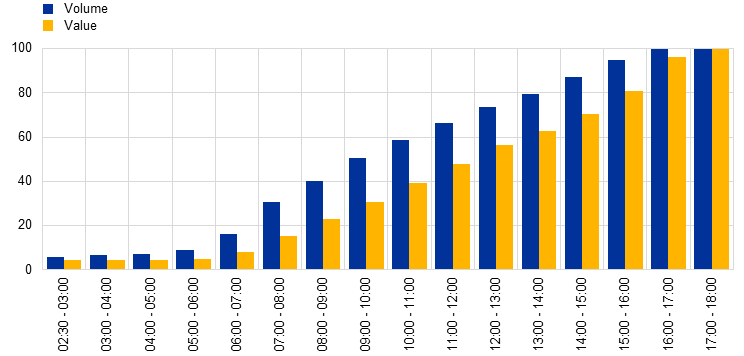
Read the diagram as text
- Read an early interval: At the end of the 07:00 to 08:00 CET interval, 30.6% by number and 15.4% by value had settled on average.
- Compare both series near the cut-off: By 17:00 CET, the shares had reached 99.7% by number and 96.3% by value. The customer payment cut-off came before the interbank cut-off.
Read the actual 2025 evidence in the ECB chart.
Read the original at full size here
Use touch, a trackpad, or the arrow keys in the image area.
This is one of the reasons cross-border payments can take longer than domestic ones. Faster messages cannot fix a locked door.
The fix being studied is simple to say and hard to build. Open the systems for longer, and make the opening times overlap. The same work also asks how banks find the money they need while they wait.
Disclosure: this topic gives the plain idea and the public work behind it. It does not describe any one country's schedule.
PICTURE IT
Two shops in different towns with different opening hours
Picture two shops in different towns that must hand a parcel to each other across a counter. The first shop is open from eight until four. The second opens at noon and closes at eight in the evening, by its own town's clock. They can hand over the parcel only in the hours when both are open.
If the parcel is ready at five in the afternoon, it waits until the next day. Staying open later, opening on weekends, or opening round the clock would widen the time when both are open.
THE REAL JOB Aligned and longer operating hours widen the time when two settlement systems are open together, so a finds both ends ready.
- Payment is ready
- One system is closed
- The payment waits
- Both systems are open
- The payment settles
HOW THE PICTURE MAPS
| In the picture | In the payment |
|---|---|
| The two shops | Two RTGS systems in different countries |
| Each shop's opening hours | A system's operating hours |
| The hours when both are open | The two systems’ bilateral overlap, distinct from the global settlement window |
| The parcel waiting overnight | A payment waiting for a closed systemWho: Asha Traders |
| Staying open later, then weekends, then round the clock | The three end states |
| A neighbour who lends the shop float for the day | A liquidity bridge between central banks |
WHERE THIS PICTURE STOPS
- A parcel waits harmlessly. A payment waiting with money committed carries funding cost and sometimes currency risk.
- Operating arrangements are determined by the relevant operator and authorities. The operator is not always a central bank, and Around-the-clock availability does not eliminate outages or maintenance.
- A shop picture has two ends. A real chain has correspondents, and each hop can add its own wait.
- Longer hours help only if banks can reach the system and have the liquidity to settle.
HOOK
Open together, and fund the wait.
REMEMBER IT THIS WAY
A chunk: a long list grouped so it is easier to hold.
Gap, window, , bridge.
| In the trick | What it stands for |
|---|---|
| gap | hours when one settlement system is closed and the other is open |
| window | the global settlement window when the most systems are open together |
| end state | one of the three ways to extend hours |
| bridge | a liquidity bridge between central banks for intraday money |
The four words leave out access for banks and the liquidity a bank needs while it waits.
TELL A FRIEND
A can depend on several services, accounts and time zones. Longer usable overlap can reduce a closing-gap delay, while access, funding, compliance and operational availability remain separate conditions.
OFTEN MIXED UP WITH Settlement risk, finality, and CLS. The settlement risk topic explains why paying one currency leg before the other is dangerous. This topic is about the calendar and funding that cause legs to wait.
CURRENT AS CHECKED
1 FIGURE
CPMI surveys of RTGS operating hours: 2022 baseline and the 2024 and 2025 monitoring survey counts
The ’s 2022 report analysed 62 systems in a survey covering 82 jurisdictions and described substantial operating-hour gaps between some pairs. Later monitoring counts belong to their own survey year and sample.
Brief 10, published 18 December 2025 for the 2024 survey, reports five systems operating 24/7 and an average of about 66 weekly hours. Brief 13, published 27 May 2026 for the 2025 survey, reports 11 systems operating 24/7 and an average of 73 hours. Sample changes affect the comparison: on a constant sample, average hours rose from 70 to . Only seven of the 11 always-open systems reported continuous processing, clearing and settlement.
An always-open service is therefore not automatically continuous settlement. These are dated research observations, not operator rules or proof that every end user already receives faster cross-border payments.
CHECKED 2026-11-07RECHECK BY 2027-03-31
Sources & standards — 3 sources
- Market practice
Extending and aligning payment system operating hours for cross-border payments ↗ — Bank for International Settlements (CPMI) · CPMI report of May 2022 (building block 12 of the G20 programme), survey of RTGS systems: operating hours differ and leave gaps that partly explain delays; some pairs of jurisdictions have gaps above 20 hours a day; few systems run at weekends; three end states (longer hours on working days, add non-operating days, full 24/7); the global settlement window is the period when the most RTGS systems operate at once (search excerpts, page not opened)
Survey figures are not restated in prose. Seen as WebSearch excerpts on the access date; the page was not opened.
- Market practice
Moving on up: results of the 2024 cross-border payments monitoring survey (CPMI Brief No 10) ↗ — Bank for International Settlements (CPMI) · Actual publisher Brief10, 18 December 2025: selected system characteristics and operating-hours sections with footnotes7–9 actually read; five24/7 systems and66hour average in2024 sample, not whole26pages.
Reports the 2024 survey, so its counts differ from the 2025 survey in Brief No 13. None is used in prose. Seen as WebSearch excerpts on the access date; the page was not opened.
- Market practice
Enhancing cross-border payments step by step: insights from the 2025 monitoring survey (CPMI Brief No 13) ↗ — Bank for International Settlements (CPMI) · Actual publisher Brief13, 27 May 2026: operating-hours body, Graph2caption and selectedGraph3footnotes actually read;2025sample82systems/11alwaysopen/7continuous processing-clearing-settlement/73hours; constant sample70to72. Notwhole35pages or alloperatorparameters.
Counts are not stated in prose. The sample changed between years. Seen as WebSearch excerpts on the access date; the page was not opened.
PRACTISE AND KEEP
Sources for this topic — 9 sources
- Scheme-specific rule
Extending and aligning payment system operating hours for cross-border payments ↗ — Bank for International Settlements (CPMI) · CPMI report of May 2022 (building block 12 of the G20 programme), survey of RTGS systems: operating hours differ and leave gaps that partly explain delays; some pairs of jurisdictions have gaps above 20 hours a day; few systems run at weekends; three end states (longer hours on working days, add non-operating days, full 24/7); the global settlement window is the period when the most RTGS systems operate at once (search excerpts, page not opened)
Survey figures are not restated in prose. Seen as WebSearch excerpts on the access date; the page was not opened.
- Scheme-specific rule
Operational and technical considerations for extending and aligning payment system operating hours for cross-border payments: an analytical framework ↗ — Bank for International Settlements (CPMI) · CPMI technical report of February 2023: an analytical framework for the operational and technical considerations; focuses on longer hours on current operating days as the most achievable short-term option (search excerpt, page not opened)
Only the abstract-level description was seen. Seen as WebSearch excerpts on the access date; the page was not opened.
- Scheme-specific rule
Changing the clock: practical approaches to extend payment system operating hours (CPMI Brief No 6) ↗ — Bank for International Settlements (CPMI) · CPMI Brief No 6, 31 January 2025: practical approaches drawn from RTGS systems that have extended their hours; extending hours may help interlinking of payment systems, liquidity management and settlement risk; systems that reached 24/7 often did so gradually (search excerpts, page not opened)
The specific practical approaches were not seen and are not taught. Seen as WebSearch excerpts on the access date; the page was not opened.
- Scheme-specific rule
Moving on up: results of the 2024 cross-border payments monitoring survey (CPMI Brief No 10) ↗ — Bank for International Settlements (CPMI) · CPMI Brief No 10, 18 December 2025: results of the 2024 cross-border payments monitoring survey: five RTGS systems operating 24/7 and an average of about 66 hours a week out of a possible 168; hours results largely steady year on year while interest in 24/7 is rising (search excerpts, page not opened)
Reports the 2024 survey, so its counts differ from the 2025 survey in Brief No 13. None is used in prose. Seen as WebSearch excerpts on the access date; the page was not opened.
- Scheme-specific rule
Enhancing cross-border payments step by step: insights from the 2025 monitoring survey (CPMI Brief No 13) ↗ — Bank for International Settlements (CPMI) · CPMI Brief No 13, May 2026: results of the 2025 cross-border payments monitoring survey; 11 RTGS systems operating 24/7 against seven in 2023 and five in 2024; average of 73 hours a week; part of the rise from the 2024 average of 66 is a change in the sample, and with the sample held constant the average rose from 70 to 72 hours (search excerpts, page not opened)
Counts are not stated in prose. The sample changed between years. Seen as WebSearch excerpts on the access date; the page was not opened.
- Scheme-specific rule
Liquidity bridges across central banks for cross-border payments ↗ — Bank for International Settlements (CPMI) · CPMI report of September 2022: a liquidity bridge is a cross-currency intraday liquidity arrangement between central banks, distinct from swap lines; the lending central bank provides intraday liquidity in its own currency against collateral held at a facilitating central bank; two bridges operating (Bank of England with De Nederlandsche Bank, and the Scandinavian Cash Pool); progress on operating hours could simplify bridge design (search excerpts, page not opened)
No design terms of either bridge are stated. Seen as WebSearch excerpts on the access date; the page was not opened.
- Scheme-specific rule
Facilitating increased adoption of payment versus payment (PvP) — final report ↗ — Committee on Payments and Market Infrastructures, Bank for International Settlements · CPMI final report of March 2023: why FX trades settle without payment versus payment; technical difficulty in connecting PvP providers to RTGS systems during operating hours that meet user demand, and differing national regulatory requirements, are among the barriers named; the report recommends considering longer and aligned RTGS hours to support PvP; extending payment system opening hours is one suggestion for widening the PvP settlement window (search excerpts, page not opened)
Verification relied on web-search excerpts of the Committee's own publication page and of the consultative report that preceded it. bis.org is blocked, so the report itself was not opened.
The publication date and the report number, d216, are consistent across three independent readings: the Committee's own page, the Bank's cross-border payments programme overview, and CLS Group's own response to the report. All three also agree that d216 is the final version rather than the consultative one — d207, from July 2022 — and describe its scope the same way.
No quantity is taken from this source. The measured share of foreign exchange settling with and without PvP protection belongs to the Triennial Survey and to the Bank's Quarterly Review articles, not to this report. Citing a proportion to it would attribute a number to a document that was not read.
- Scheme-specific rule
Enhancing cross-border payments: building blocks of a global roadmap (Stage 2 report to the G20) ↗ — CPMI, Bank for International Settlements · The G20 cross-border programme's building blocks: operating hours (block 12), PvP (block 9) and liquidity are handled as separate blocks (search excerpt, page not opened)
CPMI Papers No 193, published 13 July 2020, with a technical background report issued alongside it as No 194.
Verified from independent web-search excerpts on the access date. The publisher's own domain cannot be fetched, so no text is quoted here from the publisher's own page. A failed fetch is not evidence about what the document provides.
- Simplified educational illustration
Payments Signal editorial teaching models — Payments Signal
What this simplifies: Asha Traders, Bank Alfa, Nordbank and Maya Chen are invented, and the Friday payment is an illustration. The cost list at level 2 and the three questions at level 3 are this site's reasoning. Every source was read as a search excerpt and no page was opened. No operating-hour count is stated in prose, because the survey counts belong to different survey years and move each year. The two liquidity bridges are named as the CPMI report describes them and no design detail is added.
Used wherever diagrams, scenarios, figures, or example values are didactic constructions rather than sourced facts; every such use carries a simplifications disclosure. All people, companies, banks, and list entries in examples are fictional.
Deepest material on this page: L4 — Standards & sources. Where a topic stops short of implementation depth, that is a deliberate coverage decision, not an oversight — see coverage.