Home Learn Euro settlement infrastructure Who holds the account, and who may speak for it Euro settlement infrastructure 9 of 13
DEPTH L0 Simple L1 Core L2 Practitioner L3 Technical L4 Sources L1–L4 are part of the Pro pass
L0 Explain simplyA family car is often shared by more people than the one whose name is on the logbook. The owner holds the registration and pays the insurance. A named second driver has a licence and can take the car out alone. A child rides in it constantly and may never drive it at all.
Three different relationships to one vehicle, and only one of them is ownership. The second driver's right to drive does not come from owning anything. It was granted, and it could be granted to somebody else tomorrow without the car changing hands.
An instant settlement service sorts institutions in much the same way. Some hold an account there. Some hold none, and are reached through an account somebody else holds. And some are allowed to speak for a holder without owning anything at all.
Ordinary speech blurs the three together, which is where the trouble starts. "We are on the instant service" can mean any of them, and the differences decide whose money moves when a payment arrives.
Hear how easily it happens. Bank Alfa, Cassia Bank and Clearing System Delta can each say that sentence, each be telling the truth, and each mean a different arrangement underneath. (SYNTHETIC / TRAINING ONLY — every firm named in this topic is invented.)
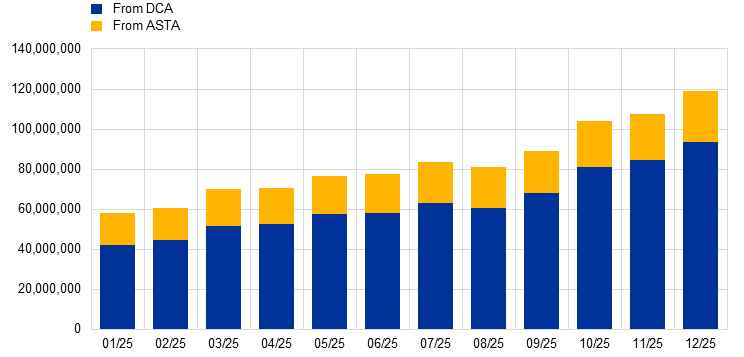
Banks and clearing systems play different roles. The chart shows how much euro traffic was sent from each account type. The chart and report are available free from the ECB. None of the three has said anything false. What none of them has said is whose account a payment will land on, and that is the one thing a settlement service has to know before it can move anything at all.
So this topic keeps two questions apart from beginning to end. Whose account settles this payment, and who was allowed to send it?
PLAIN WORDS · 1 in this section
logbook a book where a captain writes down each day's events PICTURE IT A block of flats and its caretaker's list
Picture a block of flats with a wall of boxes for letters in the hall. Some flats have their own box with the resident's name on it. One box is shared by a housing co-op, and its members' pooled rent money is kept behind it.
A lodger rents a room and has no flat of the lodger's own. The lodger's post lands in the landlord's box, under an agreement between the two. A neighbour holds a key and may post and collect letters for a flat, though the key-holder owns nothing there. A note on a box can limit how much of it one lodger may use.
The caretaker keeps one list. Each name on it points to exactly one box. Whenever a letter arrives, the caretaker reads the name, finds the one box. The letter goes in there, or nowhere.
SYNTHETIC / TRAINING ONLY: this picture is invented to carry the idea.
THE REAL JOB Every payment in the Eurosystem instant service settles on one account, and the records say which account and who may send.
1 A payment names a party by its code 2 The reference data finds the one account or limit for that code 3 The service checks the sender is authorised to act for that party 4 The payment is booked on that account 5 If no place is registered, it settles nowhere What happens to each payment. If the code has no registered place, it does not settle. HOW THE PICTURE MAPS How each part of the picture matches the payment In the picture In the payment A resident's own box with a name on it A participant: holds a dedicated cash account (DCA) and settles on it The housing co-op's shared box An ancillary system's technical account, with its members' liquidity The lodger with no flat A reachable party: holds no account and settles on somebody else's The agreement between lodger and landlord The contract that lets a reachable party use another party's account The neighbour with a key An instructing party: authorised to send and receive messages for a party The name on the caretaker's list A BIC (Business Identifier Code), the code that names an institution One list line linking a name to one box An authorised account user record in reference data A note on a box limiting what one lodger may use A credit memorandum balance: a limit that holds no money itself
WHERE THIS PICTURE STOPS A letterbox holds letters, but a dedicated cash account (DCA) holds central bank money. The picture cannot show settlement, only where it lands. A key lets a neighbour reach the box, so it looks like ownership. In the instant service, the right to send is a separate record, and it can change without moving the account. The picture blurs that split. A lodger could get post at two addresses. In the service, one code is registered against one account or one limit, never two. Many codes may share one account, but the picture does not show that asymmetry. Flats suggest size and status. The service does not sort by how large or well known an institution is, only by where a payment can be booked. The picture has no counterpart for a distinguished name, the technical address the network uses, which differs from the business code. HOOK Whose account settles it? Who may send it?
REMEMBER IT THIS WAY A contrast: two neighbours told apart by one test.
Ask two questions and never one: whose account settles, and who may send? Different owners answer each.
What each part of the trick stands for In the trick What it stands for Whose account settles the one account or limit the code is registered against Who may send the instructing party authorised to send messages for a party Fixed by money the account is short Fixed by permissions a change of permissions puts it right
It is misleading if you stop at two questions, because a reject can have other causes that this topic does not cover.
TELL A FRIEND In an instant service, a bank may settle on its own account, on an ancillary system 's account, or on somebody else's account. Who may send is a separate record from whose account settles.
OFTEN MIXED UP WITH Settling instantly, at four in the morning (TIPS) . The instant-service topic is about what the service is and how a payment settles in it. This topic is about who holds the account that a payment settles on. Who is allowed to send for them. The first tells you what happens. The second tells you whose money it happens to.
First move, changed-fact check and teach-back A Pro pass opens three more parts of this picture.
First move What to do first when the real thing goes wrong
Changed-fact check One new fact, and what follows from it
Teach-back A prompt to explain the picture, a model answer and a checklist SEE WHAT PRO ADDS →
Settlement TIPS (TARGET Instant Payment Settlement)
The layers underneath L1 Core concepts, L2 Practitioner view, L3 Technical details, L4 Standards & sources — how this mechanism actually works, what it looks like in practice, and what the standard itself says.
Terms it introduces TIPS DCA, AS technical account, Reachable party, Ancillary system, Central bank money, Instructing party
Standards it cites TIPS professional-use documents, release specifications and message examples; What is TIPS? (TARGET Instant Payment Settlement) A pass opens 8,120 deeper layers across 2,030 topics, plus 10,775 interview questions and 12,033 checkpoint questions.
Cancel any time.
Walk a whole payment free first. Cancel any time.
Walk a whole payment free — the interactive journey end to end, every step, every party, no sign-in.
SEE WHAT PRO ADDS → ALREADY PRO? SIGN IN →
2 TOPICS PRACTISE AND KEEP CHECKPOINT Market infrastructure checkpoint Check that you can reason about the shared systems banks settle through. How is a family of settlement services organised, why does liquidity sit on separate accounts, and which of a message's several addresses does which job? Four more follow: what changes when a participant holds no account of its own, why a securities platform holds cash, what never closing does to funding, and who is watching the system while all of that runs.
TEST YOURSELF → REFERENCE CARD Who holds the account, and who may speak for it on one page The terms, the sources and the shape of this topic, condensed to a printable sheet. Open up to 5 new reference cards each month in each academy: 15 a month across all three. Cards you have opened stay yours.
OPEN THE CARD → ASKED IN INTERVIEWS 145 QUESTIONS IMPLEMENTATION RESOURCES 59 RESOURCES Apply the base message definition first, then the scheme or infrastructure profile that governs this topic.
An XSD checks XML structure. A usage guideline adds profile rules, conditional fields, code restrictions, and business controls. XSD-valid does not mean scheme-compliant.
XSD + definition Base ISO 20022
ISO 20022 message definitions and XSDs Choose the exact message definition in the official catalogue. The base XSD checks XML structure; it does not prove compliance with a scheme profile. Usage guideline CBPR+
CBPR+ usage guidelines The network profile that restricts how ISO 20022 payment and reporting messages are used for cross-border traffic. Usage guideline HVPS+
HVPS+ usage guidelines The common high-value ISO 20022 market-practice layer used as a starting point by T2, CHAPS, Fedwire, CHIPS, and other payment infrastructures. Usage guideline CBPR+
PMPG correspondent-payment and reporting market practice Non-binding market practice for structured party data, cover payments, investigations, and the transition between MT and ISO 20022 reporting. Rulebook SEPA SCT
SEPA Credit Transfer rulebook The current scheme obligations, datasets, time cycles, and exception rules for a SEPA Credit Transfer. Usage guideline SEPA SCT
SEPA Credit Transfer implementation guidelines The EPC profile describing how the ISO 20022 messages implement the SCT rulebook between payment service providers. Rulebook SEPA SCT Inst
SEPA Instant Credit Transfer rulebook The current scheme rules for round-the-clock euro instant credit transfers and their exception handling. Usage guideline SEPA SCT Inst
SEPA Instant Credit Transfer implementation guidelines and XSDs Customer-to-PSP and Inter-PSP profiles for SCT Inst. EPC XSDs are technical validation subsets, not production artefacts or proof of full scheme compliance. Usage guideline T2
T2 functional specifications, validation rules, and binding XSDs The ECB release library for T2 RTGS and central-liquidity messaging, including public user specifications, business validation rules, and binding schemas. Usage guideline TIPS
TIPS release specifications and professional-use documentation The ECB release library for TIPS UDFS/UHB specifications, message examples, implementation guidance, and MyStandards message-version links. Usage guideline CHAPS
CHAPS and RTGS ISO 20022 handbook and schema access The Bank of England handbook for CHAPS message scope, enhanced data, returns, testing, and the MyStandards location of controlling schemas. Usage guideline Fedwire
Fedwire Funds Service ISO 20022 implementation and technical documents Fedwire message versions, usage guidelines, implementation guidance, testing material, and the controlled route to proprietary schemas. Usage guideline CHIPS
CHIPS ISO 20022 usage-guideline resources and rules The public CHIPS ISO 20022 resource hub, legal notes, rules, change summaries, and participant material access points. Teaching sample Illustrative; no scheme profile checked
pacs.008 FI-to-FI credit transfer — raw XML A fictional serial interbank customer credit transfer, populated more fully than an everyday payment so the field set the MT103 ↔ pacs.008 mapping describes can be seen in position. It includes a requested settlement time, the ultimate parties, the addressed instructions and structured regulatory reporting. No occurred debit or credit time is reported: this message was created before its settlement date, and a requested time is not evidence of a posting. The exchange rate and charges elements are absent on purpose: this payment is single-currency and nothing was deducted, so carrying either would make the message untrue. The settlement method is CLRG, so the reimbursement agents of the cover method do not apply here either. Its service level code reads SEPA (the Single Euro Payments Area), while several field notes cite the Cross-Border Payments and Reporting Plus (CBPR+) usage guidelines. No scheme profile was checked against this document, so the two are shown side by side and are not one scheme's rules. This standalone CLRG example is not a translation of the MT103 sample. The two samples reuse a demonstration UETR but have different payment details; a real UETR identifies one transaction. SYNTHETIC / TRAINING ONLY; structure accepted by the ISO 20022 base schema pacs.008.001.08 (schema from the ISO 20022 Registration Authority; checked 2026-11-21); this does not check code values the schema leaves to ISO's externally maintained lists, scheme usage rules, bank or market-infrastructure requirements, or whether the message is right for the situation. Owner Payments Signal Checked 2026-11-21 Integrity crc32:59ed0266 Access Payments Signal download · Original fictional teaching sample. Pro pass required. Version history current · pacs.008.001.08 · Payments Signal download · Checked 2026-11-21 · Original fictional teaching sample. Pro pass required. Teaching sample Illustrative; no scheme profile checked
pacs.008 cover announcement — COVE — raw XML An alternative to the CLRG example: here the pacs.008 goes straight to the creditor agent as an announcement, while the money travels separately as a pacs.009 COV. That is what the settlement method says — COVE means this message's own settlement happens elsewhere — and it is why the reimbursement agents appear in this example rather than in the CLRG example. They name the two correspondents that will actually carry the value, so the creditor agent knows which bank to expect it from before it arrives. Note that neither of them is the creditor agent: if that bank serviced the settlement account itself there would be no cover to reimburse. The two pacs.008 examples reuse a demonstration UETR to compare the routes, but their settlement methods and charge codes differ. They are not two messages to send for one payment, and neither is a translation of the standalone MT103 sample. SYNTHETIC / TRAINING ONLY; structure accepted by the ISO 20022 base schema pacs.008.001.08 (schema from the ISO 20022 Registration Authority; checked 2026-11-20); this does not check code values the schema leaves to ISO's externally maintained lists, scheme usage rules, bank or market-infrastructure requirements, or whether the message is right for the situation. Owner Payments Signal Checked 2026-11-20 Integrity crc32:43e4c4ef Access Payments Signal download · Original fictional teaching sample. Pro pass required. Version history current · pacs.008.001.08 · Payments Signal download · Checked 2026-11-20 · Original fictional teaching sample. Pro pass required. Lifecycle pack Illustrative; no scheme profile checked
Corporate MX positive lifecycle — ZIP pack One fictional payment followed through six messages: initiation, interbank status, payment, notification, intraday report, and statement. Owner Payments Signal Checked 2026-11-21 Integrity crc32:66985faa Access Payments Signal download · Original fictional teaching pack. Pro pass required. Version history current · pack-corporate-mx-positive-current · Payments Signal download · Checked 2026-11-21 · Original fictional teaching pack. Pro pass required. Mapping CBPR+
MT103 → pacs.008 implementation mapping Field correspondence, transformation treatment, and data-loss notes for Plain MT103 to pacs.008 for cross-border customer credit transfers, with one explicitly historical MT103 REMIT comparison. This educational mapping is not Swift’s contingency converter or the licensed CBPR+ translation rulebook. Owner Payments Signal Checked 2026-07-19 Integrity crc32:ceca7065 Access Payments Signal download · Original, source-backed teaching asset. Pro pass required. Version history current · asset-mapping-mt103-to-pacs-008-current · Payments Signal download · Checked 2026-07-19 · Original, source-backed teaching asset. Pro pass required. Mapping CBPR+
MT102 → N × pacs.008 (batch decomposition) implementation mapping Field correspondence, transformation treatment, and data-loss notes for Workflow replacement, not a field translation. MT102 was negatively acknowledged when CBPR+ coexistence ended on 22 November 2025 with no ISO substitute and no contingency conversion — one pacs.008 per sequence-B transaction, raised by the sender. This table states, per MT102 field, which pacs.008 element of each split-up message carries it, which batch-level fields are restated per message, and which die with the batch envelope. Owner Payments Signal Checked 2026-07-19 Integrity crc32:77c8a3ad Access Payments Signal download · Original, source-backed teaching asset. Pro pass required. Version history current · asset-mapping-mt102-to-pacs-008-batch-current · Payments Signal download · Checked 2026-07-19 · Original, source-backed teaching asset. Pro pass required. Field matrix Base ISO 20022
pacs.008 field matrix Curated field requirements, contexts, operational meaning, and implementation cautions. Owner Payments Signal Checked 2026-07-19 Integrity crc32:bf54f882 Access Payments Signal download · Original, source-backed teaching asset. Pro pass required. Version history current · asset-field-matrix-pacs-008-current · Payments Signal download · Checked 2026-07-19 · Original, source-backed teaching asset. Pro pass required. Test pack Illustrative; no scheme profile checked
Payment lifecycle test cases Positive and negative test cases across validation, rejection, return, recall, reversal, investigation, reconciliation, migration, instant payments, and screening. Owner Payments Signal Checked 2026-07-19 Integrity crc32:98c48cc7 Access Payments Signal download · Original, source-backed teaching asset. Pro pass required. Version history current · asset-payment-lifecycle-test-cases-current · Payments Signal download · Checked 2026-07-19 · Original, source-backed teaching asset. Pro pass required. Migration notes CBPR+
MT to MX migration notes A practical control list for semantic transformation and coexistence risk. Owner Payments Signal Checked 2026-07-19 Integrity crc32:50787584 Access Payments Signal download · Original, source-backed teaching asset. Pro pass required. Version history current · asset-mt-mx-migration-notes-current · Payments Signal download · Checked 2026-07-19 · Original, source-backed teaching asset. Pro pass required. Field matrix T2
T2 RTGS implementation pack field and process matrix Verified profile constraints with versioned evidence and explicit operating conditions. Owner Payments Signal Checked 2026-07-19 Integrity crc32:ce355754 Access Payments Signal download · Original, source-backed teaching asset. Pro pass required. Version history current · asset-t2-profile-rules-current · Payments Signal download · Checked 2026-07-19 · Original, source-backed teaching asset. Pro pass required. Test pack T2
T2 RTGS implementation pack test cases Positive and negative lifecycle tests linked to verified profile rules. Owner Payments Signal Checked 2026-07-19 Integrity crc32:52175ca5 Access Payments Signal download · Original, source-backed teaching asset. Pro pass required. Version history current · asset-t2-test-cases-current · Payments Signal download · Checked 2026-07-19 · Original, source-backed teaching asset. Pro pass required. BA checklist T2
T2 RTGS implementation pack BA checklist Discovery, controls, testing and operational-readiness checks for the profile. Owner Payments Signal Checked 2026-07-19 Integrity crc32:dabcc15d Access Payments Signal download · Original, source-backed teaching asset. Pro pass required. Version history current · asset-t2-ba-checklist-current · Payments Signal download · Checked 2026-07-19 · Original, source-backed teaching asset. Pro pass required. Acceptance criteria T2
T2 RTGS implementation pack acceptance criteria Outcome-focused profile acceptance criteria with honest release gates. Owner Payments Signal Checked 2026-07-19 Integrity crc32:90dc18ba Access Payments Signal download · Original, source-backed teaching asset. Pro pass required. Version history current · asset-t2-acceptance-criteria-current · Payments Signal download · Checked 2026-07-19 · Original, source-backed teaching asset. Pro pass required. Migration notes T2
T2 RTGS implementation pack migration notes Version, transformation, cutover and reconciliation controls. Owner Payments Signal Checked 2026-07-19 Integrity crc32:90393a22 Access Payments Signal download · Original, source-backed teaching asset. Pro pass required. Version history current · asset-t2-migration-notes-current · Payments Signal download · Checked 2026-07-19 · Original, source-backed teaching asset. Pro pass required. Coverage gaps T2
T2 RTGS implementation pack restricted and release-specific gaps Evidence that must be obtained from the owner before production readiness can be claimed. Owner Payments Signal Checked 2026-07-19 Integrity crc32:581e94a5 Access Payments Signal download · Original, source-backed teaching asset. Pro pass required. Version history current · asset-t2-coverage-gaps-current · Payments Signal download · Checked 2026-07-19 · Original, source-backed teaching asset. Pro pass required. Field matrix TIPS
TIPS instant-settlement implementation pack field and process matrix Verified profile constraints with versioned evidence and explicit operating conditions. Owner Payments Signal Checked 2026-07-19 Integrity crc32:e3f04ae8 Access Payments Signal download · Original, source-backed teaching asset. Pro pass required. Version history current · asset-tips-profile-rules-current · Payments Signal download · Checked 2026-07-19 · Original, source-backed teaching asset. Pro pass required. Test pack TIPS
TIPS instant-settlement implementation pack test cases Positive and negative lifecycle tests linked to verified profile rules. Owner Payments Signal Checked 2026-07-19 Integrity crc32:3ea6d78c Access Payments Signal download · Original, source-backed teaching asset. Pro pass required. Version history current · asset-tips-test-cases-current · Payments Signal download · Checked 2026-07-19 · Original, source-backed teaching asset. Pro pass required. BA checklist TIPS
TIPS instant-settlement implementation pack BA checklist Discovery, controls, testing and operational-readiness checks for the profile. Owner Payments Signal Checked 2026-07-19 Integrity crc32:1fa713e1 Access Payments Signal download · Original, source-backed teaching asset. Pro pass required. Version history current · asset-tips-ba-checklist-current · Payments Signal download · Checked 2026-07-19 · Original, source-backed teaching asset. Pro pass required. Acceptance criteria TIPS
TIPS instant-settlement implementation pack acceptance criteria Outcome-focused profile acceptance criteria with honest release gates. Owner Payments Signal Checked 2026-07-19 Integrity crc32:f5ef35bf Access Payments Signal download · Original, source-backed teaching asset. Pro pass required. Version history current · asset-tips-acceptance-criteria-current · Payments Signal download · Checked 2026-07-19 · Original, source-backed teaching asset. Pro pass required. Migration notes TIPS
TIPS instant-settlement implementation pack migration notes Version, transformation, cutover and reconciliation controls. Owner Payments Signal Checked 2026-07-19 Integrity crc32:74567f42 Access Payments Signal download · Original, source-backed teaching asset. Pro pass required. Version history current · asset-tips-migration-notes-current · Payments Signal download · Checked 2026-07-19 · Original, source-backed teaching asset. Pro pass required. Coverage gaps TIPS
TIPS instant-settlement implementation pack restricted and release-specific gaps Evidence that must be obtained from the owner before production readiness can be claimed. Owner Payments Signal Checked 2026-07-19 Integrity crc32:b86e4292 Access Payments Signal download · Original, source-backed teaching asset. Pro pass required. Version history current · asset-tips-coverage-gaps-current · Payments Signal download · Checked 2026-07-19 · Original, source-backed teaching asset. Pro pass required. Field matrix CHAPS
CHAPS RTGS implementation pack field and process matrix Verified profile constraints with versioned evidence and explicit operating conditions. Owner Payments Signal Checked 2026-07-19 Integrity crc32:c79b356d Access Payments Signal download · Original, source-backed teaching asset. Pro pass required. Version history current · asset-chaps-profile-rules-current · Payments Signal download · Checked 2026-07-19 · Original, source-backed teaching asset. Pro pass required. Test pack CHAPS
CHAPS RTGS implementation pack test cases Positive and negative lifecycle tests linked to verified profile rules. Owner Payments Signal Checked 2026-07-19 Integrity crc32:fb0221bc Access Payments Signal download · Original, source-backed teaching asset. Pro pass required. Version history current · asset-chaps-test-cases-current · Payments Signal download · Checked 2026-07-19 · Original, source-backed teaching asset. Pro pass required. BA checklist CHAPS
CHAPS RTGS implementation pack BA checklist Discovery, controls, testing and operational-readiness checks for the profile. Owner Payments Signal Checked 2026-07-19 Integrity crc32:a574381c Access Payments Signal download · Original, source-backed teaching asset. Pro pass required. Version history current · asset-chaps-ba-checklist-current · Payments Signal download · Checked 2026-07-19 · Original, source-backed teaching asset. Pro pass required. Acceptance criteria CHAPS
CHAPS RTGS implementation pack acceptance criteria Outcome-focused profile acceptance criteria with honest release gates. Owner Payments Signal Checked 2026-07-19 Integrity crc32:612a75ad Access Payments Signal download · Original, source-backed teaching asset. Pro pass required. Version history current · asset-chaps-acceptance-criteria-current · Payments Signal download · Checked 2026-07-19 · Original, source-backed teaching asset. Pro pass required. Migration notes CHAPS
CHAPS RTGS implementation pack migration notes Version, transformation, cutover and reconciliation controls. Owner Payments Signal Checked 2026-07-19 Integrity crc32:d9f59c8d Access Payments Signal download · Original, source-backed teaching asset. Pro pass required. Version history current · asset-chaps-migration-notes-current · Payments Signal download · Checked 2026-07-19 · Original, source-backed teaching asset. Pro pass required. Coverage gaps CHAPS
CHAPS RTGS implementation pack restricted and release-specific gaps Evidence that must be obtained from the owner before production readiness can be claimed. Owner Payments Signal Checked 2026-07-19 Integrity crc32:e565e272 Access Payments Signal download · Original, source-backed teaching asset. Pro pass required. Version history current · asset-chaps-coverage-gaps-current · Payments Signal download · Checked 2026-07-19 · Original, source-backed teaching asset. Pro pass required. Field matrix Fedwire
Fedwire Funds Service implementation pack field and process matrix Verified profile constraints with versioned evidence and explicit operating conditions. Owner Payments Signal Checked 2026-07-19 Integrity crc32:6f8b5902 Access Payments Signal download · Original, source-backed teaching asset. Pro pass required. Version history current · asset-fedwire-profile-rules-current · Payments Signal download · Checked 2026-07-19 · Original, source-backed teaching asset. Pro pass required. Test pack Fedwire
Fedwire Funds Service implementation pack test cases Positive and negative lifecycle tests linked to verified profile rules. Owner Payments Signal Checked 2026-07-19 Integrity crc32:3b72999a Access Payments Signal download · Original, source-backed teaching asset. Pro pass required. Version history current · asset-fedwire-test-cases-current · Payments Signal download · Checked 2026-07-19 · Original, source-backed teaching asset. Pro pass required. BA checklist Fedwire
Fedwire Funds Service implementation pack BA checklist Discovery, controls, testing and operational-readiness checks for the profile. Owner Payments Signal Checked 2026-07-19 Integrity crc32:d31e7e73 Access Payments Signal download · Original, source-backed teaching asset. Pro pass required. Version history current · asset-fedwire-ba-checklist-current · Payments Signal download · Checked 2026-07-19 · Original, source-backed teaching asset. Pro pass required. Acceptance criteria Fedwire
Fedwire Funds Service implementation pack acceptance criteria Outcome-focused profile acceptance criteria with honest release gates. Owner Payments Signal Checked 2026-07-19 Integrity crc32:0bf84f8f Access Payments Signal download · Original, source-backed teaching asset. Pro pass required. Version history current · asset-fedwire-acceptance-criteria-current · Payments Signal download · Checked 2026-07-19 · Original, source-backed teaching asset. Pro pass required. Migration notes Fedwire
Fedwire Funds Service implementation pack migration notes Version, transformation, cutover and reconciliation controls. Owner Payments Signal Checked 2026-07-19 Integrity crc32:e22fb314 Access Payments Signal download · Original, source-backed teaching asset. Pro pass required. Version history current · asset-fedwire-migration-notes-current · Payments Signal download · Checked 2026-07-19 · Original, source-backed teaching asset. Pro pass required. Coverage gaps Fedwire
Fedwire Funds Service implementation pack restricted and release-specific gaps Evidence that must be obtained from the owner before production readiness can be claimed. Owner Payments Signal Checked 2026-07-19 Integrity crc32:3955f552 Access Payments Signal download · Original, source-backed teaching asset. Pro pass required. Version history current · asset-fedwire-coverage-gaps-current · Payments Signal download · Checked 2026-07-19 · Original, source-backed teaching asset. Pro pass required. Field matrix CHIPS
CHIPS implementation pack field and process matrix Verified profile constraints with versioned evidence and explicit operating conditions. Owner Payments Signal Checked 2026-07-19 Integrity crc32:68dfa60c Access Payments Signal download · Original, source-backed teaching asset. Pro pass required. Version history current · asset-chips-profile-rules-current · Payments Signal download · Checked 2026-07-19 · Original, source-backed teaching asset. Pro pass required. Test pack CHIPS
CHIPS implementation pack test cases Positive and negative lifecycle tests linked to verified profile rules. Owner Payments Signal Checked 2026-07-19 Integrity crc32:241f3e0f Access Payments Signal download · Original, source-backed teaching asset. Pro pass required. Version history current · asset-chips-test-cases-current · Payments Signal download · Checked 2026-07-19 · Original, source-backed teaching asset. Pro pass required. BA checklist CHIPS
CHIPS implementation pack BA checklist Discovery, controls, testing and operational-readiness checks for the profile. Owner Payments Signal Checked 2026-07-19 Integrity crc32:e68ff5f9 Access Payments Signal download · Original, source-backed teaching asset. Pro pass required. Version history current · asset-chips-ba-checklist-current · Payments Signal download · Checked 2026-07-19 · Original, source-backed teaching asset. Pro pass required. Acceptance criteria CHIPS
CHIPS implementation pack acceptance criteria Outcome-focused profile acceptance criteria with honest release gates. Owner Payments Signal Checked 2026-07-19 Integrity crc32:fb5e2bd6 Access Payments Signal download · Original, source-backed teaching asset. Pro pass required. Version history current · asset-chips-acceptance-criteria-current · Payments Signal download · Checked 2026-07-19 · Original, source-backed teaching asset. Pro pass required. Migration notes CHIPS
CHIPS implementation pack migration notes Version, transformation, cutover and reconciliation controls. Owner Payments Signal Checked 2026-07-19 Integrity crc32:58a94a4d Access Payments Signal download · Original, source-backed teaching asset. Pro pass required. Version history current · asset-chips-migration-notes-current · Payments Signal download · Checked 2026-07-19 · Original, source-backed teaching asset. Pro pass required. Coverage gaps CHIPS
CHIPS implementation pack restricted and release-specific gaps Evidence that must be obtained from the owner before production readiness can be claimed. Owner Payments Signal Checked 2026-07-19 Integrity crc32:12f561e3 Access Payments Signal download · Original, source-backed teaching asset. Pro pass required. Version history current · asset-chips-coverage-gaps-current · Payments Signal download · Checked 2026-07-19 · Original, source-backed teaching asset. Pro pass required. Profile pack CBPR+
CBPR+ implementation pack Generated mapping, field-matrix, test, checklist, acceptance-criteria, migration, manifest, checksum, and source-inventory bundle. Owner Payments Signal Checked 2026-07-19 Integrity crc32:2efc0d5e Access Payments Signal download · Original generated teaching pack. Pro pass required. Version history current · implementation-pack-cbpr-plus-current · Payments Signal download · Checked 2026-07-19 · Original generated teaching pack. Pro pass required. Profile pack SEPA SCT
SEPA credit-transfer implementation pack Generated mapping, field-matrix, test, checklist, acceptance-criteria, migration, manifest, checksum, and source-inventory bundle. Owner Payments Signal Checked 2026-07-19 Integrity crc32:a05755e9 Access Payments Signal download · Original generated teaching pack. Pro pass required. Version history current · implementation-pack-sepa-credit-current · Payments Signal download · Checked 2026-07-19 · Original generated teaching pack. Pro pass required. Profile pack HVPS+
High-value payments implementation pack Generated mapping, field-matrix, test, checklist, acceptance-criteria, migration, manifest, checksum, and source-inventory bundle. Owner Payments Signal Checked 2026-07-19 Integrity crc32:75fc01b7 Access Payments Signal download · Original generated teaching pack. Pro pass required. Version history current · implementation-pack-high-value-current · Payments Signal download · Checked 2026-07-19 · Original generated teaching pack. Pro pass required. Profile pack T2
T2 RTGS implementation pack Generated mapping, field-matrix, test, checklist, acceptance-criteria, migration, manifest, checksum, and source-inventory bundle. Owner Payments Signal Checked 2026-07-19 Integrity crc32:fcab9d85 Access Payments Signal download · Original generated teaching pack. Pro pass required. Version history current · implementation-pack-t2-current · Payments Signal download · Checked 2026-07-19 · Original generated teaching pack. Pro pass required. Profile pack TIPS
TIPS instant-settlement implementation pack Generated mapping, field-matrix, test, checklist, acceptance-criteria, migration, manifest, checksum, and source-inventory bundle. Owner Payments Signal Checked 2026-07-19 Integrity crc32:7079522c Access Payments Signal download · Original generated teaching pack. Pro pass required. Version history current · implementation-pack-tips-current · Payments Signal download · Checked 2026-07-19 · Original generated teaching pack. Pro pass required. Profile pack CHAPS
CHAPS RTGS implementation pack Generated mapping, field-matrix, test, checklist, acceptance-criteria, migration, manifest, checksum, and source-inventory bundle. Owner Payments Signal Checked 2026-07-19 Integrity crc32:a5a749c2 Access Payments Signal download · Original generated teaching pack. Pro pass required. Version history current · implementation-pack-chaps-current · Payments Signal download · Checked 2026-07-19 · Original generated teaching pack. Pro pass required. Profile pack Fedwire
Fedwire Funds Service implementation pack Generated mapping, field-matrix, test, checklist, acceptance-criteria, migration, manifest, checksum, and source-inventory bundle. Owner Payments Signal Checked 2026-07-19 Integrity crc32:469773a6 Access Payments Signal download · Original generated teaching pack. Pro pass required. Version history current · implementation-pack-fedwire-current · Payments Signal download · Checked 2026-07-19 · Original generated teaching pack. Pro pass required. Profile pack CHIPS
CHIPS implementation pack Generated mapping, field-matrix, test, checklist, acceptance-criteria, migration, manifest, checksum, and source-inventory bundle. Owner Payments Signal Checked 2026-07-19 Integrity crc32:7ad997ab Access Payments Signal download · Original generated teaching pack. Pro pass required. Version history current · implementation-pack-chips-current · Payments Signal download · Checked 2026-07-19 · Original generated teaching pack. Pro pass required. Sources for this topic — 3 sources Official requirement R2026.JUN
TIPS professional-use documents, release specifications and message examples ↗ — European Central Bank · TIPS UDFS — parties, accounts, authorised account users and instructing parties
Provides release-specific TIPS UDFS and UHB documents, message examples, implementation guides, release milestones, and links to message versions in MyStandards. · Checked 2026-07-19
R2026.JUN is the current production release at the review date. R2026.NOV is published for review and scheduled later; implementations must select the release effective for their test and go-live window.
Scheme-specific rule
What is TIPS? (TARGET Instant Payment Settlement) ↗ — European Central Bank · TIPS service description
Describes TIPS, the Eurosystem service that settles instant payments in central bank money around the clock, in line with the SCT Inst scheme. · Checked 2026-07-12
TIPS also settles instant payments in Swedish krona and Danish krone. This page names the currencies and does not publish their go-live dates. The Danish-krone date and the statement that the Swedish krona was onboarded in 2024 are cited from ecb-dkk-target-press-2025. Detailed user documentation is published separately by the ECB.
Simplified educational illustration
Payments Signal editorial teaching models — Payments Signal
This site's own simplified teaching models. · Checked 2026-07-12
What this simplifies: The shared-car analogy carries the ownership question and nothing about liability between the parties. Three party roles are taught by behaviour; the published party model is finer and includes roles held by central banks and the operator. Privilege detail, message versions and reason codes are not reproduced, because they are release-specific and would date without notice.
Used wherever diagrams, scenarios, figures, or example values are didactic constructions rather than sourced facts; every such use carries a simplifications disclosure. All people, companies, banks, and list entries in examples are fictional.
Deepest material on this page: L4 — Standards & sources. Where a topic stops short of implementation depth, that is a deliberate coverage decision, not an oversight — see coverage .
← PREVIOUS Settling instantly, at four in the morning (TIPS) NEXT → A limit that moves: the credit memorandum balance (TIPS CMB)