Who can reach a settlement system (direct and indirect participation)
An account and the right to send your own messages are separate privileges. Separating them explains every participation type, and the one case where two addresses disagree.
L1–L4 are part of the Pro pass
L0 Explain simply
Two questions decide how any organisation uses a shared system, and they are easier to see outside banking than inside it. Does it have its own account there? And is it allowed to walk up and transact for itself, or must somebody do that on its behalf?
A company credit card shows both at once. The company holds the account and gets the bill. An employee carries a card in their own name and pays with it directly. The employee has no account, and yet the shop deals with the employee rather than with the company.
Look at what that separation buys. Holding the account and being the one who acts are different privileges, and granting one does not grant the other. The company can add a cardholder without opening an account, and can withdraw the card without closing one.
Settlement systems separate exactly the same two questions. Whose money moves, and who may set it moving, are asked and answered independently.
Three institutions will carry the rest of this topic, and it is worth meeting them before the vocabulary arrives. Meridian Bank holds an account and acts for itself. Nordbank holds no account and does not act. A branch of Meridian Bank holds no account and acts anyway. (SYNTHETIC / TRAINING ONLY — every firm named in this topic is invented.)
These examples give three patterns of account ownership and access. Some directory labels describe different relationships with the same pattern. It is worth learning the distinction, because they decide what a directory entry looks like, and so what a message has to say to reach the institution you meant.
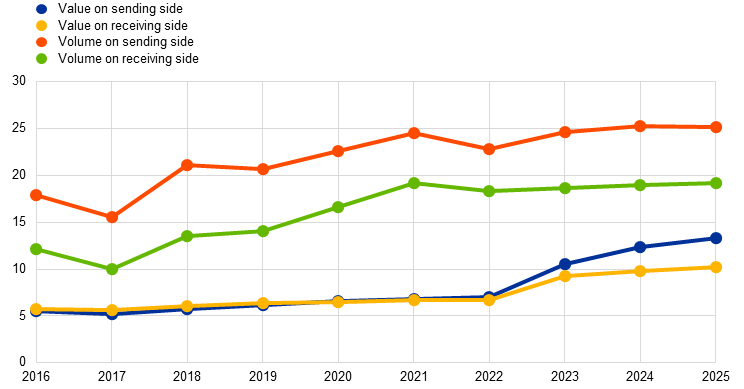
Read the diagram as text
- Read the volume series: The orange and green series show the sending and receiving sides in volume terms. They describe reported traffic, not the number of institutions.
- Read the value series: The blue and amber series describe shares by value. In 2025 they were 13.4% on the sending side and 10.2% on the receiving side.
Based on official sources
Read the actual 2025 evidence in the ECB chart.
Read the original at full size here
Use touch, a trackpad, or the arrow keys in the image area.
PICTURE IT
A company with a card account, a card in a name and a colleague without one
Picture a company that holds one card account with a card provider. The account sits in the company's name, and the monthly bill goes to the company.
The finance team uses the account directly. An employee in a branch office carries a card of their own. Shops deal with that employee, but every purchase is billed to the company account. A third colleague has no card at all. When that colleague needs something, the finance team buys it on their behalf.
Two questions sort these three people. Does the person hold the account? Does the person act in their own name? The finance team answers yes and yes. The employee with a card answers no and yes. The colleague without a card answers no and no.
The company also keeps a phone book. Each entry has three columns: the lookup name, the addressee and the account.
THE REAL JOB Participation types tell a sender who holds the account and who acts in their own name.
- Search for the institution you mean
- Read the addressee field: who receives the message
- Read the account field: whose account moves
- If the two differ, it is a multi-addressee
- Use the entry's codes, not the name you searched
HOW THE PICTURE MAPS
| In the picture | In the payment |
|---|---|
| The company's card account and its bill | A direct participant: it holds an account and acts for itself |
| The employee with a card in their own name | A multi-addressee: no account, but it sends and receives under its own code |
| The colleague without a card, served by the finance team | An addressable Business Identifier Code (BIC): reached through a direct participant |
| Every purchase billed to the company account | The debit or credit lands on the direct participant's account |
| A staff phone book entry with three columns | A directory entry: the lookup name, the addressee and the account |
WHERE THIS PICTURE STOPS
- A card account sits with a card provider. A settlement account holds central bank money and must be funded across the day. The picture cannot show that funding.
- A company gives a card to anyone it chooses. Who may be a participant is set by the legal framework, and the picture cannot show that.
- Two questions allow four combinations, but the picture has only three people. It does not show that the published list of participation types is finer than four. So the register decides which type applies.
- A shop never needs a directory to find the employee. In a message, the sender must read the code off the directory entry and not copy the name searched for, which the picture cannot show.
HOOK
Who holds the account? Who may act? Ask both.
REMEMBER IT THIS WAY
A rule of thumb: if you see this, think that.
Read the last two fields of a directory entry. If they name the same institution, nothing is unusual; if they name two, you are looking at a multi-addressee.
| In the trick | What it stands for |
|---|---|
| Last two fields | the addressee, who receives the message, and the account, which moves |
| Same institution | a direct participant or an addressable Business Identifier Code (BIC), where both fields name the direct participant |
| Two institutions | a multi-addressee: the branch receives, the account holder's account moves |
It breaks if you stop at the rule: the published participation types are finer than four, so check the type recorded against the entry itself.
TELL A FRIEND
Having an account in a settlement system and being allowed to send your own messages are two separate things. Only a multi-addressee has one without the other, so only its message address and its account differ.
OFTEN MIXED UP WITH Three addresses on one message. The addressing topic shows how a message finds its destination. This topic explains why the destination and the account can be different institutions, because holding an account and acting for yourself are separate privileges.
CURRENT AS CHECKED
1 FIGURE
Eurosystem TARGET Services — the T2 real-time gross settlement component
charges a in its real-time gross settlement component on a two-part tariff: a fixed monthly fee for each dedicated cash account, plus a fee for each payment order sent. Two options are published — one pairing a lower monthly fee with a flat per-payment fee, the other a higher monthly fee with per-payment fees that fall across volume bands.
Both the amounts and the bands move. Version 3.0 of the pricing guide is dated July 2026 and supersedes version 2.0 of January 2024; a revision taking effect on 1 July 2026 raised the fixed monthly fees for dedicated cash accounts and recalibrated the volume-based bands. Read the current guide for the figures in force rather than any figure quoted elsewhere.
CHECKED 2026-08-16RECHECK BY 2027-02-16
Sources & standards — 1 source
- Scheme-specific rulev3.0
TARGET Services pricing guide ↗ — European Central Bank (Eurosystem) · RTGS dedicated cash account tariff — the fixed monthly fee, the per-payment-order fee, and the two published pricing options
Version 3.0 is dated July 2026 and supersedes version 2.0 of January 2024. The amounts in force change on the Eurosystem's own cycle and are deliberately not reproduced on this site; the registered fact
t2-rtgs-tariff-structurecarries the structure with its dates and sends a reader here for the figures.Verified from independent web-search excerpts on the access date, including the document's own title line. The publisher's domain could not be fetched (a reachability gap, not a statement about the publisher), so nothing in the tariff table is quoted verbatim. In particular the per-account monthly fees and the volume bands were seen only in search summaries that did not agree on whether they described version 2.0 or version 3.0, and are asserted nowhere on this site.
Follow-up8 November2026: actual July2026 v3.0 introduction/sections3.1–3.2,7.1/7.2.1.1 read, superseding earlier excerpt-only limits for those sections. Fixed/per-item structure and billable rejected/revoked orders are scoped to the actual guide; synthetic lesson units are not operator prices.
SEE THE PAYMENT MOVE
PICTURE THE JOURNEY
A village reading room with no page in the county bookOpen to read the picture, how it matches the payment and where it stops.
PICTURE IT
A village reading room with no page in the county book
Picture a town library that runs a small reading room in a village hall. The reading room has a librarian, a phone and its own stamp. It may send and receive notices in its own name. It holds no money of its own. The county keeps one page for the whole town library service in its accounts book, and that page belongs to the town library.
A reading circle in a nearby district wants to pay a share of costs to the town library. The circle has no page in the county book, so it asks the district library, which has one. The district library does not reuse the name it searched for. It looks the reading room up in the county directory. The entry gives three answers: the name searched, the room that reads the notice and the page that changes. Here the reading room reads, and the town library's page changes.
So the district library writes two names on one form. The send-to line names the reading room, because that is where the notice is read. The charge-to line names the town library, because only it has a page. Both lines are correct.
The district library hands the form to the county accounts office, not to the reading room. The office checks that the two names are a pair its directory holds together. Then it changes the pages: less on the district library's page, more on the town library's page. Once written, the entry stands. Only then does the office make its own copy of the notice and send it to the reading room. The librarian cannot touch a page. She notes a claim on the town library and keeps the amount aside in a waiting tray until it is used.
Three turns are possible. First, if the two names are not a pair the directory holds, the office hands the form back before it changes any page. The district library then looks the room up again.
Second, the reading room later sends a payment of its own, charged to the town library's page. The receiving side has to send it back. A clerk addresses that return from the charge-to line alone. The money goes back to the right page, but the notice lands on the town library's front desk, where nobody knows the payment.
Third, the reading room passes a matter on to a library in the next county. The form names only one of the two libraries that handled it. That library cannot say who really sent it. (SYNTHETIC / TRAINING ONLY: the libraries, the circle and the office are invented.)
THE REAL JOB It lets a branch with no account send and receive payment messages, while the money moves on its head office's account.
HOW THE PICTURE MAPS
| In the picture | In the payment |
|---|---|
| A reading circle with no page in the county book | Bank Alfa cannot reach the euro settlement system, so it passes the payment onWho: Bank Alfa |
| The district library, which has a page and takes the circle's request | Meridian Bank, a direct participant, sends the pacs.009 bank-to-bank payment messageWho: Meridian Bank |
| A county directory entry listing name searched, reading room and page that changes | Meridian Bank looks the institution up; the entry gives the addressee and the accountWho: Meridian Bank |
| The send-to line names the reading room, where the notice is read | The business header To names the branch, because the branch receives the message |
| The charge-to line names the town library, the only holder of a page | The instructed agent in the payment names Cassia Bank, which holds the accountWho: Cassia Bank |
| The county accounts office, which keeps the pages and writes entries that stand | The euro settlement system settles in central bank money, and each entry is final |
| The office checks that the two names are a pair it holds together | The system checks the header addressee is registered against the account in the payment |
| Less on the district library's page, more on the town library's page | Debit Meridian Bank's dedicated cash account, credit Cassia Bank's, at the central bank |
| The office sends its own copy of the notice to the reading room | The system forwards its own pacs.009 payment message to the branch |
| The librarian notes a claim on the town library and holds the amount aside | The branch books a claim on head office and holds the funds in suspense |
| A library in the next county, handed the matter to carry on | Nordbank receives the onward leg and has to trace the agents behind itWho: Nordbank |
| No such pair: the office hands the form back before any page changes | A pacs.002 status report rejects the payment before settlement; nothing moves |
| A return built from the charge-to line alone reaches the town library's front desk | A pacs.004 return built from the account field reaches Cassia Bank, not the branch |
| The form passed on names only one of the two libraries that handled it | The onward leg records one previous instructing agent, so the chain is one short |
WHERE THIS PICTURE STOPS
- The picture's accounts office is an ordinary county office whose book could be corrected. In the journey the settlement system books central bank money, and an entry is final the moment it settles. A return is a new payment, never an undo.
- The picture makes the reading room's right to receive notices look natural. In the journey that right exists only because the directory entry says so, and the settlement service publishes the directory.
- The picture makes the put in the wrong place return and the short chain look like clerks' slips. In the journey, the parties agree how a return is addressed and how many agents a continuing chain carries. These are market practice, not platform rules. The system raises no error for either.
- The picture has one reading room and one hop on each side. Real chains carry more agents, and a group may run several branches of this kind on one account. The network address the system delivers to is left out.
HOOK
Who reads it, and whose account moves, are separate questions.
REMEMBER IT THIS WAY
A contrast: two neighbours told apart by one test.
Two lines, two jobs: the header addressee receives the message, and the holds the account.
| In the trick | What it stands for |
|---|---|
| Header addressee | names the branch, because the branch receives the message |
| Instructed agent | names Cassia Bank, which holds the account |
TELL A FRIEND
One payment can carry two names, and both are right. The header names the branch that reads it, the payment names the head office whose account moves, and the system checks they belong together.
OFTEN MIXED UP WITH Who can reach a settlement system (direct and indirect participation). That topic sorts institutions by two yes-or-no questions: does it hold an account, and does it act for itself. An answers no to both. This journey follows one payment to a branch that acts but holds no account.
PRACTISE AND KEEP
IMPLEMENTATION RESOURCES
70 RESOURCES
EVIDENCE AT ARM'S REACH
Apply the base message definition first, then the scheme or infrastructure profile that governs this topic.
An XSD checks XML structure. A usage guideline adds profile rules, conditional fields, code restrictions, and business controls. XSD-valid does not mean scheme-compliant.
OPEN OFFICIAL SOURCE
CBPR+ usage guidelines
HVPS+ usage guidelines
PMPG correspondent-payment and reporting market practice
SEPA Credit Transfer rulebook
SEPA Credit Transfer implementation guidelines
SEPA Instant Credit Transfer rulebook
SEPA Instant Credit Transfer implementation guidelines and XSDs
SEPA Direct Debit Core rulebook
SEPA Direct Debit Core implementation guidelines and XSDs
SEPA Direct Debit B2B rulebook
SEPA Direct Debit B2B implementation guidelines and XSDs
T2 functional specifications, validation rules, and binding XSDs
TIPS release specifications and professional-use documentation
CHAPS and RTGS ISO 20022 handbook and schema access
Fedwire Funds Service ISO 20022 implementation and technical documents
CHIPS ISO 20022 usage-guideline resources and rules
pacs.009 COV financial institution transfer — raw XML
pacs.004 payment return — raw XML
MX cancellation, return, reversal, and investigation lifecycle — ZIP pack
MT202 → pacs.009 implementation mapping
MT202 COV → pacs.009 COV implementation mapping
MT200 → pacs.009 implementation mapping
MT205 → pacs.009 implementation mapping
MT103 /RETN/ convention → pacs.004 implementation mapping
MT201 → N × pacs.009 (batch decomposition) implementation mapping
MT203 → N × pacs.009 (batch decomposition) implementation mapping
pacs.009 field matrix
pacs.004 field matrix
Payment lifecycle test cases
MT to MX migration notes
T2 RTGS implementation pack field and process matrix
T2 RTGS implementation pack test cases
T2 RTGS implementation pack BA checklist
T2 RTGS implementation pack acceptance criteria
T2 RTGS implementation pack migration notes
T2 RTGS implementation pack restricted and release-specific gaps
TIPS instant-settlement implementation pack field and process matrix
TIPS instant-settlement implementation pack test cases
TIPS instant-settlement implementation pack BA checklist
TIPS instant-settlement implementation pack acceptance criteria
TIPS instant-settlement implementation pack migration notes
TIPS instant-settlement implementation pack restricted and release-specific gaps
CHAPS RTGS implementation pack field and process matrix
CHAPS RTGS implementation pack test cases
CHAPS RTGS implementation pack BA checklist
CHAPS RTGS implementation pack acceptance criteria
CHAPS RTGS implementation pack migration notes
CHAPS RTGS implementation pack restricted and release-specific gaps
Fedwire Funds Service implementation pack field and process matrix
Fedwire Funds Service implementation pack test cases
Fedwire Funds Service implementation pack BA checklist
Fedwire Funds Service implementation pack acceptance criteria
Fedwire Funds Service implementation pack migration notes
Fedwire Funds Service implementation pack restricted and release-specific gaps
CHIPS implementation pack field and process matrix
CHIPS implementation pack test cases
CHIPS implementation pack BA checklist
CHIPS implementation pack acceptance criteria
CHIPS implementation pack migration notes
CHIPS implementation pack restricted and release-specific gaps
CBPR+ implementation pack
SEPA credit-transfer implementation pack
SEPA direct-debit implementation pack
High-value payments implementation pack
T2 RTGS implementation pack
TIPS instant-settlement implementation pack
CHAPS RTGS implementation pack
Fedwire Funds Service implementation pack
CHIPS implementation pack
Sources for this topic — 5 sources
- Official requirementR2026.JUN
T2 professional-use documents, binding XSDs and validation rules ↗ — European Central Bank · CRDM UDFS — RTGS Directory participation types
The ECB publishes multiple release lines on the same page; implementations must select the release effective for their test and go-live window.
- Market practice
Cross-Border Payments and Reporting Plus (CBPR+) usage guidelines ↗ — Swift (CBPR+ working group) · Previous instructing agents and the return chain
Full guidelines require MyStandards access. Public guidance had set 14 November 2026 as the date after which fully unstructured addresses would be removed for in-scope CBPR+ traffic. The explicit message exceptions included admi.024, camt.025, camt.052, camt.053, camt.054 and camt.060. Swift has since deferred that requirement and set no replacement date. The current fact
swift-cbpr-unstructured-address-removalcarries the position. - Simplified educational illustration
Payments Signal editorial teaching models — Payments Signal
What this simplifies: Four arrangements are taught by behaviour; the published participation types are finer and several behave identically when a message is addressed. The company-card analogy carries the two questions and nothing about liability or settlement risk. The return-addressing consequence is reasoning about market practice, not a platform rule, and is labelled as such. The cost argument uses T2's published tariff as the worked case and generalises from it: the shape holds wherever an operator charges a standing fee alongside a per-item one, but a system that charges no standing fee, or a sponsor that prices on something other than volume, would not produce the same crossing point. No fee, tariff or sponsor price is stated in the prose; the registered fact carries the structure and sends the reader to the operator for the figures.
Used wherever diagrams, scenarios, figures, or example values are didactic constructions rather than sourced facts; every such use carries a simplifications disclosure. All people, companies, banks, and list entries in examples are fictional.
- Scheme-specific rulev3.0
TARGET Services pricing guide ↗ — European Central Bank (Eurosystem) · The T2 RTGS tariff — a fixed monthly fee per dedicated cash account plus a fee per payment order, published as two options
Version 3.0 is dated July 2026 and supersedes version 2.0 of January 2024. The amounts in force change on the Eurosystem's own cycle and are deliberately not reproduced on this site; the registered fact
t2-rtgs-tariff-structurecarries the structure with its dates and sends a reader here for the figures.Verified from independent web-search excerpts on the access date, including the document's own title line. The publisher's domain could not be fetched (a reachability gap, not a statement about the publisher), so nothing in the tariff table is quoted verbatim. In particular the per-account monthly fees and the volume bands were seen only in search summaries that did not agree on whether they described version 2.0 or version 3.0, and are asserted nowhere on this site.
Follow-up8 November2026: actual July2026 v3.0 introduction/sections3.1–3.2,7.1/7.2.1.1 read, superseding earlier excerpt-only limits for those sections. Fixed/per-item structure and billable rejected/revoked orders are scoped to the actual guide; synthetic lesson units are not operator prices.
- Official requirement
Principles for financial market infrastructures ↗ — CPMI and IOSCO (Bank for International Settlements) · Principles 18 and 19 — access and participation requirements, and tiered participation arrangements
V40 actual primary PDF read at https://www.bis.org/publications/principles-financial-market-infrastructures.pdf :complete3.4.1–3.4.7,3.8.1–3.8.8 and AnnexD payment designs through liquidity-saving discussion (printed38–40,64–66,148–149). Cover/title verified;not full188page reading. Specific credit/liquidity/finality/design statements here use these sections. Earlier registry scope/history:Published by the CPSS (now CPMI) and IOSCO; contains 24 principles plus responsibilities for authorities. This site uses it only for high-level concepts such as settlement finality.
Deepest material on this page: L4 — Standards & sources. Where a topic stops short of implementation depth, that is a deliberate coverage decision, not an oversight — see coverage.