When the payer is a government: G2P payments and bulk payouts
A government that pays wages, pensions and benefits sends many payments at once to people who may have no bank account. Getting the money there takes more than a rail.
L1–L4 are part of the Pro pass
L0 Explain simply
A government-to-person, or , payment is money a government agency pays to an individual. A pension, social benefit or public-sector wage can be a G2P payment. It starts with a programme's obligation or award, rather than a relative choosing to send a remittance.
Programmes often pay many people in a batch. One submitted file can represent many separate obligations and many separate payment outcomes. A successful upload is therefore not the same thing as successful payment to every person.
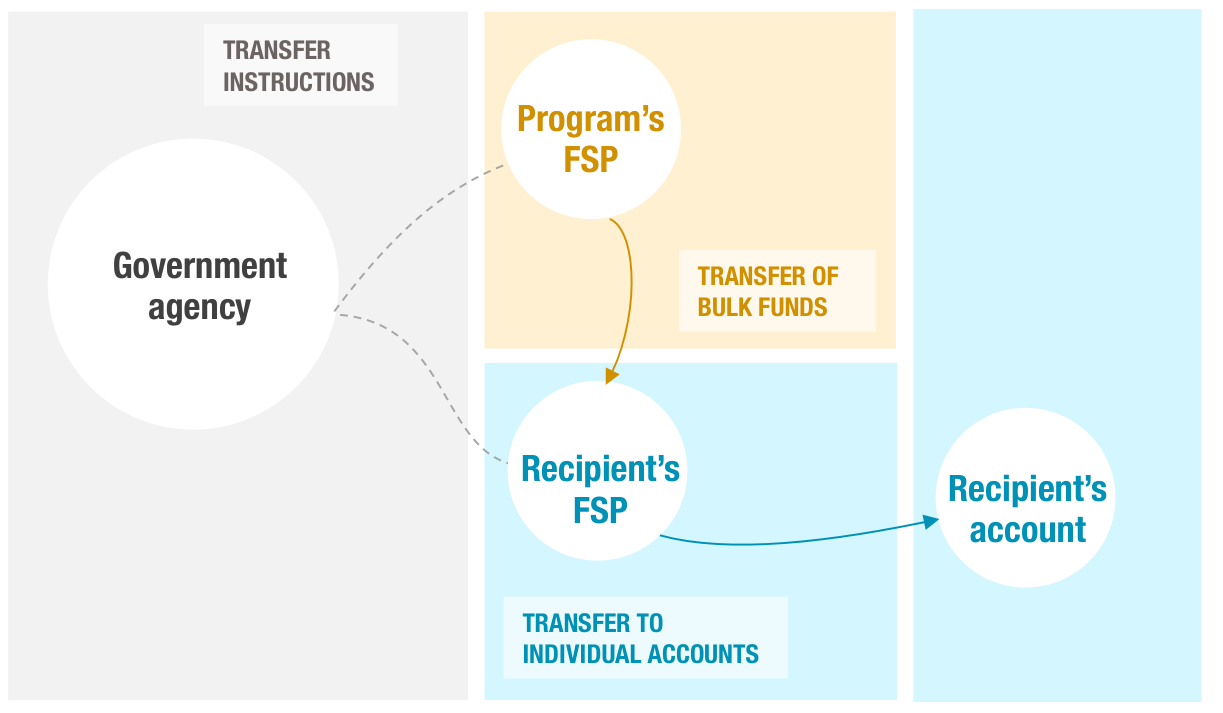
Read the diagram as text
- Read the instruction path: The government agency separately supplies transfer instructions to the programme’s provider and the recipient provider.
- Trace the bulk funds: The provider holding the programme’s account sends bulk funds in advance to the recipient’s provider.
- Trace a particular recipient credit: The recipient’s provider uses the bulk funds to credit individual accounts.
The programme sends instructions and moves funds on separate paths. This prefunded example shows how one bulk movement can support multiple individual payment obligations.
Read the original at full size here
Use touch, a trackpad, or the arrow keys in the image area.
Digitising the programme can mean paying into bank or accounts instead of handing over cash. It can also mean improving registration, identity checks, account routing, payment records and complaints. The is only one part of the service.
Before paying, the programme must establish who is entitled to what. Identifying a person does not, by itself, decide eligibility for a pension or benefit. A correct identity can belong to someone who is not entitled under that programme's rules.
After paying, the programme needs evidence of the individual outcome and a route for people who cannot access their money. A phone-only design, a distant agent or a missing identity document can exclude people even when the central works.
The World Bank's work recommends recipient-centred design and choice of convenient accounts and providers where the architecture supports it. This is a design approach, not a claim that every country uses one model or requires every recipient to own a phone.
PLAIN WORDS · 1 in this section
- therefore
- for that reason; as a result
PICTURE IT
Handing out school lunch tickets
Picture a school office that must hand out lunch tickets to every pupil who is entitled to one. Printing the tickets is the easy part. The office first needs a correct list of pupils, a way to tell one pupil from another, a place for each ticket to go, and a window where a parent can complain if a ticket is missing. If the list is wrong, the tickets go to the wrong children however well they are printed. Some pupils, who are absent or have no desk, may never get one.
THE REAL JOB Separate programme entitlement, identity, selected destination and actual individual payment outcomes.
- Establish programme entitlement and amount
- Verify identity and authorised payout destination
- Submit referenced payment instructions
- Reconcile individual outcomes
- Resolve access problems and complaints
G2P payout needsHOW THE PICTURE MAPS
| In the picture | In the payment |
|---|---|
| Printing the tickets | The bulk payment through the rail |
| The list of entitled pupils | The list of recipients |
| Telling one pupil from another | Recipient identification |
| A place for each ticket to go | A bank or mobile money account |
| The complaints window | Handling complaints |
| Pupils who never get a ticket | People excluded from a digital payout |
WHERE THIS PICTURE STOPS
- A school office serves a few hundred pupils. A government programme can serve millions.
- The picture shows what has to be in place. It gives no figures on cost or savings.
- A ticket is handed over once. A programme pays again and again.
- Identification does not itself establish entitlement or account control. A file acknowledgement is not proof each recipient was paid; repair confirmed unpaid items without replaying successful or unknown outcomes.
HOOK
The rail is easy; the list and the person are not.
REMEMBER IT THIS WAY
A sequence: the real steps, in order.
Who, which account, then pay, then listen.
| In the trick | What it stands for |
|---|---|
| Who | recipient identification of each person |
| Which account | open or confirm a bank or mobile money account |
| Then pay | send the bulk payment through the rail |
| Then listen | handle complaints and fix gaps |
TELL A FRIEND
A government payment to an individual, with programme entitlement and individual payment outcomes beyond batch submission.
OFTEN MIXED UP WITH Whose money is in the wallet. The lesson explains accounts held on a phone. This lesson covers a government paying many people, where identification and accounts decide who receives.
Sources & standards — 1 source
- Market practice
Digital Public Infrastructure and Development: A World Bank Group Approach, Volume1 ↗ — World Bank · March 2025, printed pages 49–50, G2P section and Box 7: recipient choice, identity/account matching, reconciliation, access and offline delivery example.
Primary document opened for the exact cited sections during V12 domain review. Educational examples and source-specific limits are disclosed in the lesson and audit.
PRACTISE AND KEEP
Sources for this topic — 9 sources
- Market practice
Digital public infrastructure (DPI) Use Case: Digital G2P Payments (workshop presentation) ↗ — World Bank · G2P payments are payments or cash transfers that government agencies make to individuals, covering public sector wages, social protection and sectoral subsidies; moving to digital payment can mean paying digitally instead of in cash, or using digital systems for the end-to-end process of identifying recipients, opening accounts and handling complaints; the accounts can be bank accounts or mobile money accounts (World Bank digital public infrastructure (DPI) workshop material, search excerpt, page not opened)
Search excerpt returned 2026-10-11; the workshop PDF was not opened.
- Simplified educational illustration
Payments Signal editorial teaching models — Payments Signal
What this simplifies: The office and Arjun are invented. G2P is described in outline from World Bank material.
Used wherever diagrams, scenarios, figures, or example values are didactic constructions rather than sourced facts; every such use carries a simplifications disclosure. All people, companies, banks, and list entries in examples are fictional.
- Market practice
The Opportunities and Challenges of Digitizing Government-to-Person Payments ↗ — World Bank Research Observer (Klapper and Singer, 2017) · Klapper and Singer, World Bank Research Observer 2017: the move to digital payment could cut costs and raise transparency and can serve as a first step into financial inclusion for recipients, but needs substantial up-front spending on payment infrastructure, a financial identification system and consumer protection and education (search excerpt of the catalogue record, page not opened)
Search excerpt of a library catalogue record returned 2026-10-11; the article was not opened.
- Market practice
G2Px programme overview ↗ — World Bank · G2Px is a World Bank programme with the Gates Foundation across social protection, payment systems, financial inclusion and gender; moving to digital payment payments on shared infrastructure can reduce government costs, losses and fraud (search excerpt, page not opened)
Search excerpts returned 2026-10-11 from worldbank.org; pages not opened.
- Simplified educational illustration
Payments Signal editorial teaching models — Payments Signal
What this simplifies: Benefits are stated by the sources and are not measured here.
Used wherever diagrams, scenarios, figures, or example values are didactic constructions rather than sourced facts; every such use carries a simplifications disclosure. All people, companies, banks, and list entries in examples are fictional.
- Simplified educational illustration
Payments Signal editorial teaching models — Payments Signal
What this simplifies: The four steps sum up the sources and put them in an order the sources do not give.
Used wherever diagrams, scenarios, figures, or example values are didactic constructions rather than sourced facts; every such use carries a simplifications disclosure. All people, companies, banks, and list entries in examples are fictional.
- Market practice
G2Px programme overview ↗ — World Bank · The World Bank's G2Px work flags that women face heightened exclusion risk during the move to digital payment, citing gaps in financial access, ID ownership and phone ownership (search excerpt of a World Bank blog, page not opened)
Search excerpts returned 2026-10-11 from worldbank.org; pages not opened.
- Simplified educational illustration
Payments Signal editorial teaching models — Payments Signal
What this simplifies: The reading of hidden receiving-side costs is the lesson's reasoning; the sources give no figures.
Used wherever diagrams, scenarios, figures, or example values are didactic constructions rather than sourced facts; every such use carries a simplifications disclosure. All people, companies, banks, and list entries in examples are fictional.
- Simplified educational illustration
Payments Signal editorial teaching models — Payments Signal
What this simplifies: No country, figure or file format is covered. Evidence was a single search pass of excerpts.
Used wherever diagrams, scenarios, figures, or example values are didactic constructions rather than sourced facts; every such use carries a simplifications disclosure. All people, companies, banks, and list entries in examples are fictional.
Deepest material on this page: L4 — Standards & sources. Where a topic stops short of implementation depth, that is a deliberate coverage decision, not an oversight — see coverage.