Whose money is in the wallet
A wallet balance is a receipt for money held in trust somewhere else, not a deposit the provider is using — and nearly everything else about mobile money follows from that.
L1–L4 are part of the Pro pass
L0 Explain simply
A balance on a phone can look like a bank balance. Before comparing the screens, ask who owes the customer and what protects that claim.
In this lesson's non-bank model, the customer holds electronic money: value recorded electronically, issued against funds received, accepted by other people and redeemable for money. Kenya's 2014 regulations define it as a claim on its issuer. It is not merely a receipt that makes the issuer irrelevant.
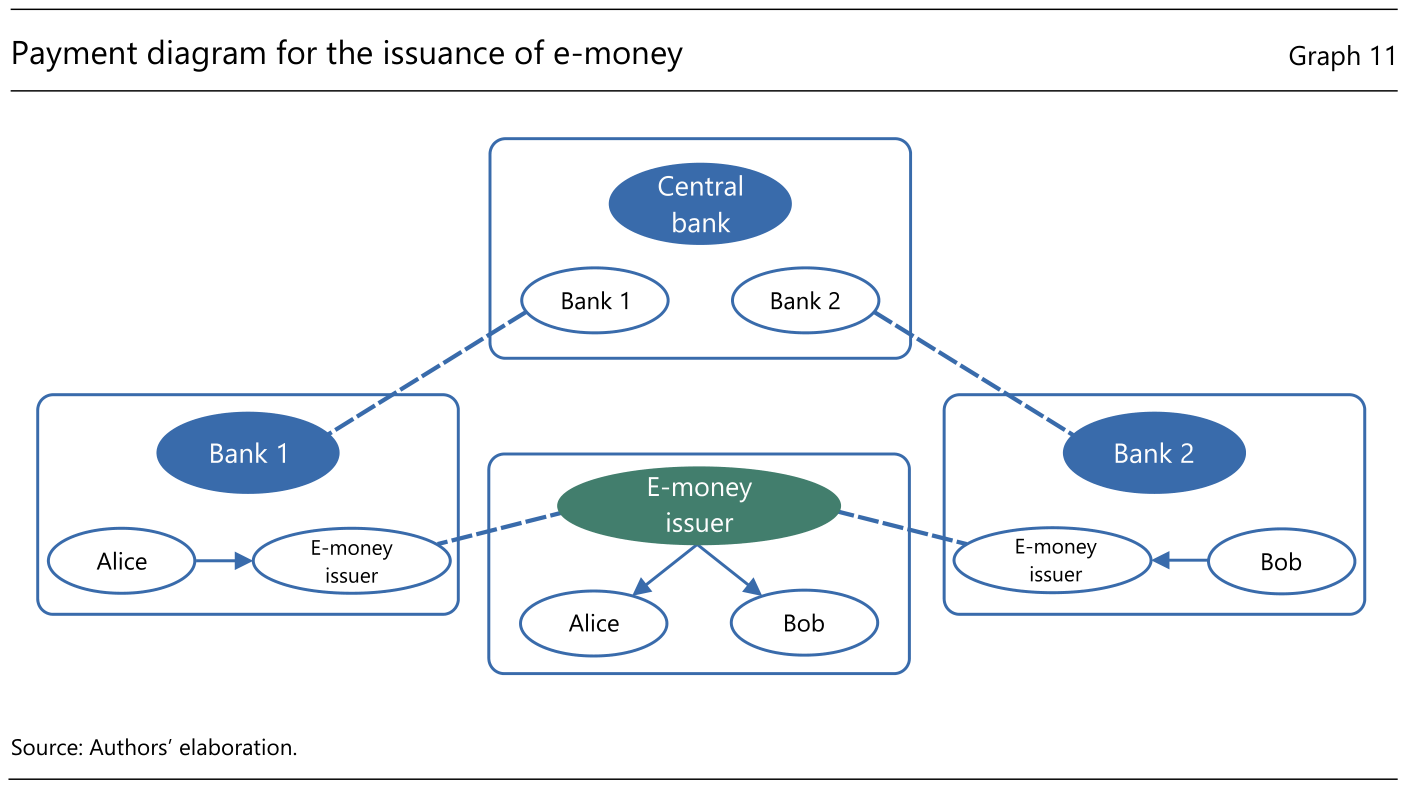
Read the diagram as text
- Find the bank balance used to fund the wallet: Alice uses funds at Bank 1. The issuer also holds an account at Bank 1.
- Find the balance the issuer creates: Follow the line from the green issuer to Alice in the lower box. The issuer owes this electronic balance to Alice.
- Compare Bob’s funding path: On the right, Bob funds his wallet from Bank 2. Both customers can end up with balances at the same issuer.
The diagram uses bank accounts to fund wallets. This is another way to add wallet value beside the cash example in the lesson.
Read the original at full size here
Use touch, a trackpad, or the arrow keys in the image area.
Suppose Marcus hands cash to an authorised agent and receives an equal wallet balance. He can use that balance to pay another customer or merchant. Later he can exchange it for cash through an agent. The provider records the balances; the agent supplies the physical cash. (SYNTHETIC / TRAINING ONLY.)
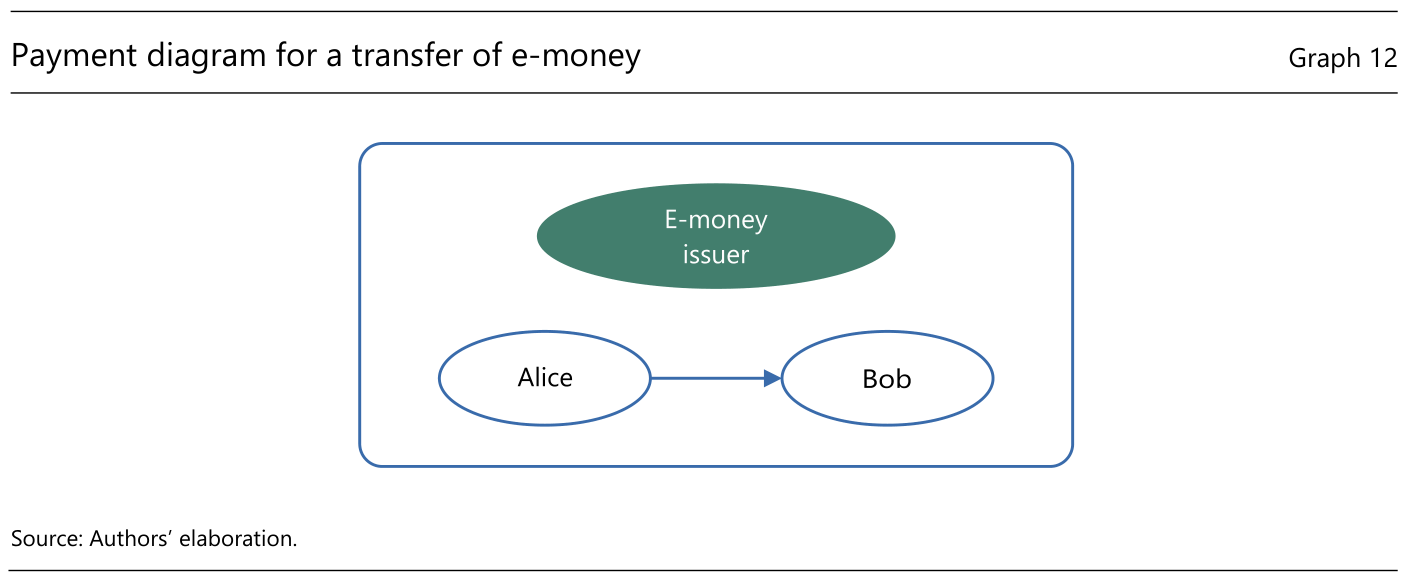
Read the diagram as text
- Locate the wallet provider: The green label marks the electronic money issuer. Both customers hold balances with this issuer.
- Follow the wallet-value transfer: The arrow runs from Alice to Bob. Under the model, the issuer reduces Alice’s balance and increases Bob’s balance.
In this simplified case, both wallets use the same issuer. The figure shows the movement of wallet value.
Read the original at full size here
Use touch, a trackpad, or the arrow keys in the image area.
The protection behind the balance is safeguarding. Customer backing must be held under the applicable , apart from the provider's own business money. In the Kenyan example, that includes a trust fund with a balance sufficient to cover what is owed to customers.
This differs from a deposit claim on a bank. It does not mean the wallet is risk-free. Records can be wrong, an agent can lack cash, a custodian can fail, or the provider can stop operating. Legal protection of the backing and immediate access to a working service are different questions.
Keep three things separate: the issuer's liability to the customer, the assets backing the outstanding value, and the cash available at the agent. A problem in one does not prove the other two have disappeared. Kenya supplies the legal example here; another country's wallet needs that country's rules.
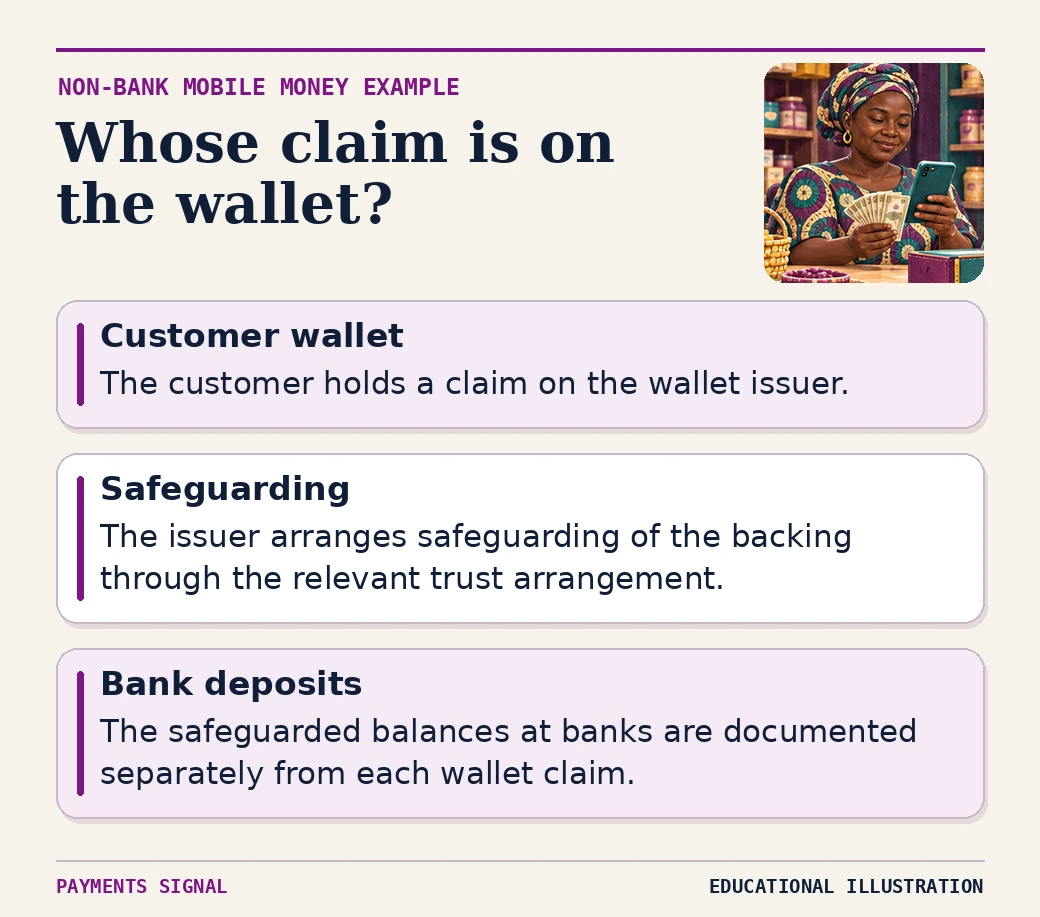
Read the diagram as text
- Customer wallet: The customer holds a claim on the wallet issuer.
- Safeguarding: The issuer arranges safeguarding of the backing through the relevant trust arrangement.
- Bank deposits: The safeguarded balances at banks are documented separately from each wallet claim.
This Kenyan non-bank example separates the wallet issuer’s liability to the customer from the account holding backing funds. The local rules determine how both are protected.
PLAIN WORDS · 4 in this section
- electronically
- by computer rather than on paper
- redeemable
- can be exchanged back for real money
- sufficient
- enough for what is needed
- custodian
- a bank or firm that holds assets for their owner
PICTURE IT
Customer money in a separately labelled strongroom
A market office issues receipts against money received. Backing assets are kept under a separately labelled customer arrangement, not in the office’s till for rent and wages. The custodian can hold them only in permitted places. A nearby stall exchanges receipts for cash but needs enough cash at its own counter. The customer still has a claim on the office; the labelled backing and a working cash counter are separate protections.
THE REAL JOB Distinguish the issuer claim, safeguarded backing and under the applicable law.
- Customer funds are received
- Issuer records electronic-money liability
- Applicable protected backing is maintained
- Customer can pay electronically
- Agent exchanges electronic value for available cash
HOW THE PICTURE MAPS
| In the picture | In the payment |
|---|---|
| Receipt | Customer’s electronic-money claim on the issuer |
| Separately labelled backing | Protected customer backing under Kenya’s trust arrangement |
| Permitted custodial placements | Licensed-bank placements or Government of Kenya securities subject to regulation 25 |
| Office’s own till | Provider business funds, separate from customer backing |
| Stall cash drawer | Agent cash needed to exchange for electronic value |
WHERE THIS PICTURE STOPS
- The strongroom is an analogy for protection and records, not a rule that backing cannot be invested. Kenya expressly permits specified placements.
- Safeguarding does not guarantee instant access or full recovery after every failure. Records, custody, liquidity and the authorised recovery process matter.
- An agent without cash does not prove that the provider has lost the backing or that an already credited wallet payout failed.
- Kenya is the legal example; other regimes require their own review.
HOOK
Claim, backing and cash drawer are different.
REMEMBER IT THIS WAY
A chunk: a long list grouped so it is easier to hold.
Name the claim, backing and cash drawer separately.
| In the trick | What it stands for |
|---|---|
| Claim | What the issuer owes customers |
| Backing | Assets held under the applicable protective arrangement |
| Cash drawer | Agent cash for a withdrawal |
The analogy cannot decide which assets, fees or recovery procedures another jurisdiction permits.
TELL A FRIEND
Electronic money used through a phone service, with an issuer claim and safeguarding under the applicable law.
OFTEN MIXED UP WITH Money, accounts, and ledgers. A bank deposit is a claim on a bank; this non-bank wallet is a claim on its issuer with a different safeguarding mechanism.
Sources & standards — 1 source
- Official requirement
The National Payment System Regulations, 2014 ↗ — Central Bank of Kenya (Kenya Gazette Supplement No. 119, Legal Notice 109 of 2014) · Kenya National Payment System Regulations 2014: regulations 2,10,25–28,44–45; primary CBK PDF opened 6 November 2026.
Actual substantive body read for the selected MEA audit. Legal Notice 109, Gazette 119, 1 August 2014. Trust placements include licensed-bank deposits and permitted government securities; historical transaction limits not recertified. Draft 2026 Bill is not enacted law. Analysis: docs/research/v34-middle-east-africa-complete-analysis-20261106.md.
CURRENT AS CHECKED
1 FIGURE
Mobile money worldwide, 2025 data, as reported in the GSMA 2026 edition
The GSMA, the industry association of mobile network operators, published its State of the Industry Report on 2026, the 14th edition, in March 2026. It reports more than 2 trillion US dollars of transactions through mobile money in 2025, double the 2021 level, and 2.3 billion registered accounts, 268 million more than a year earlier.
Press coverage of the report says more than 60% of providers believed that rules on interoperability, know-your-customer and consumer protection had supported their operations. It says rules on moving data across borders were the main hindrance. The coverage was seen as a search excerpt and the report's regulatory chapter was not seen.
CHECKED 2026-10-25RECHECK BY 2027-04-30
Sources & standards — 3 sources
- Market practice
The State of the Industry Report on Mobile Money 2026 ↗ — GSMA · 14th edition, March 2026: more than 2 trillion US dollars through wallets in 2025; supportive regulation continues to drive growth while some challenges remain (search excerpt, page not opened)
Known from WebSearch excerpts on the access date (search excerpt, page not opened). The report's regulatory chapter was not seen, so no finding is attributed to it beyond the summary above. An industry association's report is a count and a view, not a rule.
- Market practice
Mobile Money accounted for $2 trillion in transactions in 2025, doubling since 2021 as active accounts continue to grow ↗ — GSMA · Press release of 24 March 2026: 2 trillion US dollars in 2025, double 2021, and 2.3 billion registered accounts after growth of 268 million (search excerpt, page not opened)
Known from WebSearch excerpts on the access date (search excerpt, page not opened). The release is the publisher's own summary of its report; the report itself was not opened.
- Market practice
$2 trillion in mobile money transactions were clocked last year ↗ — Telecoms.com · Trade-press coverage: more than 60% of providers saw interoperability, know-your-customer and consumer protection rules as supportive; cross-border data transfer rules were the main hindrance (search excerpt, page not opened)
Known from a WebSearch excerpt on the access date (search excerpt, page not opened). The percentages come from a search summary of this coverage and were not checked against the GSMA report. They sit in the dated fact gsma-mobile-money-industry-scale and not in prose.
PRACTISE AND KEEP
Sources for this topic — 6 sources
- Official requirement
The National Payment System Regulations, 2014 ↗ — Central Bank of Kenya (Kenya Gazette Supplement No. 119, Legal Notice 109 of 2014) · The trust arrangement behind issued electronic money, and a provider's responsibility for the agents it appoints
Actual substantive body read for the selected MEA audit. Legal Notice 109, Gazette 119, 1 August 2014. Trust placements include licensed-bank deposits and permitted government securities; historical transaction limits not recertified. Draft 2026 Bill is not enacted law. Analysis: docs/research/v34-middle-east-africa-complete-analysis-20261106.md.
- Market practice
GSMA Mobile Money API — specification and developer portal ↗ — GSMA · An openly published, harmonised mobile money interface with an international-transfer component
An industry association's specification, not a regulation and not a scheme rulebook. Implementing it is a commercial choice, so its existence says what a harmonised interface looks like and says nothing about how much of any corridor runs on one.
The specification is versioned and the portal serves the current release, so a claim resting on a particular field or endpoint should name the version it was read at. Nothing on this site rests on one.
Verified from independent web-search excerpts on the access date. The publisher's own domain cannot be fetched, so no text is quoted here from the publisher's own page. A failed fetch is not evidence about what the document provides.
- Regulatory guidance
General principles for international remittance services ↗ — Committee on Payment and Settlement Systems (now CPMI) and the World Bank · Disbursement to a wallet as one end of a remittance service, and transparency about the total price
Issued 23 January 2007 by the CPSS (renamed the Committee on Payments and Market Infrastructures in 2014) jointly with the World Bank. It is a set of general principles addressed to countries, not an obligation on any institution, and it is cited on this site with that strength and no more.
Its age is load-bearing and is stated wherever it is used: a 2007 report supports the structure of a remittance service and the names of its parts. It does not support any current price, any current corridor volume, and nothing about the products offered in any market today.
Verified from independent web-search excerpts on the access date. The publisher's own domain cannot be fetched, so no text is quoted here from the publisher's own page. A failed fetch is not evidence about what the document provides.
- Simplified educational illustration
Payments Signal editorial teaching models — Payments Signal
What this simplifies: Agent economics are described in general terms rather than with any operator's commission structure, and the provider failure the reader is asked to work through is a teaching exercise rather than an account of any real insolvency. Safeguarding is illustrated from one jurisdiction's rules; the mechanism generalises, the drafting does not.
Used wherever diagrams, scenarios, figures, or example values are didactic constructions rather than sourced facts; every such use carries a simplifications disclosure. All people, companies, banks, and list entries in examples are fictional.
- Market practice
The State of the Industry Report on Mobile Money 2026 ↗ — GSMA · 2026 edition: scale of mobile money and how providers see the rules (search excerpt, page not opened)
Known from WebSearch excerpts on the access date (search excerpt, page not opened). The report's regulatory chapter was not seen, so no finding is attributed to it beyond the summary above. An industry association's report is a count and a view, not a rule.
- Market practice
The Mobile Money Regulatory Index ↗ — GSMA · How the GSMA scores countries on enabling mobile money rules (search excerpt, page not opened)
Known from WebSearch excerpts on the access date (search excerpt, page not opened). The dimensions have changed between editions, and in the 2018 edition interoperability sat under a wider infrastructure dimension. Check which edition you need. An industry association's index is a view and not a legal measure.
Deepest material on this page: L4 — Standards & sources. Where a topic stops short of implementation depth, that is a deliberate coverage decision, not an oversight — see coverage.