Documentary collections
The trade settlement where no bank promises anything. Follow the documents from exporter to importer, and watch who carries the risk when the buyer changes its mind.
L1–L4 are part of the Pro pass
L0 Explain simply
Two companies in different countries agree a sale, and a is one way to settle it. The seller wants to be paid. The buyer wants the goods. Neither of them wants to go first.
It is the cheap way out of that standoff. The seller ships the goods and hands the shipping documents to its own bank. That bank sends them on to the buyer's bank. The buyer's bank hands the documents over only when the buyer pays, or formally promises to pay on a later date.
Here is the part that matters most, and it is the part people get wrong in interviews. No bank in that chain promises to pay anything. The banks carry documents and collect money. They are agents working to instructions, not guarantors.
Set that beside a (a bank's promise to pay an exporter), where the buyer's bank gives its own promise to pay against the right documents. That promise is the entire product. Take the promise away and what is left is a documentary collection: much less protection for the seller, and a much smaller bill.
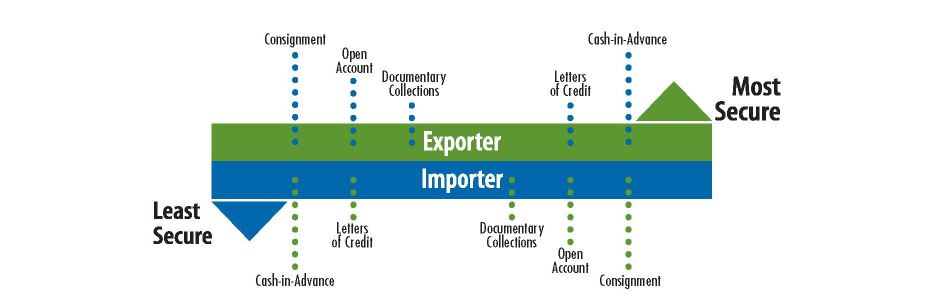
Read the diagram as text
- Find documentary collections on both rows: Collections are in the middle on both rows. The banks can tie document release to payment or acceptance under the collection instructions. The exporter’s payment protection depends on those conditions.
- Compare letters of credit: The guide places letters of credit closer to the secure end for the exporter. The exporter gains a bank payment commitment if the required terms and document conditions are met.
- Check how cash in advance changes sides: Cash in advance protects the exporter from buyer nonpayment by moving payment before shipment. It puts the importer at greater risk because the importer pays before receiving the goods.
Based on official sources
Follow the published figure step by step.
Read the original at full size here
Use touch, a trackpad, or the arrow keys in the image area.
The seller retains control of the documents until their instructed release. How far this controls the cargo depends on the transport document and carriage arrangements. A properly controlled negotiable order bill is different from a nonnegotiable waybill or direct delivery to the buyer.
(SYNTHETIC / TRAINING ONLY — every firm and bank named in this topic is fictional.)
PLAIN WORDS · 2 in this section
- guarantors
- firms or people who promise to pay if another cannot
- waybill
- a paper listing goods being carried and where to
PICTURE IT
A claim ticket for a storage locker, passed on by two agents
Picture a seller who has put goods in a storage locker in the buyer's city. A keeper looks after the locker, and the keeper opens it only for the claim ticket. The keeper is a third person, not one of the two agents, and does not read the note. The seller gives the ticket and one written note to an agent who works for the seller's own bank. The seller chooses which of two notes to write. Note one says: hand over the ticket only when the buyer pays.
Note two says: hand over the ticket when the buyer signs a slip promising to pay on a named day. That agent passes the ticket and the note to a second agent who works near the buyer. The second agent stands in front of the buyer and follows the note. Neither agent promises the seller anything. They pass on the ticket and collect what the note allows. If the buyer says no, the second agent reports it back along the same road and asks what to do next.
THE REAL JOB A lets a seller keep control of the shipping documents and set the release terms, with no bank promising to pay.
- The exporter ships and collects the documents
- The exporter gives the collection instruction to its bank
- The remitting bank sends the documents to the presenting bank
- The presenting bank shows them to the buyer
- The buyer pays under
D/P, or signs underD/A - The documents are released to the buyer
- If the buyer refuses, the presenting bank reports it with
MT416, the advice of non-payment or non-acceptance - The presenting bank asks for instructions with
MT422, the advice of fate and request for instructions
HOW THE PICTURE MAPS
| In the picture | In the payment |
|---|---|
| The seller who put goods in the locker | The exporter, who ships the goods and hands the collection to a bank (the principal)Who: Example Supplies Ltd |
| The buyer who wants to open the locker | The importer, who is asked to pay or to accept (the drawee)Who: Asha Traders |
| The claim ticket, which the keeper accepts | The shipping documents, which the carrier releases the goods against |
| The note that goes with the ticket | The collection instruction, which says how the documents may be released |
| The two agents, one near each side | Remitting bank (seller's side) and presenting bank (buyer's side): agents, no promise to pay |
| Note one: hand over the ticket only against payment | Documents against payment, D/P |
| Note two: hand over the ticket for a signed slip promising to pay later | Documents against acceptance, D/A: a signed bill of exchange, an order to pay later |
WHERE THIS PICTURE STOPS
- The picture shows an agent who simply obeys a note. Real banks work to the collection instruction, and the Uniform Rules for Collections,
URC 522, apply because that instruction says they apply. The rules are not law, and the picture cannot show them. - A signed slip looks like a simple promise between two people. A bill of exchange is a written order to pay a stated sum on a stated day, and the buyer accepts it by signing it. No bank stands behind it.
- In the picture the ticket holds the goods. In a collection the hold is real but lasts only while the documents stay controlled. Under
D/Pthat is until the buyer pays, and underD/Auntil the buyer accepts the bill. It is a hold over the goods, not a guarantee of payment. - The hold also depends on the transport document. A bill of lading is a title document, so whoever holds it can claim the cargo. A sea waybill or an air waybill is not, and the carrier may release the goods to the named receiver without the seller's papers.
- The picture has two release notes. Real collections can carry other terms, such as part payments or documents released against another stated condition. The pair in the picture is where the risk turns.
- Document control depends on the transport and carriage arrangement. No payment guarantee does not mean no good-faith, reasonable-care, list-check or reporting duties.
HOOK
Banks carry papers; the seller's release term sets the risk.
REMEMBER IT THIS WAY
A contrast: two neighbours told apart by one test.
The test is whether the buyer gets the goods before paying. Under D/P the papers wait for the money; under D/A they go out on a signature, so under D/A the answer is yes.
| In the trick | What it stands for |
|---|---|
| Does the buyer get the goods before paying? | the one question that decides who carries the risk |
D/P: the papers wait for the money | documents against payment: the buyer's bank hands over the documents only when the buyer pays |
D/A: the papers go on a signature | documents against acceptance: the buyer gets the documents for a signed bill of exchange |
Real collections can carry other release terms, such as part payments, and the question then needs the instruction read in full.
TELL A FRIEND
Uniform Rules for Collections, URC 522, applying through the subject to applicable law.
OFTEN MIXED UP WITH Trade finance payments. A is the buyer's bank giving its own promise to pay against the right documents, and that promise is the product. A has no such promise. The banks carry documents and collect money, so the seller has less protection if the buyer does not pay.
Sources & standards — 1 source
- Scheme-specific rule
ICC Uniform Rules for Collections (URC 522) ↗ — International Chamber of Commerce (ICC) · Opened ICC URC 522,1995 revision: arts 1,4,6–12,24,26; incorporated instructions, good faith/reasonable care, list check, presentation, protest and advice.
Primary ICC text opened6November 2026, including articles1–13,16–26. Earlier blanket unavailable/paywall wording is superseded. Incorporation and mandatory law matter; no bank payment guarantee follows merely from handling a collection.
CURRENT AS CHECKED
1 FIGURE
Swift CBPR+ FI-to-FI payment instructions
Swift coexistence for in-scope -to-FI payment instructions ended on 22 November 2025; that deadline did not retire every MT reporting, initiation, investigation or correspondence message.
CHECKED 2026-10-11RECHECK BY 2027-01-05
Sources & standards — 2 sources
- Official requirement
ISO 20022 Standards (Swift ISO 20022 adoption programme) ↗ — Swift · End of coexistence — 22 November 2025
Do not generalise the payment-instruction deadline to every FIN message. Swift publishes differentiated NAK, contingency-conversion, reporting, initiation and exceptions-and-investigations treatment.
- Official requirementJune 2026 edition read in full; September 2026 edition seen as search excerpts only
CBPR+ roadmap beyond November 2025 ↗ — Swift · Message-specific roadmap beyond November 2025
Roadmap dates and message treatment are service-specific and can change. Recheck the current document before using a milestone in delivery planning.
The June 2026 download (swift.com/swift-resource/252463/download) is the same programme this document-centre page points at. It lists, under exceptions and investigations, MT199 / MT299 / MT999 as retired for E&I in favour of camt.110 and camt.111, and it separately sends non-E&I MT199/MT299 use cases to admi.024 by November 2027. That pairing is what the MT999 record's ISO counterpart note now cites. The document-centre URL stays the registered address because it is the publisher's standing location for the current file.
Re-checked on 2026-10-04 by web search. The roadmap now has a September 2026 edition at swift.com/swift-resource/252463/download, and only search excerpts of it were seen; the page was not opened.
The excerpts said the exceptions and investigations changes were deferred, and that the mandate to receive a camt.110 would come with the deferred part of Standards Release 2026. They also said the roadmap's dates might be out of date until the scope and timeline of that release, and of Standards Release 2027, are confirmed. Other lines of the same roadmap still gave November 2026 for receiving a camt.110, so the excerpts disagree with each other. The fact swift-exceptions-investigations-migration-milestones records both readings.
SEE THE PAYMENT MOVE
PICTURE THE JOURNEY
A used van sold abroad, with its ownership book held backOpen to read the picture, how it matches the payment and where it stops.
PICTURE IT
A used van sold abroad, with its ownership book held back
A seller in one country sells a used van to a buyer in another. The seller sends the van off with a transport company before being paid. Nobody has promised that the buyer will pay.
At the far end, the transport company's yard gives the van only to a person who shows its ownership book. The seller does not post the book to the buyer. The seller keeps it back and takes it to a savings office the seller already uses, with a sheet of written wishes. The sheet says when the book may be handed over, who pays the fees, and what to do if the buyer says no.
The savings office sends the book and the sheet to a partner office near the buyer. It uses a post service that holds each packet until the far office collects it. The two offices only handle papers on the sheet's orders. They never see the sale contract, and they have not promised that the buyer will pay.
The far office tells the buyer that the book is waiting, and on what terms. The buyer can take it up or say no, and the office cannot make the buyer choose. On one kind of sheet, the book goes out only when cash is paid. The buyer then drives the van away. On the other kind, the book goes out for a signed pay-later slip, and no cash moves yet.
When the buyer pays, the far office writes to the seller's office that the sum is collected. The two offices settle through accounts they already keep with each other. The seller's office then adds the sum to the seller's account.
Two things can go differently. If the buyer says no at the counter, the book stays in the far office's drawer and the seller still controls the van. The far office writes back that the buyer refused, and asks what to do with the book. The seller can find another buyer there, bring the van home, or lower the price. Yard fees keep growing meanwhile.
If the buyer signed a pay-later slip, took the book and drove the van away, the seller has nothing left to hold. When the day on the slip passes with no cash, the far office writes that the slip was not paid. The seller now has a signed slip against someone in another country, and no van.
THE REAL JOB A moves shipping documents from a seller to a buyer through two banks that follow the seller's instruction and promise no payment.
HOW THE PICTURE MAPS
| In the picture | In the payment |
|---|---|
| The seller, who sends the van off before being paid | The exporter, who ships first and takes back the document setWho: Example Supplies Ltd |
| The ownership book the yard needs before it releases the van | The shipping documents; a document of title is what the carrier releases cargo against |
| The sheet of written wishes that travels with the book | The collection instruction: release terms, charges, and what to do if refused |
| The seller's own savings office | Meridian Bank, the remitting bank, which sends the documents on |
| A post service that holds each packet until the far office collects it | Swift FIN, a store-and-forward network that carries the messages |
| The partner office near the buyer | Bank Alfa, the presenting bank, which shows the documents to the buyerWho: Bank Alfa |
| The buyer, who may take up the book or say no | The importer, the drawee, who pays, accepts or declinesWho: Asha Traders |
| One kind of sheet: the book goes out only when cash is paid | Documents against payment: money moves before any document is released |
| The other kind: the book goes out for a signed pay-later slip | Documents against acceptance: the buyer signs a bill of exchange and gets the documents |
| The far office writes that the sum is collected | MT400, the advice of payment, which closes the collection |
| The offices settle through accounts they already keep with each other | Settlement over correspondent accounts, the payments half of the collection |
| The seller's office adds the sum to the seller's account | Meridian Bank credits the exporter's account, and the collection is closed |
| The buyer says no at the counter, and the book stays in the drawer | Refusal at presentation: no payment, and the documents are not released |
| The far office writes back that the buyer refused | MT416, the advice of non-payment, with any reason the drawee gave |
| The far office asks what to do with the book | MT422, which asks the remitting bank what to do with the documents |
| The seller still controls the van: re-sell it, bring it home or cut the price | The exporter still controls the goods, because the documents were never released |
| The buyer signs the slip, takes the book and drives the van away | Acceptance, then release: the buyer collects the cargo and can sell it |
| The day on the slip passes with no cash | The due date arrives and the bill is not paid |
| The far office writes that the slip was not paid | A second advice of non-payment, MT416, now sent at maturity |
| The seller holds a signed slip against someone abroad, and no van | The exporter is an unsecured creditor, with only a claim against the buyer |
WHERE THIS PICTURE STOPS
- The picture has one sheet of wishes and no rulebook. The rules behind this route are the International Chamber of Commerce (ICC) Uniform Rules for Collections, which define the party roles and the instruction. This site has not read their text, so their time limits and article numbers are not drawn.
- The ownership book looks like a lock that always works. In the flow, the goods are tied up only where the document set includes a document of title. Even then, the hold is a lever, not a promise that the buyer will pay.
- The two offices look like helpful neighbours who would chase the buyer. Real banks are agents with no power to make the buyer choose. No bank in this chain undertakes that the buyer will pay.
- The picture settles with accounts the offices already share. In the flow, the cash crosses correspondent accounts, like any other payment between banks in different countries. So a collection has a trade half and a payments half. The route may use more banks than the flow draws.
- A pay-later slip looks like a note between two people. In the flow it is a bill of exchange, a written promise to pay on a stated future date. Banks may also lend against an accepted bill, which the picture leaves out.
- The picture has one van and one sale. Real collections add disputes over charges, part payments and a representative at the destination, and the flow leaves them out.
HOOK
Release the papers and the seller's hold on the goods ends.
REMEMBER IT THIS WAY
A chunk: a long list grouped so it is easier to hold.
Split a collection into two chunks: a trade half that moves the documents, and a payments half that moves the cash.
| In the trick | What it stands for |
|---|---|
| trade half | The shipping documents; a document of title is what the carrier releases cargo against |
| payments half | Settlement over correspondent accounts, the payments half of the collection |
TELL A FRIEND
A seller ships first and hands the papers to its bank, which passes them to the buyer's bank. The buyer's bank releases them on the seller's terms, but no bank promises that the buyer will pay.
OFTEN MIXED UP WITH Trade finance payments. A has the buyer's bank give its own promise to pay against the right documents. This journey has no such promise, because the banks are agents that carry documents and collect money.
WHAT THIS PAGE CANNOT SHOW YOU
1 RAIL
These rails are explained here in words, and their message layout is not shown, because it is not something this site can honestly print. Each was looked for on the date given. Some specifications are issued only to a scheme’s own members; some are published openly and we could not retrieve a copy; and one or two we have not yet searched far enough to settle. Read what you have read above as an account of how each rail works, never as a specification you can build against.
The collection instruction itself — the document that governs the collectionPUBLISHED TO MEMBERS ONLY
The article text of the ICC Uniform Rules for Collections (URC 522) — the wording that says what a collection instruction must contain, what a bank handling documents is answerable for, and the time limits that run once documents are presented
LOOKED FOR 2026-10-12
PRACTISE AND KEEP
IMPLEMENTATION RESOURCES
6 RESOURCES
EVIDENCE AT ARM'S REACH
Apply the base message definition first, then the scheme or infrastructure profile that governs this topic.
An XSD checks XML structure. A usage guideline adds profile rules, conditional fields, code restrictions, and business controls. XSD-valid does not mean scheme-compliant.
Sources for this topic — 8 sources
- Scheme-specific rule
ICC Uniform Rules for Collections (URC 522) ↗ — International Chamber of Commerce (ICC) · URC 522,1995 revision; ICC Digital Library text opened for incorporated instructions, accepted duties, presentation and advices.
Primary ICC text opened6November 2026, including articles1–13,16–26. Earlier blanket unavailable/paywall wording is superseded. Incorporation and mandatory law matter; no bank payment guarantee follows merely from handling a collection.
- Market practice2022 edition
Trade Finance Guide: A Quick Reference for U.S. Exporters ↗ — International Trade Administration, U.S. Department of Commerce · Documentary Collections — the bank's role, and documents against payment versus documents against acceptance
A correction to the access note. The previous note said the guide was not opened because trade.gov could not be fetched. It answers now: the landing page fetched at HTTP 200, 250,850 bytes, and the 2022 PDF edition at HTTP 200, 1,181,462 bytes. Chapter 5 was read in full and it carries what this entry attributes to it, in its own words. Also that although the banks control the flow of documents they neither verify the documents nor take any risks, and that their role is limited and they do not guarantee payment.
Cited because the ICC rules are paid and this is not: a free, attributable publication stating the existence, the direction and the consequence without reproducing a word of URC 522. Topics and records citing it may now drop the disclosure that it was corroborated rather than opened.
The sourceType was "government-guidance", which is not a member of SourceType. sourcesByType groups through a nine-type order, so this record fell out of /sources silently and the drawer rendered an empty document-kind chip beside its citations.
Re-typed to industry-paper rather than to regulatory-guidance, on what the document turns out to be. The International Trade Administration is a trade-promotion agency, not a regulator; the guide describes itself as explaining the basics of trade finance so that exporters can evaluate financing options, and it regulates nothing and interprets no obligation. Filing it as regulatory guidance would misdescribe it to the reader who is deciding what may be cited as a requirement.
The type industry-paper is where this registry already files explanatory publications by official bodies, including the BIS and CPMI papers and a Federal Reserve Bank research paper on payment-instrument transfer, and it sits outside BINDING_SOURCE_TYPES, which is correct here. Twelve of the thirteen citations in the tree already claim the market-practice label.
- Market practice
prowide/prowide-core — a reader, writer and validator for SWIFT MT messages ↗ — Prowide (open source, Apache 2.0) · MT400, MT416 and MT422 at SRU 2025 for each message's identity and field list
An implementation, not the standard. Swift's own standards releases are the authority and where the handbook and a library disagree, the handbook wins — the same relationship this registry already records for the Nacha, Fedwire and Australian batch-file implementations.
What it does not carry, and what is therefore not published from it: code values — what may legitimately appear in a form-of-credit, confirmation-instruction, partial-shipment or purpose field — and the network-validated rules that bind one field to another. Those live in the handbook, and their absence is the boundary that the login still enforces.
Cross-checked rather than taken alone: an independent bank-published standards-release guide states the same field count and the same count of mandatory fields for the issue-of-a-documentary-credit message, and names the same two fields as that release's additions.
Read again on 2026-10-17 by direct fetch of the raw source files: the header block classes, the trailer field list, the character set helper, the generated field classes 103 to 121 and the generated message classes. Block 1 gives application identifiers F, A and L, service identifiers 01 and 21, a four-character session number and a six-character sequence number. Input block 2 gives priority S, U or N, delivery monitoring 1, 2 or 3, and time limit 003 for urgent and 020 for normal.
Field 103 is named the FINCopy service code. The X, Y and Z lists are the implementation's reading of the User Handbook. These are comments in an implementation, not Swift's handbook. The library notes that, per Swift documentation, the time limit a sender types is ignored by the system. Where the handbook and the library differ, the handbook wins.
On 2026-10-25 the field classes Field22D, Field23S and Field44J were opened and read at raw.githubusercontent.com. So were the message classes MT300 (the foreign exchange confirmation), MT707 (the documentary credit amendment) and MT760 (the guarantee message). They gave these validation patterns: 22D 4!c, 23S 6!a, and for 44J a country code with optional subdivision of 35 and narrative of 65. They also gave the sequence structure of the MT300 (A to F with B1, B2, D1, E1, E1a, E1a1) and of the MT760 (A, B, C). They carry no code lists.
- Scheme-specific rule
Swift Standards MT (annual standards releases) ↗ — Swift · Category 4 — Collections and Cash Letters
Full field-level specifications live in the Swift Knowledge Centre User Handbook behind a swift.com login. Coexistence for in-scope FI-to-FI payment instructions ended on 22 November 2025, but treatment differs by MT: some instructions are NAKed and selected messages can enter temporary, chargeable contingency conversion. Reporting, initiation, investigations and correspondence follow separate roadmaps.
Re-checked on 2026-10-04 by web search for the schedule of Standards Release 2026. Only search excerpts of the Standards Releases page were seen; the page was not opened. They said the deferred part of the release, which holds MT messages outside category 1, ISO 20022 securities and funds messages, tracker messages and exceptions and investigations messages, now has a date of 12 June 2027. They said the first target was the first quarter of 2027, and that the later date follows industry feedback about other change work, including the European move to T+1 settlement. An audit note in docs/research dated 29 September 2026 recorded the same date from the same page.
Re-checked 12 November 2026 via Swift Standards Releases schedule: SR2025 remains the in-force annual MT release pending the deferred SR2026 package.
- Simplified educational illustration
Payments Signal editorial teaching models — Payments Signal
What this simplifies: The collection is drawn with fictional parties and a single shipment. Charges, part payments, protest, case-of-need instructions, financing against an accepted bill, and the full set of Category 4 messages are omitted. No article of the ICC rules is quoted or put in other words, and the rules were not read; the mechanism is described from open secondary accounts, disclosed in L4.
Used wherever diagrams, scenarios, figures, or example values are didactic constructions rather than sourced facts; every such use carries a simplifications disclosure. All people, companies, banks, and list entries in examples are fictional.
- Scheme-specific ruleIncoterms 2020
Incoterms 2020 rules ↗ — International Chamber of Commerce (ICC) · Named so the reader can tell the sale terms from the collection instruction — identity and scope only; search excerpt, page not opened
Seen as search excerpts of the International Chamber of Commerce's own pages on the access date. The page was not opened, because iccwbo.org could not be fetched.
The excerpts agree that the rules came into force on 1 January 2020 and that there are eleven terms. An earlier check of this page is recorded in the sourcing negative icc-trade-finance-rule-texts. It found that the complete text is sold and that a checklist and flow charts are free.
What the rules leave out comes from other sources. See munichre-incoterms-2020.
- Scheme-specific rule
Uniform Rules for Collections, URC 522 including eURC version 1.1: contents ↗ — International Chamber of Commerce · Contents list: headings of Articles 1 to 7 and 21; search excerpt, page not opened
Known from web-search excerpts on the access date, page not opened. The publisher's own domain cannot be fetched from the authoring environment, so nothing is quoted from the page itself.
The rules text is sold by the Chamber and was not read.
- Market practice
Uniform Rules for Collections: key concepts ↗ — Trade Finance Training · Headings of Articles 24 to 26 and the point about protest guidance; search excerpt, page not opened
Known from web-search excerpts on the access date, page not opened. The publisher's own domain cannot be fetched from the authoring environment, so nothing is quoted from the page itself.
Deepest material on this page: L4 — Standards & sources. Where a topic stops short of implementation depth, that is a deliberate coverage decision, not an oversight — see coverage.