The fee is not the price
Most of what a remittance costs is hidden in the exchange rate. This is how the cost is measured, corridor by corridor, and what the measurement cannot tell you.
L1–L4 are part of the Pro pass
L0 Explain simply
The fee on a remittance advert is only one part of its price. The exchange rate can change what the receiver gets just as much.
A provider states a transaction fee and offers a rate for converting the sender's currency. The exchange-rate margin compares that offered rate with a reference rate for the same comparison period. It is a pricing benchmark, not a measurement of what the provider privately paid for its currency.
Suppose two offers charge the same fee. One gives more of the receiving currency for each unit sent. It can deliver more money even though the fee column looks identical. A “zero fee” offer can likewise be more expensive when its rate is worse. (SYNTHETIC / TRAINING ONLY.)
The World Bank's Remittance Prices Worldwide survey combines the transfer fee and the (foreign exchange) margin as percentages of a specified transfer amount. Its measure makes that comparison visible.
Ask practical questions alongside the percentage. How much does the sender pay in total? How much is converted? What amount is quoted for the receiver, through which payout method and by when? Are any receiving-country fees, taxes or later cash-out charges outside the quote?
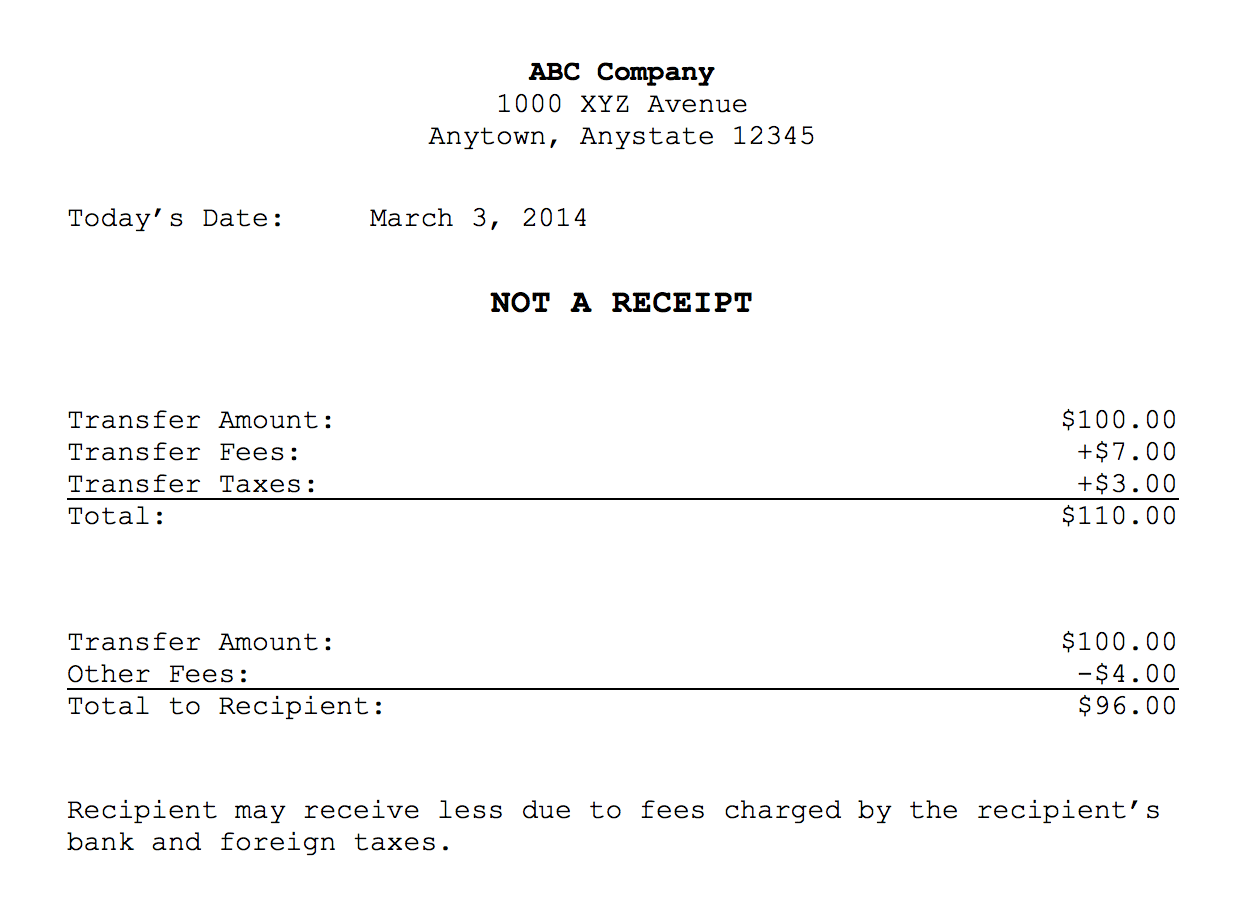
Read the diagram as text
- Identify the quote: The model is labelled “NOT A RECEIPT.” Its transfer details appear before payment.
- Find the sender’s total: The model adds a $7 transfer fee and $3 in transfer taxes to the $100 principal. The sender’s total is $110.
- Find the amount to the recipient: The example separately deducts $4 in other fees from the $100 transfer amount, leaving $96 as the disclosed total to the recipient.
- Read the receiving-side warning: The model warns that fees charged by the recipient’s bank and foreign taxes can reduce the amount actually received.
This US model disclosure shows three different amounts in one currency. Even without currency conversion, charges can make the amount paid and the amount received differ.
Read the original at full size here
Use touch, a trackpad, or the arrow keys in the image area.
The survey methodology warns that some recipient-country fees and taxes are not captured. A missing FX quote can also understate the recorded total. Calling a statistic total cost is not proof that it captures every cost one family will face.
Compare like with like: amount, date, funding instrument, payout method and speed. The percentage is useful because it reveals a rate margin that a fee-only comparison misses. It does not decide whether a particular provider treated a customer fairly.
PLAIN WORDS · 2 in this section
- payout
- money paid out to the person receiving it
- understate
- describe as smaller than it is
PICTURE IT
A delivery charge and a sign price at a shop
A shop offers rice delivery with a delivery fee and a rice price. Compare its rice price with a public comparison price, rather than guess what it paid its supplier. For a larger order, the same flat delivery fee is a smaller share. One shop’s dated offer and an average across shops are different evidence.
THE REAL JOB The is the fee the counter states plus the rate gap, which is not printed as a charge.
- Specify transfer principal and fee convention
- Compare quoted and reference rates
- Combine fee and FX percentages consistently
- Check receiver charges and actual payout
- Distinguish a provider observation from a market aggregate
HOW THE PICTURE MAPS
| In the picture | In the payment |
|---|---|
| A customer paying at the shop | A sender paying at the remittance counterWho: Ananya |
| The delivery charge on the receipt | The transaction fee the counter states |
| The price per kilo on the shop's sign | The exchange rate the counter quotes to the sender |
| The price the shop pays its supplier | The reference rate for the same day, used as the yardstick |
| The extra on each kilo above the supplier's price | The rate gap (the industry word is margin), charged on the amount converted |
| The delivery charge plus the extra on each kilo | The total cost of sending, as a share of the amount sent |
| The family member who collects the rice | The receiver, who gets money in the other currencyWho: Marcus |
| Someone who writes down the sign price in each shop | The survey, which reads provider/product quotes for specified amount baskets and dates |
WHERE THIS PICTURE STOPS
- The rice analogy reverses rate direction: more receiving currency per dollar is better for the sender.
- The public reference rate is not a provider’s private wholesale acquisition price.
- Specify principal versus total budget. The lesson now uses USD
200principal plusUSD4fee, offered82versus reference84: about4.38% quoted total cost. - RPW observes provider/product quotes for two historical local baskets and also publishes aggregates; collection includes mystery shopping and API/web data.
- Some receiving fees/taxes and unobserved FX margins can be missing. A quoted benchmark is not proof of every final customer cost.
HOOK
A fee is part of the price, not all of it.
REMEMBER IT THIS WAY
A rule of thumb: if you see this, think that.
Add two costs to find the price: the printed fee, plus the gap between the rate you were given and the reference rate. Show both as a share of the amount sent.
| In the trick | What it stands for |
|---|---|
| printed fee | the fee the counter states |
| rate gap | the gap in the exchange rate that is not printed as a charge |
It misleads if the comparison rate is not the reference rate, so say which rate you compared with.
TELL A FRIEND
A benchmark remittance price combining the transfer fee and reference-rate margin as percentages of principal.
OFTEN MIXED UP WITH Charges and foreign exchange. Both teach an exchange-rate margin. In charges and foreign exchange, each bank in the chain can take a charge as the payment passes. Whichever bank converts applies its own rate. In a remittance price, the counter fixes the fee and the rate together, at the start.
Sources & standards — 2 sources
- Market practice
Remittance Prices Worldwide ↗ — World Bank · Opened methodology, 6 November 2026: provider/product quotes, two amount baskets, collection methods, reference FX rate and coverage limitations.
Full methodology page opened6November 2026. Collection includes mystery shopping and automated API/web data. A dated quote or corridor aggregate is not evidence of every actual customer charge. No current price statistic introduced.
- Simplified educational illustration
Payments Signal editorial teaching models — Payments Signal · Synthetic teaching example; no real provider, price or programme outcome is asserted.
What this simplifies: Synthetic teaching example with fictional parties, amounts and statuses; no real provider outcome or universal operating rule is asserted.
Used wherever diagrams, scenarios, figures, or example values are didactic constructions rather than sourced facts; every such use carries a simplifications disclosure. All people, companies, banks, and list entries in examples are fictional.
CURRENT AS CHECKED
1 FIGURE
World Bank Remittance Prices Worldwide — global average cost of sending USD 200
The World Bank's Remittance Prices Worldwide survey put the global average cost of sending USD 200 at 6.36% in the third quarter of 2025, against a and Sustainable Development Goal target of 3% by 2030. The reading is re-taken every quarter and has been running above 6% — roughly double the target — for as long as the roadmap has been running. The figure is a simple survey measurement, not a price any single provider charges.
CHECKED 2026-08-13RECHECK BY 2027-02-13
Sources & standards — 1 source
- Market practice
Remittance Prices Worldwide ↗ — World Bank · Global average total cost of sending USD 200 as a percentage of the amount sent, quarterly series
Full methodology page opened6November 2026. Collection includes mystery shopping and automated API/web data. A dated quote or corridor aggregate is not evidence of every actual customer charge. No current price statistic introduced.
PRACTISE AND KEEP
Sources for this topic — 2 sources
- Market practice
Remittance Prices Worldwide ↗ — World Bank · How remittance cost is measured: the USD 200 basket, the corridor-and-quarter unit, mystery-shopped advertised prices, and total cost as a percentage of the amount sent
Full methodology page opened6November 2026. Collection includes mystery shopping and automated API/web data. A dated quote or corridor aggregate is not evidence of every actual customer charge. No current price statistic introduced.
- Regulatory guidance
General principles for international remittance services ↗ — Committee on Payment and Settlement Systems (now CPMI) and the World Bank · General principle 1 — transparency and consumer protection — and the vocabulary of a remittance service
What this simplifies: Issued in January 2007. It is cited here for what a remittance service is called and for the disclosure principle, and for no current price, volume or product.
Issued 23 January 2007 by the CPSS (renamed the Committee on Payments and Market Infrastructures in 2014) jointly with the World Bank. It is a set of general principles addressed to countries, not an obligation on any institution, and it is cited on this site with that strength and no more.
Its age is load-bearing and is stated wherever it is used: a 2007 report supports the structure of a remittance service and the names of its parts. It does not support any current price, any current corridor volume, and nothing about the products offered in any market today.
Verified from independent web-search excerpts on the access date. The publisher's own domain cannot be fetched, so no text is quoted here from the publisher's own page. A failed fetch is not evidence about what the document provides.
Deepest material on this page: L4 — Standards & sources. Where a topic stops short of implementation depth, that is a deliberate coverage decision, not an oversight — see coverage.