Trade finance payments
When a buyer and seller who have never met trade across borders, banks and documents stand in for trust. Follow how a letter of credit's payment leg settles.
L1–L4 are part of the Pro pass
L0 Explain simply
Cross-border trade has an old problem, and it is a problem of who goes first. The seller does not want to ship before being sure of payment. The buyer does not want to pay before being sure of the goods.
Banks solve it by inserting a promise that neither trading party could give the other.
In a , the buyer's bank undertakes to pay the seller against a presentation of documents that complies with the credit. The bank examines those documents; it does not establish that the goods actually meet the sale contract.
Follow what that does to both sides. The exporter, Example Supplies Ltd, ships knowing a bank stands behind the payment rather than only the importer, Demo Trading Ltd. The importer knows the bank will pay only against the right documents. (SYNTHETIC / TRAINING ONLY — every firm named here is fictional.)
The exporter gains a bank undertaking in place of relying only on the buyer's willingness to pay. It still needs a usable credit, a complying presentation and an issuer able to honour. The importer still bears risks that document examination does not remove, including false documents or disappointing goods.
A lighter alternative exists. In a , banks pass the shipping documents along and collect payment, but they do not themselves promise to pay. Less protection for the exporter, lower cost for everyone.
The through-line for a payments reader is that three things are moving on three separate tracks: the goods, the documents, and the money. The bank's promise is what links them, and the rest of this topic follows each track in turn.
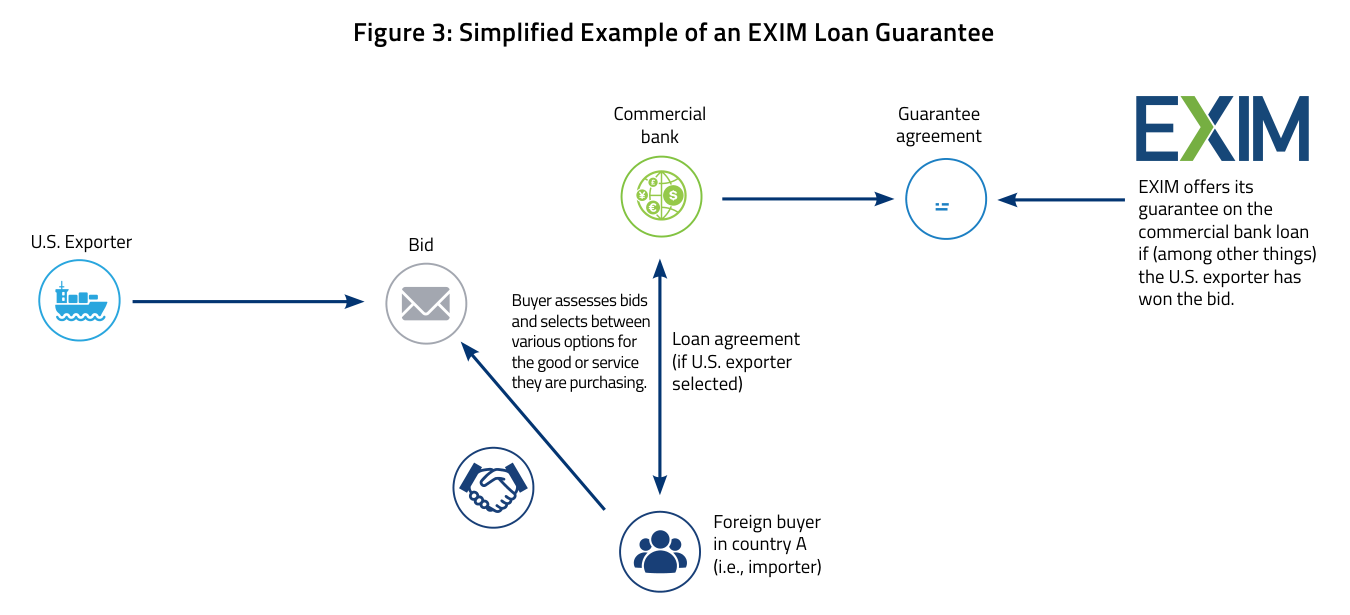
Read the diagram as text
- Find the bid: The exporter bids to provide goods or services. The foreign buyer reviews the bid.
- Find the lender and borrower: If the exporter wins under the example, the commercial bank’s loan agreement is with the foreign buyer.
- Find the guarantee: EXIM’s guarantee runs to the commercial bank. Follow that line separately from the loan to the foreign buyer.
Based on official sources
A buyer may also need financing for a purchase. This EXIM example follows the financing arrangement alongside the sale. The commercial bank lends to the buyer and EXIM guarantees that bank’s loan.
Read the original at full size here
Use touch, a trackpad, or the arrow keys in the image area.
PLAIN WORDS · 1 in this section
- complies
- follows the rules
PICTURE IT
A trusted money-keeper who pays against a signed sheet
Picture a school that hires a theatre troupe from another town to play at its festival. The troupe does not want to travel and perform and then hope to be paid. The school does not want to pay before the show. So a trusted money-keeper writes a promise. It will pay the troupe once the troupe brings a sheet that matches the written booking form.
A helper in the troupe's town checks that the promise is real and passes it on to the troupe. The money-keeper decides only on the papers. It reads the sheet against the booking form and never watches the show. If every line matches, it pays. The promise is the money-keeper's own. Afterwards the school repays the money-keeper.
If a line does not match, the money-keeper is not yet bound to pay. It can ask the school whether to accept the difference anyway, or the troupe can bring a corrected sheet.
THE REAL JOB A lets strangers trade, because a bank promises to pay the exporter against matching documents.
- The importer asks its bank to issue a credit
- The issuing bank sends the credit with an
MT700 - The advising bank passes it to the exporter
- The exporter ships and presents documents
- A bank examines the documents against the credit
- The bank acts on a complying presentation and advises using the applicable message
- The payment leg settles between the banks
- The exporter's bank credits the exporter
HOW THE PICTURE MAPS
| In the picture | In the payment |
|---|---|
| The school that asks the money-keeper for the promise | The importer who asks its bank to issue the credit |
| The money-keeper who writes the promise to pay | The issuing bank, taking on the risk that the importer cannot pay |
| The troupe in another town | The exporter who ships the goods |
| A helper in the troupe's town who checks and passes on the promise | The advising bank |
| The written booking form that says what the sheet must show | The terms of the credit |
| The signed sheet the troupe brings | The documents presented, such as the bill of lading (the carrier's receipt) |
| The money-keeper reads sheets, not shows | Banks deal in documents, not in goods |
| A line on the sheet that does not match the booking form | Discrepant documents, advised with an MT750 |
| The school agrees to accept the difference | The importer requests waiver; the issuer must agree |
| The school repays the money-keeper after it has paid | The importer pays back the issuing bank |
WHERE THIS PICTURE STOPS
- The picture makes sheet-only checking look like a choice. In a letter of credit, payment turns on the documents even when the goods are fine. No bank in the chain looks at the cargo.
- The picture has one money-keeper and one troupe. A real credit crosses two countries and passes through banks with different jobs. The issuing bank makes the promise. An advising bank on its own only passes the credit on. In the lesson's longer route, no bank along the way adds a promise of its own.
- The picture cannot show the payment leg. In the lesson the money moves between banks across their correspondent accounts, which are the accounts banks hold with each other. Messages only advise about it.
MT750is an advice of discrepancy.MT754is an advice of payment or acceptance.MT756is an advice of reimbursement or payment. They are notices about the money, not the money. - The picture shows no rulebook behind the booking form. In a credit the terms come from the credit itself. The rulebook that governs it, the
UCP(Uniform Customs and Practice for Documentary Credits), applies only because the credit says so. The picture does not show that rulebook, and this lesson does not quote it. - The picture swaps goods in transit for a show. A bill of lading is the carrier's receipt and also a title document, which means whoever holds it can claim the cargo. A signed sheet cannot show that.
- The bank's undertaking exists from issuance. A complying presentation is the condition for honour; issuer agreement is needed for an applicant waiver. Nomination alone is not an obligation, and confirmation is a separate undertaking.
HOOK
The promise is the bank's; the match is the trigger.
REMEMBER IT THIS WAY
A contrast: two neighbours told apart by one test.
Separate honour, advice and actual reimbursement.
| In the trick | What it stands for |
|---|---|
| Honour | Action required under the credit, which can include a future payment obligation rather than immediate cash |
| Advice | An MT754 or MT756 has its defined role and route; the worked pair is not universal |
| Reimbursement | The actual interbank amount reconciled under the credit’s funding instructions |
The worked sight-payment route cannot determine every deferred-payment or separate reimbursing-bank arrangement.
TELL A FRIEND
The bank with which a credit is available; nomination alone does not impose an undertaking to honour or negotiate.
OFTEN MIXED UP WITH Correspondent banking, nostro & vostro. is one bank providing accounts and payment services to another. Money then moves across the accounts banks keep with each other. Trade finance uses that same movement for its payment leg. What it adds is a promise to pay that matching documents trigger.
Sources & standards — 1 source
- Scheme-specific rule
ICC rules for documentary credits (UCP 600) and related trade-finance rules ↗ — International Chamber of Commerce (ICC) · Opened ICC UCP 600, 2007 revision: articles 1–16; nomination, independent undertaking, documentary compliance, refusal and issuer agreement to applicant waiver.
ICC Digital Library text opened6 November 2026. This replaces an earlier identity-only/search-excerpt access note. Rules are not legislation; read incorporation, modifications and applicable mandatory law. V46 independently read complete Articles 1–20 on6 November; no full39-article certification. Paraphrases use incorporation, role, amendment, examination and refusal scope; mandatory applicable law remains separate.
CURRENT AS CHECKED
1 FIGURE
Rule sets of the International Chamber of Commerce (ICC) named on this site: URDG (Uniform Rules for Demand Guarantees) 758, ISP98 (International Standby Practices), ISBP (International Standard Banking Practice) 821 and Incoterms 2020 — edition and date
The (ICC) publishes the rule sets that trade instruments adopt by naming them. The , URDG 758, came into force on 1 July 2010 as ICC Publication 758E. The International Standby Practices, ISP98, are ICC Publication 590, approved in January 1999. ISBP 821, the International Standard Banking Practice for examining documents under the Uniform Customs and Practice (UCP 600), was published in July 2023. Incoterms 2020 hold eleven trade terms and came into force on 1 January 2020.
An instrument is read under the edition it names. No successor to any of these four was found in the ICC pages seen. So the review date is a periodic check and is not tied to an announced event.
CHECKED 2026-10-04RECHECK BY 2027-04-04
Sources & standards — 4 sources
- Scheme-specific rulePublication No. 758E, 2010 edition
Uniform Rules for Demand Guarantees (URDG 758) ↗ — International Chamber of Commerce (ICC) · Publication 758E and its 1 July 2010 start — search excerpt of the page of the International Chamber of Commerce (ICC), page not opened
Seen as search excerpts of the International Chamber of Commerce's own pages on the access date. The page was not opened, because iccwbo.org could not be fetched.
The excerpts agree on four points. The rules came into force on 1 July 2010. The text has 35 articles. A United Nations body endorsed it at a 2011 session in Vienna. It is a Chamber publication, and the Chamber sells it.
The rules text is sold, so it was not read. This entry supports what the rulebook is and what it is for, and nothing inside it. The sourcing negative icc-trade-finance-rule-texts explains why.
- Scheme-specific rulePublication No. 590, approved January 1999
International Standby Practices (ISP98), Publication 590 ↗ — International Chamber of Commerce (ICC) · Publication 590 and its January 1999 approval — search excerpt of the International Chamber of Commerce (ICC) Academy page, page not opened
ICC primary preface opened6November 2026. This is not a claim to have re-read every rule. The prior exclusive “no other instrument” interpretation was contradicted by the preface.
- Scheme-specific rulePublication No. 821E, July 2023
International Standard Banking Practice (ISBP 821) for the Examination of Documents under the Uniform Customs and Practice ↗ — International Chamber of Commerce (ICC) · Publication 821E, published July 2023 — search excerpt of the International Chamber of Commerce (ICC) Academy page, page not opened
Seen as search excerpts of the International Chamber of Commerce's own pages on the access date. The page was not opened, because iccwbo.org could not be fetched.
The excerpts agree that this edition covers practices taken from opinions that the Chamber's national committees approved since 2013. They also agree that it does not amend the Uniform Customs and Practice.
The text is sold, so it was not read. Identity and scope only.
- Scheme-specific ruleIncoterms 2020
Incoterms 2020 rules ↗ — International Chamber of Commerce (ICC) · Eleven rules, in force 1 January 2020 — search excerpt of the page of the International Chamber of Commerce (ICC), page not opened
Seen as search excerpts of the International Chamber of Commerce's own pages on the access date. The page was not opened, because iccwbo.org could not be fetched.
The excerpts agree that the rules came into force on 1 January 2020 and that there are eleven terms. An earlier check of this page is recorded in the sourcing negative icc-trade-finance-rule-texts. It found that the complete text is sold and that a checklist and flow charts are free.
What the rules leave out comes from other sources. See munichre-incoterms-2020.
SEE THE PAYMENT MOVE
PICTURE THE JOURNEY
A rug order backed by a society's promise letterOpen to read the picture, how it matches the payment and where it stops.
PICTURE IT
A rug order backed by a society's promise letter
A shop owner in one country wants a large order of hand-woven carpets from a weaver in another country. Neither wants to go first. The weaver fears making and shipping the carpets and then going unpaid. The owner fears paying and then finding that the carpets were never sent.
The owner belongs to a buyers' society. The owner asks the society for a promise letter in the society's own name. The society first judges whether it trusts the owner to repay it. The letter says the society will pay the weaver if the weaver brings a stated set of papers by a stated last day. The set is the carrier's receipt for the carpets, the sale invoice and the paper that insures the load.
The letter travels in a sealed bag through a courier service that the societies share. The courier stamps the sender's mark on each bag and holds it until the far side collects it. The weavers' board in the weaver's country collects the bag and checks the mark. Then it tells the weaver what the letter promises. The letter also names the board as the body that may check the papers and pay.
The weaver ships the carpets and takes the papers to the board. The board reads the papers against the letter, line by line. It never sees the carpets. If every line matches, the board posts the full set to the society and asks to be paid back. A short note follows to say that the board has acted on the papers.
From then on the society owes the board. The two bodies each keep a page for the other in their own ledgers. The society's page is marked down and the board's page is marked up. The board then adds the sum to the weaver's own account. The owner takes up the papers, uses the carrier's receipt to collect the carpets, and repays the society.
Three things can turn the story. The owner may ask to change the letter, for example to move the last day. The change binds the weaver only if the weaver agrees. The weaver may arrive after the last day, and then the promise has ended. Or the board may find a mismatch. It then holds the payment and tells the society, which asks the owner to accept the mismatch or refuse. The owner may refuse if carpets now sell for less.
THE REAL JOB This journey follows a from the importer's request to the exporter's credit, with payment only when the papers match.
HOW THE PICTURE MAPS
| In the picture | In the payment |
|---|---|
| The shop owner, who wants the carpets but will not pay first | The importer, which asks its bank to issue the creditWho: Demo Trading Ltd |
| The buyers' society, which judges the owner and lends its own name | Bank Alfa, the issuing bank, which makes the promise to payWho: Bank Alfa |
| The promise letter, with its list of papers and a last day | The documentary credit, sent as an MT700 message with its terms |
| The shared courier that stamps the sender's mark and holds each bag | Swift's store-and-forward network, which checks who sent each message |
| The weavers' board, which checks the mark and tells the weaver | Meridian Bank, the advising bank: checks the credit is real, tells the exporterWho: Meridian Bank |
| The weaver, who ships first and brings the papers | The exporter, which ships the goods and presents the documentsWho: Example Supplies Ltd |
| The board reads the papers against the letter, never the carpets | Examination: banks check the documents against the credit's terms, not the goods |
| The full set of papers posted to the society with a request | The documents forwarded to Bank Alfa with Meridian Bank's claim to be paid back |
| The short note that follows, saying the board has acted | MT754, the advice that Meridian Bank has acted on the presentation |
| The page each body keeps for the other in its own ledger | Settlement across correspondent accounts, which are accounts banks keep with each other |
| The board adds the sum to the weaver's own account | Meridian Bank credits the exporter, which completes the payment leg |
| The owner asks to move the last day, and the weaver must agree | An amendment binds the exporter only if the exporter accepts it |
| The weaver arrives after the last day, so the promise has ended | Papers shown after the credit has ended leave nothing to pay against |
| A line fails to match the letter, so the board holds payment | Meridian Bank holds payment and sends MT750, the advice listing the mismatches |
| The society asks the owner to accept the mismatch or refuse | Bank Alfa asks the importer to accept the mismatch anyway, called a waiver |
| The owner refuses, leaving the weaver with carpets and no promise | A refused waiver leaves goods abroad and no bank promise to rely on |
WHERE THIS PICTURE STOPS
- The picture shows the owner repaying the society and stops there. Once the issuing bank promises, it takes the importer's credit risk. A failure to repay is then the bank's loss, not the exporter's.
- The picture has one letter and no rulebook. Real documentary credits follow rules from the International Chamber of Commerce, because the credit says they apply. Those rules carry notice deadlines and article numbers, which this flow does not reproduce.
- The ledger pages look like a simple swap. In the flow the money crosses correspondent accounts, like any cross-border bank payment. The advice
MT754tells Bank Alfa that the bank has acted. A message is a notice, not the money. - The carrier's receipt looks like an ordinary receipt. An ocean bill of lading is also usually a document of title, so whoever holds the original can claim the cargo.
- The board looks like a second promiser. An advising bank by itself only passes the credit on, and nothing in this flow gives Meridian Bank a promise of its own.
- The picture has one letter, one weaver and one set of papers, paid at once. The flow leaves out a confirming bank, credits paid later, part shipments and a longer examination cycle.
HOOK
Match the papers to the letter, and the bank pays.
REMEMBER IT THIS WAY
A rule of thumb: if you see this, think that.
Ask of each bank whether it promises or passes on. The promises; the checks the credit is real and tells the exporter.
| In the trick | What it stands for |
|---|---|
| Issuing bank | Bank Alfa, which makes the promise to pay |
| Advising bank | Meridian Bank, which checks the credit is real and tells the exporter |
This flow leaves out a confirming bank, so the rule describes the journey as drawn and does not cover every credit.
TELL A FRIEND
The importer's bank promises the exporter payment if matching papers arrive by a set day. Banks read only the papers, and any mismatch holds the payment.
OFTEN MIXED UP WITH Documentary collections. A has banks pass papers along and collect payment, with no bank promising to pay. Here Bank Alfa promises to pay when matching papers arrive.
PRACTISE AND KEEP
IMPLEMENTATION RESOURCES
17 RESOURCES
EVIDENCE AT ARM'S REACH
Apply the base message definition first, then the scheme or infrastructure profile that governs this topic.
An XSD checks XML structure. A usage guideline adds profile rules, conditional fields, code restrictions, and business controls. XSD-valid does not mean scheme-compliant.
OPEN OFFICIAL SOURCE
MT700 issue of a documentary credit — raw FIN
MT707 amendment to a documentary credit — raw FIN
MT750 advice of discrepancy — raw FIN
MT754 advice of payment, acceptance or negotiation — raw FIN
MT756 advice of reimbursement or payment — raw FIN
MT799 free format message — raw FIN
MT202 general financial institution transfer — raw FIN
MT202 → pacs.009 implementation mapping
MT202 field matrix
MT700 field matrix
MT707 field matrix
MT750 field matrix
MT754 field matrix
MT799 field matrix
MT756 field matrix
MT to MX migration notes
Sources for this topic — 10 sources
- Scheme-specific rule
Swift Standards MT (annual standards releases) ↗ — Swift
Full field-level specifications live in the Swift Knowledge Centre User Handbook behind a swift.com login. Coexistence for in-scope FI-to-FI payment instructions ended on 22 November 2025, but treatment differs by MT: some instructions are NAKed and selected messages can enter temporary, chargeable contingency conversion. Reporting, initiation, investigations and correspondence follow separate roadmaps.
Re-checked on 2026-10-04 by web search for the schedule of Standards Release 2026. Only search excerpts of the Standards Releases page were seen; the page was not opened. They said the deferred part of the release, which holds MT messages outside category 1, ISO 20022 securities and funds messages, tracker messages and exceptions and investigations messages, now has a date of 12 June 2027. They said the first target was the first quarter of 2027, and that the later date follows industry feedback about other change work, including the European move to T+1 settlement. An audit note in docs/research dated 29 September 2026 recorded the same date from the same page.
Re-checked 12 November 2026 via Swift Standards Releases schedule: SR2025 remains the in-force annual MT release pending the deferred SR2026 package.
- Scheme-specific rule
ICC rules for documentary credits (UCP 600) and related trade-finance rules ↗ — International Chamber of Commerce (ICC) · UCP 600,2007 revision; ICC Digital Library text opened for the specific role, independence, examination and refusal claims.
ICC Digital Library text opened6 November 2026. This replaces an earlier identity-only/search-excerpt access note. Rules are not legislation; read incorporation, modifications and applicable mandatory law. V46 independently read complete Articles 1–20 on6 November; no full39-article certification. Paraphrases use incorporation, role, amendment, examination and refusal scope; mandatory applicable law remains separate.
- Simplified educational illustration
Payments Signal editorial teaching models — Payments Signal
What this simplifies: The letter-of-credit journey is drawn to show where the payment leg sits, with every party in it invented. The ICC rules are cited for their identity and scope only, and no article is quoted from them or put in other words.
Used wherever diagrams, scenarios, figures, or example values are didactic constructions rather than sourced facts; every such use carries a simplifications disclosure. All people, companies, banks, and list entries in examples are fictional.
- Scheme-specific rulePublication No. 821E, July 2023
International Standard Banking Practice (ISBP 821) for the Examination of Documents under the Uniform Customs and Practice ↗ — International Chamber of Commerce (ICC) · Identity and scope of ISBP 821 — search excerpt, page not opened; no paragraph is quoted
Seen as search excerpts of the International Chamber of Commerce's own pages on the access date. The page was not opened, because iccwbo.org could not be fetched.
The excerpts agree that this edition covers practices taken from opinions that the Chamber's national committees approved since 2013. They also agree that it does not amend the Uniform Customs and Practice.
The text is sold, so it was not read. Identity and scope only.
- Scheme-specific ruleIncoterms 2020
Incoterms 2020 rules ↗ — International Chamber of Commerce (ICC) · Identity, scope and edition of Incoterms 2020 — search excerpt of the ICC's page, page not opened
Seen as search excerpts of the International Chamber of Commerce's own pages on the access date. The page was not opened, because iccwbo.org could not be fetched.
The excerpts agree that the rules came into force on 1 January 2020 and that there are eleven terms. An earlier check of this page is recorded in the sourcing negative icc-trade-finance-rule-texts. It found that the complete text is sold and that a checklist and flow charts are free.
What the rules leave out comes from other sources. See munichre-incoterms-2020.
- Scheme-specific rulePublication No. 758E, 2010 edition
Uniform Rules for Demand Guarantees (URDG 758) ↗ — International Chamber of Commerce (ICC) · Named so the reader can find the guarantee rulebook — identity only
Seen as search excerpts of the International Chamber of Commerce's own pages on the access date. The page was not opened, because iccwbo.org could not be fetched.
The excerpts agree on four points. The rules came into force on 1 July 2010. The text has 35 articles. A United Nations body endorsed it at a 2011 session in Vienna. It is a Chamber publication, and the Chamber sells it.
The rules text is sold, so it was not read. This entry supports what the rulebook is and what it is for, and nothing inside it. The sourcing negative icc-trade-finance-rule-texts explains why.
- Scheme-specific rulePublication No. 590, approved January 1999
International Standby Practices (ISP98), Publication 590 ↗ — International Chamber of Commerce (ICC) · Named so the reader can find the standby rulebook — identity only
ICC primary preface opened6November 2026. This is not a claim to have re-read every rule. The prior exclusive “no other instrument” interpretation was contradicted by the preface.
- Scheme-specific rule
ISO 15022 user handbook: scope of the proprietary message (n98) ↗ — ISO 20022 Registration Authority · MT n98 proprietary message: fields 20, 12 and 77E; envelope purpose; prior arrangement (search excerpt, page not opened)
search excerpt, page not opened: returned by WebSearch on 2026-10-11 for the field query. Sits beside the registered n90, n91, n92, n95, n96 and n99 handbook pages.
- Scheme-specific rule
ISO 15022 user handbook: MT n98 field 77E (proprietary message) ↗ — ISO 20022 Registration Authority · Field 77E: contents in an agreed format; maximum 9,800 characters (search excerpt, page not opened)
search excerpt, page not opened: returned by WebSearch on 2026-10-11. A vendor guide discusses a different line length for the field in one release; that is a vendor workaround and is not used.
- Scheme-specific rule
MT 798 (Swift trade finance) ↗ — Swift · MT 798 as a trade envelope for import and export letters of credit and guarantees or standbys; SCORE (search excerpt, page not opened)
search excerpt, page not opened: returned by WebSearch on 2026-10-11. The search also showed Volume II of the Swift implementation guide (July 2023); that PDF was not opened and its address is not registered.
Deepest material on this page: L4 — Standards & sources. Where a topic stops short of implementation depth, that is a deliberate coverage decision, not an oversight — see coverage.