Digital trade documents
The bill of lading without the paper. See what must be true before a computer record can do a paper document's job, and who decides.
L1–L4 are part of the Pro pass
L0 Explain simply
A records sea carriage. In the negotiable order-bill example here, the lawful holder with the necessary endorsements can use it to claim cargo. Other transport documents do not necessarily have the same title or delivery-control effect.
Paper bills can travel by courier and arrive after the ship. They may be issued in a set of originals. The legal and carriage rules govern their effect; the mechanism is not simply a worldwide rule that only one physical sheet can exist.
An , or eBL, is the same document kept as a computer record. Making the record is the easy part. The hard part is making the law and the banks treat it as the one and only original.
A United Nations body wrote a template law for this, called the , a United Nations model law on electronic records that work like a paper original. Its main idea is control. Holding the paper is replaced by being the one person who controls the record.
A template law does nothing alone. A country must adopt it, or write its own law, before it counts there. The United Kingdom did the second with an Act in 2023.
The , or ICC, also runs a Digital Standards Initiative. Its job is to push shared standards, so that records made on one system can be understood by another.
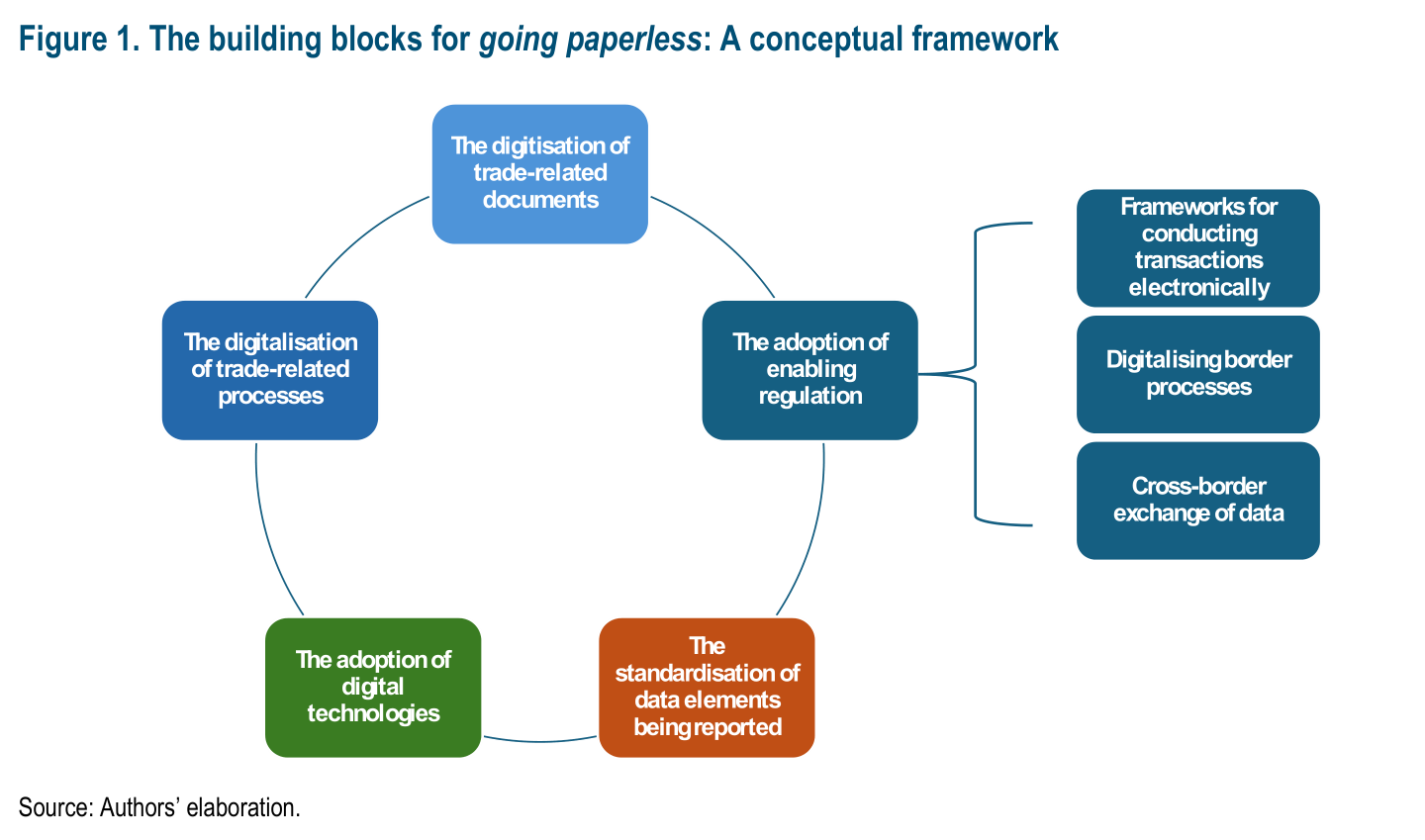
Read the diagram as text
- Find the document and the process: Digitising a paper document makes it electronic. Digitalising a process changes how people and systems use it. The source lists these as separate tasks.
- Look at technology and data together: Digital technology moves or verifies the record. Standardising reported data helps parties understand the same fields across systems.
- Find where the rules matter: Enabling rules cover electronic transactions, digital border processes and cross-border data exchange. For an electronic bill of lading, check the specific law on control and transfer.
An electronic file is one piece of paperless trade. This OECD figure puts digital documents alongside shared data, redesigned processes, technology and the rules that support them.
Read the original at full size here
Use touch, a trackpad, or the arrow keys in the image area.
(SYNTHETIC / TRAINING ONLY for every firm named in this topic.) Simplified: this lesson explains the idea of the law and does not give legal advice. The law that governs a real bill of lading decides what counts.
PICTURE IT
A drawer with one key and a keeper's book
Picture a drawer that holds an important paper. The drawer has only one key, and one person holds it. A keeper writes in a book every time the key changes hands. Nobody can cut a spare key, and nobody can change the book without a trace.
Whoever holds the key can open the drawer and use the paper. When the holder gives the key to the next person, the first person no longer has it. A copy of the paper does not open the drawer, so it proves nothing about who may use the original.
THE REAL JOB An lets a record do a paper bill's job, so one holder alone can claim the goods.
- The carrier loads the goods
- A record is made as the bill of lading
- A reliable method shows who controls it
- Control passes to the next holder
- The holder claims the goods
HOW THE PICTURE MAPS
| In the picture | In the payment |
|---|---|
| The drawer with the paper inside | The electronic bill of lading, a record that stands in for the paper original |
| The single key | Control of the record, the stand-in for holding the paper |
| The person who holds the key | The holder, who can claim the goodsWho: Aldergrove Foods |
| The keeper's book of key changes | A reliable method that shows who has control and keeps the record intact |
| A photocopy of the paper | A scan or PDF, which shows nothing about who may claim |
| The person who first gave out the key | The party that hands over control to the next holderWho: Example Supplies Ltd |
WHERE THIS PICTURE STOPS
- The picture shows a key. The law decides whether holding control counts as holding the document. A model law, such as the Model Law on Electronic Transferable Records, counts only where a state has adopted it or written a similar law.
- A drawer suggests one fixed technology. The model law does not name a technology, and judges whether the method is reliable enough for the job.
- The key shows who may deal with the record. It does not show that the goods exist or that the words on the record are true.
- Multiple readers are not multiple controllers; a jointly acting group can be one person under the UKAct. Paper bills can have sets of originals. Printing is not lawful conversion by itself.
HOOK
One key, one holder, one honest record.
REMEMBER IT THIS WAY
A chunk: a long list grouped so it is easier to hold.
Ask three things of any : which law, which system, who holds control?
| In the trick | What it stands for |
|---|---|
| Which law | the national law that decides whether an electronic record counts |
| Which system | the method that holds the record and shows who controls it |
| Who holds control | exclusive control by one party at a time, the stand-in for holding the paper |
The three questions leave out whether the bank or the buyer will accept the document, which depends on their own rules.
TELL A FRIEND
A bill represented and controlled electronically under the applicable law and agreed system, rather than merely a readable scan.
OFTEN MIXED UP WITH Documentary collections. A is a way to settle a sale, where banks pass documents on and no bank promises to pay. An is one of the documents that can travel inside it. This topic is about the document, not the settlement route.
Sources & standards — 1 source
- Official requirement
Electronic Trade Documents Act 2023, c38 ↗ — UK Parliament · UK Act 2023, c38, sections1–4: reliable exclusive control, reading/viewing not control, joint control, conversion and former form ceasing effect.
Primary document opened for the exact cited sections during V12 domain review. Educational examples and source-specific limits are disclosed in the lesson and audit.
CURRENT AS CHECKED
2 FIGURES
Ocean carriers in Digital Container Shipping Association (DCSA) - public eBL commitment
Nine ocean carriers that are members of DCSA, the shipping industry's standards body, announced in February 2023 a public commitment to issue 100% of their original bills of lading as electronic bills by 2030. Search excerpts also report an interim target of 50% within five years; only the 2030 end point is carried here. The commitment comes from the carriers, not from the (ICC).
CHECKED 2026-10-10RECHECK BY 2027-04-10
Sources & standards — 2 sources
- Market practice
eBL commitment by carriers (Baltic and International Maritime Council (BIMCO) page on Digital Container Shipping Association (DCSA) members) ↗ — BIMCO · The carriers' commitment to electronic original bills of lading by 2030 (search excerpt, page not opened)
Known from a search result title and URL plus a combined excerpt; the page was not opened. Sources differed on the interim milestone (50% by 2027 or within five years), so only the 2030 end point is carried.
- Market practice
Digital Container Shipping Association (DCSA) standardises electronic bill of lading (Global Trade Review) ↗ — Global Trade Review · Trade-press report of the commitment and the 100% by 2030 end point (search excerpt, page not opened)
Known from a search excerpt; the page was not opened and the excerpt could not be tied to one article among the Global Trade Review results (it mixed several). Treat as a lead of market-practice strength.
Share of bills of lading issued electronically - 2021 to 2024, as reported by Digital Container Shipping Association (DCSA)
A piece written by the carriers' standards body reported that the share of bills of lading issued electronically grew from 1.2% in 2021 to almost 5% in 2024 so far. It is a self-reported figure for one year and may be out of date.
CHECKED 2026-10-10RECHECK BY 2027-04-10
Sources & standards — 1 source
- Market practice
Digital Container Shipping Association (DCSA) standardises electronic bill of lading (Global Trade Review) ↗ — Global Trade Review · Adoption growing from 1.2% in 2021 to almost 5% in 2024 so far, attributed to a DCSA-authored piece (search excerpt, page not opened)
Known from a search excerpt; the page was not opened and the excerpt could not be tied to one article among the Global Trade Review results (it mixed several). Treat as a lead of market-practice strength.
PRACTISE AND KEEP
Sources for this topic — 5 sources
- Scheme-specific rule
UNCITRAL Model Law on Electronic Transferable Records (2017) ↗ — United Nations Commission on International Trade Law · The model law's scope, functional-equivalence test and control as the equivalent of possession; known from search excerpts
Verified from one web-search call on the access date that returned the UNCITRAL page, the model-law ebook and working papers; the page was not opened, so no article is quoted. A model law binds nobody until a state adopts it, and which states have done so was not checked. Cited as scheme-specific-rule at most because it is known from excerpts.
- Market practice
UK Electronic Trade Documents Act 2023: a further step towards paper-free trade (briefing) ↗ — Clifford Chance · The UK Electronic Trade Documents Act 2023 as an example of a national law; known from search excerpts of a law-firm briefing
Seen only as a search result with excerpts; the briefing and the statute were not opened and legislation.gov.uk did not appear in the results. Several law-firm results agreed on the date and the conditions. Market-practice evidence, never a statement of the statute's wording.
- Market practice
ICC Digital Standards Initiative ↗ — International Chamber of Commerce (ICC) · The ICC Digital Standards Initiative, identity only
The home page appeared in a search result list; its content was not read. What the initiative does is taken from trade-press excerpts (see gtreview-ebl-standardisation). It is not a law and makes no document legally valid.
- Market practice
Digital Container Shipping Association (DCSA) standardises electronic bill of lading (Global Trade Review) ↗ — Global Trade Review · The ICC working with the carriers' standards body on eBL standards; known from search excerpts
Known from a search excerpt; the page was not opened and the excerpt could not be tied to one article among the Global Trade Review results (it mixed several). Treat as a lead of market-practice strength.
- Simplified educational illustration
Payments Signal editorial teaching models — Payments Signal · Four-question check and the story
What this simplifies: The story uses fictional firms and one shipment. Transport documents other than a bill of lading, the statute text, country adoption and bank acceptance rules are omitted. The pages cited were read through search excerpts, not opened.
Used wherever diagrams, scenarios, figures, or example values are didactic constructions rather than sourced facts; every such use carries a simplifications disclosure. All people, companies, banks, and list entries in examples are fictional.
Deepest material on this page: L4 — Standards & sources. Where a topic stops short of implementation depth, that is a deliberate coverage decision, not an oversight — see coverage.