Send, convert, pay out, cash out (the remittance journey)
One remittance passes through four hand-overs, each held by a different firm. When it stalls, the first question is which hand-over it is at.
L1–L4 are part of the Pro pass
L0 Explain simply
Marcus is waiting for money from Ananya. She pays at a counter on a Saturday morning. By the afternoon, Marcus has cash in his hand. (SYNTHETIC / TRAINING ONLY: Ananya and Marcus are made-up people.)
This wallet example follows four teaching stages: send, convert, pay out and . They need not be four separate firms or strictly separate system events; the quote precedes the sender's final agreement.
Send is where Ananya hands over money and details. The firm she pays is a operator, a business whose whole job is moving money for people. It checks who she is. It checks both names against watch lists. Then it tells her what Marcus will receive.
Convert is where the amount is priced in the other currency. The operator fixes the exchange rate. That rate is part of the price, along with the fee Ananya can see.
Pay out is where Marcus is paid. A partner in his country pays him from money it already holds. Here the partner puts the money in his wallet, which is a balance kept against a phone number.
Cash out is where the balance becomes cash. Marcus visits an agent. The agent gives him cash and takes the balance in exchange. This is a separate step, and a different firm may do it.
Behind the customer stages, the firms fund and settle their positions under the chosen arrangement. A hold, failed instruction, missing wallet credit and failed cash-out can look similar to a family but need different evidence and different action.
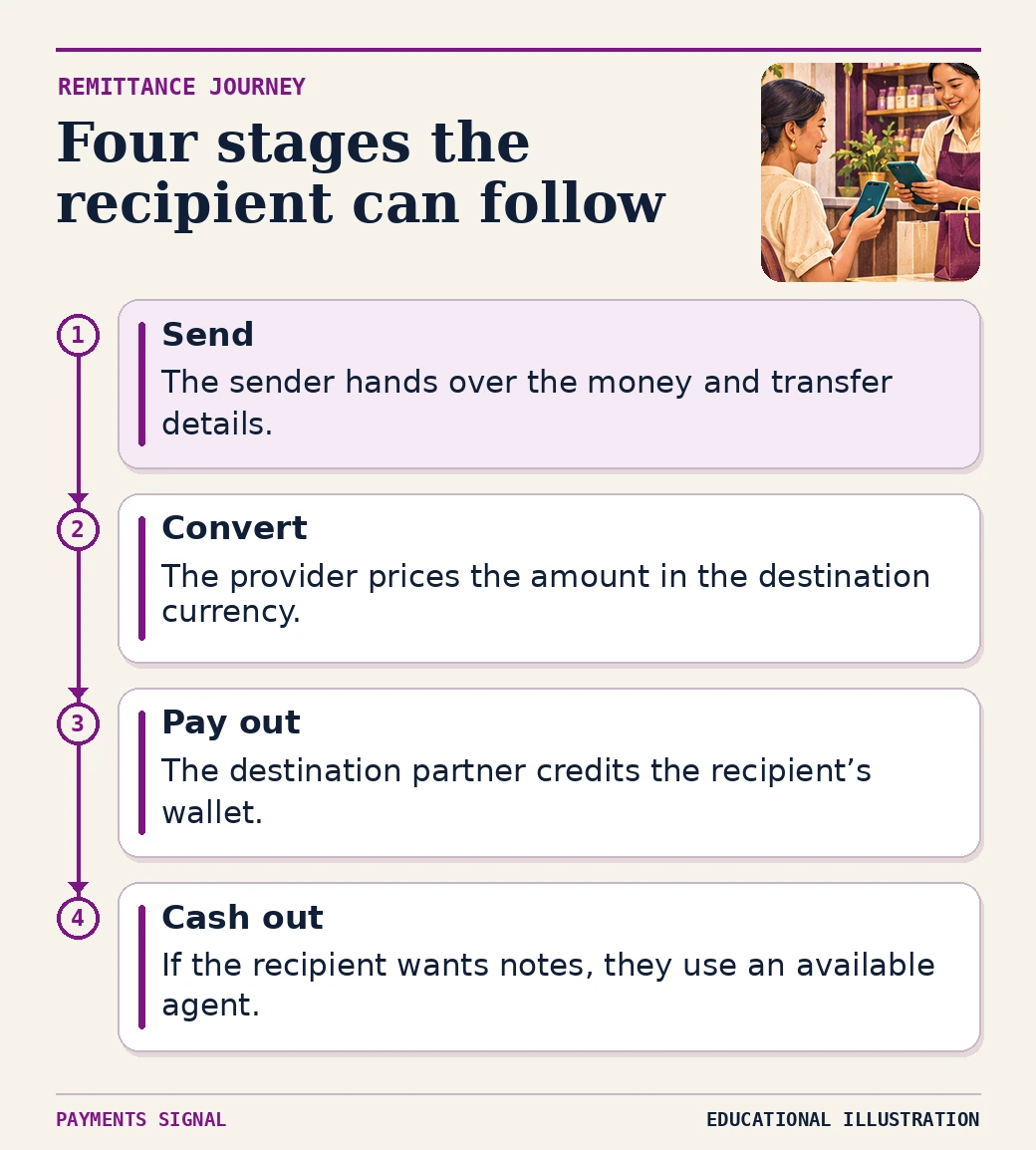
Read the diagram as text
- Send: The sender hands over the money and transfer details.
- Convert: The provider prices the amount in the destination currency.
- Pay out: The destination partner credits the recipient’s wallet.
- Cash out: If the recipient wants notes, they use an available agent.
Follow the customer’s instruction to recipient access. A recipient can keep funds in an account or use an available cash-out method. Provider funding behind the service is a separate part of the arrangement.
PLAIN WORDS · 1 in this section
- precedes
- comes before
PICTURE IT
A note passed along four desks at a village fair
Picture a village fair with four desks in a row. At the first desk you give your cash and a note that names your cousin. The clerk checks your name and keeps the cash. The second desk writes a price in your cousin's coins on the note. The note goes on to the third desk, in your cousin's town. That desk pays your cousin with a token from its own box. At the fourth desk your cousin swaps the token for coins. Your cash never leaves the first desk.
THE REAL JOB The journey gets money from a sender's hand to a receiver's cash, while the operator and its partners settle up behind the scenes.
- Sender receives quote and agrees
- Operator records and authorises the transfer
- Partner records wallet payout result
- Agent exchanges wallet value for available cash
- Firms settle under their funding agreement
HOW THE PICTURE MAPS
| In the picture | In the payment |
|---|---|
| The first desk, where you give cash and a note | Send: the sender hands over money and detailsWho: Ananya |
| The clerk checking your name | Screening of both names against watch lists |
| The second desk writing a price on the note | Convert: the rate and fee quoted before she agrees |
| The third desk paying from its own box | Pay out: the partner pays from money it already holds |
| The token your cousin receives | The wallet balance the receiver holds after pay outWho: Marcus |
| The fourth desk swapping the token for coins | Cash out: an agent gives cash in exchange for the balance |
| The note that moves from desk to desk | The instruction that passes between firms, while the cash mostly stays put |
| Your cash staying at the first desk | The sender's cash stays with the operator, which repays the partner later |
WHERE THIS PICTURE STOPS
- The picture has four desks in a row, but a real route can join steps. If Marcus is paid cash at a counter, pay out and cash out are one hand-over.
- A note on paper shows no checks. A real operator can stop a transfer at the first desk for a closer look, and that is a control working, not a fault.
- In the picture the third desk always has tokens in its box. A real partner can run short of money for a route, and then the pay out waits although the instruction is good.
- The picture is one clean shape. Real operators may use several partners, other payout kinds and different settling-up schedules, and the lesson names no prices.
- A wallet credit can have succeeded while cash-out fails. Name the actual result before retrying; quote precedes final authorisation, and funding models vary.
HOOK
Send, convert, pay out, cash out: ask which hand-over.
REMEMBER IT THIS WAY
A sequence: the real steps, in order.
Name the hand-over, then the firm that holds the money, then what could stop it. Do this for each of the four.
| In the trick | What it stands for |
|---|---|
| the hand-over | send, convert, pay out or cash out |
| the firm | the operator, the partner or the agent |
| what could stop it | a check, a partner short of money or an agent short of cash |
It misleads when cash is collected at the partner's counter, because pay out and cash out then merge into one hand-over.
TELL A FRIEND
The payout end of a remittance: cash delivery, account credit or wallet credit.
OFTEN MIXED UP WITH The money that arrives is not the money you sent (remittance corridor). The corridor topic explains why the payout comes from money already at the far end. This topic follows one transfer through all four hand-overs and names who holds the money at each.
Sources & standards — 1 source
- Regulatory guidance
General principles for international remittance services ↗ — Committee on Payment and Settlement Systems (now CPMI) and the World Bank · January2007, annex2 paragraphs 13–15 and General Principles1,5: settlement timing, funds or credit, disclosure and risk.
Issued 23 January 2007 by the CPSS (renamed the Committee on Payments and Market Infrastructures in 2014) jointly with the World Bank. It is a set of general principles addressed to countries, not an obligation on any institution, and it is cited on this site with that strength and no more.
Its age is load-bearing and is stated wherever it is used: a 2007 report supports the structure of a remittance service and the names of its parts. It does not support any current price, any current corridor volume, and nothing about the products offered in any market today.
Verified from independent web-search excerpts on the access date. The publisher's own domain cannot be fetched, so no text is quoted here from the publisher's own page. A failed fetch is not evidence about what the document provides.
CURRENT AS CHECKED
1 FIGURE
G20 cross-border payments roadmap — speed targets for wholesale, retail and remittance payments
The speed target, endorsed in October 2021, is the same in all three market segments. By end-2027, 75% of cross-border payments should make funds available to the recipient within one hour of , and the remainder within one business day. It is a target addressed to the international community, not an obligation on any institution, and no bank can be sanctioned for missing it.
CHECKED 2026-08-13RECHECK BY 2027-02-13
Sources & standards — 1 source
- Regulatory guidance
Targets for Addressing the Four Challenges of Cross-border Payments: Final Report ↗ — Financial Stability Board (FSB) · Speed targets for the wholesale, retail and remittance segments, and the end-2027 common target date
Published 13 October 2021, following a consultative document in May 2021 and the public responses to it. The targets are addressed to the international community rather than to any firm: no institution can be sanctioned for missing one.
Verified from independent web-search excerpts on the access date. The publisher's own domain cannot be fetched, so no text is quoted here from the publisher's own page. A failed fetch is not evidence about what the document provides.
PRACTISE AND KEEP
Sources for this topic — 5 sources
- Regulatory guidance
General principles for international remittance services ↗ — Committee on Payment and Settlement Systems (now CPMI) and the World Bank · The capturing end and the paying-out end of a remittance service, the service provider, and the network types joining them
Issued 23 January 2007 by the CPSS (renamed the Committee on Payments and Market Infrastructures in 2014) jointly with the World Bank. It is a set of general principles addressed to countries, not an obligation on any institution, and it is cited on this site with that strength and no more.
Its age is load-bearing and is stated wherever it is used: a 2007 report supports the structure of a remittance service and the names of its parts. It does not support any current price, any current corridor volume, and nothing about the products offered in any market today.
Verified from independent web-search excerpts on the access date. The publisher's own domain cannot be fetched, so no text is quoted here from the publisher's own page. A failed fetch is not evidence about what the document provides.
- Regulatory guidanceAs amended June 2026
The FATF Recommendations: International Standards on Combating Money Laundering and the Financing of Terrorism & Proliferation ↗ — Financial Action Task Force · Recommendation 14: money or value transfer services licensed or registered and supervised, agents licensed or registered or listed by the provider; Recommendation 16: originator and beneficiary information stays with a transfer, and a provider controlling both ends considers both sides when deciding whether to report suspicion
Adopted in 2012 and updated regularly since; the June 2025 FATF plenary agreed revisions to Recommendation 16 on payment transparency. Consult the live consolidated text for the current wording. V46 actual June 2026 PDF selected read 6 November: R1,3,10–12,20–21, INR20 and selected glossary criminal-activity/designated-offence entries. National implementation required; suspicion reporting differs from proof/conviction. No whole151 page certification. Reproduction requires prior written permission.
- Market practice
GSMA Mobile Money API — specification and developer portal ↗ — GSMA · Agent services including cash-in and cash-out, and the international transfer use case with a mobile money wallet as the pay-out channel
An industry association's specification, not a regulation and not a scheme rulebook. Implementing it is a commercial choice, so its existence says what a harmonised interface looks like and says nothing about how much of any corridor runs on one.
The specification is versioned and the portal serves the current release, so a claim resting on a particular field or endpoint should name the version it was read at. Nothing on this site rests on one.
Verified from independent web-search excerpts on the access date. The publisher's own domain cannot be fetched, so no text is quoted here from the publisher's own page. A failed fetch is not evidence about what the document provides.
- Market practice
Remittance Prices Worldwide ↗ — World Bank · Total cost of sending split into a transfer fee and a foreign exchange margin, as a percentage of the amount sent
Full methodology page opened6November 2026. Collection includes mystery shopping and automated API/web data. A dated quote or corridor aggregate is not evidence of every actual customer charge. No current price statistic introduced.
- Simplified educational illustration
Payments Signal editorial teaching models — Payments Signal
What this simplifies: The journey is drawn with one operator, one payout partner, one wallet provider and one agent, in four clean steps. Real routes use several partners at once, can join steps (cash collected at the partner's counter makes pay out and cash out one hand-over), settle on schedules that differ by partner, and hedge the currency they hold. The agent running short of cash is a teaching illustration, not a report of how any agent behaves. No price, fee, volume or route statistic appears in the prose.
Used wherever diagrams, scenarios, figures, or example values are didactic constructions rather than sourced facts; every such use carries a simplifications disclosure. All people, companies, banks, and list entries in examples are fictional.
Deepest material on this page: L4 — Standards & sources. Where a topic stops short of implementation depth, that is a deliberate coverage decision, not an oversight — see coverage.