Forms of money: central vs commercial bank money
The money in your account and the money banks settle in are two different things. Knowing which is which explains what actually settles a payment, and why.
L1–L4 are part of the Pro pass
L0 Explain simply
Whose promise is the money you hold? Maya Chen has EUR 2,000 in her account at Bank Alfa. And she does not hold cash in a vault with her name on it.
What she holds is a claim on Bank Alfa. The bank owes her that amount, and the balance on her screen is the record of the debt.
That is : a promise from a private bank. It is money because you can spend it. It is only as good as the bank behind it, and that second half is the part most people never think about.
There is another kind of money, and banks are the ones who use it. In this example, Bank Alfa settles with Northstar Bank through accounts at the . Both banks have access to that system. Other arrangements use a commercial settlement bank or a sponsor.
Money on that account is central-bank money — a claim on the central bank, which is the one institution that cannot run short of the currency it issues.
So there are two layers, stacked. Customers hold claims on their banks. Banks hold claims on the central bank.
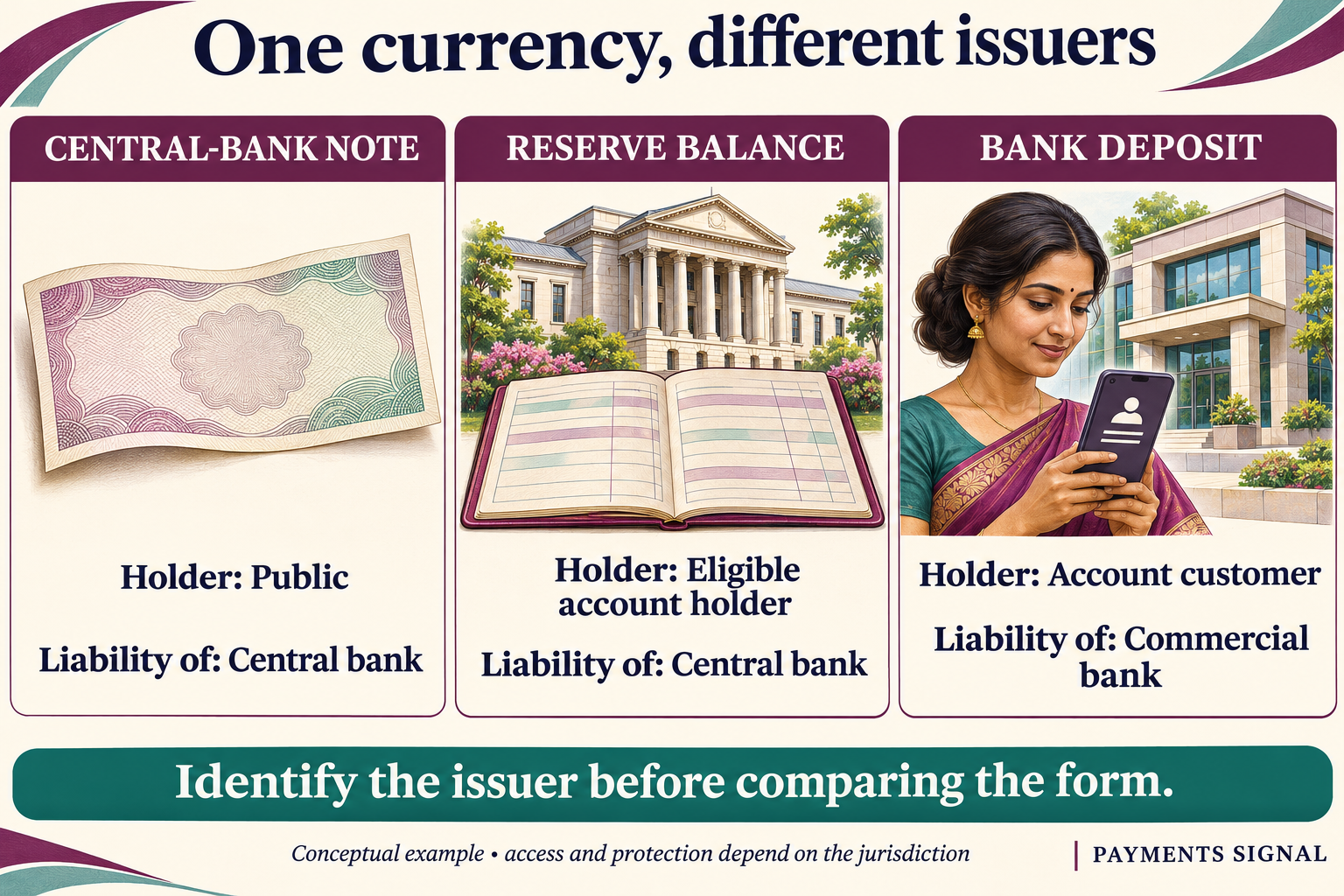
Read the diagram as text
- Central-bank note: Holder: Public. Liability of: Central bank. The card is specifically a central-bank note, not a claim that every banknote worldwide has that issuer.
- Reserve balance: Holder: Eligible account holder. Liability of: Central bank. Eligibility and account access depend on the relevant central bank’s framework.
- Bank deposit: Holder: Account customer. Liability of: Commercial bank. Footer: Identify the issuer before comparing the form. Conceptual example; access and protection depend on the jurisdiction.
Payments Signal original conceptual illustration, not a Bank of England diagram. The first card specifically shows a central-bank-issued note; some jurisdictions also have authorised commercial-bank notes. Reserve-account access is restricted to eligible holders under the jurisdiction’s framework, not the general public or necessarily only banks. Deposit protection and access depend on actual law, institution and eligibility. Generic note/ledger/app props show no real currency amounts, ownership records or guaranteed insurance.
Why should a payment between two customers care about the lower layer? Because the two banks have to square up with each other afterwards, and neither one wants to be left holding a promise from the other. They settle in the money nobody has any reason to refuse.
Keep the layer question in your pocket for the rest of this domain. For any new form of money you meet, ask which layer it sits in and whose promise it is. Almost everything else follows from that answer. (SYNTHETIC / TRAINING ONLY — every person and firm named in this topic is invented.)
PICTURE IT
Shop credit slips and the estate office's tokens
Picture a housing estate with a few shops. Each shop gives its regular residents credit slips, and a resident spends a slip at any shop on the estate. When two shops owe each other at the end of the week, they do not swap slips. They settle with tokens from the estate office. Each shop keeps a token account at the office. The office makes the tokens itself, so it cannot run short of them.
THE REAL JOB Customers hold a claim on their bank, and banks pay their debts to each other in money nobody has a reason to refuse.
- Maya holds a claim on Bank Alfa
- Her payment moves claims between customers' banks
- Bank Alfa and Northstar Bank now owe each other
- They settle up in accounts at the Central Bank
- Central-bank money ends the debt between the banks
HOW THE PICTURE MAPS
| In the picture | In the payment |
|---|---|
| A credit slip held by a resident | Commercial bank money, a claim on a private bank |
| The shop that gave out the slip | The private bank that owes the balance (Bank Alfa) |
| Two shops that owe each other at week end | Two banks that must settle up after a customer payment (Bank Alfa and Northstar Bank) |
| Tokens in a shop's account at the estate office | Central-bank money, balances banks hold at the Central Bank |
| The estate office that makes the tokens | The central bank, which issues the currency |
| Shops settling in tokens, not in each other's slips | The settlement asset, the money that finishes a payment between banks |
| Any shop accepting a slip at its face value | Money's singleness: every form worth the same, held up by supervision, deposit protection, central-bank settlement |
WHERE THIS PICTURE STOPS
- A slip is a plain paper promise, and a bank balance is a promise too. The picture does not show that the balance is only as good as the bank behind it.
- The picture has two layers and a single office. In real life an indirect participant reaches the system through a direct one, so there can be more layers, each one adding a private promise.
- The estate office settles every shop. In real life not every institution has a central-bank account. Some systems, such as card schemes, settle in a settlement bank.
- The picture shows no digital forms. A stablecoin or tokenized deposit is a claim on a private issuer, and a central bank digital currency would be central-bank money. Where each one sits depends on the design and on the jurisdiction.
HOOK
Ask whose promise it is, and which layer.
REMEMBER IT THIS WAY
A contrast: two neighbours told apart by one test.
Ask of any money: could the one who owes it run short? A private bank could, but the makes its own currency.
| In the trick | What it stands for |
|---|---|
| could the one who owes it run short of it | the test that tells commercial bank money from central-bank money |
| a private bank could | commercial bank money, a claim on a private bank, only as good as that bank |
| the central bank makes its own currency | central-bank money, a claim on the central bank, which cannot run short of its own currency |
It tests who owes the money, not the number of layers: an indirect participant holds a claim on its sponsor.
TELL A FRIEND
Customers hold claims on their banks, and banks hold claims on the . Banks settle with each other in the lower layer, because nobody has a reason to refuse it.
OFTEN MIXED UP WITH Stablecoins and tokenized deposits. This topic gives the layer question for any money. The stablecoins and tokenized deposits topic applies it to claims on a private issuer, where safety depends on what backs the claim.
Sources & standards — 1 source
- Official requirement
Principles for financial market infrastructures ↗ — CPMI and IOSCO (Bank for International Settlements) · PFMI April 2012, Principles 9 and 19: system settlement asset and risks from tiered participation.
V40 actual primary PDF read at https://www.bis.org/publications/principles-financial-market-infrastructures.pdf :complete3.4.1–3.4.7,3.8.1–3.8.8 and AnnexD payment designs through liquidity-saving discussion (printed38–40,64–66,148–149). Cover/title verified;not full188page reading. Specific credit/liquidity/finality/design statements here use these sections. Earlier registry scope/history:Published by the CPSS (now CPMI) and IOSCO; contains 24 principles plus responsibilities for authorities. This site uses it only for high-level concepts such as settlement finality.
SEE THE PAYMENT MOVE
PICTURE THE JOURNEY
A village store with a back shed, a front rack and one keeperOpen to read the picture, how it matches the payment and where it stops.
PICTURE IT
A village store with a back shed, a front rack and one keeper
Picture a village where households settle debts in fuel logs. The council keeps a shared store. Each household has a back shed and a front rack there. Moving logs between these places is a separate action. The back shed also serves other village needs.
One household owes another a load. It gives the keeper a note. The note asks for a transfer; it does not move logs. The keeper checks the note, available stock and other controls. Some stock may be reserved. Some notes have higher priority or limits.
An eligible transfer moves the full load between racks. Several notes can also pass together if their combined movements meet the controls. Each debt is still settled in full. This differs from replacing several debts with one net debt.
A note that passes validation may wait when settlement conditions fail. More stock can help, but its arrival does not guarantee release. The keeper may fetch back-shed stock only under the agreed arrangements. Some eligible notes can trigger a set-up transfer; others cannot.
A household can ask to withdraw a waiting note where the rules allow. It checks the answer before sending a replacement. Removing an undebited note does not create new logs. A note still waiting at its applicable closing point is returned unsettled in this example. The household investigates the confirmed result before deciding what comes next. (SYNTHETIC / TRAINING ONLY: the village and households are invented.)
THE REAL JOB The Eurosystem's T2 real-time gross settlement service settles eligible euro payment obligations in full, using central-bank money and applicable settlement controls.
HOW THE PICTURE MAPS
| In the picture | In the payment |
|---|---|
| A household that owes a large load and has a place in the store | Bank Alfa, the sending bank, has a large euro payment to make to NordbankWho: Bank Alfa |
| The household that is owed the load, with its own front rack | Nordbank, the receiving bank, whose settlement account is creditedWho: Nordbank |
| The note given to the keeper at the hatch; no log has moved | The pacs.009 payment message: an instruction only, nothing has moved yet |
| The keeper checks the note, stock and other controls | T2 checks the instruction and settlement conditions, including available liquidity |
| The council runs the store and keeps the household records | Eurosystem central banks hold the settlement accounts; T2 provides the service |
| The front rack, including stock subject to controls | The RTGS dedicated cash account, with liquidity affected by reservations and limits |
| The back shed also serves other village needs | The main cash account in Central Liquidity Management, separate from the RTGS account |
| Moving logs forward under agreed arrangements | A permitted liquidity transfer from the main cash account to the RTGS account |
| The keeper checks usable stock and other controls | The settlement check: available liquidity, priorities, reservations, limits and applicable windows |
| The full debt is discharged, including within an eligible combined movement | Gross obligations settle in full; eligible offsetting can reduce the extra funding needed |
| Logs once set down belong to the other household for good | Settlement is final the instant it happens |
| The receiving household confirms its own records separately | Nordbank reconciles the settled interbank transfer; no customer credit is established hereWho: Nordbank |
| A validated note waits when settlement conditions fail | This selected QUEUED instruction is unsettled; liquidity is not the only possible queue condition |
| Eligible notes move together under the controls | The selected GRIDLOCK recovery uses eligible offsetting while preserving full payment obligations |
| The household asks to remove a waiting note and checks the answer | A permitted pre-settlement withdrawal needs confirmed status before a replacement is considered |
| A note reaches its applicable closing point still unsettled | The selected CUTOFF instruction is rejected unsettled; no automatic next-day resend follows |
| The keeper refuses a note that fails validation | An invalid receiver is one rejection example; it is not the only validation failure |
WHERE THIS PICTURE STOPS
- Logs are physical objects. Real settlement changes central-bank account balances. Final settlement of this interbank leg does not erase every underlying claim or prove a customer credit.
- The Eurosystem operates the service and its central banks hold the accounts. The picture separates these functions to explain them, not to invent an independent settlement agency.
- The main cash account serves wider liquidity needs. Its visible balance is not automatically available in the RTGS dedicated cash account. Transfers have their own conditions.
- The production
R2026.JUNrules include transfers triggered by certain eligible urgent, ancillary-system or high-priority queues. This is not an automatic unlimited transfer for every normal payment. - An eligible offsetting set can settle full payment obligations with less extra funding. The picture does not establish that every queued set is eligible or that gross means no offsetting.
- Queue handling also depends on reservations, limits, priority and time. Funding alone does not guarantee release. A validation failure can cause rejection before settlement.
- This selected closing branch rejects the unsettled instruction. The exact applicable window and confirmed outcome must be checked before any replacement. An unanswered request is not proof of cancellation.
- Withdrawal is conditional and pre-settlement. Removing an instruction does not release cash that was never debited or guarantee that another payment will settle.
- The chosen
pacs.009is an interbank transfer message example. Local branch words are teaching labels, not certified ISO reason codes. The complete current message profile is not reproduced. - An unknown or suspended receiver needs investigation under the actual access rules. Do not bypass a suspension by trying another route.
HOOK
Check conditions, distinguish queued from final, and confirm the outcome before replacing.
REMEMBER IT THIS WAY
A sequence: the real steps, in order.
Separate the request, the release conditions and the final account movement.
| In the trick | What it stands for |
|---|---|
| Check | Validate the instruction and test usable liquidity plus other settlement controls |
| Settle | Discharge the full gross obligation, possibly within an eligible offsetting set |
| Deliver | Reconcile the confirmed interbank outcome without inferring customer credit |
TELL A FRIEND
T2 settles full payment obligations in central-bank money when the controls permit. A queue may involve liquidity or other conditions; eligible offsetting can help.
OFTEN MIXED UP WITH Two components, one service: liquidity and settlement (T2, CLM, RTGS). The and account serve different roles; transferring liquidity between them is separate from settling this payment.
PRACTISE AND KEEP
Sources for this topic — 5 sources
- Official requirement
Principles for financial market infrastructures ↗ — CPMI and IOSCO (Bank for International Settlements)
V40 actual primary PDF read at https://www.bis.org/publications/principles-financial-market-infrastructures.pdf :complete3.4.1–3.4.7,3.8.1–3.8.8 and AnnexD payment designs through liquidity-saving discussion (printed38–40,64–66,148–149). Cover/title verified;not full188page reading. Specific credit/liquidity/finality/design statements here use these sections. Earlier registry scope/history:Published by the CPSS (now CPMI) and IOSCO; contains 24 principles plus responsibilities for authorities. This site uses it only for high-level concepts such as settlement finality.
- Market practice
Central bank digital currencies ↗ — CPMI and Markets Committee, Bank for International Settlements · a central bank digital currency as a digital form of central bank money
Published in March 2018 as an initial analysis, so its account of which central banks are exploring a central bank digital currency is dated. Search excerpts only, page not opened.
- Market practice
Tokenisation in the context of money and other assets ↗ — Committee on Payments and Market Infrastructures · settlement assets and the claim structure of tokenised money
The report supports architecture questions and risk boundaries; it does not make a tokenised deposit, security, or settlement arrangement compliant by design.
- Market practiceSuperseded — see Glossary of payments and market infrastructure terminologyMarch 2003 edition
A glossary of terms used in payments and settlement systems ↗ — CPSS (now CPMI), Bank for International Settlements
Superseded for currency, not for coverage, and that distinction is the reason this entry stays. The live glossary at bis.org/cpmi/publ/d00b.htm is the current text. This edition remains the only published CPMI definition of ten headwords the live glossary does not carry.
Both editions were downloaded and compared on the access date. The 2003 PDF is 346,977 bytes; the generated PDF of the live glossary is 197,553 bytes. Four definitions this site teaches had moved. Six passages quoted the 2003 wording of netting in prose while attributing it to the CPMI glossary, and those now say which edition they are quoting.
Checks that returned nothing, recorded so they are not repeated. Singleness of money, payment token, electronic wallet and book transfer are headwords in neither edition. A citation for any of those was pointing at a document that does not contain the term.
- Simplified educational illustration
Payments Signal editorial teaching models — Payments Signal
What this simplifies: The claim-on-whom framing, the three legs of par and the named banks are this site's construction. Deposit protection, resolution powers and access to a central-bank account are jurisdictional questions, and no country's rules or limits are stated.
Used wherever diagrams, scenarios, figures, or example values are didactic constructions rather than sourced facts; every such use carries a simplifications disclosure. All people, companies, banks, and list entries in examples are fictional.
Deepest material on this page: L4 — Standards & sources. Where a topic stops short of implementation depth, that is a deliberate coverage decision, not an oversight — see coverage.