The digital euro: central bank money for the public, with a cap and a linked account
A proposed digital form of central bank money for everyone: no interest, a limit on holdings, and a waterfall to a bank account. What is designed, agreed and open.
L1–L4 are part of the Pro pass
L0 Explain simply
Riya owes Arjun her share of a dinner. She has two ordinary ways to pay. She can hand him cash, or she can send money from her bank account. (SYNTHETIC / TRAINING ONLY. Riya, Arjun and Bank Alfa are invented.)
Those two ways are different kinds of money. Cash is made by the . A bank balance is a promise made by the bank. The central bank is the public body that runs a currency, such as the European Central Bank () for the euro.
The is a proposal for a third way. It would be , meaning a direct claim on the central bank, in digital form, held in a wallet on a phone or a card. A person could pay with it online or, in the design being built, without a connection.
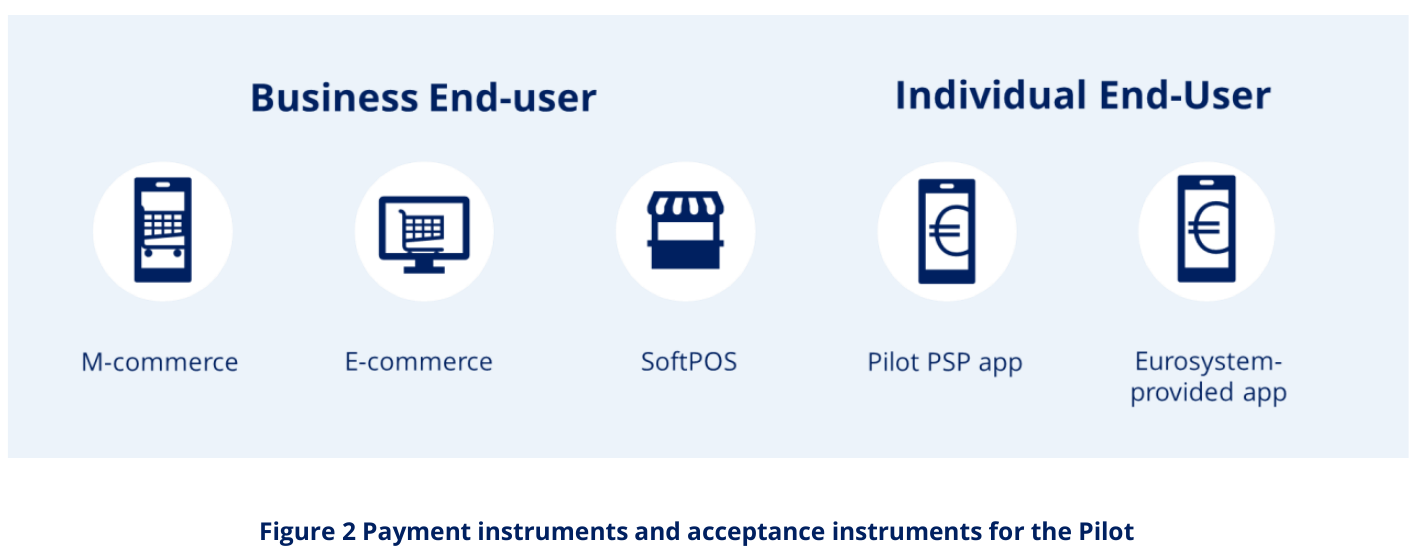
Read the diagram as text
- Find the remote merchant options: A business can offer the beta digital euro through mobile commerce or electronic commerce. These options illustrate online checkout.
- Find the in-person merchant option: SoftPOS lets a compatible phone or tablet act as a point-of-sale acceptance device. It is the pictured option for proximity payments at a business.
- Find the individual’s app options: The planned pilot supports an app from the payment service provider or an app supplied by the Eurosystem. The individual uses an available app to access the participating provider’s payment services.
Follow the published figure step by step.
Read the original at full size here
Use touch, a trackpad, or the arrow keys in the image area.
It does not exist yet. The law that would create it is still being negotiated, and nobody can pay with it today. Everything here describes a design and a plan, not a product.
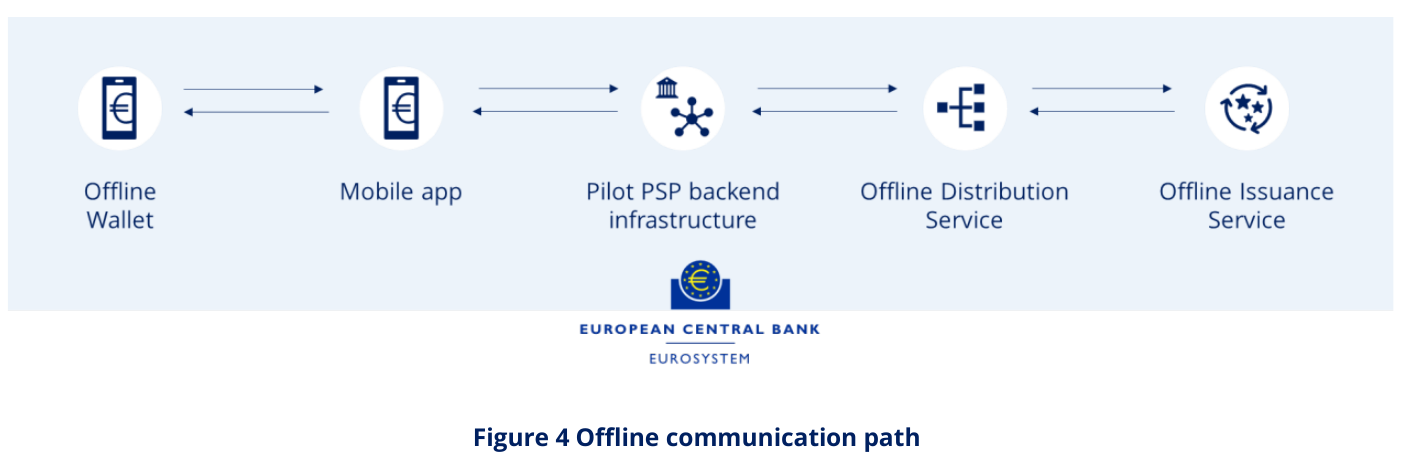
Read the diagram as text
- Start at the wallet: The offline wallet sits on the individual’s device. It uses the mobile app to reach the provider when it needs to load funds or convert offline funds back.
- Follow the distributing provider: The pilot payment service provider handles the funding or withdrawal request at its back end. The offline distribution service forwards messages to the issuance service.
- Find the issuance service and return path: The offline issuance service returns a response through the same chain. Some online integrity checks also use this path. The two-way arrows help distinguish these service exchanges from an offline payment between devices.
Follow the published figure step by step.
Read the original at full size here
Use touch, a trackpad, or the arrow keys in the image area.
Two design choices decide a lot. First, it would not earn interest. The ECB says it is a means of payment, not a place to save. Second, each person would be allowed to hold only a limited amount. That cap exists so that people do not drain their bank accounts into it.
A cap raises a puzzle. What happens if Arjun is paid more than his wallet may hold? The answer is a mechanism called the waterfall, and the next level explains it.
Disclosure: this is a simplified picture. The final rules depend on a regulation that has not been agreed, and the facts register holds the current status.
PICTURE IT
A rain barrel with an overflow pipe to a tank
Picture a rain barrel with a marked maximum level. If its overflow pipe is connected and open, excess water goes into a nearby tank. A separate working tap can bring water back for a task. The pipe and tap can fail or be closed. This picture helps explain the direction of linked online conversions; it does not promise that a payment always succeeds.
THE REAL JOB The limit, the waterfall and the reverse waterfall let a digital currency serve everyday payments without becoming a large store of savings.
- Money arrives
- The wallet checks the cap
- The surplus overflows to the account
- A short wallet draws from the account
- The payment completes
HOW THE PICTURE MAPS
| In the picture | In the payment |
|---|---|
| The rain barrel | A digital euro wallet |
| The painted line on the barrel | The holding limit |
| The overflow pipe | The waterfall: the surplus above the cap goes to the linked account |
| The big tank | The user's linked bank account |
| The tap from tank to barrel | The reverse waterfall: a top-up for an online payment |
| The gardener | The payer or payeeWho: Riya |
WHERE THIS PICTURE STOPS
- A barrel and tank hold the same water. The wallet holds central bank money and the account holds bank money, which are different kinds of money with different risk.
- A tap works anywhere in the garden. The reverse waterfall works only for online payments, so offline payments can use only what the wallet holds.
- A painted line is fixed. The holding limit is not yet set and will be decided by law and by the central bank.
- Businesses are meant to hold zero, so the barrel picture fits individuals best.
- In draft
version 0.91, individual links and activation are optional. Waterfall and reverse waterfall are online features. A payment that breaches the cap is not processed if the waterfall is inactive or fails.
HOOK
Cap in, overflow out, top-up back.
REMEMBER IT THIS WAY
A chunk: a long list grouped so it is easier to hold.
Cap on the wallet, overflow to the account, top-up for online payments only.
| In the trick | What it stands for |
|---|---|
| cap in | the holding limit set on a wallet |
| overflow out | the waterfall sending the surplus to the linked account |
| top-up back | the reverse waterfall drawing from the linked account for an online payment |
The three words leave out business holdings and the offline case, where no top-up is possible.
TELL A FRIEND
The would be for everyone, with no interest and a cap on holdings. Money above the cap flows to a linked bank account, a short wallet can draw from it online, and it is not live yet.
OFTEN MIXED UP WITH Forms of money: central vs commercial bank money. The forms-of-money topic explains and in general. This topic is about one proposed design of the first kind, the digital euro, and where its law stands.
CURRENT AS CHECKED
2 FIGURES
Digital euro: legislative and Eurosystem status, positions and indicative timeline
The does not exist yet. The Council of the European Union agreed its negotiating position on 19 December 2025. The European Parliament's economic affairs committee voted its report on 23 June 2026, and the plenary confirmed the mandate to open negotiations on 9 July 2026 by 416 votes to 169 with 22 abstentions. Secondary reports say the first trilogue took place on 13 July 2026 and that further rounds were planned after the summer break. No provisional agreement was found as of this date.
The Governing Council decided on 29 October 2025, and announced on 30 October, to move to the next phase. If the regulation is adopted in 2026, a pilot could begin from mid-2027 and a first issuance could follow in 2029. The final decision to issue comes only after adoption.
The is not set. Figures tested by the ECB were hypothetical and illustrative, and the Council's text leaves the limits to the ECB within a ceiling it reviews at least every two years.
CHECKED 2026-10-11RECHECK BY 2026-12-31
Sources & standards — 6 sources
- Scheme-specific rule
Single currency: Council agrees position on the digital euro and on strengthening the role of cash ↗ — Council of the European Union · Council press release of 19 December 2025: negotiating position on the digital euro; limits on how much a person may hold, set by the ECB within a ceiling the Council approves and reviews at least every two years; online and offline use (search excerpt, page not opened)
A position is not an adopted act. Seen as a WebSearch excerpt on the access date; the page was not opened.
- Scheme-specific rule
Procedure file 2023/0212(COD): establishment of the digital euro ↗ — European Parliament (Legislative Observatory) · Procedure file 2023/0212(COD): Economic and Monetary Affairs Committee vote on the report of 23 June 2026 and decision to open interinstitutional negotiations (search excerpt, page not opened)
Dates from a search excerpt. Seen as a WebSearch excerpt on the access date; the page was not opened.
- Scheme-specific rule
The European Parliament decided to open negotiations on the Digital Euro Regulation ↗ — Banca d'Italia · Banca d'Italia notice that the European Parliament decided to open negotiations on the Digital Euro Regulation: plenary vote in Strasbourg on 9 July 2026, 416 votes in favour, 169 against, 22 abstentions in press coverage of the same vote (search excerpts, page not opened)
A news notice, not the procedure file. Seen as a WebSearch excerpt on the access date; the page was not opened.
- Scheme-specific rule
The digital euro project moves to the next phase ↗ — Banca d'Italia (Eurosystem) · Governing Council decision of 29 October 2025, announced in the ECB press release of 30 October, to move to the next phase from 1 November 2025; if co-legislators adopt the regulation in 2026 a pilot and first transactions could start from mid-2027 and a first issuance could follow in 2029; a final decision to issue comes only after the legislation is adopted (search excerpt, page not opened)
Carries the ECB announcement through a national central bank. The ECB's own press release was not returned by search. Seen as a WebSearch excerpt on the access date; the page was not opened.
- Market practice
Digital euro enters trilogues: what the Council-Parliament positions mean for banks and payment providers ↗ — Freshfields · Law-firm commentary on the start of trilogue talks between Council and Parliament: the first political trilogue took place on 13 July 2026 and further rounds were planned after the summer break; secondary reporting of the positions (search excerpt, page not opened)
A secondary source. Seen as a WebSearch excerpt on the access date; the page was not opened.
- Scheme-specific rule
Preparation phase of a digital euro: closing report ↗ — European Central Bank · Closing report of the preparation phase: holding limits follow the Commission's legislative proposal; technical analysis tested hypothetical limits from 500 to 3,000 euro at the co-legislators' request, illustrative and not a decision; the waterfall moves incoming funds above the cap into a linked account; conditional payments reserve an amount temporarily; the rulebook sets one set of rules for basic payment services (search excerpt, page not opened)
The tested range is illustrative and is not stated in prose on any page citing this entry. Seen as a WebSearch excerpt on the access date; the page was not opened.
Digital euro scheme rulebook, interim draft 0.91
The European has published an interim draft of the scheme rulebook, version 0.91, with annexes for the front end, the back end and testing. The draft says it is non-binding and should not be used to build or run a pilot. Its settlement annex describes a web interface in the representational state transfer (REST) style that sends JSON, with a data dictionary based on ISO 20022 where a standard name exists. The final first version is to follow the adoption of the Digital Euro Regulation.
CHECKED 2026-10-12RECHECK BY 2027-01-31
Sources & standards — 2 sources
- Scheme-specific ruleVersion 0.91, interim draft, marked non-binding
Digital euro scheme rulebook, version 0.91 (interim draft) ↗ — European Central Bank · Status notice: interim draft, non-binding, not for pilot or implementation use; final first version after the regulation (search excerpt, page not opened)
Actual primary 177-page PDF downloaded and read for actors, funding, waterfall, transaction flow and dispute sections. Cover date 2 July 2026; version-table entry dated 24 April 2026 is distinct. Nonbinding draft; explicitly not for pilot implementation. Figures1-1(p19),3-4(p60),3-5(p73), related descriptions and footnotes visually inspected.
- Scheme-specific ruleVersion 0.91, interim draft
Digital euro scheme rulebook v0.91, Annex D2: back-end implementation specifications, part 7, Settlement ↗ — European Central Bank · Settlement interface: REST principles, JSON, data dictionary based on ISO 20022 where available (search excerpt, page not opened)
Known from web-search excerpts on the access date, page not opened. The publisher's own domain cannot be fetched from the authoring environment, so nothing is quoted from the page itself.
PRACTISE AND KEEP
Sources for this topic — 12 sources
- Scheme-specific rule
FAQs on the digital euro ↗ — European Central Bank · ECB FAQs on the digital euro: a means of payment and not an investment; holdings not remunerated and subject to limits (search excerpt of ECB speech and FAQ results, page not opened)
No answer from the page is quoted beyond that intent. Seen as a WebSearch excerpt on the access date; the page was not opened.
- Scheme-specific rule
Preparation phase of a digital euro: closing report ↗ — European Central Bank · Closing report of the preparation phase: holding limits follow the Commission's legislative proposal; technical analysis tested hypothetical limits from 500 to 3,000 euro at the co-legislators' request, illustrative and not a decision; the waterfall moves incoming funds above the cap into a linked account; conditional payments reserve an amount temporarily; the rulebook sets one set of rules for basic payment services (search excerpt, page not opened)
The tested range is illustrative and is not stated in prose on any page citing this entry. Seen as a WebSearch excerpt on the access date; the page was not opened.
- Scheme-specific rule
Summary of feedback on work on methodology for holding limit calibration ↗ — European Central Bank (Euro Retail Payments Board) · ECB summary of feedback on holding-limit calibration: a waterfall converts the amount above the threshold into private money in a linked source; a reverse waterfall converts private money into digital euro when holdings are not enough to pay; the reverse waterfall works for online transactions only; optional for individuals and mandatory for businesses, which are meant to hold zero (search excerpt, page not opened)
A working document: the design may change. Seen as a WebSearch excerpt on the access date; the page was not opened.
- Scheme-specific rule
The digital euro project moves to the next phase ↗ — Banca d'Italia (Eurosystem) · Governing Council decision of 29 October 2025, announced in the ECB press release of 30 October, to move to the next phase from 1 November 2025; if co-legislators adopt the regulation in 2026 a pilot and first transactions could start from mid-2027 and a first issuance could follow in 2029; a final decision to issue comes only after the legislation is adopted (search excerpt, page not opened)
Carries the ECB announcement through a national central bank. The ECB's own press release was not returned by search. Seen as a WebSearch excerpt on the access date; the page was not opened.
- Scheme-specific rule
Single currency: Council agrees position on the digital euro and on strengthening the role of cash ↗ — Council of the European Union · Council press release of 19 December 2025: negotiating position on the digital euro; limits on how much a person may hold, set by the ECB within a ceiling the Council approves and reviews at least every two years; online and offline use (search excerpt, page not opened)
A position is not an adopted act. Seen as a WebSearch excerpt on the access date; the page was not opened.
- Scheme-specific rule
Procedure file 2023/0212(COD): establishment of the digital euro ↗ — European Parliament (Legislative Observatory) · Procedure file 2023/0212(COD): Economic and Monetary Affairs Committee vote on the report of 23 June 2026 and decision to open interinstitutional negotiations (search excerpt, page not opened)
Dates from a search excerpt. Seen as a WebSearch excerpt on the access date; the page was not opened.
- Scheme-specific rule
The European Parliament decided to open negotiations on the Digital Euro Regulation ↗ — Banca d'Italia · Banca d'Italia notice that the European Parliament decided to open negotiations on the Digital Euro Regulation: plenary vote in Strasbourg on 9 July 2026, 416 votes in favour, 169 against, 22 abstentions in press coverage of the same vote (search excerpts, page not opened)
A news notice, not the procedure file. Seen as a WebSearch excerpt on the access date; the page was not opened.
- Market practice
Digital euro enters trilogues: what the Council-Parliament positions mean for banks and payment providers ↗ — Freshfields · Law-firm commentary on the start of trilogue talks between Council and Parliament: the first political trilogue took place on 13 July 2026 and further rounds were planned after the summer break; secondary reporting of the positions (search excerpt, page not opened)
A secondary source. Seen as a WebSearch excerpt on the access date; the page was not opened.
- Simplified educational illustration
Payments Signal editorial teaching models — Payments Signal
What this simplifies: Riya, Arjun, Bank Alfa and Maya Chen are invented. The afternoon walk-through, the provider workload at level 3 and the questions listed there are this site's illustrations of the ECB's description. Every source was read as a web-search excerpt and no page was opened. The holding limit, any launch date and the content of the final regulation are not settled, so no figure is stated in prose. The positions of the Council and Parliament are positions, not law.
Used wherever diagrams, scenarios, figures, or example values are didactic constructions rather than sourced facts; every such use carries a simplifications disclosure. All people, companies, banks, and list entries in examples are fictional.
- Scheme-specific ruleVersion 0.91, interim draft, marked non-binding
Digital euro scheme rulebook, version 0.91 (interim draft) ↗ — European Central Bank · Status of the interim draft, and the provider roles it gives; search excerpt, page not opened
Actual primary 177-page PDF downloaded and read for actors, funding, waterfall, transaction flow and dispute sections. Cover date 2 July 2026; version-table entry dated 24 April 2026 is distinct. Nonbinding draft; explicitly not for pilot implementation. Figures1-1(p19),3-4(p60),3-5(p73), related descriptions and footnotes visually inspected.
- Scheme-specific ruleVersion 0.91, interim draft
Digital euro scheme rulebook v0.91, Annex D2: back-end implementation specifications, part 7, Settlement ↗ — European Central Bank · Settlement interface in the REST style with JSON, and a data dictionary based on ISO 20022 where available; search excerpt, page not opened
Known from web-search excerpts on the access date, page not opened. The publisher's own domain cannot be fetched from the authoring environment, so nothing is quoted from the page itself.
- Scheme-specific rule
FAQs on the digital euro pilot ↗ — European Central Bank · The bank identifier code as the main provider identifier, and two to four provider roles in a settlement; search excerpt, page not opened
Known from web-search excerpts on the access date, page not opened. The publisher's own domain cannot be fetched from the authoring environment, so nothing is quoted from the page itself.
Deepest material on this page: L4 — Standards & sources. Where a topic stops short of implementation depth, that is a deliberate coverage decision, not an oversight — see coverage.