Crypto rails, and the ramps on and off them
How value crosses between a bank account and a public ledger. The exchange or custodian is the real counterparty, and the ramp is where a payments person's questions land.
L1–L4 are part of the Pro pass
L0 Explain simply
Riya wants to hold a dollar-pegged token. What she has is rupees in a bank account. Somewhere between those two facts, value has to cross from one kind of system into another, and that crossing is what this topic is about.
In the custodial purchase example taught here, Riya’s bank payment and the provider’s token records are separate operations. Her is not itself a transfer recorded on the public ledger. That distinction does not mean banks, payment systems and ledgers can never be integrated.
In the custodial example taught here, what happens is a purchase. Riya makes an ordinary domestic payment to a business — an exchange, a broker, a payment firm — and that business credits her with a token position on its own books. The payment was a payment, on the rail it was always on. Nothing was sent onto a chain.
That business is called an on-ramp when value goes in and an off-ramp when it comes back out. It is the same firm doing the same job, facing two directions.
Here is the idea to hold on to before any detail arrives. In this custodial example, the ramp provider is a counterparty. It holds your money or your tokens, it decides when to release them, and while it does, it is the party you are exposed to.
That one fact answers most of the questions a payments person actually has. Why a crypto payout may still depend on the provider and payout rail’s hours. Why the ramp needs screening controls, including checks on relevant ledger addresses. Why "the transfer is final" can be true and useless in the same breath.
The rungs ahead take those in order: what the ramp really gives you, why finality on a ledger is a different promise, and why the ramp is where the rules attach.
The (Committee on Payments and Market Infrastructures) also uses on- and off-ramp infrastructure more broadly: entities, payment systems or both can enable conversion between sovereign currency and stablecoins. Its stylised model does not prescribe one custody or settlement implementation. Here we follow one custodial business to make the exposures concrete.
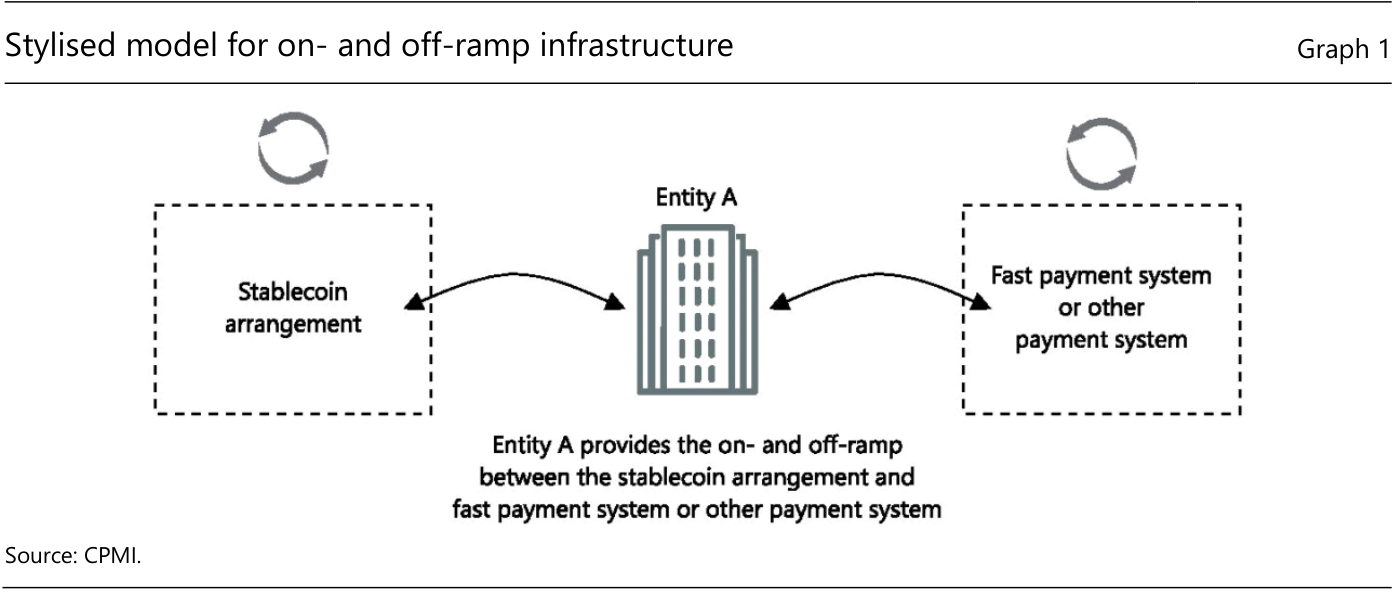
Read the diagram as text
- Stablecoin arrangement: Left dashed box: Stablecoin arrangement. Its circular two-arrow motif remains above it; the curved double-headed connection links it to Entity A.
- Entity A: The central building is labelled Entity A. Full source explanation: Entity A provides the on- and off-ramp between the stablecoin arrangement and fast payment system or other payment system. Both curved double-headed connections remain.
- Payment-system infrastructure: Right dashed box: Fast payment system or other payment system. Its circular two-arrow motif remains. Heading: Stylised model for on- and off-ramp infrastructure. Graph 1. Source: CPMI.
© BIS/CPMI. Publisher figure extracted from the PDF with complete heading, explanation and source. Original available free. This stylised 2023 model describes possible infrastructure, not a live provider or guaranteed conversion service. An on/off-ramp can involve entities and payment systems; Entity A is not necessarily a bank. Limited source extract reproduced with acknowledgement; Payments Signal’s teaching is separate.
PLAIN WORDS · 7 in this section
- pegged
- tied to the value of another currency
- rupees
- the money used in India and some nearby countries
- custodial
- held and looked after by another party
- payout
- money paid out to the person receiving it
- rungs
- steps of a ladder, or levels in rank
- stylised
- simplified into a standard, tidy form
- prescribe
- lay down as a rule to follow
PICTURE IT
A left-luggage desk at a ferry port
Picture a desk at a ferry port where travellers leave their bags. A traveller pays at the port's ordinary ticket till. Nothing is carried to the store room at that moment. The desk writes the traveller's name against a bag in its own book. The bag stands for the traveller's value, and the desk keeps it.
The bags of many travellers sit together in one big store room. The desk decides when a bag is handed back, and it keeps its own opening hours.
What the traveller really holds is the desk's promise to hand a bag over. The traveller does not hold a bag. Two travellers can swap bags at the desk by changing two lines in the book, without anyone entering the store room.
When the traveller is paid back, the money comes through the same ticket till, which closes at set hours. Before it takes or gives back a bag, the desk checks who the traveller is, and it may hold or refuse a bag.
THE REAL JOB In this custodial example, the provider converts bank money and a token position while holding customer value; identify the actual counterparty exposure.
- Riya makes an ordinary domestic payment to the ramp
- The ramp credits her a token position in its own book
- Value may move between addresses on the chain
- The ramp records the change in its book again
- The ramp makes an ordinary domestic payout on the rail's hours
HOW THE PICTURE MAPS
| In the picture | In the payment |
|---|---|
| Paying at the port's ordinary ticket till | An ordinary domestic payment to the ramp's own bank accountWho: Riya |
| The desk writing a name against a bag in its own book | The ramp crediting a token position in its own records, kept off the chain |
| A bag the desk keeps for the traveller | The value the ramp holds for the customer |
| The big store room shared by many travellers | Accounts that pool many customers; the chain is one place the ramp keeps assets |
| The desk deciding when a bag is handed back | The ramp holds the value and chooses when to release it |
| The desk's promise to hand a bag over | A claim on the firm and its solvency |
| Exchanging bags by changing two lines in the book | Two customers trading on one platform, which moves nothing on the chain |
| The ticket till's closing time when the traveller is paid back | The off-ramp payout, which follows the domestic rail's cut-off times |
| The desk checking who the traveller is and refusing a bag | The ramp identifying the customer, screening the payment and holding or refusing a transfer |
WHERE THIS PICTURE STOPS
- Handing back a bag is a physical act. A ledger’s technical completion and a transfer’s legal finality are different questions. The technical model depends on the named ledger, not on the word public.
- A desk is one place with one owner. This synthetic ramp-to-ramp example has five legs: domestic payment in, book entry, ledger transfer, book entry and domestic payout. The picture shows only the first two; other infrastructures can have different legs.
- A luggage desk has no rule that names it as a regulated business. The standard-setters decide which businesses must follow the rules by what they do for other people. A ramp falls inside it because of what it does, not its technology.
- The picture does not show mixing services, blockchain analytics or the travel rule. This topic stops at the ramp as counterparty, and the travel rule has its own topic.
- The lesson does not say how any real firm keeps client assets, which jurisdiction licenses it, or whether a given transfer is final.
- A desk has an owner you can call. A decentralised finance arrangement may have none, so the question becomes who controls it in practice.
- This is a custodial example. Some providers send tokens to a customer’s own wallet. The payout rail may operate around the clock; the provider’s controls and funding still matter.
HOOK
A custodial ramp provider holds value and creates exposure.
REMEMBER IT THIS WAY
A sequence: the real steps, in order.
Rail, book, chain, book, rail: the same five legs read forwards or backwards.
| In the trick | What it stands for |
|---|---|
| Rail | a domestic payment in to the ramp's bank account |
| Book | an internal book entry, a change in the ramp's own records |
| Chain | a transfer between addresses on the ledger, the fast leg |
| Book | another internal book entry back |
| Rail | a domestic payout, which decides when the recipient can spend |
Two customers trading on the same platform skip the chain leg, and a real arrangement may have fewer or different legs than this composite.
TELL A FRIEND
In this custodial example, a provider holds value and updates its own records. Check the custody, legal rights, conversion and payout route; other on/off-ramp infrastructure models are possible.
OFTEN MIXED UP WITH Stablecoins and tokenized deposits. The stablecoin topic asks what the token is and who issued it. This topic asks who holds your money or tokens while you cross between a bank account and the ledger. That holder is the ramp.
Sources & standards — 1 source
- Regulatory guidanceOctober 2023 CPMI report; 37-page actual PDF
Considerations for the use of stablecoin arrangements in cross-border payments ↗ — Committee on Payments and Market Infrastructures · CPMI October 2023 report, section 1.3 and Graph 1, printed pages 8–9 / PDF10–11: on/off-ramp infrastructure can comprise entities, payment systems or both; conceptual PDR arrangements, not certification of an actual provider.
The report is analytical guidance, not an endorsement of a stablecoin arrangement or evidence that a token transfer constitutes final settlement in a particular jurisdiction. Actual 37-page primary PDF recovered from the new publication download URL; sections 1–1.3, Graph 1 and 2–2.1 reread on 6 November 2026. Old d220.pdf URL redirected to HTML. The report considers conceptual properly designed and regulated arrangements and does not certify a current arrangement. Limited extracts may be reproduced with source attribution (PDF page 2).
CURRENT AS CHECKED
2 FIGURES
FATF implementation of the virtual-asset travel rule
's seventh targeted update on virtual assets and virtual asset service providers, published 16 July 2026, found 83% of surveyed jurisdictions had passed travel-rule legislation, up from 73% in 2025. Only around 40% of the jurisdictions with a law in place had taken supervisory or enforcement action to check that providers comply. The share of jurisdictions rated largely compliant with Recommendation 15 rose from 29% to 34%. These are survey measurements, re-taken with each update.
CHECKED 2026-07-27RECHECK BY 2027-07-31
Sources & standards — 1 source
- Regulatory guidance
Seventh Targeted Update on Implementation of the FATF Standards on Virtual Assets/VASPs ↗ — Financial Action Task Force · Travel Rule legislation and supervision shares, and Recommendation 15 compliance ratings
Published 16 July 2026. Finds 83% of surveyed jurisdictions have now passed Travel Rule legislation (up from 73% in 2025). But only around 40% of jurisdictions with a law in place have taken supervisory or enforcement action to check VASPs are complying with it in practice. The share of jurisdictions rated largely compliant with Recommendation 15 rose from 29% to 34%.
Financial Action Task Force: implementation of the standards for decentralised finance arrangements
The (FATF) published a targeted report on decentralised finance on 21 July 2026. Almost 93 percent of the jurisdictions that answered its survey (132 of 143) had not yet applied the to qualifying DeFi arrangements. Of 142 jurisdictions, only two had licensed or registered a DeFi arrangement in practice. The report gives a base of 143 for the first figure and 142 for the second. Read the report for the reason.
The figures come from search excerpts of the report and its press release; the report was not opened.
CHECKED 2026-10-25RECHECK BY 2027-07-31
Sources & standards — 1 source
- Scheme-specific rule
Targeted Report on Regulatory Challenges from Decentralised Finance ↗ — Financial Action Task Force · 21 July 2026 report: survey results on implementation for DeFi arrangements (search excerpt, page not opened)
Published 21 July 2026. Finds almost 93% of surveyed jurisdictions have not yet implemented the FATF Standards for qualifying DeFi arrangements, and only two of 142 have licensed or registered one in practice. It also flags that many arrangements described as 'decentralised' retain an identifiable controller, and so remain in scope of Recommendation 15 rather than escaping it.
PRACTISE AND KEEP
Sources for this topic — 11 sources
- Regulatory guidanceAs amended June 2026
The FATF Recommendations: International Standards on Combating Money Laundering and the Financing of Terrorism & Proliferation ↗ — Financial Action Task Force · Recommendation 15 and its interpretive note — the activities that make a business a virtual asset service provider
Adopted in 2012 and updated regularly since; the June 2025 FATF plenary agreed revisions to Recommendation 16 on payment transparency. Consult the live consolidated text for the current wording. V46 actual June 2026 PDF selected read 6 November: R1,3,10–12,20–21, INR20 and selected glossary criminal-activity/designated-offence entries. National implementation required; suspicion reporting differs from proof/conviction. No whole151 page certification. Reproduction requires prior written permission.
- Regulatory guidance
Policy Recommendations for Crypto and Digital Asset Markets: Final Report ↗ — International Organization of Securities Commissions (IOSCO) · Custody and client asset protection; internal off-chain recordkeeping of ownership changes in omnibus accounts
Published 16 November 2023 as an IOSCO final report. IOSCO is a standard-setter for securities regulators: its recommendations are addressed to those regulators and are not themselves law in any jurisdiction, so they are cited here as guidance and never as a requirement.
Verified from independent web-search excerpts on the access date. The publisher's own domain cannot be fetched, so no text is quoted here from the publisher's own page. A failed fetch is not evidence about what the document provides.
- Market practiceOctober 2023 CPMI report; 37-page actual PDF
Considerations for the use of stablecoin arrangements in cross-border payments ↗ — Committee on Payments and Market Infrastructures · On- and off-ramp infrastructure, and the legal, governance and finality considerations for these arrangements
The report is analytical guidance, not an endorsement of a stablecoin arrangement or evidence that a token transfer constitutes final settlement in a particular jurisdiction. Actual 37-page primary PDF recovered from the new publication download URL; sections 1–1.3, Graph 1 and 2–2.1 reread on 6 November 2026. Old d220.pdf URL redirected to HTML. The report considers conceptual properly designed and regulated arrangements and does not certify a current arrangement. Limited extracts may be reproduced with source attribution (PDF page 2).
- Market practiceSuperseded — see Glossary of payments and market infrastructure terminologyMarch 2003 edition
A glossary of terms used in payments and settlement systems ↗ — CPSS (now CPMI), Bank for International Settlements · Settlement finality, settlement asset and the vocabulary this topic contrasts a ledger transfer against
Superseded for currency, not for coverage, and that distinction is the reason this entry stays. The live glossary at bis.org/cpmi/publ/d00b.htm is the current text. This edition remains the only published CPMI definition of ten headwords the live glossary does not carry.
Both editions were downloaded and compared on the access date. The 2003 PDF is 346,977 bytes; the generated PDF of the live glossary is 197,553 bytes. Four definitions this site teaches had moved. Six passages quoted the 2003 wording of netting in prose while attributing it to the CPMI glossary, and those now say which edition they are quoting.
Checks that returned nothing, recorded so they are not repeated. Singleness of money, payment token, electronic wallet and book transfer are headwords in neither edition. A citation for any of those was pointing at a document that does not contain the term.
- Regulatory guidance
Targeted Report on Regulatory Challenges from Decentralised Finance ↗ — Financial Action Task Force · Arrangements described as decentralised that retain an identifiable controller
Published 21 July 2026. Finds almost 93% of surveyed jurisdictions have not yet implemented the FATF Standards for qualifying DeFi arrangements, and only two of 142 have licensed or registered one in practice. It also flags that many arrangements described as 'decentralised' retain an identifiable controller, and so remain in scope of Recommendation 15 rather than escaping it.
- Regulatory guidance
Updated Guidance for a Risk-Based Approach to Virtual Assets and Virtual Asset Service Providers ↗ — Financial Action Task Force · The owner/operator test for DeFi arrangements, and blockchain analytics as a peer-to-peer risk tool with real limits
Search excerpts only, page not opened, so this was read as search summarisation over the guidance's own published content and independent secondary descriptions of it, not as a direct fetch.
The guidance itself notes real limits on blockchain analytics as a risk-mitigation tool — coverage, timeliness, accuracy and reliability all vary — which is why this site frames analytics as narrowing exposure rather than eliminating it.
- Regulatory guidance
Virtual Assets Red Flag Indicators of Money Laundering and Terrorist Financing ↗ — Financial Action Task Force · Interaction with a mixing or tumbling service as an anonymity-enhancing red flag
Search excerpts only, page not opened, so this was read as search summarisation over the report's own indicator language and independent secondary descriptions of it, not as a direct fetch.
This is a red-flag catalogue for reporting entities to watch for, not a rule that mixer use is itself unlawful — the report frames mixer interaction as a signal to investigate further, alongside other indicators, rather than as a standalone finding.
- Regulatory guidance
Seventh Targeted Update on Implementation of the FATF Standards on Virtual Assets/VASPs ↗ — Financial Action Task Force · Implementation and supervision of the standards on virtual assets and their service providers
Published 16 July 2026. Finds 83% of surveyed jurisdictions have now passed Travel Rule legislation (up from 73% in 2025). But only around 40% of jurisdictions with a law in place have taken supervisory or enforcement action to check VASPs are complying with it in practice. The share of jurisdictions rated largely compliant with Recommendation 15 rose from 29% to 34%.
- Simplified educational illustration
Payments Signal editorial teaching models — Payments Signal
What this simplifies: Riya is fictional, the failed-counterparty test is our teaching device, and the leg-by-leg ramp-to-ramp description is a composite rather than any particular arrangement. No product, platform or jurisdiction's authorisation regime is characterised here.
Used wherever diagrams, scenarios, figures, or example values are didactic constructions rather than sourced facts; every such use carries a simplifications disclosure. All people, companies, banks, and list entries in examples are fictional.
- Scheme-specific ruleOriginal OJ L150,9June2023, selected provisions read; later consolidated edition not fully reviewed
Regulation (EU) 2023/1114 on markets in crypto-assets ↗ — European Union (EUR-Lex) · The EU regime for crypto-asset service providers (search excerpts; page not opened)
Actual original OJ166-page primary PDF recovered via PublicationsOffice on6November2026. Selected Articles36(1)–(3),39,48–50,54 read. Article48 covers EU offer/admission conditions, including written-consent offers/exemptions and its Member-State-currency deeming rule. This is not a full later consolidated-text review or a legal conclusion for any token. Historical ESMA search-excerpt references remain separately identified. ART redemption is not simply the same fixed-par mechanism as EMT49; recovery provisions qualify fee/redemption analysis.
- Regulatory guidanceOctober 2023 CPMI report; 37-page actual PDF
Considerations for the use of stablecoin arrangements in cross-border payments ↗ — Committee on Payments and Market Infrastructures · CPMI October 2023 report, section 1.3 and Graph 1, printed pages 8–9 / PDF10–11: on/off-ramp infrastructure can comprise entities, payment systems or both; conceptual PDR arrangements, not certification of an actual provider.
The report is analytical guidance, not an endorsement of a stablecoin arrangement or evidence that a token transfer constitutes final settlement in a particular jurisdiction. Actual 37-page primary PDF recovered from the new publication download URL; sections 1–1.3, Graph 1 and 2–2.1 reread on 6 November 2026. Old d220.pdf URL redirected to HTML. The report considers conceptual properly designed and regulated arrangements and does not certify a current arrangement. Limited extracts may be reproduced with source attribution (PDF page 2).
Deepest material on this page: L4 — Standards & sources. Where a topic stops short of implementation depth, that is a deliberate coverage decision, not an oversight — see coverage.