Stablecoins and tokenized deposits
Two ways to put private money on a ledger that settles differently. What backs each, how you redeem it, and what risk you keep are what separate them.
L1–L4 are part of the Pro pass
L0 Explain simply
If a is central-bank money in digital form, the next two instruments are in digital form — and the difference between those two sentences is the whole topic.
A stablecoin is a digital token whose issuer aims to keep it worth a fixed amount of a currency, say one unit for one euro.
A is an ordinary bank deposit represented as a token on a ledger. It is still a claim on the bank that holds it, written down a different way.
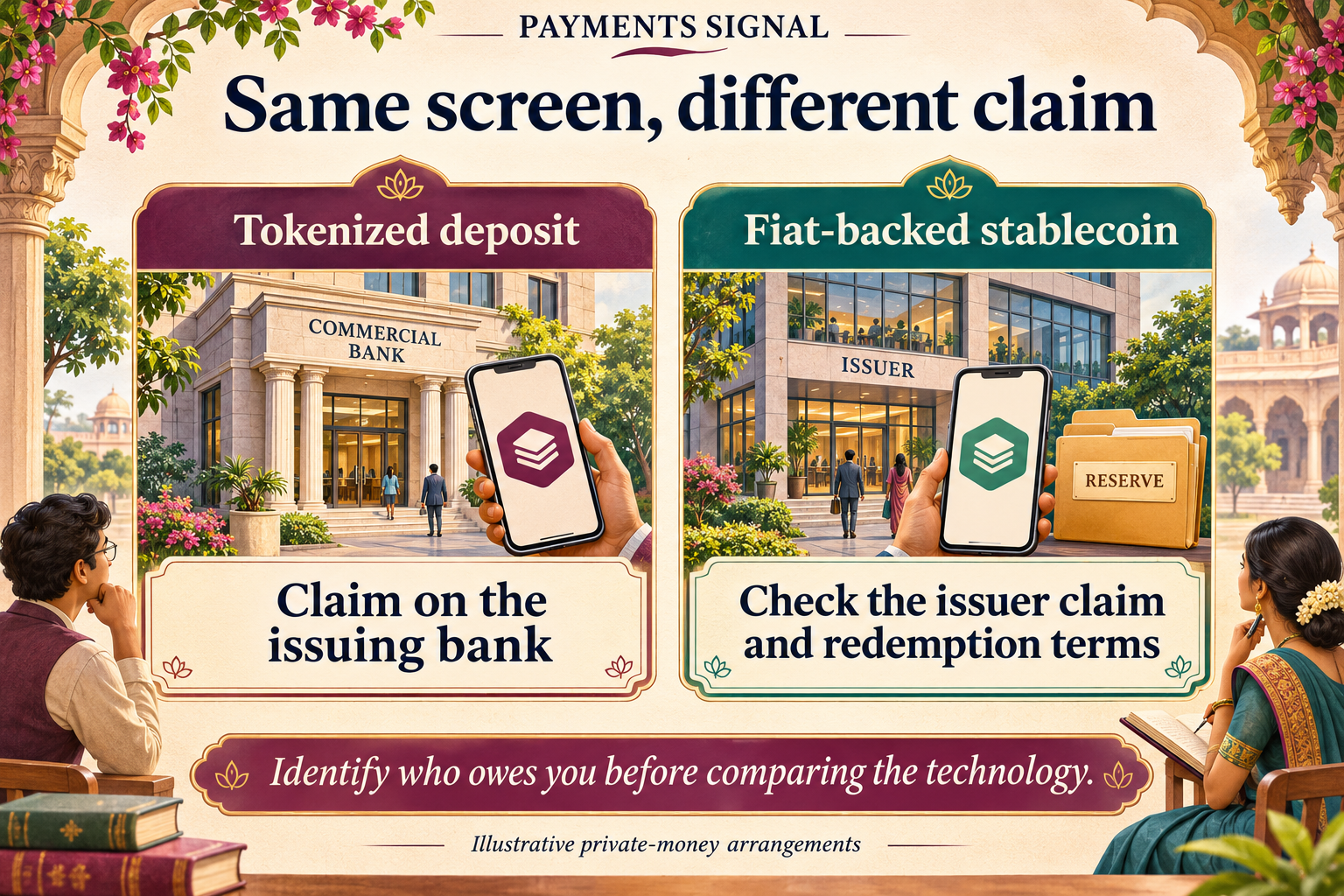
Read the diagram as text
- Tokenized deposit: Claim on the issuing bank. A generic commercial-bank building and smartphone depict the claim’s recording form, not a new central-bank liability or guaranteed deposit protection.
- Fiat-backed stablecoin: Check the issuer claim and redemption terms. Generic issuer office, smartphone and reserve folder. No automatic reserve ownership is shown. Footer: Identify who owes you before comparing the technology. Illustrative private-money arrangements.
- Deposit and prototype source links: Bank deposit liability: https://www.bankofengland.co.uk/-/media/boe/files/quarterly-bulletin/2014/money-in-the-modern-economy-an-introduction.pdf . Agorá dated prototype: https://www.bis.org/publications/project-agora-shared-programmable-platform-wholesale-cross-border-payments.pdf . These support the issuer distinction, not a claim that every token uses that prototype.
Payments Signal original conceptual private-money comparison, not a publisher figure or assessment of a named product. These are issuing roles, not a mandatory bank-versus-nonbank split or two necessarily distinct legal entities. A tokenized deposit remains a liability of its issuing bank. For a fiat-backed stablecoin, inspect the actual issuer claim, law and terms; restricted direct redemption does not automatically mean no legal claim. The reserve folder does not imply holder ownership of the assets, guaranteed par, bank-deposit status or insurance. Operating, custody and intermediary risks remain.
Both can move on a shared ledger and settle quickly. Both are private money rather than central-bank money, so both put a private institution between you and your euro.
So the plain question to ask of either is the one from the first topic in this domain. Whose promise is this, and what stands behind it?
Here is the wrong reading to head off now, because it is the most common one in the subject. A stablecoin's peg is a claim about a balance sheet, not a property of the token. Nothing in the software makes a token worth a euro; the issuer’s legal obligations, assets, redemption arrangements, custody and reliable operations matter. A ledger failure can still disrupt access or transfers.
These are forward-looking, design-dependent instruments, and concrete designs, backing arrangements and rules vary by jurisdiction. What is described here is the shape the instruments take, drawn from the sources cited on the deeper levels; no particular product is characterised.
PLAIN WORDS · 1 in this section
- peg
- a fixed link between one currency's value and another's
PICTURE IT
A bank balance on a new screen, and a prepaid card from a separate company
Picture two things in your pocket that both show a number on a phone. The first is your ordinary bank balance, now displayed in a new app. Only the display changed. The money is still a debt that your bank owes you. The second is a prepaid card sold by a separate company. The company says it keeps savings in a jar to cover every card it sold. It promises to swap a card for cash at the refund desk. The two look alike on the screen. The question that tells them apart is whose promise sits behind the number.
THE REAL JOB Both let move on a shared ledger, but the one who owes you and what stands behind the promise are different.
- Both are private money on a ledger
- Ask first: who owes you?
- Ask next: what stands behind it?
- Ask then: when can you get out?
- Ask last: what happens if the one who owes you fails?
- A tokenized deposit answers with a supervised bank
- A stablecoin answers with an issuer and its reserves
- Choosing a settlement asset is choosing a counterparty
HOW THE PICTURE MAPS
| In the picture | In the payment |
|---|---|
| The bank balance shown in a new app | A tokenized deposit: a bank deposit written down as a token |
| The bank that owes you the balance | The issuing bank, whose existing rules, supervision and credit risk still apply |
| The prepaid card from a separate company | A stablecoin, a token whose issuer aims to keep it worth a fixed amount |
| The jar of savings behind the cards | Reserve assets held against the tokens in issue |
| The refund desk that swaps a card for cash | Redemption: turning the token back into currency on demand |
| A card that sells for less than its face value | A token trading below its face value, on the market and not by anyone's decision |
WHERE THIS PICTURE STOPS
- Restricted direct redemption and absence of a legal claim are different facts. A holder may have a claim on an issuer while using an intermediary to redeem; inspect the law, terms and custody chain.
- The picture shows no reserve rules. Whether the jar is kept apart from the company's own money is a separate fact to check. So is who holds it, and whether the refund desk works on a bad day.
- The picture does not show settlement. Strict atomic execution applies all linked changes or none; DvP links final delivery to final payment without necessarily settling simultaneously. This addresses principal risk, not every risk.
- A bank balance has protections that depend on the bank, its documents and its country. The picture does not say that any deposit is covered, and it describes no real product.
HOOK
Same ledger, different promise: ask whose, and what stands behind it.
REMEMBER IT THIS WAY
A contrast: two neighbours told apart by one test.
Name the one who promises before you look at any reserve: the bank for a , the issuer for a stablecoin. The reserve is only what the issuer keeps against that promise.
| In the trick | What it stands for |
|---|---|
| Name the one who promises first | the one who owes you: the bank for a tokenized deposit, the issuer for a stablecoin |
| The reserve is only what the issuer keeps | reserve assets held against the tokens in issue |
| against that promise | a stablecoin turns on its reserve assets and whether redemption works |
Some arrangements restrict direct redemption; check separately whether the holder has a legal claim, who can redeem and which intermediary the holder must use.
TELL A FRIEND
A remains a claim on its . A stablecoin depends on its legal claim, reserves, redemption, custody and operating arrangements; software alone does not preserve its value.
OFTEN MIXED UP WITH Central bank digital currency (CBDC). A is central-bank money in digital form. Stablecoins and tokenized deposits are private money, so a private institution stands between you and your euro.
CURRENT AS CHECKED
2 FIGURES
United Kingdom - UK Finance Regulated Liability Network work (industry-led, not a regulator's programme)
The is a concept, not a live national system. UK Finance published a discovery report in September 2023 and ran an experimentation phase with eleven member firms that concluded in September 2024. In September 2025 it announced a live pilot, backed by six banks, to deliver tokenised sterling deposits against three use cases, due to run until mid-2026.
No outcome report for the pilot was found as of this date.
CHECKED 2026-10-11RECHECK BY 2027-04-11
Sources & standards — 3 sources
- Market practice
Regulated Liability Network: UK Discovery Phase ↗ — UK Finance · UK Finance Regulated Liability Network discovery phase report, September 2023: the RLN concept is a regulated financial market infrastructure with a shared ledger recording liabilities of central banks, commercial banks and regulated non-banks; each issuer has its own partition; only regulated entities issue; technology neutral (search excerpts, page not opened)
An industry trade body, not a regulator. Search excerpts only, page not opened: verified from web-search excerpts on the access date. A failed fetch is not evidence about what the document provides.
- Market practice
UK RLN Experimentation Phase Summary report ↗ — UK Finance · UK Finance RLN experimentation phase summary report, September 2024: programmable payments in commercial bank money tested with member banks; tokenised deposits described as an incremental development of commercial bank money consistent with the singleness of money (search excerpts, page not opened)
The report argues a position; it is not a regulator's view. Search excerpts only, page not opened: verified from web-search excerpts on the access date. A failed fetch is not evidence about what the document provides.
- Market practice
UK Finance announces live pilot phase to deliver tokenised sterling deposits ↗ — UK Finance · UK Finance announcement of September 2025 of a live pilot phase to deliver tokenised sterling deposits against three use cases, backed by six banks and due to run until mid-2026; the pilot outcome was not found (search excerpt, page not opened)
The pilot outcome was not found. Search excerpts only, page not opened: verified from web-search excerpts on the access date. A failed fetch is not evidence about what the document provides.
FATF implementation of the virtual-asset travel rule
's seventh targeted update on virtual assets and virtual asset service providers, published 16 July 2026, found 83% of surveyed jurisdictions had passed travel-rule legislation, up from 73% in 2025. Only around 40% of the jurisdictions with a law in place had taken supervisory or enforcement action to check that providers comply. The share of jurisdictions rated largely compliant with Recommendation 15 rose from 29% to 34%. These are survey measurements, re-taken with each update.
CHECKED 2026-07-27RECHECK BY 2027-07-31
Sources & standards — 1 source
- Regulatory guidance
Seventh Targeted Update on Implementation of the FATF Standards on Virtual Assets/VASPs ↗ — Financial Action Task Force · Travel Rule legislation and supervision shares, and Recommendation 15 compliance ratings
Published 16 July 2026. Finds 83% of surveyed jurisdictions have now passed Travel Rule legislation (up from 73% in 2025). But only around 40% of jurisdictions with a law in place have taken supervisory or enforcement action to check VASPs are complying with it in practice. The share of jurisdictions rated largely compliant with Recommendation 15 rose from 29% to 34%.
PRACTISE AND KEEP
Sources for this topic — 15 sources
- Official requirement
Principles for financial market infrastructures ↗ — CPMI and IOSCO (Bank for International Settlements)
V40 actual primary PDF read at https://www.bis.org/publications/principles-financial-market-infrastructures.pdf :complete3.4.1–3.4.7,3.8.1–3.8.8 and AnnexD payment designs through liquidity-saving discussion (printed38–40,64–66,148–149). Cover/title verified;not full188page reading. Specific credit/liquidity/finality/design statements here use these sections. Earlier registry scope/history:Published by the CPSS (now CPMI) and IOSCO; contains 24 principles plus responsibilities for authorities. This site uses it only for high-level concepts such as settlement finality.
- Regulatory guidanceAs amended June 2026
The FATF Recommendations: International Standards on Combating Money Laundering and the Financing of Terrorism & Proliferation ↗ — Financial Action Task Force
Adopted in 2012 and updated regularly since; the June 2025 FATF plenary agreed revisions to Recommendation 16 on payment transparency. Consult the live consolidated text for the current wording. V46 actual June 2026 PDF selected read 6 November: R1,3,10–12,20–21, INR20 and selected glossary criminal-activity/designated-offence entries. National implementation required; suspicion reporting differs from proof/conviction. No whole151 page certification. Reproduction requires prior written permission.
- Market practiceSuperseded — see Glossary of payments and market infrastructure terminologyMarch 2003 edition
A glossary of terms used in payments and settlement systems ↗ — CPSS (now CPMI), Bank for International Settlements
Superseded for currency, not for coverage, and that distinction is the reason this entry stays. The live glossary at bis.org/cpmi/publ/d00b.htm is the current text. This edition remains the only published CPMI definition of ten headwords the live glossary does not carry.
Both editions were downloaded and compared on the access date. The 2003 PDF is 346,977 bytes; the generated PDF of the live glossary is 197,553 bytes. Four definitions this site teaches had moved. Six passages quoted the 2003 wording of netting in prose while attributing it to the CPMI glossary, and those now say which edition they are quoting.
Checks that returned nothing, recorded so they are not repeated. Singleness of money, payment token, electronic wallet and book transfer are headwords in neither edition. A citation for any of those was pointing at a document that does not contain the term.
- Market practice
Tokenisation in the context of money and other assets ↗ — Committee on Payments and Market Infrastructures
The report supports architecture questions and risk boundaries; it does not make a tokenised deposit, security, or settlement arrangement compliant by design.
- Market practiceOctober 2023 CPMI report; 37-page actual PDF
Considerations for the use of stablecoin arrangements in cross-border payments ↗ — Committee on Payments and Market Infrastructures
The report is analytical guidance, not an endorsement of a stablecoin arrangement or evidence that a token transfer constitutes final settlement in a particular jurisdiction. Actual 37-page primary PDF recovered from the new publication download URL; sections 1–1.3, Graph 1 and 2–2.1 reread on 6 November 2026. Old d220.pdf URL redirected to HTML. The report considers conceptual properly designed and regulated arrangements and does not certify a current arrangement. Limited extracts may be reproduced with source attribution (PDF page 2).
- Market practice
Seventh Targeted Update on Implementation of the FATF Standards on Virtual Assets/VASPs ↗ — Financial Action Task Force
Published 16 July 2026. Finds 83% of surveyed jurisdictions have now passed Travel Rule legislation (up from 73% in 2025). But only around 40% of jurisdictions with a law in place have taken supervisory or enforcement action to check VASPs are complying with it in practice. The share of jurisdictions rated largely compliant with Recommendation 15 rose from 29% to 34%.
- Market practice
Regulated Liability Network: UK Discovery Phase ↗ — UK Finance · UK Finance Regulated Liability Network discovery phase report, September 2023: the RLN concept is a regulated financial market infrastructure with a shared ledger recording liabilities of central banks, commercial banks and regulated non-banks; each issuer has its own partition; only regulated entities issue; technology neutral (search excerpts, page not opened)
An industry trade body, not a regulator. Search excerpts only, page not opened: verified from web-search excerpts on the access date. A failed fetch is not evidence about what the document provides.
- Market practice
UK RLN Experimentation Phase Summary report ↗ — UK Finance · UK Finance RLN experimentation phase summary report, September 2024: programmable payments in commercial bank money tested with member banks; tokenised deposits described as an incremental development of commercial bank money consistent with the singleness of money (search excerpts, page not opened)
The report argues a position; it is not a regulator's view. Search excerpts only, page not opened: verified from web-search excerpts on the access date. A failed fetch is not evidence about what the document provides.
- Market practice
UK Finance announces live pilot phase to deliver tokenised sterling deposits ↗ — UK Finance · UK Finance announcement of September 2025 of a live pilot phase to deliver tokenised sterling deposits against three use cases, backed by six banks and due to run until mid-2026; the pilot outcome was not found (search excerpt, page not opened)
The pilot outcome was not found. Search excerpts only, page not opened: verified from web-search excerpts on the access date. A failed fetch is not evidence about what the document provides.
- Scheme-specific rule
Innovations in the use by deposit-takers of deposits, e-money and regulated stablecoins (PRA Dear CEO letter, May 2026) ↗ — Bank of England (Prudential Regulation Authority) · PRA Dear CEO letter on innovations in the use by deposit-takers of deposits, e-money and regulated stablecoins, May 2026 (replacing the November 2023 letter, reaffirming its expectations): retail tokenised deposits are expected to meet the PRA's depositor protection rules; e-money or stablecoins for retail customers should come from a separate, insolvency-remote, non-bank entity; tokenised deposits are described as deposit claims on programmable ledgers, with no formal rule definition found (search excerpts, page not opened; the letter text was not read)
The May 2026 letter was seen only in search excerpts. Search excerpts only, page not opened: verified from web-search excerpts on the access date. A failed fetch is not evidence about what the document provides.
- Market practice
ISDA Tokenized Collateral Guidance Note ↗ — International Swaps and Derivatives Association · ISDA Tokenized Collateral Guidance Note, May 2024: tokenisation as a technological and legal process of attaching enforceable rights to entries in a ledger system; distinguishes bearer, registered and claims structures (search excerpt, page not opened)
Trade body guidance, not law. Search excerpts only, page not opened: verified from web-search excerpts on the access date. A failed fetch is not evidence about what the document provides.
- Scheme-specific rule
Capital Treatment of Tokenized Securities Frequently Asked Questions ↗ — Board of Governors of the Federal Reserve System · Federal Reserve capital-treatment FAQs: a tokenised security is assessed against the financial collateral definition in the capital rule and is subject to the same haircuts as the non-tokenised form (search excerpt, page not opened)
United States capital treatment only. Search excerpts only, page not opened: verified from web-search excerpts on the access date. A failed fetch is not evidence about what the document provides.
- Simplified educational illustration
Payments Signal editorial teaching models — Payments Signal
What this simplifies: The four-question comparison and the perimeter framing are this site's teaching devices, and the bank named in them is fictional. Whether a particular token behaves as described depends on its issuer, its documentation and its jurisdiction.
Used wherever diagrams, scenarios, figures, or example values are didactic constructions rather than sourced facts; every such use carries a simplifications disclosure. All people, companies, banks, and list entries in examples are fictional.
- Market practice
III. The next-generation monetary and financial system (BIS Annual Economic Report 2025) ↗ — Bank for International Settlements · Chapter III of the 2025 Annual Economic Report: stablecoins tested against singleness, elasticity and integrity (search excerpt, page not opened)
Actual 2025 Chapter III PDF read on 6 November 2026: pp77–79 introduction and pp85–87 stablecoin singleness, elasticity and integrity. This is the BIS analysis, not a binding requirement. Selected source text is now read; the 2026 report is not substituted or represented as reviewed.
- Scheme-specific rule
Application of the Principles for Financial Market Infrastructures to stablecoin arrangements ↗ — CPMI and IOSCO (Bank for International Settlements) · July 2022 guidance applying the PFMI to systemically important stablecoin arrangements, with no new standards (search excerpt, page not opened)
Actual July 2022 PDF read on 6 November 2026: section 3.4.1–3.4.6. Guidance addresses systemically important stablecoin arrangements, defines legal finality, describes possible probabilistic settlement and forks, and requires maintaining alignment of ledger and legal state. This supersedes earlier excerpt-only access for these selected sections; it does not certify every ledger or the entire document.
Deepest material on this page: L4 — Standards & sources. Where a topic stops short of implementation depth, that is a deliberate coverage decision, not an oversight — see coverage.