What money is, and where bank money comes from
Money is a shared agreement with three jobs. Most of it is a bank's promise, made when a bank lends and cancelled when the loan is repaid.
L1–L4 are part of the Pro pass
L0 Explain simply
Money is a shared agreement. A coin, a note or a bank balance has little use by itself. It works because strangers expect the next person to accept it too.
That agreement does three jobs. Money is a : you hand it over to get something. You do not need to find someone who wants what you have. It is a unit of account: prices, wages and debts are written in it, so you can compare a loaf of bread with a lamp. It is a store of value: you can keep it today and spend it later. No money does the third job perfectly, because prices can rise.
Most money today is . It means money with no promise to convert it into a fixed amount of gold or another commodity. Its value rests on trust and on being accepted. is a narrower idea: a law that says a debt paid in certain notes and coins counts as paid. Legal tender rules usually cover only notes and coins, and they differ from country to country.
Now a story. (SYNTHETIC / TRAINING ONLY: every person and bank in this topic is invented.) Riya wants a small loan to rent a shop for her baking. Northstar Bank funds the loan by crediting Riya’s deposit account. It records a loan asset and matching deposit liability together. This is an actual credit in the story, not merely a loan-approval notification. The bank does not need to reduce another customer’s deposit to make those matching entries.
Riya pays her landlord, Arjun, the first month's rent. The money moves from her balance to his. In this fee-free transfer example, the existing deposit moves; no new loan is made. Later Riya repays loan principal to Northstar Bank. Her balance falls and her debt falls with it, and that money is deleted. So bank lending creates deposits, and repayment of principal reduces them.
This is bank money: a promise by a commercial bank to pay you. Commercial bank deposits are our example of , an economics term linked to private credit. illustrate the contrasting outside money category in this lesson. These research labels have wider definitions. Identify the actual issuer: national note and coin arrangements differ, so not every physical note is itself the central bank’s liability.
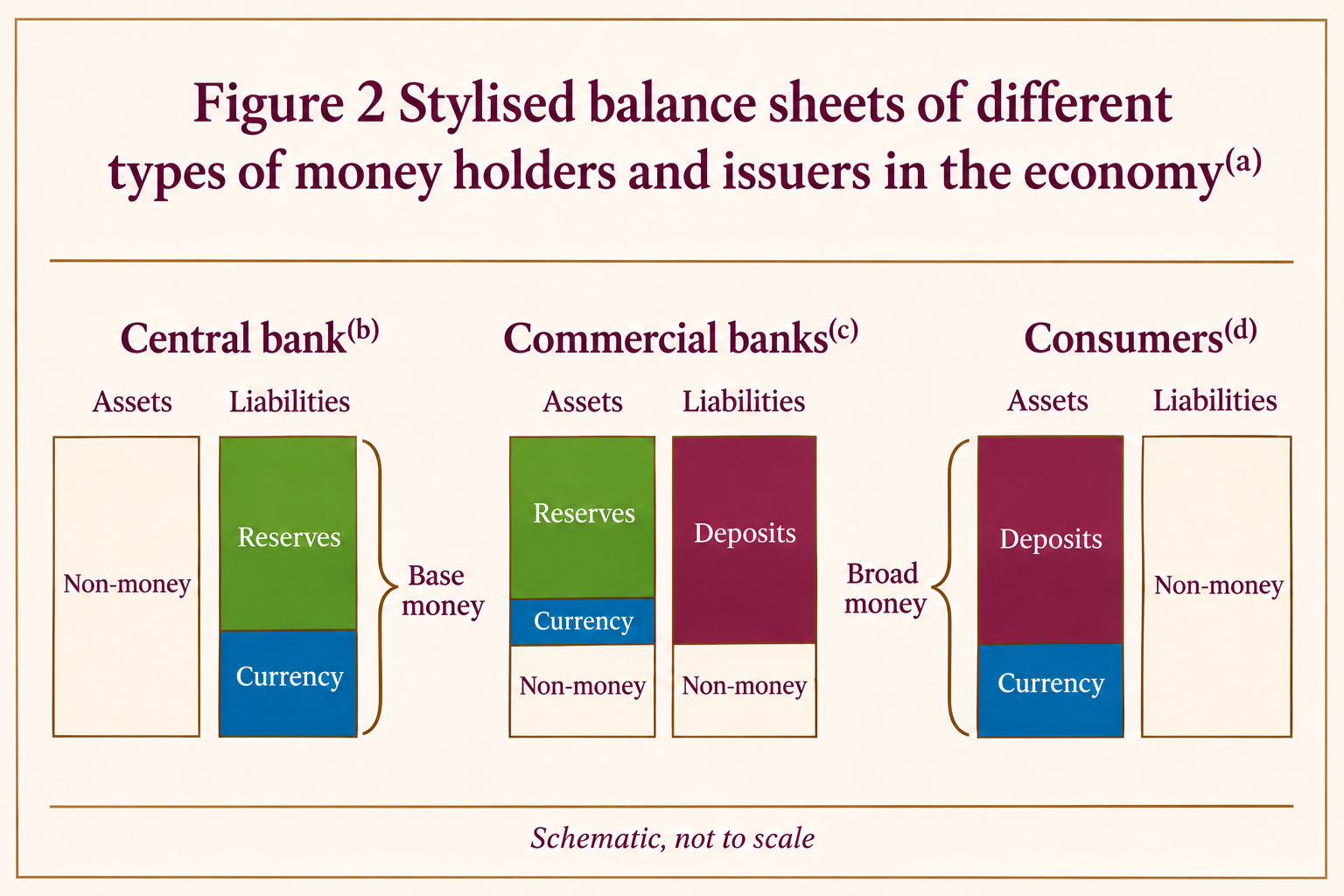
Read the diagram as text
- Central bank(b): One non-money asset block matches reserves and currency liabilities. The Base money brace spans the entire pictured liability column.
- Commercial banks(c): Bank assets comprise reserves, currency and non-money assets; liabilities comprise deposits and non-money liabilities.
- Consumers(d): Consumers’ deposit and currency assets are bracketed as Broad money; non-money liabilities stand in the separate right column.
- Source footnote(a) — schematic quantities: The block sizes are explanatory drawings. They do not measure the actual amounts each sector holds.
- Source footnote(b) — central-bank scope: This sheet includes base-money liabilities and matching assets, omitting other central-bank liabilities. The source describes mainly government-debt assets and qualifies their accounting presentation through the Bank of England’s Asset Purchase Facility; this is its2014 explanatory model, not a current full balance sheet.
- Source footnote(c) — bank non-money items: Non-money bank assets can include government debt. The other liability category includes long-term debt and equity, rather than treating all bank funding as deposits.
- Source footnote(d) — consumer scope: Consumers here includes households and companies. The source shows broad-money assets and matching liabilities; the non-money liabilities include secured and unsecured loans.
Read each group’s books: assets show what it holds, including claims on others; liabilities show what it owes. The same IOU can be an asset for its holder and a liability for its issuer. Payments Signal original educational presentation recreation of Bank of England Figure2 (Quarterly Bulletin2014Q1, printedp8), not unchanged publisher bytes. This highly stylised UK2014 model shows stocks and corresponding claims, not a payment flow, current quantities or today’s access rules. Currency includes notes and coins; the article notes that some Scottish/Northern Irish commercial banks issue notes and the Royal Mint produces coins. It does not mean every banknote is a central-bank liability. The complete source footnotes(a)–(d) follow in the accessible transcript.
Read the diagram as text
- Central bank(b): One non-money asset block matches reserves and currency liabilities. The Base money brace spans the entire pictured liability column.
- Commercial banks(c): Bank assets comprise reserves, currency and non-money assets; liabilities comprise deposits and non-money liabilities.
- Consumers(d): Consumers’ deposit and currency assets are bracketed as Broad money; non-money liabilities stand in the separate right column.
- Source footnote(a) — schematic quantities: The block sizes are explanatory drawings. They do not measure the actual amounts each sector holds.
- Source footnote(b) — central-bank scope: This sheet includes base-money liabilities and matching assets, omitting other central-bank liabilities. The source describes mainly government-debt assets and qualifies their accounting presentation through the Bank of England’s Asset Purchase Facility; this is its2014 explanatory model, not a current full balance sheet.
- Source footnote(c) — bank non-money items: Non-money bank assets can include government debt. The other liability category includes long-term debt and equity, rather than treating all bank funding as deposits.
- Source footnote(d) — consumer scope: Consumers here includes households and companies. The source shows broad-money assets and matching liabilities; the non-money liabilities include secured and unsecured loans.
PICTURE IT
The chalkboard in the village hall
Picture a village hall with one wall board and one keeper. Each villager has a line on the board showing the marks the keeper owes them. The villagers pay each other by asking the keeper to rub marks off one line and write them on another. When a villager needs more, the keeper can lend. The keeper writes new marks on that villager's line. Beside them, the keeper writes the villager's promise to give them back. When the villager gives the marks back, the keeper wipes out the marks and the promise together.
THE REAL JOB Money lets strangers trade, and most of it is a bank's promise, made when the bank lends and erased when the loan is paid back.
- Riya asks Northstar Bank for a small loan
- Northstar Bank records two things: Riya's debt, and a balance it owes her
- Riya pays Arjun: the balance moves and the total stays the same
- If Arjun banks elsewhere, identify the actual settlement asset and route
- Riya repays: her debt and her balance both fall
- That money is gone, and limits shaped how much the bank could lend
HOW THE PICTURE MAPS
| In the picture | In the payment |
|---|---|
| The keeper of the chalkboard | A commercial bank, such as Northstar Bank |
| A villager's line of marks that the keeper owes them | A customer's bank balance, which is the bank's promise to pay |
| Keeper writes new marks and the villager's promise together | A funded loan: matching loan asset and deposit liability |
| Marks rubbed off one line and written on another | A payment between customers: existing money moves and the total stays the same |
| Keeper wipes out the marks and the promise together | Repayment: the balance and the debt both fall, so that money is destroyed |
| The keeper's rules about whom to lend to | The limits on a bank: profit, safety rules and monetary policy |
WHERE THIS PICTURE STOPS
- The hall has one keeper; separate institutions need an actual settlement arrangement, which need not always use central bank money.
- A keeper can write marks without rules. A real bank cannot. Three things limit it. They are its profit, the safety rules regulators set, and the central bank's monetary policy.
- The picture leaves out interest and fees, and it does not show a bank failing. A real bank can fail, and rules and insurance then decide what customers get back, which differ by country.
- The board does not represent the full inside/outside research framework or every country’s cash issuer and legal-tender rules.
HOOK
Bank lending creates deposits; principal repayment reduces them.
REMEMBER IT THIS WAY
A sequence: the real steps, in order.
Make, move, remove: a loan makes a balance, a payment moves it, and repayment removes it.
| In the trick | What it stands for |
|---|---|
| Make | the bank makes a balance and a debt together when it lends |
| Move | the borrower pays someone and the balance moves to them, so the total stays the same |
| Remove | the borrower repays and the balance and the debt both fall, so the money is destroyed |
Interest and fees are left out, and a bank's limits decide whether it can make a loan at all.
TELL A FRIEND
Money is a shared agreement that does three jobs. When a bank makes a loan it creates a matching balance, and repaying the loan removes it, within limits.
OFTEN MIXED UP WITH Money, accounts, and ledgers. This topic explains money and funded loan/deposit creation; the next follows the issuer claims and actual settlement arrangements.
Sources & standards — 7 sources
- Market practice
What is money? (explainer) ↗ — Bank of England · BoE What is money?, displayed update 27 February 2025, complete main body and transcript freshly read 7 November 2026. Functions/common price unit and commodity/fiat discussion; not a formal instrument taxonomy or new certification of current UK money shares.
Verified on 2026-10-11 from web-search excerpts only: the pages were not opened by this author, so nothing here is quoted from a page this environment rendered. The Bank's own explainer text was returned in the search result.
- Market practice
Money creation in the modern economy (Quarterly Bulletin 2014 Q1) ↗ — Bank of England · BoE Money creation in the modern economy, 2014 Q1 complete PDF1–2/printed 14–15 overview: matching loan/deposit, repayment, limits and non-bank asset-purchase overview. Not whole 14 pages/current monetary operations.
Verified on 2026-10-11 from web-search excerpts only: the pages were not opened by this author, so nothing here is quoted from a page this environment rendered. The mechanism and the limits statement were returned in the Bank's own page snippet. The repayment point was corroborated in the Bank's online explainer How is money created?. An explanation by central bank staff, not law or a scheme rule.
- Simplified educational illustration
Payments Signal editorial teaching models — Payments Signal · The story uses one invented bank and one loan with no interest, fees, deposit insurance or reserve rules; real banks and countries differ
Used wherever diagrams, scenarios, figures, or example values are didactic constructions rather than sourced facts; every such use carries a simplifications disclosure. All people, companies, banks, and list entries in examples are fictional.
- Market practice
It's all about the role of money - speech by Nathanaël Benjamin ↗ — Bank of England · Bank of England speech by Nathanael Benjamin (July 2026): lists money's core functions as a safe store of value, a reliable unit of account and an effective medium of exchange (search excerpt, page not opened)
Verified on 2026-10-11 from a web-search excerpt only: page not opened. A Bank of England official speech, not law or a scheme rule.
- Market practice
Bank for International Settlements (BIS), role of central-bank money (August 2003), sections 1.1–1.3, Figures 1 and 4 ↗ — Bank for International Settlements (BIS) · BIS, role of central-bank money (August 2003), sections 1.1–1.3, Figures 1 and 4; relevant source sections opened and reviewed
relevant source sections opened and reviewed. See the Foundations V7 analysis for source/version boundaries.
- Market practice
Money in the modern economy: an introduction (Quarterly Bulletin 2014 Q1) ↗ — Bank of England · BoE Quarterly Bulletin 2014 Q1 Introduction, complete PDF1–2/printed 4–5 and PDF4–5/printed 7–8, functions/IOUs/Figure2footnotes. Fresh 7 November 2026 selected historical UKmodel, not whole 10 pages or current country totals.
Verified on 2026-10-11 from web-search excerpts only: the pages were not opened by this author, so nothing here is quoted from a page this environment rendered. Unit of account and store of value are not claimed from this article; those functions rest on the 2026 Bank of England speech. The gold-exchange point came from a search summary that was cut off mid-sentence, so the date the exchange ended is not used.
- Market practice
Federal Reserve Bank of Minneapolis Staff Report 374 (2006): inside money and outside money ↗ — Federal Reserve Bank of Minneapolis · Ricardo Lagos Staff Report 374(2006), complete official Minneapolis Fed abstract/DOI/publicationmetadata freshlyread 7 November 2026. Inside/outside privatecredit/backing classification, not full 8-page paper or a statutory issuer rule.
Verified on 2026-10-11 from web-search excerpts only: the pages were not opened by this author, so nothing here is quoted from a page this environment rendered. The report title is not recorded because only the abstract line was returned; the entry is named by its report number. The Wikipedia article Inside money and outside money gave the same split in the same search and is not cited.
7 November 2026: complete official publisher abstract, DOI and publication metadata freshly read at this working URL. Original fedinprint discovery path and prior search scope remain historical evidence. PDF click returned 403; normal web search and official abstract worked. No full 8-page paper reading or present-day legal classification inferred.
PRACTISE AND KEEP
Sources for this topic — 15 sources
- Market practice
Money creation in the modern economy (Quarterly Bulletin 2014 Q1) ↗ — Bank of England · BoE Money creation in the modern economy, 2014 Q1 complete PDF1–2/printed 14–15 overview: matching loan/deposit, repayment, limits and non-bank asset-purchase overview. Not whole 14 pages/current monetary operations.
Verified on 2026-10-11 from web-search excerpts only: the pages were not opened by this author, so nothing here is quoted from a page this environment rendered. The mechanism and the limits statement were returned in the Bank's own page snippet. The repayment point was corroborated in the Bank's online explainer How is money created?. An explanation by central bank staff, not law or a scheme rule.
- Market practice
How is money created? (explainer) ↗ — Bank of England · How is money created? explainer: lending creates money, repayment deletes it; regulation, including capital requirements, limits it
Verified on 2026-10-11 from web-search excerpts only: the pages were not opened by this author, so nothing here is quoted from a page this environment rendered. The search tool's summary of the explainer said the electronic money created for a loan is deleted as it is paid off. The explainer excerpt did not mention profitability or the policy rate, so those limits rest on the 2021 Bank of England paper instead.
- Market practice
Money in the modern economy: an introduction (Quarterly Bulletin 2014 Q1) ↗ — Bank of England · BoE Quarterly Bulletin 2014 Q1 Introduction, complete PDF1–2/printed 4–5 and PDF4–5/printed 7–8, functions/IOUs/Figure2footnotes. Fresh 7 November 2026 selected historical UKmodel, not whole 10 pages or current country totals.
Verified on 2026-10-11 from web-search excerpts only: the pages were not opened by this author, so nothing here is quoted from a page this environment rendered. Unit of account and store of value are not claimed from this article; those functions rest on the 2026 Bank of England speech. The gold-exchange point came from a search summary that was cut off mid-sentence, so the date the exchange ended is not used.
- Market practice
What is money? (explainer) ↗ — Bank of England · BoE What is money?, displayed update 27 February 2025, complete main body and transcript freshly read 7 November 2026. Functions/common price unit and commodity/fiat discussion; not a formal instrument taxonomy or new certification of current UK money shares.
Verified on 2026-10-11 from web-search excerpts only: the pages were not opened by this author, so nothing here is quoted from a page this environment rendered. The Bank's own explainer text was returned in the search result.
- Regulatory guidance
The euro as legal tender ↗ — European Commission, Directorate-General for Economic and Financial Affairs · European Commission current Euro as legal tender main body, read 7 November 2026: mandatory acceptance in principle/full face value/debt discharge/exceptions;2023 proposal remains described as proposal. Underlying judgment/regulations not independently fully read.
What this simplifies: Describes the euro area only. Other countries set their own legal tender rules.
Verified on 2026-10-11 from web-search excerpts only: the pages were not opened by this author, so nothing here is quoted from a page this environment rendered. Corroborated by the Court of Justice of the EU case summary and the ECB's pages on acceptance of cash, which came back in the same search and make the same point that legal tender means acceptance in principle, not absolute acceptance.
- Market practice
How is money created? (frequently asked questions) ↗ — Banco de España · A bank that grants a loan and credits the account creates inside money
Verified on 2026-10-11 from web-search excerpts only: the pages were not opened by this author, so nothing here is quoted from a page this environment rendered. A national central bank page that uses the term, found because the BIS, the Federal Reserve and the ECB pages did not define it.
- Market practice
Federal Reserve Bank of Minneapolis Staff Report 374 (2006): inside money and outside money ↗ — Federal Reserve Bank of Minneapolis · Ricardo Lagos Staff Report 374(2006), complete official Minneapolis Fed abstract/DOI/publicationmetadata freshlyread 7 November 2026. Inside/outside privatecredit/backing classification, not full 8-page paper or a statutory issuer rule.
What this simplifies: Economists define outside money more widely than central bank money; the site uses the pair as plain labels.
Verified on 2026-10-11 from web-search excerpts only: the pages were not opened by this author, so nothing here is quoted from a page this environment rendered. The report title is not recorded because only the abstract line was returned; the entry is named by its report number. The Wikipedia article Inside money and outside money gave the same split in the same search and is not cited.
7 November 2026: complete official publisher abstract, DOI and publication metadata freshly read at this working URL. Original fedinprint discovery path and prior search scope remain historical evidence. PDF click returned 403; normal web search and official abstract worked. No full 8-page paper reading or present-day legal classification inferred.
- Market practiceSuperseded — see Glossary of payments and market infrastructure terminologyMarch 2003 edition
A glossary of terms used in payments and settlement systems ↗ — CPSS (now CPMI), Bank for International Settlements · central bank money and commercial bank money
Superseded for currency, not for coverage, and that distinction is the reason this entry stays. The live glossary at bis.org/cpmi/publ/d00b.htm is the current text. This edition remains the only published CPMI definition of ten headwords the live glossary does not carry.
Both editions were downloaded and compared on the access date. The 2003 PDF is 346,977 bytes; the generated PDF of the live glossary is 197,553 bytes. Four definitions this site teaches had moved. Six passages quoted the 2003 wording of netting in prose while attributing it to the CPMI glossary, and those now say which edition they are quoting.
Checks that returned nothing, recorded so they are not repeated. Singleness of money, payment token, electronic wallet and book transfer are headwords in neither edition. A citation for any of those was pointing at a document that does not contain the term.
- Simplified educational illustration
Payments Signal editorial teaching models — Payments Signal · One invented bank and one loan, with no interest, fees, deposit insurance or reserve rules
What this simplifies: Real loans carry interest and fees, and rules differ by country.
Used wherever diagrams, scenarios, figures, or example values are didactic constructions rather than sourced facts; every such use carries a simplifications disclosure. All people, companies, banks, and list entries in examples are fictional.
- Market practice
It's all about the role of money - speech by Nathanaël Benjamin ↗ — Bank of England · The three core functions of money
Verified on 2026-10-11 from a web-search excerpt only: page not opened. A Bank of England official speech, not law or a scheme rule.
- Market practice
New forms of digital money (discussion paper, 2021) ↗ — Bank of England · New forms of digital money (2021): profitability in a competitive system, prudential regulation and monetary policy limit money creation
Verified on 2026-10-11 from a web-search excerpt only: page not opened. The excerpt was returned for a query limited to the Bank of England domain and quotes the profitability, prudential regulation and ultimate-limit wording. A Bank of England discussion paper, not law or a scheme rule.
- Market practice
What is legal tender? ↗ — Bank of England · BoE What is legal tender?, updated 26 February 2025, complete main body freshlyread 7 November 2026: full debt offer/no alternate contract, UK regional differences/coin limits/shop acceptance. Explainer, not full statute/case-law review.
Search excerpt, page not opened. Read from web-search excerpts on 2026-10-12. The excerpts state that Royal Mint coins and Bank of England notes are legal tender in England and Wales, only Royal Mint coins in Scotland and Northern Ireland, and that a creditor offered the exact amount in legal tender cannot sue for non-payment unless a contract names another way to pay. Rules are for the United Kingdom only.
- Market practice
Bank for International Settlements (BIS), role of central-bank money (August 2003), sections 1.1–1.3, Figures 1 and 4 ↗ — Bank for International Settlements (BIS) · BIS, role of central-bank money (August 2003), sections 1.1–1.3, Figures 1 and 4; relevant source sections opened and reviewed
relevant source sections opened and reviewed. See the Foundations V7 analysis for source/version boundaries.
- Market practiceExplainer displayed as updated 1 April 2026
What is capital? ↗ — Bank of England · BoE What is capital?, displayedupdate 1 April 2026, complete main body read 7 November 2026; loss absorption/retained earnings/new shares concepts only, not full regulatory capital calculation or deposit-protection eligibility certification.
Complete main body and stress-test transcript freshly read 7 November 2026 via normal web reader. The page includes dated historical and deposit-protection figures, but this curriculum citation uses only conceptual loss-absorption/funding examples. No new guarantee of bank safety, universal capital ratio or full Basel/national regime review.
- Regulatory guidance
Principles for financial market infrastructures ↗ — CPMI and IOSCO (Bank for International Settlements) · PFMI April 2012 Principle 9 complete head/key considerations/§§3.9.1–8 and footnotes 96–98, printed 67–69/PDF73–75: practical/available central bank money, commercial/FMI own-book alternatives and claim-holder. Not every current operator profile.
V40 actual primary PDF read at https://www.bis.org/publications/principles-financial-market-infrastructures.pdf :complete3.4.1–3.4.7,3.8.1–3.8.8 and AnnexD payment designs through liquidity-saving discussion (printed38–40,64–66,148–149). Cover/title verified;not full188page reading. Specific credit/liquidity/finality/design statements here use these sections. Earlier registry scope/history:Published by the CPSS (now CPMI) and IOSCO; contains 24 principles plus responsibilities for authorities. This site uses it only for high-level concepts such as settlement finality.
Deepest material on this page: L4 — Standards & sources. Where a topic stops short of implementation depth, that is a deliberate coverage decision, not an oversight — see coverage.