How a bank account is addressed
Every payment address has two parts, one for the bank and one for the account, whatever each country calls them.
L1–L4 are part of the Pro pass
L0 Explain simply
When Riya pays her landlord Arjun, her bank needs more than his name. Two people can share a name. A name can be spelled three ways. So the bank asks for account identifiers, which can contain letters as well as digits. An exact string can still name the wrong account.
Think of a . The town and street tell the post office which building to go to. The flat number then picks the one door inside that building. For this ordinary account-payment example, the postal picture helps separate two jobs. One part says which bank. The other says which account at that bank.
Different countries write those two parts in different ways. In the United Kingdom they are a and an account number. In the United States they are a and an account number. In countries that use the International Bank Account Number (IBAN), that identifies the account using a national format. A Business Identifier Code (BIC) or another institution identifier may be required for the selected route; IBAN and BIC are not a universal pair for every international payment. The selected service determines which identifiers and any extra reference it needs.
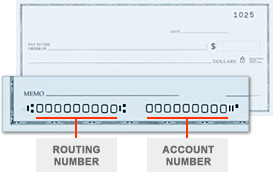
Read the diagram as text
- Find the routing number: The example labels the field at left as the routing number. Its nine digits identify the institution through the selected payment service.
- Find the account number: The sample labels the separate field to the right as the account number. Keep its full string, including any leading zeros.
This US example shows how the two fields identify different things. The routing number identifies the institution for the selected service. The account number identifies the account in that institution’s records.
Read the original at full size here
Use touch, a trackpad, or the arrow keys in the image area.
Why does this matter so early? Because a wrong digit can send a payment to the wrong place, or stop it altogether. A validation stop can prevent an error. Verify the beneficiary’s details and the original instruction’s outcome before correcting or resubmitting; a missing response does not prove nothing was sent. Even so, the delay costs time, and time is what the later topics on cut-off times and value dates are about.
Keep one question in mind as you read on. For any payment address, which part says where, and which part says which one? (SYNTHETIC / TRAINING ONLY: Riya, Arjun and the banks in this topic are invented.)
An account identifier can contain letters as well as digits. Treat it as text. Even a correctly formed identifier does not prove who owns the account or whether it can receive this payment.
PLAIN WORDS · 1 in this section
- resubmitting
- sending something in again
PICTURE IT
A letter to one flat in a large apartment block
Riya posts a letter to her landlord Arjun, who lives in a large apartment block. The envelope carries the street and the building name. The postal worker reads those first, and they bring the letter to the right building. Inside the building, the flat number picks the one door. The postal worker does not need the flat number until the letter is already in the right building.
If the street is wrong, the letter never finds the building. If the street is right and the flat number is wrong, the letter reaches the building. Then it lands at the wrong door or at none.
THE REAL JOB Separate institution and account identifiers in the worked account payment, then check format, arithmetic and actual service evidence.
- Shape: is the length right and are the characters allowed?
- Arithmetic: do the check digits agree with the rest of the number?
- Reality: does the bank exist, and is this the right open account?
- Name check, where a country offers one: does the name match the account?
HOW THE PICTURE MAPS
| In the picture | In the payment |
|---|---|
| The street and the building name | The bank part, such as a sort code, which finds the bank |
| The flat number inside the building | The account part: the account number, which picks one account at that bank |
| The postal worker who reads the street first | The institution-routing job, not a rule that account checks must wait |
| A wrong street | A wrong bank part: the payment cannot find the right bank |
| The right building and the wrong flat number | A wrong account detail can fail validation or identify a different accountWho: Riya |
WHERE THIS PICTURE STOPS
- The name is separate from the identifier. A provider name-check response may be match, close match, no match or unavailable; even a match is no guarantee against fraud.
- The picture has a building and flat. Real service requirements differ, and pooled accounts can need an extra reference for the final recipient; neither part proves global uniqueness.
- The postal picture omits country format and checksum checks. Passing a checksum proves only its arithmetic result; permitted length and characters need separate checks, and none of these proves account existence.
- Reading the street before the flat is the postal story’s sequence. Payment systems can validate account and bank details before sending; a wrong digit need not reach the receiving bank.
HOOK
One part finds the bank. One part finds the account.
TELL A FRIEND
In the worked account address, bank and account information do different jobs, like a building and flat.
OFTEN MIXED UP WITH The parties in a payment. That topic says who takes part in a payment: the payer, the payee and their banks. This topic is about the numbers that point to the banks and the accounts.
Sources & standards — 6 sources
- Scheme-specific ruleRelease103, September2026
Swift IBAN Registry — Registration Authority for ISO 13616 ↗ — Swift (Society for Worldwide Interbank Financial Telecommunication) · Swift IBAN Registry release103,September2026, conventions/history printed6, complete general structure printed7 and GB entry printed35; read7November2026. GB BBAN4!a6!n8!n/18characters, IBAN22; GB29NWBK60161331926819 is the published format example, not a live account certification.
Earlier research used search excerpts without opening the PDF. On6November2026 the primary Swift PDF cover, general structure and GB country-format entry printedp35 were opened and read: release103, September2026. It describes national IBAN formats; no live example account was queried or certified. The older access limitation is retained here as historical research context.
- Market practiceBaku2013; unnumbered methodological guide
Methodological Guidelines on the International Bank Account Number (IBAN) ↗ — Central Bank of Azerbaijan · Central Bank of Azerbaijan, Methodological Guidelines on the International Bank Account Number (IBAN), Baku2013, sectionVII PDFpages5–6, alphabet table/generation/validation. Complete6page text read7November2026; use mathematical procedure only, not current AZ national rules or historical country count.
Complete6page extracted substantive guide text and alphabet table read7November2026; only mathematical sectionVII adopted. Official PDF405546bytes SHA2566708dc313d0c09dc037f6201d0eb75bf11131e09f78fa03e732fd9ca5b74bdd2. The cover saysBaku2013, no invented exact publication or effective day. Historical77-country claim and dated AZ format not adopted as current facts. No publisher image reproduced.
- Market practiceCurrent unnumbered operator webpage, read6November2026
IBAN Checker: formal structure and validation limits ↗ — SIX Group · SIX IBAN standardisation page, complete substantive main body/FAQs read7November2026: formal structure/checkdigits do not certify account validity; actual account relationship is known by account servicer. Swiss/LI IID extra check is not a global live-account query.
Actual publisher webpage opened and formal-validation note read6November2026. No live IBAN was submitted, no account ownership or name match certified, no publisher graphic reproduced.
- Scheme-specific rule
Confirmation of Payee ↗ — Pay.UK · Pay.UK CoP FAQ, complete substantive mainbody read7November2026: new/amendedpayees; match/close/no match/unavailable, provider account data, accounttype and SRD for final recipient in pooled accounts; no automatic fraud or reimbursement guarantee. Ambiguous adjacent SRD error sentence not adopted.
Still unreachable, re-tested on the access date. The address could not be fetched; it returned a 460-byte body, before any page is served, both with a browser user agent and with a warmed cookie jar. No interstitial was presented and none was worked around.
The previous note's account therefore stands, but the failure is the publisher's refusal rather than anything missing on our side. Recorded so the next person can see the test was made rather than repeating it.
Follow-up6November2026: actual public operator FAQ was opened and selected service body reviewed during the UK/Europe audit. It covers four outcomes, account type/secondary reference data, joint/trading-name examples, unavailable causes and fraud limits. Earlier failed access remains historical evidence, not current inaccessibility. Ambiguous adjacent SRD/error wording is not adopted as a universal rule; no proprietary matching thresholds certified.
Follow-up7November2026 Foundations: complete substantive current public FAQ read, including new/amended payees, account type, SRD for final recipient behind pooled accounts, four outcomes/unavailable causes and fraud limits. Adjacent ambiguous unconditional SRD/error wording is not adopted. No private matching thresholds or legal-liability certification.
- Regulatory guidance
Swift — Business Identifier Code (BIC), ISO 9362 ↗ — Swift (Society for Worldwide Interbank Financial Telecommunication) · Swift Business Identifier Code public page, complete substantive main body lines406–473 read7November2026: business-party prefix/country/suffix, optional unit; financial/nonfinancial and connected/nonconnected, dated/expiring reference records. Linked policy/procedures/private services not certified.
Known from web-search excerpts only: search excerpt, page not opened. Added because iso-9362-bic records the element structure but not the XXX default rule. Cited as scheme-specific-rule at most.
- Simplified educational illustration
Payments Signal editorial teaching models — Payments Signal · Synthetic Riya/Arjun/Asha/Alfa/Nordbank account-payment and postal analogy. Validation order is a chosen intake design, not every provider sequence. Mathematical examples do not establish real accounts, BIC assignment or payment eligibility.
Used wherever diagrams, scenarios, figures, or example values are didactic constructions rather than sourced facts; every such use carries a simplifications disclosure. All people, companies, banks, and list entries in examples are fictional.
PRACTISE AND KEEP
Sources for this topic — 12 sources
- Scheme-specific ruleISO 9362:2022
ISO 9362 — Business identifier code (BIC) ↗ — International Organization for Standardization · ISO9362:2022 business-party prefix, country and suffix with optional unit identifier; public Swift overview/structure read7November2026 confirms this terminology, financial/nonfinancial and connected/nonconnected distinctions. Not a full licensed ISO standard review.
Verified from two independent web-search excerpts on the access date — Swift's own Business Identifier Code page and ISO's catalogue entry for the standard. Both giving the same element list and both naming ISO 3166-1 as the source of the country characters. Neither page could be fetched: iso.org was unreachable and the standards mirrors are blocked outright, so nothing is quoted here beyond the structure above. The full standard text is a paid publication.
The 2022 edition renamed the elements — 'business party prefix' and 'business party suffix' where earlier editions said institution code and location code — so a document written against an older edition uses the older words for the same positions. That is why L1 describes the positions plainly and L4 gives the standard's own names.
- Scheme-specific rule
Sort code information ↗ — Pay.UK · a sort code is a six-digit number that identifies the UK institution and branch
Verified from a web-search excerpt on the access date, search excerpt, page not opened. The excerpt said a sort code is a 6 numeric digit number that identifies the UK institution and branch, and is part of the information used to route and settle payments in the UK payment systems. Nothing here is quoted from the page itself.
- Market practice
Bank account number and UK sort code: what they are and how to find them ↗ — Single payment-provider explainer (Airwallex) · a UK account number is usually eight digits
Verified from one web-search excerpt on the access date, a single vendor URL (Airwallex); the page was not opened. A market-practice source, not a scheme rule. The sort code format is sourced to pay-uk-sort-code-information and the scheme-level use of a sort code and account number to pay-uk-cop.
- Scheme-specific rulePolicy printed Revised 09/25; registrar-hostedfilenamepolicy_2026 read 6 November 2026
Routing Number Policy & Procedures ↗ — American Bankers Association · nine-digit routing number: routing symbol of the Federal Reserve Banks, institution identifier, check digit
Earlier search-only research is superseded for the specified provisions by a primary PDF text read via the web reader on 6 November 2026: policy printed Revised 09/25, section II categories, section III.A.1 relocation and V.Bregistrar. ABA webpage and direct urllib PDF access returned403; screenshots were unavailable. The filename2026 is not treated as the policy revision date. No normative checksum weighting specification was verified here. Follow-up8 November2026 read the purpose/no ownership-rights paragraph, II, III.A.1, IV structure/prefix series, V.B and selected V.D retirement/reassignment. No normative checksum weights verified; filename2026 is not a revision date.
- Scheme-specific rule
E-Payments Routing Directory ↗ — Federal Reserve Financial Services · routing numbers identify participants in Fedwire Funds Service and FedACH
Earlier research used search excerpts only. The actual FRFS service-scope page was opened and read on 6 November 2026. No live bank record or assignment/service status for the synthetic example was queried or certified.
- Scheme-specific ruleEPC218-23, 2026 version1.1, issued16March2026
Verification Of Payee scheme rulebook ↗ — European Payments Council · EPC218-23 VOP Rulebook2026v1.1, effective20September2026, §§1.3–1.4 and3.2.1 Table1p21:4account-number/name outcomes versus3account-number/identification-code outcomes; payment initiation/execution outside scheme.
The first rulebook entered into force on 5 October 2025. Current EPC218-23 v1.1 was issued on 16 March 2026 for urgent change requests and became effective on 20 September 2026. Primary PDF sections 1.3–1.4, 3.2.1 and 3.3 and the current official landing/calendar were read on 6 November 2026. The calendar schedules rulebooks 1.2/2.0 for publication at the end of November 2026; these are future releases. Matching recommendations EPC288-23 v2.0, published on 3 November 2026, are separate guidance supporting current rulebook 1.1. No publisher figure pixels reproduced here. Current landing: https://www.europeanpaymentscouncil.eu/document-library/rulebooks/verification-payee-scheme-rulebook
- Scheme-specific ruleRelease103, September2026
Swift IBAN Registry — Registration Authority for ISO 13616 ↗ — Swift (Society for Worldwide Interbank Financial Telecommunication) · Swift IBAN Registry release103,September2026, conventions/history printed6, complete general structure printed7 and GB entry printed35; read7November2026. GB BBAN4!a6!n8!n/18characters, IBAN22; GB29NWBK60161331926819 is the published format example, not a live account certification.
Earlier research used search excerpts without opening the PDF. On6November2026 the primary Swift PDF cover, general structure and GB country-format entry printedp35 were opened and read: release103, September2026. It describes national IBAN formats; no live example account was queried or certified. The older access limitation is retained here as historical research context.
- Market practiceBaku2013; unnumbered methodological guide
Methodological Guidelines on the International Bank Account Number (IBAN) ↗ — Central Bank of Azerbaijan · Central Bank of Azerbaijan, Methodological Guidelines on the International Bank Account Number (IBAN), Baku2013, sectionVII PDFpages5–6, alphabet table/generation/validation. Complete6page text read7November2026; use mathematical procedure only, not current AZ national rules or historical country count.
Complete6page extracted substantive guide text and alphabet table read7November2026; only mathematical sectionVII adopted. Official PDF405546bytes SHA2566708dc313d0c09dc037f6201d0eb75bf11131e09f78fa03e732fd9ca5b74bdd2. The cover saysBaku2013, no invented exact publication or effective day. Historical77-country claim and dated AZ format not adopted as current facts. No publisher image reproduced.
- Market practiceCurrent unnumbered operator webpage, read6November2026
IBAN Checker: formal structure and validation limits ↗ — SIX Group · SIX IBAN standardisation page, complete substantive main body/FAQs read7November2026: formal structure/checkdigits do not certify account validity; actual account relationship is known by account servicer. Swiss/LI IID extra check is not a global live-account query.
Actual publisher webpage opened and formal-validation note read6November2026. No live IBAN was submitted, no account ownership or name match certified, no publisher graphic reproduced.
- Scheme-specific rule
Confirmation of Payee ↗ — Pay.UK · Pay.UK CoP FAQ, complete substantive mainbody read7November2026: new/amendedpayees; match/close/no match/unavailable, provider account data, accounttype and SRD for final recipient in pooled accounts; no automatic fraud or reimbursement guarantee. Ambiguous adjacent SRD error sentence not adopted.
Still unreachable, re-tested on the access date. The address could not be fetched; it returned a 460-byte body, before any page is served, both with a browser user agent and with a warmed cookie jar. No interstitial was presented and none was worked around.
The previous note's account therefore stands, but the failure is the publisher's refusal rather than anything missing on our side. Recorded so the next person can see the test was made rather than repeating it.
Follow-up6November2026: actual public operator FAQ was opened and selected service body reviewed during the UK/Europe audit. It covers four outcomes, account type/secondary reference data, joint/trading-name examples, unavailable causes and fraud limits. Earlier failed access remains historical evidence, not current inaccessibility. Ambiguous adjacent SRD/error wording is not adopted as a universal rule; no proprietary matching thresholds certified.
Follow-up7November2026 Foundations: complete substantive current public FAQ read, including new/amended payees, account type, SRD for final recipient behind pooled accounts, four outcomes/unavailable causes and fraud limits. Adjacent ambiguous unconditional SRD/error wording is not adopted. No private matching thresholds or legal-liability certification.
- Regulatory guidance
Swift — Business Identifier Code (BIC), ISO 9362 ↗ — Swift (Society for Worldwide Interbank Financial Telecommunication) · Swift Business Identifier Code public page, complete substantive main body lines406–473 read7November2026: business-party prefix/country/suffix, optional unit; financial/nonfinancial and connected/nonconnected, dated/expiring reference records. Linked policy/procedures/private services not certified.
Known from web-search excerpts only: search excerpt, page not opened. Added because iso-9362-bic records the element structure but not the XXX default rule. Cited as scheme-specific-rule at most.
- Simplified educational illustration
Payments Signal editorial teaching models — Payments Signal · Synthetic Riya/Arjun/Asha/Alfa/Nordbank account-payment and postal analogy. Validation order is a chosen intake design, not every provider sequence. Mathematical examples do not establish real accounts, BIC assignment or payment eligibility.
Used wherever diagrams, scenarios, figures, or example values are didactic constructions rather than sourced facts; every such use carries a simplifications disclosure. All people, companies, banks, and list entries in examples are fictional.
Deepest material on this page: L4 — Standards & sources. Where a topic stops short of implementation depth, that is a deliberate coverage decision, not an oversight — see coverage.