What was counted? Reading a payments statistic
Two payment statistics can disagree and both be right, because each counts something different. Before using a figure, ask what was counted, in whose country and over what period.
L1–L4 are part of the Pro pass
L0 Explain simply
Maya reads a report that says a country has more cards than people. (SYNTHETIC / TRAINING ONLY: Maya, Riya and the country are invented here.) Is that a mistake? No. Riya has three cards: a debit card, a credit card and a card for a shop. She counts once as a person and three times as cards.
That shows the first lesson about payment statistics. A figure is the answer to a question about what was counted. If you do not know the question, you cannot judge the answer.
Now suppose two reports give different totals for card payments in the same year. One may count payments made by cards the country's institutions issued. The other may count payments made inside the country. Both can be right.
The habit this lesson builds is simple. Before using a payments statistic, ask what was counted, whose country it belongs to, and over what period. Then ask whether the figure is the same kind of figure as the one beside it.
The example here is the , a set of payment statistics from . It is a good example because its counting rules are published.
Disclosure: people and numbers are invented. Selected sections of the (Bank for International Settlements) August 2017 methodology were read in full; this is not a review of every country table.
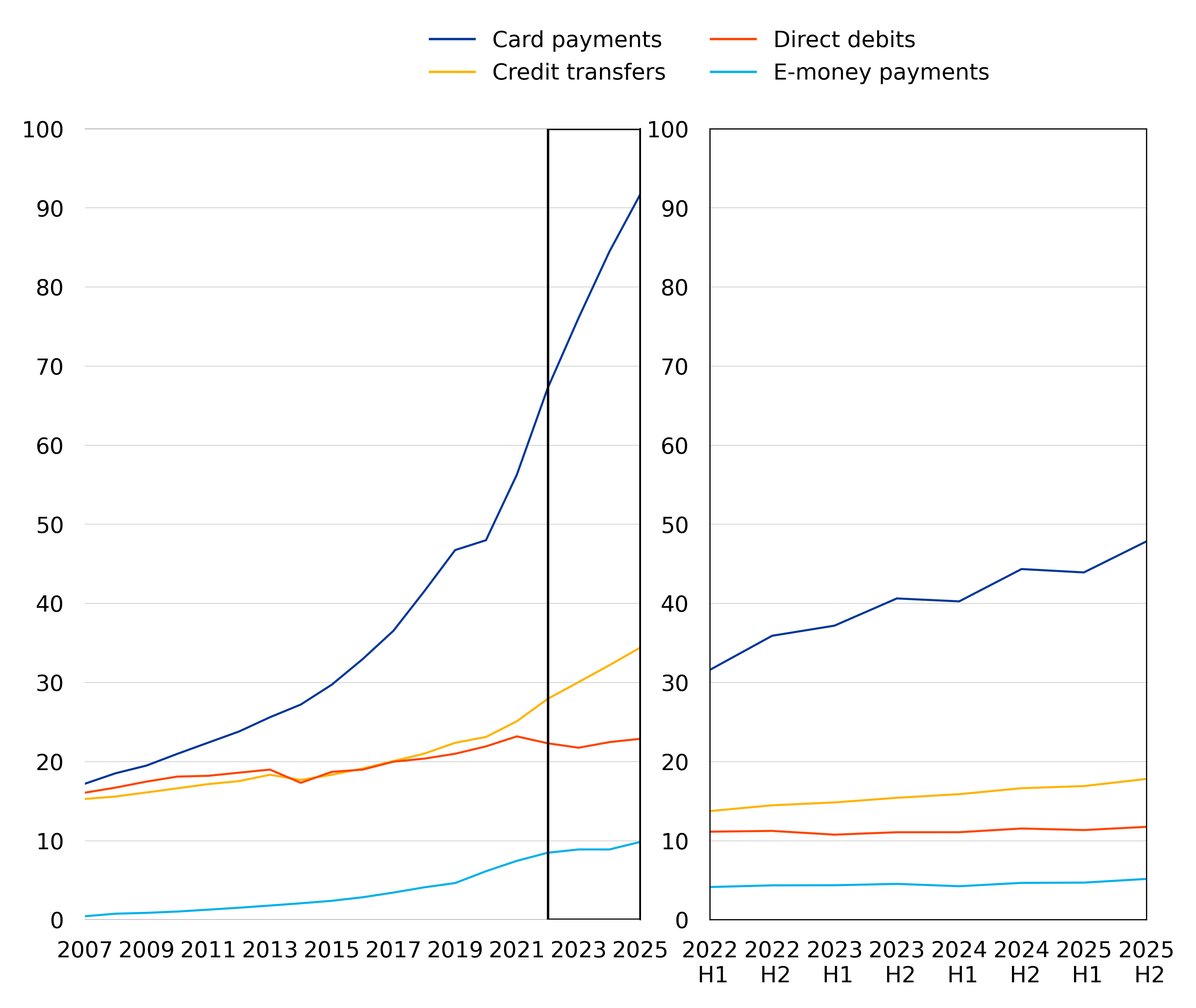
Here is a real example from the . Its euro-area chart gives annual totals on the left and half-year totals on the right. When two bars seem different, compare their periods as well as their payment types.
Read the diagram as text
- Read the annual panel: The left panel counts payments in billions for a full year. Its dark blue line records card payments, which rose faster than the other series over the period shown.
- Read the half-year panel: The right panel uses the same count unit. Each point covers one half of a year. Card payments reached 47.8 billion in the second half of 2025. It would be misleading to compare the endpoint directly with an annual total.
- Check the historical note: The ECB release notes that some pre-2010 data were estimated after methodological changes. Include the period, publisher notes and data revision or release date when you quote the chart.
The European Central Bank (ECB) publishes euro-area counts by instrument. Compare annual totals on the left with half-year totals on the right. The ECB release uses its own reporting framework. Use the chart as an example of why the reporting period matters. The ECB chart and release are available free from the European Central Bank.
Read the original at full size here
Use touch, a trackpad, or the arrow keys in the image area.
PICTURE IT
Counting the chairs in a town
Picture a survey that counts chairs in a town. One surveyor counts every chair a shop sold in the town. Another counts every chair owned by people in the town, including ones kept abroad. A third counts chairs by type, but a folding chair that is also a stool is listed under both. The three totals differ. None is wrong. Each answers a different question, and the only way to compare them is to read what each surveyor counted.
THE REAL JOB Knowing that a statistic depends on its counting rule helps an analyst avoid comparing figures that count different things.
- What was counted
- Whose country it belongs to
- Which period and methodology
- Do the parts overlap
- Is it like for like with its neighbour
HOW THE PICTURE MAPS
| In the picture | In the payment |
|---|---|
| Chairs sold in the town | Payments made inside a country |
| Chairs owned by people in the town | Cards belonging to the country's issuers |
| A chair listed under two types | A card in two function categories |
| Each surveyor's written instructions | The counting rule |
| Comparing totals without reading the instructions | Comparing figures with different rules |
WHERE THIS PICTURE STOPS
- A chair is one object in one place. A card can be used abroad and held at home.
- The picture shows why rules matter. It does not list the Red Book rules.
- A town survey has one surveyor team. Payment statistics come from many central banks.
HOOK
Before you trust a figure, ask what was counted.
REMEMBER IT THIS WAY
A sequence: the real steps, in order.
What, whose, when, overlap, like for like.
| In the trick | What it stands for |
|---|---|
| What | what was counted, such as unique cards |
| Whose | whose country the count belongs to, such as the issuer's country |
| When | the period and the methodology version |
| Overlap | whether the categories overlap so they cannot be added |
| Like for like | whether the figure is comparable with its neighbour |
TELL A FRIEND
A payments statistic is the answer to a counting rule, meaning the written definition of what is counted. Ask what was counted, in whose country and over what period.
OFTEN MIXED UP WITH What a payment actually is. The first lesson defines what a payment is. This lesson covers how a count of payments or cards depends on a written rule.
Sources & standards — 4 sources
- Market practiceAugust 2017
Methodology of the statistics on payments and financial market infrastructures in the Committee on Payments and Market Infrastructures (CPMI) countries (Red Book statistics) ↗ — Bank for International Settlements (Committee on Payments and Market Infrastructures) · August 2017 methodology: §§2–4/PartA introduction printed 1–4; Table 4 printed 15–19; completeTables5/6 printed 20–35. Selected complete source sections freshly read 7 November 2026; not all 82-pages, current datasets or country footnotes.
Search excerpts returned 2026-10-11 from bis.org; the PDF was not opened and the exact cross-border rules were not retrieved. The search did not show whether the methodology has been updated since 2017.
7 November 2026: downloaded the official 932,926-byte PDF from the publication URL below, SHA256 a0609da23084afe4ea8fb43a5ce406e7bf70ef0d8c90de2edb250a9246568500. Complete selected §§2–4/Part A introduction printed 1–4, Table 4 printed 15–19 and Tables 5–6 printed 20–35 read. These selected historical method rules are now available, including payment residency; this is not a whole 82-page or current country-dataset certification. The original October 2026 search-only record above is preserved as history. Source-image permission is separate.
- Simplified educational illustration
Payments Signal editorial teaching models — Payments Signal
What this simplifies: People, amounts and examples are synthetic. Selected methodology rules are explained; current country datasets and all 82-pages are not certified.
Used wherever diagrams, scenarios, figures, or example values are didactic constructions rather than sourced facts; every such use carries a simplifications disclosure. All people, companies, banks, and list entries in examples are fictional.
- Market practice
Committee on Payments and Market Infrastructures (CPMI) Red Book methodology (August 2017), card counts and Tables 5–6, pages 15 and 20–23 ↗ — Committee on Payments and Market Infrastructures (CPMI) Red Book methodology (August 2017) · CPMI Red Book methodology August 2017, completeTable 4 printed 15–19 and Tables5/6 printed 20–35 freshly read 7 November 2026; historical method, not current country dataset certification.
relevant source sections opened and reviewed. See the Foundations V7 analysis for source/version boundaries.
PRACTISE AND KEEP
Sources for this topic — 13 sources
- Market practiceAugust 2017
Methodology of the statistics on payments and financial market infrastructures in the Committee on Payments and Market Infrastructures (CPMI) countries (Red Book statistics) ↗ — Bank for International Settlements (Committee on Payments and Market Infrastructures) · August 2017 methodology: §§2–4/PartA introduction printed 1–4; Table 4 printed 15–19; completeTables5/6 printed 20–35. Selected complete source sections freshly read 7 November 2026; not all 82-pages, current datasets or country footnotes.
Search excerpts returned 2026-10-11 from bis.org; the PDF was not opened and the exact cross-border rules were not retrieved. The search did not show whether the methodology has been updated since 2017.
7 November 2026: downloaded the official 932,926-byte PDF from the publication URL below, SHA256 a0609da23084afe4ea8fb43a5ce406e7bf70ef0d8c90de2edb250a9246568500. Complete selected §§2–4/Part A introduction printed 1–4, Table 4 printed 15–19 and Tables 5–6 printed 20–35 read. These selected historical method rules are now available, including payment residency; this is not a whole 82-page or current country-dataset certification. The original October 2026 search-only record above is preserved as history. Source-image permission is separate.
- Simplified educational illustration
Payments Signal editorial teaching models — Payments Signal
What this simplifies: Examples and citation checklist are Payments Signal teaching. Selected August 2017 rules were read; no current country total or all 82-page certification.
Used wherever diagrams, scenarios, figures, or example values are didactic constructions rather than sourced facts; every such use carries a simplifications disclosure. All people, companies, banks, and list entries in examples are fictional.
- Market practice
Statistics on payments and financial market infrastructures ↗ — Bank for International Settlements · The data come in country tables and comparative tables; the Bank for International Settlements (BIS) publishes analysis of the statistics each year (BIS statistics pages, search excerpt, pages not opened)
Search excerpts returned 2026-10-11; pages not opened.
- Simplified educational illustration
Payments Signal editorial teaching models — Payments Signal
What this simplifies: Examples and citation checklist are Payments Signal teaching. Selected August 2017 rules were read; no current country total or all 82-page certification.
Used wherever diagrams, scenarios, figures, or example values are didactic constructions rather than sourced facts; every such use carries a simplifications disclosure. All people, companies, banks, and list entries in examples are fictional.
- Market practiceAugust 2017
Methodology of the statistics on payments and financial market infrastructures in the Committee on Payments and Market Infrastructures (CPMI) countries (Red Book statistics) ↗ — Bank for International Settlements (Committee on Payments and Market Infrastructures) · August 2017 methodology: §§2–4/PartA introduction printed 1–4; Table 4 printed 15–19; completeTables5/6 printed 20–35. Selected complete source sections freshly read 7 November 2026; not all 82-pages, current datasets or country footnotes.
Search excerpts returned 2026-10-11 from bis.org; the PDF was not opened and the exact cross-border rules were not retrieved. The search did not show whether the methodology has been updated since 2017.
7 November 2026: downloaded the official 932,926-byte PDF from the publication URL below, SHA256 a0609da23084afe4ea8fb43a5ce406e7bf70ef0d8c90de2edb250a9246568500. Complete selected §§2–4/Part A introduction printed 1–4, Table 4 printed 15–19 and Tables 5–6 printed 20–35 read. These selected historical method rules are now available, including payment residency; this is not a whole 82-page or current country-dataset certification. The original October 2026 search-only record above is preserved as history. Source-image permission is separate.
- Simplified educational illustration
Payments Signal editorial teaching models — Payments Signal
What this simplifies: Examples and citation checklist are Payments Signal teaching. Selected August 2017 rules were read; no current country total or all 82-page certification.
Used wherever diagrams, scenarios, figures, or example values are didactic constructions rather than sourced facts; every such use carries a simplifications disclosure. All people, companies, banks, and list entries in examples are fictional.
- Market practiceAugust 2017
Methodology of the statistics on payments and financial market infrastructures in the Committee on Payments and Market Infrastructures (CPMI) countries (Red Book statistics) ↗ — Bank for International Settlements (Committee on Payments and Market Infrastructures) · August 2017 methodology: §§2–4/PartA introduction printed 1–4; Table 4 printed 15–19; completeTables5/6 printed 20–35. Selected complete source sections freshly read 7 November 2026; not all 82-pages, current datasets or country footnotes.
Search excerpts returned 2026-10-11 from bis.org; the PDF was not opened and the exact cross-border rules were not retrieved. The search did not show whether the methodology has been updated since 2017.
7 November 2026: downloaded the official 932,926-byte PDF from the publication URL below, SHA256 a0609da23084afe4ea8fb43a5ce406e7bf70ef0d8c90de2edb250a9246568500. Complete selected §§2–4/Part A introduction printed 1–4, Table 4 printed 15–19 and Tables 5–6 printed 20–35 read. These selected historical method rules are now available, including payment residency; this is not a whole 82-page or current country-dataset certification. The original October 2026 search-only record above is preserved as history. Source-image permission is separate.
- Simplified educational illustration
Payments Signal editorial teaching models — Payments Signal
What this simplifies: Examples and citation checklist are Payments Signal teaching. Selected August 2017 rules were read; no current country total or all 82-page certification.
Used wherever diagrams, scenarios, figures, or example values are didactic constructions rather than sourced facts; every such use carries a simplifications disclosure. All people, companies, banks, and list entries in examples are fictional.
- Market practice
Committee on Payments and Market Infrastructures (CPMI) Red Book methodology (August 2017), card counts and Tables 5–6, pages 15 and 20–23 ↗ — Committee on Payments and Market Infrastructures (CPMI) Red Book methodology (August 2017) · CPMI Red Book methodology August 2017, completeTable 4 printed 15–19 and Tables5/6 printed 20–35 freshly read 7 November 2026; historical method, not current country dataset certification.
relevant source sections opened and reviewed. See the Foundations V7 analysis for source/version boundaries.
- Market practice27 September 2018 media release
CPMI releases latest Red Book payments statistics in new interactive format ↗ — Bank for International Settlements / Committee on Payments and Market Infrastructures · BIS/CPMI media release 27 September 2018, complete operative paragraphs: revised August 2017methodology; data through end 2017. Historical publication, not current coverage.
Complete substantive release paragraphs freshly read 7 November 2026 using normal web reader. Describes the revised-method data through end 2017 and planned December 2018 final tables. No entire underlying dataset, current jurisdiction coverage or whole methodology review inferred.
Deepest material on this page: L4 — Standards & sources. Where a topic stops short of implementation depth, that is a deliberate coverage decision, not an oversight — see coverage.