Why a Friday-evening payment credits on Monday (cut-offs, value dates and the booking day)
A payment carries a cut-off, a time of receipt, a booking date and a value date. Learn the four, why Friday evening becomes Monday on some rails, and how to test them.
L1–L4 are part of the Pro pass
L0 Explain simply
Riya pays her landlord Arjun on a Friday evening. Everything in this story is SYNTHETIC / TRAINING ONLY. Her bank app says the payment is sent. Arjun sees nothing that night. On Monday morning the money is there. Riya wonders whether somebody was slow.
The calendar can explain this example; the screen alone does not prove that nobody was slow. Several clocks were running, and some stop for the weekend. Each bank and each keeps a calendar of business days. A business day is a day on which the bank or the system is open to process payments.
A bank also sets a cut-off, which is the last time on a business day for an instruction to count for that day. In this UK receipt example, a covered order arriving after the provider’s cut-off counts as received on its next business day. Here that is Monday, and Monday is not a holiday. The order counts as received on Monday; that alone does not establish Monday credit.
This topic names the dates and times that a payment carries: the cut-off, the , the and the value date, the account-interest reference date in this UK example. Keep them apart and most 'why is it late?' questions answer themselves.
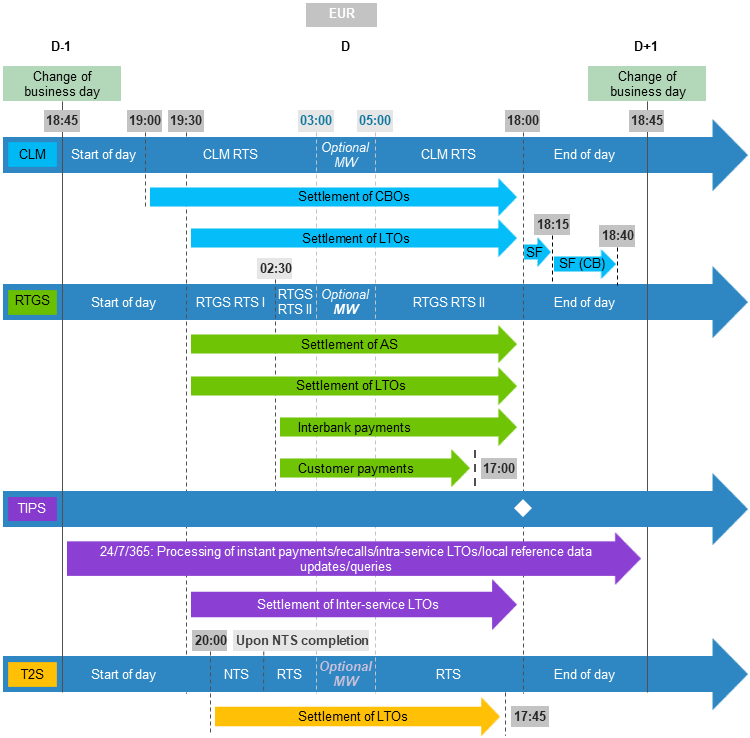
Read the diagram as text
- Find the business-day change: The diagram sets an operating business day against the preceding and following days. A service can change its assigned business date while the same calendar evening continues.
- Separate liquidity management from payment settlement: The CLM band shows the central liquidity management timetable. The arrows below identify when central bank operations and liquidity transfers settle.
- Read the customer-payment deadline on the RTGS row: The RTGS band has different windows for different work. In this baseline the diagram marks the 17:00 cut-off for customer payments. Customer instructions also have the provider’s own deadline.
- Follow continuous TIPS processing: The long TIPS arrow shows continuous processing of instant payments and the other listed functions. Transfers between TARGET services still follow the narrower window on the other arrow.
- Read the T2S cash-transfer window: The lowest band shows the T2S day. The yellow arrow covers liquidity transfer orders. The ECB caption specifies that this row depicts cash-relevant T2S processes.
Follow the ECB figure step by step.
Read the original at full size here
Use touch, a trackpad, or the arrow keys in the image area.
PICTURE IT
A ferry that sails only on working days
A ferry sails only on working days. The last boat of the day leaves at a set time. A passenger who arrives after it is treated as arriving the next working day. The ticket is stamped on the day it is processed. The crossing counts from its own day. A separate bridge open every day contrasts with the working-day ferry; access conditions still apply.
THE REAL JOB A payment's date depends on which clock decided it, and each rail keeps its own calendar.
- Order sent
- Cut-off passed or not
- Time of receipt set
- Entry booked
- Value date: interest reference
HOW THE PICTURE MAPS
| In the picture | In the payment |
|---|---|
| The last boat of the day | The cut-off |
| Counting the passenger as arriving the next working day | The time of receipt moving to the next business day |
| The day the ticket is stamped | The booking date |
| The day the crossing counts from | The account value date used for interest |
| A bridge that is open every day | The selected instant scheme’s all-calendar-day service, subject to access conditions |
WHERE THIS PICTURE STOPS
- A ferry has one timetable. Each payment rail keeps its own calendar and cut-offs.
- A stamped ticket has one date. A bank can book and value an entry on different days.
- The ferry analogy does not define interest or funds usability. UK account value date is an interest reference; availability is separately governed.
- The calendar explains the synthetic delay but proves neither a processing fault nor timely credit. Monday assumes the relevant provider is open; receipt and the execution deadline are different.
HOOK
Cut, receive, book, value.
REMEMBER IT THIS WAY
A sequence: the real steps, in order.
The cut-off decides today or tomorrow; receipt, booking and value are three separate dates.
| In the trick | What it stands for |
|---|---|
| Cut | the cut-off decides whether the order counts for today |
| Receive | the time of receipt is when the bank treats the order as received |
| Book | the booking date is when the entry is posted |
| Value | the UK account value date is the interest-calculation reference; availability is separate |
TELL A FRIEND
Keep receipt, booking, and availability separate; the weekday example assumes Monday is open.
OFTEN MIXED UP WITH The payment lifecycle. That lesson shows the stages a payment goes through. This one names the dates and times that decide when each stage counts.
Sources & standards — 7 sources
- Official requirement
The Payment Services Regulations 2017, regulation 81 (Receipt of payment orders) ↗ — UK Government (legislation.gov.uk) · UK PSR2017 regulation81(1)–(6), complete operative officialXML reread7November2026: no debit before receipt, providerbusinessday/deemedreceipt/latecutoff, agreedfutureday and nextbusinessday. No startofdaytimestamp or guaranteedMondaycredit.
Verified from a web-search excerpt on the access date; the page was not opened. The excerpt showed no recent amendment to this regulation. Independently read complete operative officialdata.xml7November2026 (SHA010b769449512812ed31f038866847063a0a895ed046972c9f4579f2e9f7c163); former excerpt-only access note remains historical. Not fullPSR/amendment-history certification.
- Simplified educational illustration
Payments Signal editorial teaching models — Payments Signal · Riya, Arjun and the Friday-evening payment are invented for teaching.
Used wherever diagrams, scenarios, figures, or example values are didactic constructions rather than sourced facts; every such use carries a simplifications disclosure. All people, companies, banks, and list entries in examples are fictional.
- Official requirement
UK Payment Services Regulations 2017, regulations 81, 86 and 89 ↗ — UK Payment Services Regulations 2017 · UK Payment Services Regulations 2017, regulations 81, 86 and 89; relevant source sections opened and reviewed
relevant source sections opened and reviewed. See the Foundations V7 analysis for source/version boundaries.
- Regulatory guidance
TARGET Services Annual Report 2025 ↗ — European Central Bank · ECB TARGET Services Annual Report 2025, T2/TIPS activity, operations and costs; relevant source sections opened and reviewed
Read as a search excerpt.
The T2 figures and the figures for the instant payment service were seen as search excerpts on 18 October 2026, and the page was not opened. The report is dated June 2026. It gives values in each currency, so currencies are not added together here. The 2024 report gave an average payment of EUR 4.3 million and a median of EUR 6,532.
- Regulatory guidance
Faster Payments System Principles: FPS information guide (January 2026) ↗ — Pay.UK · Pay.UK Faster Payments System Principles v11 (January 2026), sections 3–6; relevant source sections opened and reviewed
Known from a WebSearch excerpt on 2026-10-11; the page was not opened (search excerpt, page not opened), so it is cited as scheme-specific-rule at most.
Follow-up6November2026: actual selected primary PDF sections read. Three daily banking-day net settlements in the reviewed guide; PFA normally untouched, cap reduces if drawn. Original response conditions affect returns; no generic minutes guarantee or compulsory same-cycle offset. Public information guide, not the complete scheme rulebook; public classification is not reproduction permission. No source figure copied.
- Official requirementSI2017/752 regulation2(1); revised provision retrieved6November2026
Payment Services Regulations2017, regulation2(1): value date ↗ — UK legislation · UK PSR2017 reg2selectedvalue-date definition and complete operative89(1)–(4), read7November2026: interestreference,credit/debitvalue-date limits and conditionalimmediateavailability89(2)–(3). Not universalallcurrency/service rule.
Official provision downloaded and read via legislation.gov.uk XML on6November2026. This is a scoped definition, not certification of every later amendment or another jurisdiction.
7 November 2026: complete three exact regulation 2 XML definition items for payment instrument, payment order and payment transaction freshly read, including subordinate text. SHA256 of fetched XML: b372637d97eb1ff5316378e2ee9ecfa521a5dbc06f10f57916d947d5f701447e. Original value-date and regulation89 findings above remain unchanged; no whole regulation, whole PSR or amendment-history review claimed.
- Official requirement
The Payment Services Regulations 2017, regulation 86 (Payment transactions to a payment account) ↗ — UK Government (legislation.gov.uk) · UK PSR2017 complete operative85/86 officialXML reread7November2026:86(1)providercreditdeadline subjectexceptions, paperorder86(2), qualifiedfrauddelay85(1A)/86(2A–D),86(3)otherUKtransactions,86(4)payeecredit. Not fullPSR/legalopinion.
Actual current full regulation86read via officialdata.xml6November2026, with selected85scope. Execution deadline and qualified2024UKsterlingfraud-delay2A–2Ddistinct from regulation89value dates; title here is historical shorthand, not proof89is containedin86. Not allcross-border/consumer/corporatecases identical. Fulloperative85/86officialXML reread7November2026; actual86heading corrected and previousapplicability misattribution to89 withdrawn. SHA86fbbe3b63ac1bf0a6da595bf569efdfb9440f2ca87d6661378dae918582798758; preserve historical notes/accessdate, not wholelawreview.
CURRENT AS CHECKED
8 FIGURES
Nacha ACH Network — banking day definition under review
On 12 May 2026 Nacha asked the industry for views on how a is defined, with responses due 26 June 2026, because Nacha, The and the Federal Reserve each word the term differently. This is a request for information, not a rule change.
CHECKED 2026-10-11RECHECK BY 2027-03-11
Sources & standards — 1 source
- Scheme-specific rule
Request for Information — Definition of Banking Day and Related Operational Topics ↗ — Nacha · Request for information of 12 May 2026 and the differing definitions
Read as a WebSearch result on 2026-10-11, not opened: the search returned a summary of the page, not its text. A request for information is not a rule; it describes how the rules work today and asks whether to change them.
European Payments Council (EPC) Single Euro Payments Area (SEPA) Credit Transfer (SCT) Inst scheme: availability and planned non-availability
The Single Euro Payments Area () Instant rulebook makes its services available 24 hours a day on all calendar days, subject to the payment initiation channel. There is no cut-off time for a SEPA Credit Transfer (SCT) Inst transaction. A payment service provider may still set planned periods of non-availability, for example for planned maintenance or downtime.
This wording was seen as a search excerpt of the rulebook only, and the rulebook page was not opened.
CHECKED 2026-10-04RECHECK BY 2027-04-04
Sources & standards — 1 source
- Scheme-specific rule2025 version 1.2 (EPC004-16)
2025 SEPA Instant Credit Transfer rulebook version 1.2 (EPC004-16) ↗ — European Payments Council · Services available 24 hours a day on all calendar days, no cut-off time for a Single Euro Payments Area (SEPA) Credit Transfer (SCT) Inst transaction, and provider-set planned periods of non-availability for maintenance (search excerpt, page not opened)
Version 1.2 formally replaced version 1.1 at its publication on 30 September 2026 (the European Payments Council's wording, seen as a search excerpt; the page was not opened). The change is limited to address-message elements and delays the previously planned end date for unstructured addresses. The EPC states that no other business or operational rules changed compared with version 1.1.
Selected primary follow-up7November2026: actual EPC004-16 2025v1.2 PDF, issued/effective30September2026, operative4.2.1–3A–D/fn14,4.3.1 and4.3.2.1–4 read. Successful checks require reservation; formal debit follows Originator PSP receipt of positive confirmation; beneficiary availability follows certainty of delivery to its CSM. Restoration lifts the reservation while settlement certainty continues until confirmation; late-positive notice is required and further action is outside the Scheme.
Recall and RFRO have distinct grounds and authorisation rules. Not all142pages, AnnexIII, licensed implementation guidelines, private CSM profiles or reproduction permission. Prior search-only release-history note remains historical.
Re-checked 12 November 2026: 2025 SCT Inst rulebook version 1.2 remains the edition in effect; published/effective 30 September 2026; unstructured-address end date removed with no replacement yet.
Fedwire Funds Service: daily operating hours
The runs on each day that is not a Bank holiday. A funds-transfer business day opens at 9:00 p.m. Eastern Time on the calendar day before and closes at 7:00 p.m. Eastern Time. A transfer made for a third party, such as a bank's customer, has an earlier deadline in the evening.
Saturdays and Sundays are not business days, so on a Friday evening after the close the service next opens on Sunday at 9:00 p.m. for Monday's business day. The Board has announced longer hours, expected in 2028 or 2029, so these times are a snapshot. Seen as a search excerpt only, with the page not opened.
CHECKED 2026-10-11RECHECK BY 2027-04-11
Sources & standards — 1 source
- Scheme-specific rule
Fedwire Funds Service and National Settlement Service Operating Hours ↗ — Federal Reserve Financial Services · Business day opens 9 p.m. ET on the preceding calendar day and ends 7 p.m. ET; earlier deadline for third-party transfers; Saturdays, Sundays and Reserve Bank holidays not business days; longer hours announced for a later year (search excerpt, page not opened)
Known from a web search excerpt only, page not opened. The publisher's pages answer with a block from this authoring environment. The same excerpt said the Board announced in October 2025 a move to longer hours that the Reserve Banks expect to put in place in 2028 or 2029, so these hours are a snapshot of an arrangement that will change. Not cited for any holiday date.
UKPSRselected execution/value-date/liability provisions—scoped comparison, not fullUK law certification
Apply Part 7 scope before a UK execution/compensation conclusion: currency, provider/account location, initiation and permitted user/contract variations matter. Regulation sets the qualified next-business-day execution rule and paper extension. The 2024 fraud-delay route is a necessary-enquiries exception for the specified authorised UK sterling cases, with a fourth-business-day outer limit and qualified notification duties—not every suspicious payment. Regulation 89 separates and availability; debit VALUE date cannot precede actual account debit, not onward interbank settlement. Regulations 91–94 address the stated liability/correction/trace/charges-interest framework. Separate 94 Acan cover specified fraud-delay costs even where the delay was lawful and regardless of ultimate execution. Notice and qualified exceptions matter; there is no universal fixed daily UK sum.
CHECKED 2026-11-06RECHECK BY 2027-04-11
Sources & standards — 6 sources
- Official requirement
Payment Services Regulations2017, regulation63: Part7 scope ↗ — UK legislation · Actual currentfull63/64andselected74/85/86/89–94A/96read viaofficialXML.
Selected related actual current regulations64/74/85/86/89–94A/96also read for the India comparison; not allUKpayments law or FCA guidance certified.
- Official requirement
The Payment Services Regulations 2017, regulation 86 (Payment transactions to a payment account) ↗ — UK Government (legislation.gov.uk) · Actual current85/86: scope/execution/paperextension/qualifiedfrauddelay2A–D;value-date separately89.
Actual current full regulation86read via officialdata.xml6November2026, with selected85scope. Execution deadline and qualified2024UKsterlingfraud-delay2A–2Ddistinct from regulation89value dates; title here is historical shorthand, not proof89is containedin86. Not allcross-border/consumer/corporatecases identical. Fulloperative85/86officialXML reread7November2026; actual86heading corrected and previousapplicability misattribution to89 withdrawn. SHA86fbbe3b63ac1bf0a6da595bf569efdfb9440f2ca87d6661378dae918582798758; preserve historical notes/accessdate, not wholelawreview.
- Official requirement
UK Payment Services Regulations 2017, regulations 81, 86 and 89 ↗ — UK Payment Services Regulations 2017 · Actual current89: credit/debitvalue dates and fundsavailability.
relevant source sections opened and reviewed. See the Foundations V7 analysis for source/version boundaries.
- Official requirementRevised provision retrieved 6 November 2026; SI 2017/752
Payment Services Regulations 2017: regulation 91, payer-initiated non-execution, defective and late execution ↗ — UK legislation · Actual fullcurrent91andrelated90/92–94A/96: statedliability/proof/latecorrection/freetrace.
Actual official XML for regulations 91–93 downloaded and read. Citation to this record is specifically to regulation 91, not a universal backvaluation procedure.
- Official requirement
The Payment Services Regulations 2017, regulation 94 (Liability for charges and interest) ↗ — UK Government (legislation.gov.uk) · Actual fullcurrent94: statedcharges/interest,readwithscope/notice/exceptions.
Actual full current94read via officialXML6November2026 alongside74/89–94A/96. Covers stated charges/interest resulting from non-execution/defective/lateexecution under the liability framework; statutory scope/exceptions and separate94Afrauddelayrule matter.
- Official requirement
Payment Services Regulations2017, regulation94A: fraud-delay charges/interest ↗ — UK legislation · Actual fullcurrent94A: specifiedfraud-delaycharges/interest eveniflawful.
Read alongside actual85/86scope and74/96; not a blanket four-day delay or a general scam reimbursement rule.
UK Faster Payments Service availability and settlement, with Bacs for contrast
Pay.UK's information guide says sending participants can submit payments at any time, 24 hours a day, including weekends and bank holidays. Payments are exchanged in real time and normally arrive within seconds. Settlement between banks is deferred and netted, and takes place three times each business day in the 's real-time gross settlement service.
By contrast the Bank of England says Bacs runs across a three-day cycle with once each business day. Seen as search excerpts only; the pages were not opened.
CHECKED 2026-10-11RECHECK BY 2027-04-11
Sources & standards — 2 sources
- Scheme-specific rule
Faster Payments System Principles: FPS information guide (January 2026) ↗ — Pay.UK · Payments can be submitted at any time, 24/7, including weekends and bank holidays; settlement deferred and netted (search excerpt, page not opened) search excerpt, page not opened
Known from a WebSearch excerpt on 2026-10-11; the page was not opened (search excerpt, page not opened), so it is cited as scheme-specific-rule at most.
Follow-up6November2026: actual selected primary PDF sections read. Three daily banking-day net settlements in the reviewed guide; PFA normally untouched, cap reduces if drawn. Original response conditions affect returns; no generic minutes guarantee or compulsory same-cycle offset. Public information guide, not the complete scheme rulebook; public classification is not reproduction permission. No source figure copied.
- Scheme-specific rule
Payment and settlement — the systems that settle in RTGS ↗ — Bank of England · Net settlement three times each business day for Faster Payments; Bacs three-day cycle (search excerpt, page not opened) search excerpt, page not opened
Added 2026-09-19. Both
content/flows/bacs-direct-credit.tsandbacs-direct-debit.tshad the settlement leg right in prose: both said the obligations settle across the banks' accounts at the Bank of England. But both also drew the arrow from one commercial bank straight to the other, with no Bank of England lane on the page at all.Verified from independent web-search excerpts on the access date. A direct fetch of the publisher's domain was attempted and failed (a network block, not a statement about the publisher). Nothing here is quoted from a page that was opened.
The three-day cycle and the once-a-business-day net settlement in RTGS are corroborated across the Bank's own payment and settlement pages and its RTGS service description, which agree on both. The existing registry entry
pay-uk-bacsindependently establishes the three-day cycle from the operator's side and says nothing about the settlement leg, which is the gap this entry fills.
Nacha Automated Clearing House (ACH) Network: settlement days and credit settlement options
Nacha's fact sheet says () payments are not currently settled on weekends and federal holidays. For ACH credits, the sender can choose same-day settlement, settlement on the next banking day, or settlement two banking days later, and no further ahead than that.
A later weekend window was proposed in a 2024 request for comment, and its outcome was not checked. Seen as search excerpts only; the pages were not opened.
CHECKED 2026-10-11RECHECK BY 2027-04-11
Sources & standards — 1 source
- Scheme-specific rule
ACH Payments Fact Sheet ↗ — Nacha · Not settled on weekends and federal holidays; credit settlement options (search excerpt, page not opened) search excerpt, page not opened
Verified from a web-search excerpt on the access date; the page was not opened. A 2024 Nacha request for comment about a later weekend window was a proposal and its outcome was not checked.
Eurosystem T2: closing days for euro settlement
, the euro real-time gross settlement service of the Eurosystem, is open Monday to Friday. It is closed on Saturday and Sunday and on New Year's Day, Good Friday, Easter Monday, 1 May, 25 December and 26 December. At Easter it is therefore closed for four calendar days in a row.
The European () consulted in 2025 on extending T2 operating hours. A May 2026 outcome report found limited appetite for changing the closing and cut-off times. Seen as search excerpts only; the pages were not opened.
CHECKED 2026-10-11RECHECK BY 2027-04-11
Sources & standards — 1 source
- Scheme-specific rule
What is T2? (European Central Bank) ↗ — European Central Bank · Open Monday to Friday; closed Saturday, Sunday and six named holidays (search excerpt, page not opened) search excerpt, page not opened
Verified from web-search excerpts on the access date; the page was not opened. T2 and the securities service T2S stay open for the Danish krone on 1 May, which this site does not teach.
Bank of England CHAPS — Monday-to-Friday settlement hours, closing times, the contingency extension and the 2026 decisions on longer hours
currently settles from Monday to Friday, 06:00 to 18:00. Customer payments must be sent by 5.40 pm and financial institution payments by 6 pm. The can extend CHAPS operating hours to 8 pm in extremis, so that payment service providers can make maximum use of the operating day and still give end users same-day value.
In February 2026 the Bank decided to open CHAPS settlement at 01:30 instead of 06:00, Monday to Friday, with the aim of starting in September 2027. Sending during the early window is optional for direct participants, but all direct participants must be able to receive settlement into their accounts. Customer availability remains a separate policy and legal question. The planned start is subject to final timeline confirmation. It also decided not to take forward a longer evening contingency window at this stage.
On 18 May 2026 the Bank consulted on adding Sunday and bank-holiday settlement, not before 2029, and on longer settlement days after that, not before 2031. The consultation closed on 10 August 2026. The Bank has not said when it will publish its response, so those two steps are proposals and not rules.
CHECKED 2026-11-07RECHECK BY 2027-09-01
Sources & standards — 3 sources
- Scheme-specific rule
Background information about invoking the Market Infrastructure Resiliency Service (MIRS) as a contingency solution for RTGS and CHAPS settlement ↗ — Bank of England · Normal CHAPS closing times, and the extension of CHAPS operating hours in extremis
A correction, recorded rather than quietly replaced. The previous note said the publisher's own domain could not be fetched (a reachability gap, not a statement about the publisher). The real fault was a dead address, and two claims did not survive the page.
The registered URL sat under /payment-and-settlement/, a path the Bank has retired in favour of /payments/, and it answers HTTP 404. The equivalent live page is registered above and was read at HTTP 200 and 15,547 bytes.
Two claims are dropped. The entry said the arrangement was introduced in 2014; "2014" does not occur on the page. The note said the Bank intends to evolve or replace the third-site solution and is consulting on longer settlement hours; the words "evolve", "replace" and "consult" do not occur either. Both may be true elsewhere, but they are not this document's.
One duty on participants is added because it is operationally load-bearing. On invocation, direct participants must reconcile their expected account balances and the status of payments in flight.
Primary page reopened 6 November 2026: paragraphs 5–7 expressly state MIRS can settle peak CHAPS volumes and net retail settlements, omits the liquidity-saving mechanism, and requires participants to reconcile expected balances and in-flight payments at invocation. Do not generalise ECONS critical-payment scope or slower acceptance to MIRS.
- Scheme-specific rule
Extending RTGS (real-time gross settlement) and CHAPS (Clearing House Automated Payment System) settlement hours – early morning extension ↗ — Bank of England · Actual February2026 policy statement selectedbody0–110 read:01:30targetSeptember2027,optionalsendingbutallDPsreceiveRTGSsettlement;currenthoursunchangeduntilgo-live.
Known from web-search excerpts on the access date. The Bank's own domain cannot be fetched from this authoring environment, so the page was not opened and nothing is quoted from it.
Two search results dated the policy statement to 24 February 2026. The excerpts gave the move from 06:00 to 01:30, the September 2027 aim and the optional participation model.
A search summary said the Bank would not take the evening contingency window further at this stage. It did not make clear whether this paper or the later consultation paper says so. The fact citing both papers keeps that point open.
- Scheme-specific ruleDraft, not in force
Extending RTGS (real-time gross settlement) and CHAPS (Clearing House Automated Payment System) settlement hours – next steps towards near 24x7 settlement ↗ — Bank of England · Consultation of 18 May 2026 on Sunday and bank-holiday settlement and longer settlement days, a proposal and not a rule; search excerpt, page not opened. A search summary placed the evening contingency window decision in the Bank's 2026 papers without saying which one
Known from web-search excerpts on the access date. The Bank's own domain cannot be fetched from this authoring environment, so the page was not opened.
Several search results gave 18 May 2026 as the publication date and 10 August 2026 as the closing date. The excerpts also gave the proposed order of steps: weekend and bank-holiday settlement first, then longer settlement days from Monday to Friday and on one weekend day. They gave two longer-term options, and this entry does not rely on them.
Standing is draft because the paper asks questions and decides nothing.
PRACTISE AND KEEP
Sources for this topic — 12 sources
- Official requirement
The Payment Services Regulations 2017, regulation 81 (Receipt of payment orders) ↗ — UK Government (legislation.gov.uk) · UK PSR2017 regulation81(1)–(6), complete operative officialXML reread7November2026: no debit before receipt, providerbusinessday/deemedreceipt/latecutoff, agreedfutureday and nextbusinessday. No startofdaytimestamp or guaranteedMondaycredit.
Verified from a web-search excerpt on the access date; the page was not opened. The excerpt showed no recent amendment to this regulation. Independently read complete operative officialdata.xml7November2026 (SHA010b769449512812ed31f038866847063a0a895ed046972c9f4579f2e9f7c163); former excerpt-only access note remains historical. Not fullPSR/amendment-history certification.
- Official requirement
The Payment Services Regulations 2017, regulation 86 (Payment transactions to a payment account) ↗ — UK Government (legislation.gov.uk) · UK PSR2017 complete operative85/86 officialXML reread7November2026:86(1)providercreditdeadline subjectexceptions, paperorder86(2), qualifiedfrauddelay85(1A)/86(2A–D),86(3)otherUKtransactions,86(4)payeecredit. Not fullPSR/legalopinion.
Actual current full regulation86read via officialdata.xml6November2026, with selected85scope. Execution deadline and qualified2024UKsterlingfraud-delay2A–2Ddistinct from regulation89value dates; title here is historical shorthand, not proof89is containedin86. Not allcross-border/consumer/corporatecases identical. Fulloperative85/86officialXML reread7November2026; actual86heading corrected and previousapplicability misattribution to89 withdrawn. SHA86fbbe3b63ac1bf0a6da595bf569efdfb9440f2ca87d6661378dae918582798758; preserve historical notes/accessdate, not wholelawreview.
- Scheme-specific rule2025 version 1.2 (EPC125-05)
2025 SEPA Credit Transfer rulebook version 1.2 (EPC125-05) ↗ — European Payments Council · Banking business days; cut-off times set by each PSP; value date correction search excerpt, page not opened
Version 1.2 formally replaced version 1.1 at its publication on 30 September 2026 (the European Payments Council's wording, seen as a search excerpt; the page was not opened). Its change is limited to the address-message elements: the previously planned end date for unstructured addresses is delayed, unstructured addresses remain supported beyond 15 November 2026, and the EPC will set a new end date later. The EPC states that version 1.2 makes no other business or operational rule changes compared with version 1.1.
Follow-up 7 November 2026 for shared authored sponsor flow only: actual current publication page read plus selected v1.2 PDF printed pages 23–29 (sections 3.1–3.6, 4.2 and 4.3.1). Intermediaries do not modify scheme PSP obligations; bilateral/CSM arrangements and cutoff boundaries are distinct. This is not a complete 150-page read or visual/field-profile certification.
- Scheme-specific rule2025 version 1.2 (EPC004-16)
2025 SEPA Instant Credit Transfer rulebook version 1.2 (EPC004-16) ↗ — European Payments Council · EPC004-16 2025SCTInstRulebookv1.2 issued/effective30September2026, selected complete operative4.2.1–3A–D/fn14, printed26–28/30/32–33, read7November2026: receipt/datedorders, no scheme cutoff subjectchannel/plannedshortforeseeabledowntimewithadvanceinformation. Not fullrulebook/ANNEXIII.
Version 1.2 formally replaced version 1.1 at its publication on 30 September 2026 (the European Payments Council's wording, seen as a search excerpt; the page was not opened). The change is limited to address-message elements and delays the previously planned end date for unstructured addresses. The EPC states that no other business or operational rules changed compared with version 1.1.
Selected primary follow-up7November2026: actual EPC004-16 2025v1.2 PDF, issued/effective30September2026, operative4.2.1–3A–D/fn14,4.3.1 and4.3.2.1–4 read. Successful checks require reservation; formal debit follows Originator PSP receipt of positive confirmation; beneficiary availability follows certainty of delivery to its CSM. Restoration lifts the reservation while settlement certainty continues until confirmation; late-positive notice is required and further action is outside the Scheme.
Recall and RFRO have distinct grounds and authorisation rules. Not all142pages, AnnexIII, licensed implementation guidelines, private CSM profiles or reproduction permission. Prior search-only release-history note remains historical.
Re-checked 12 November 2026: 2025 SCT Inst rulebook version 1.2 remains the edition in effect; published/effective 30 September 2026; unstructured-address end date removed with no replacement yet.
- Scheme-specific rule
Faster Payments System Principles: FPS information guide (January 2026) ↗ — Pay.UK · FPS available at any time; settlement deferred and netted search excerpt, page not opened
Known from a WebSearch excerpt on 2026-10-11; the page was not opened (search excerpt, page not opened), so it is cited as scheme-specific-rule at most.
Follow-up6November2026: actual selected primary PDF sections read. Three daily banking-day net settlements in the reviewed guide; PFA normally untouched, cap reduces if drawn. Original response conditions affect returns; no generic minutes guarantee or compulsory same-cycle offset. Public information guide, not the complete scheme rulebook; public classification is not reproduction permission. No source figure copied.
- Scheme-specific rule
Fedwire Funds Service and National Settlement Service Operating Hours ↗ — Federal Reserve Financial Services · Fedwire business day search excerpt, page not opened
Known from a web search excerpt only, page not opened. The publisher's pages answer with a block from this authoring environment. The same excerpt said the Board announced in October 2025 a move to longer hours that the Reserve Banks expect to put in place in 2028 or 2029, so these hours are a snapshot of an arrangement that will change. Not cited for any holiday date.
- Scheme-specific rule
ACH Payments Fact Sheet ↗ — Nacha · ACH not settled on weekends and federal holidays search excerpt, page not opened
Verified from a web-search excerpt on the access date; the page was not opened. A 2024 Nacha request for comment about a later weekend window was a proposal and its outcome was not checked.
- Scheme-specific rule
What is T2? (European Central Bank) ↗ — European Central Bank · T2 closing days search excerpt, page not opened
Verified from web-search excerpts on the access date; the page was not opened. T2 and the securities service T2S stay open for the Danish krone on 1 May, which this site does not teach.
- Simplified educational illustration
Payments Signal editorial teaching models — Payments Signal · Riya, Arjun and the Friday-evening payment are invented for teaching.
What this simplifies: Synthetic weekdayreceipt example assumes Monday and Tuesday are relevant providerbusinessdays. CurrentUK81/85/86/89 and selectedSCTInst2025v1.2sections freshlyread; otheroperator calendars retain their datedsource scopes. Not a fullspecification/legalopinion.
Used wherever diagrams, scenarios, figures, or example values are didactic constructions rather than sourced facts; every such use carries a simplifications disclosure. All people, companies, banks, and list entries in examples are fictional.
- Official requirement
UK Payment Services Regulations 2017, regulations 81, 86 and 89 ↗ — UK Payment Services Regulations 2017 · UK Payment Services Regulations 2017, regulations 81, 86 and 89; relevant source sections opened and reviewed
relevant source sections opened and reviewed. See the Foundations V7 analysis for source/version boundaries.
- Regulatory guidance
TARGET Services Annual Report 2025 ↗ — European Central Bank · ECB TARGET Services Annual Report 2025, T2/TIPS activity, operations and costs; relevant source sections opened and reviewed
Read as a search excerpt.
The T2 figures and the figures for the instant payment service were seen as search excerpts on 18 October 2026, and the page was not opened. The report is dated June 2026. It gives values in each currency, so currencies are not added together here. The 2024 report gave an average payment of EUR 4.3 million and a median of EUR 6,532.
- Official requirementSI2017/752 regulation2(1); revised provision retrieved6November2026
Payment Services Regulations2017, regulation2(1): value date ↗ — UK legislation · UK PSR2017 reg2selectedvalue-date definition and complete operative89(1)–(4), read7November2026: interestreference,credit/debitvalue-date limits and conditionalimmediateavailability89(2)–(3). Not universalallcurrency/service rule.
Official provision downloaded and read via legislation.gov.uk XML on6November2026. This is a scoped definition, not certification of every later amendment or another jurisdiction.
7 November 2026: complete three exact regulation 2 XML definition items for payment instrument, payment order and payment transaction freshly read, including subordinate text. SHA256 of fetched XML: b372637d97eb1ff5316378e2ee9ecfa521a5dbc06f10f57916d947d5f701447e. Original value-date and regulation89 findings above remain unchanged; no whole regulation, whole PSR or amendment-history review claimed.
Deepest material on this page: L4 — Standards & sources. Where a topic stops short of implementation depth, that is a deliberate coverage decision, not an oversight — see coverage.