The payment lifecycle
From capture to confirmation: a learning map of payment functions, evidence and scheme-specific timing.
L1–L4 are part of the Pro pass
L0 Explain simply
A payment is a journey with checkpoints, not a single event. Riya taps send, and her app tells her the money is on its way. That can describe an instruction being captured, checks being performed or funds being credited. These are different events; their exact order and timing depend on the payment arrangement.
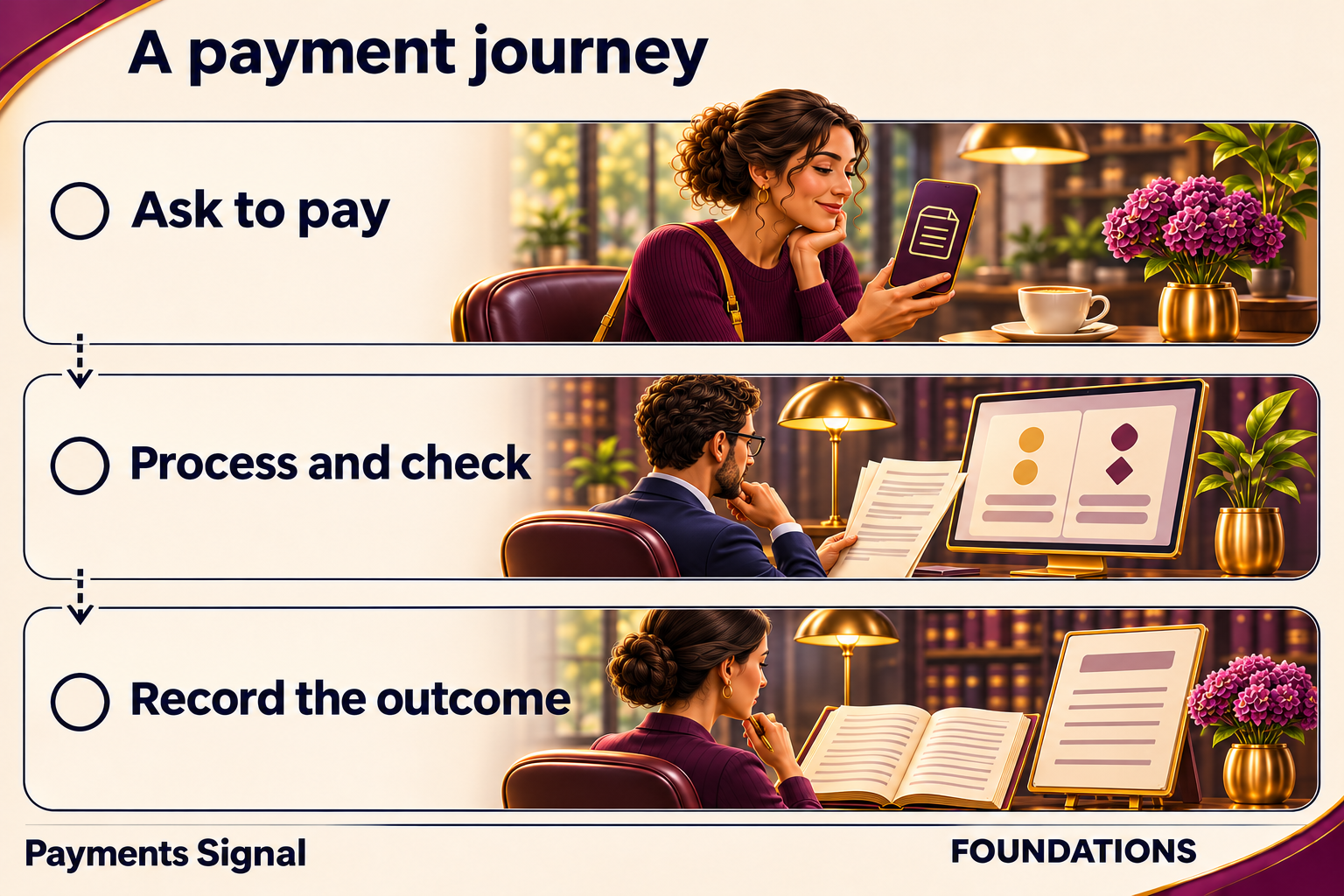
Read the diagram as text
- Ask to pay: A payer gives an instruction through an agreed channel. The phone and person represent this request; they do not prescribe an app or mandatory message format.
- Process and check: Providers check the instruction and its execution conditions. Checks can repeat and a receiving institution can also check; a hold or rejection may stop normal execution.
- Record the outcome: Use the actual evidence for account entries, available funds and settlement. A sent label, neutral document or customer debit alone does not establish the payee was credited or the relevant obligation finally settled.
Based on official sources
Payments Signal original educational overview, not a shortened or redrawn official EPC process figure. The complete official SCT five-actor execution and exception diagram remains separate. Three original concepts, three open markers and exactly two downward dashed links remain. They guide this simple learning journey, not every technical stage, message, possible repeat check or exception route. Representative people and neutral documents are examples, not provider eligibility or identity restrictions. The payer uses an agreed instruction channel; providers apply checks and may hold or reject an instruction. Recording an outcome requires evidence: customer account posting, usable funds and interbank settlement are distinct. A report or neutral screen symbol does not guarantee approval, successful execution or final settlement.
Read the diagram as text
- Ask to pay: A payer gives an instruction through an agreed channel. The phone and person represent this request; they do not prescribe an app or mandatory message format.
- Process and check: Providers check the instruction and its execution conditions. Checks can repeat and a receiving institution can also check; a hold or rejection may stop normal execution.
- Record the outcome: Use the actual evidence for account entries, available funds and settlement. A sent label, neutral document or customer debit alone does not establish the payee was credited or the relevant obligation finally settled.
Analogy: an online order. Placing the order resembles capturing an instruction; checking the details resembles validation; arranging what is owed resembles clearing; paying that obligation resembles settlement. The analogy helps separate functions. A payment does not travel as one physical parcel, and a bank may repeat checks or make customer funds usable before a later interbank settlement.
Two checkpoints are often merged. Clearing covers exchanging and reconciling transactions and may establish the positions to be paid. Settlement discharges an obligation under the agreed terms. Netting can be part of clearing, but clearing does not always mean netting. Customer account entries and the availability of funds are another part of the journey.
That is why 'where is my payment?' rarely has a one-word answer. Your app may say 'sent' while another institution is still checking the payment. Ask what the status proves: the instruction was received, an interbank obligation was settled, or the payee can use the funds. Those claims need different evidence. (SYNTHETIC / TRAINING ONLY — every person and firm named in this topic is invented.)
PLAIN WORDS · 1 in this section
- checkpoints
- points along the way where a payment is checked
A SHORT CASE
In this selected settlement-before-credit example, Riya asks Bank Alfa to pay Arjun at Nordbank. Bank Alfa captures the instruction and applies checks. The banks exchange the instruction and establish the relevant obligation, settle it, and Nordbank then credits Arjun. Other arrangements order customer credit differently. A status message reports an event; it is not the money or automatic proof of final settlement. (SYNTHETIC / TRAINING ONLY)
A parcel follows one physical route. A payment has messages and account entries, whose checkpoints need to be kept separate.
THE REAL JOB The payment lifecycle locates an instruction, its checks, settlement between banks and the credit on the payee’s account.
- Initiation: capture the request
- Validation: check details and funds
- Risk controls: screening and fraud checks
- Clearing: exchange instructions and establish obligations
- Settlement: discharge the banks’ obligation
- Posting and confirmation: credit the payee and report
WHERE THIS CASE STOPS
- The six functions are a learning map. Checks can repeat, and an on-us payment need not cross an interbank system.
- Customer credit and usable funds may precede or follow interbank settlement. Faster Payments uses near-real-time customer processing and deferred net settlement.
HOOK
Sent is not arrived: ask which checkpoint the payment last passed.
REMEMBER IT THIS WAY
A sequence: the real steps, in order.
Request, check, control; distinguish clearing, settlement and credit.
| In the trick | What it stands for |
|---|---|
| Request | initiation captures the instruction |
| Check and control | validation checks details; risk controls check sanctions and fraud |
| Clear and settle | clearing establishes obligations; settlement discharges them |
| Credit | posting puts the credit on the payee’s account and confirmation reports it |
These are functions to locate, not a prescribed order: checks can repeat and customer credit can precede interbank settlement.
TELL A FRIEND
Ask which checkpoint has completed. A debit to Riya, settlement between banks and a credit to Arjun are different events.
OFTEN MIXED UP WITH Clearing versus settlement. That topic looks closely at the two stages people merge: clearing works out who owes what, and settlement pays it.
Sources & standards — 5 sources
- Scheme-specific rule2025 v1.2
European Payments Council (EPC) Single Euro Payments Area (SEPA) Credit Transfer (SCT) 2025 v1.2 (30 September 2026), sections 3.2, 4.3.1–4.3.2; Figures 2 and 3 ↗ — European Payments Council (EPC) Single Euro Payments Area (SEPA) Credit Transfer (SCT) 2025 v1.2 (30 September 2026) · EPC SCT 2025 v1.2 (30 September 2026), sections 3.2, 4.3.1–4.3.2; Figures 2 and 3; relevant source sections opened and reviewed
relevant source sections opened and reviewed. See the Foundations V7 analysis for source/version boundaries.
- Scheme-specific rule2025 v1.0
European Payments Council (EPC) Single Euro Payments Area (SEPA) Credit Transfer (SCT) Inter-payment service provider (PSP) implementation guidelines (IG) 2025 v1.0, sections 2.1–2.3; pacs.008.001.08 (customer credit transfer) and pacs.004.001.09 (payment return) ↗ — European Payments Council (EPC) Single Euro Payments Area (SEPA) Credit Transfer (SCT) Inter-payment service provider (PSP) implementation guidelines (IG) 2025 v1.0 · EPC SCT Inter-PSP IG 2025 v1.0, sections 2.1–2.3; pacs.008.001.08 and pacs.004.001.09; relevant source sections opened and reviewed
relevant source sections opened and reviewed. See the Foundations V7 analysis for source/version boundaries.
- Market practice
Faster Payments System Principles: FPS information guide (January 2026) ↗ — Pay.UK · Pay.UK FPS information guide, January 2026 V11: section1.4 status of guide;5.1/5.4 sending checks and Return Payment;6 deferred net settlement alongside near-real-time customer processing;9 receiving checks and outcomes. Explanatory guide, not controlling rules.
Known from a WebSearch excerpt on 2026-10-11; the page was not opened (search excerpt, page not opened), so it is cited as scheme-specific-rule at most.
Follow-up6November2026: actual selected primary PDF sections read. Three daily banking-day net settlements in the reviewed guide; PFA normally untouched, cap reduces if drawn. Original response conditions affect returns; no generic minutes guarantee or compulsory same-cycle offset. Public information guide, not the complete scheme rulebook; public classification is not reproduction permission. No source figure copied.
- Market practiceLive glossary, page-stated update 17 October 2016
Glossary of payments and market infrastructure terminology ↗ — CPMI, Bank for International Settlements · Actual live CPMI glossary entries and glossary_terms.json opened6November2026: clearing, netting, settlement (discharge definition), acceptance for settlement and transfer-system settlement lag (payment lag).
Four definitions this site teaches moved between the two editions, and the wording is the evidence. Netting read "an agreed offsetting of positions or obligations by trading partners or participants" in 2003. Real-time gross settlement read "the continuous (real-time) settlement of funds or securities transfers individually on an order by order basis (without netting)". Both the bracketed text and the word continuous are gone here. A settlement asset was defined for a payment system and is now defined for an FMI. Final settlement read "settlement which is irrevocable and unconditional" and now adds that it is a legally defined moment.
The page states its own update as 17 October 2016. Its content-management metadata records a later touch on 29 October 2024. A search summary claimed a March 2026 update; that date is not on the page and is not asserted here.
The page directs readers back to the earlier edition in terms. Additional terms not included in the main glossary can be found in the previous version, it says. So the 2003 PDF is not simply stale, and this site still cites it for the headwords listed above. Choose the edition by the term rather than by the date.
The live glossary PDF defines payment versus payment (PvP) as a settlement mechanism. It ensures the final transfer of a payment in one currency occurs if and only if the final transfer of a payment in another currency takes place. Seen as a search excerpt of bis.org on 2026-10-03; the PDF was not opened that day.
- Simplified educational illustration
Payments Signal editorial teaching models — Payments Signal
What this simplifies: Six functions are an educational map, not a universal order, queue design or message mapping. Customer credit, usable funds and interbank settlement are distinct events.
Used wherever diagrams, scenarios, figures, or example values are didactic constructions rather than sourced facts; every such use carries a simplifications disclosure. All people, companies, banks, and list entries in examples are fictional.
SEE THE PAYMENT MOVE
PICTURE THE JOURNEY
Two neighbourhood clubs and one association officeOpen to read the picture, how it matches the payment and where it stops.
PICTURE IT
Two neighbourhood clubs and one association office
Riya belongs to one neighbourhood club. Arjun belongs to another. Each club has a treasurer who keeps a members' book with one page for each member. A page shows the credit that member has paid in. Both clubs belong to one association, and its office has two desks.
Riya asks her treasurer to pass some credit to Arjun. The treasurer checks her page and sees there is enough. The treasurer lowers her page and sends a slip to the office. Arjun's page has not moved yet.
At the tally desk, a clerk collects slips from many clubs and writes who owes whom overall. That is only a sheet of totals. At the deposit desk, another clerk keeps one deposit page for each club. Now that clerk lowers one club's deposit page and raises the other's. Only now has real value moved between the clubs. The slip then reaches Arjun's treasurer, who finds his page and raises it.
Three things can end the story differently. If Riya's page is too low, her treasurer says no at the desk and writes nothing. If the slip names a page that does not exist, the deposit pages have already moved. So a new slip goes back, the deposit pages move again, and Riya's page goes back up. If both members belong to one club, the treasurer changes two pages and no slip leaves the room. (SYNTHETIC / TRAINING ONLY: Riya and Arjun are invented.)
THE REAL JOB Follow the selected domestic transfer while separating customer entries, clearing, settlement and any return obligation.
HOW THE PICTURE MAPS
| In the picture | In the payment |
|---|---|
| Riya, a member of the first club | The payer, who gives the instruction |
| The first club's treasurer and members' book | Bank Alfa, the payer's bank, which keeps the payer's accountWho: Bank Alfa |
| The treasurer checking Riya's page before saying yes | The checks: valid account, enough funds, nothing suspicious |
| Lowering Riya's page before the slip leaves | Chosen order: customer debit before interbank settlement and payee credit |
| The slip carried to the association office | The payment message sent to the clearing system |
| The tally desk's sheet of who owes whom | Clearing calculates the selected obligation; it does not post the settlement ledger |
| The deposit desk lowering one club's page and raising the other's | Omega posts the selected central-bank settlement entries on its books |
| The second club's treasurer, who finds Arjun's page and raises it | Nordbank, the payee's bank, which credits the payee's accountWho: Nordbank |
| Arjun, a member of the second club | The payee, whose balance rises when the credit posts |
| A treasurer who finds too little credit and writes nothing | Definitive pre-debit refusal, labelled NOFUNDS in this illustration |
| A slip naming a page that does not exist | Selected post-settlement absent-account case, labelled NOACCT here |
| A new slip sent back, both deposit pages move again, Riya's page rises | A separate permitted return obligation settles before the payer is recredited |
| Both members in one club, so no slip leaves the room | Chosen ONUS route: no external interbank clearing or settlement leg |
WHERE THIS PICTURE STOPS
- The picture merges two office functions. The native flow separates Delta’s clearing from Omega’s settlement ledger; the picture is not their legal or technical organisation.
- The picture can collect many slips; this native example selects one
EUR 200obligation and no other offsetting contributions, so its position equals the selected amount. - The chosen debit, interbank settlement and customer-credit order is not universal. Finality depends on applicable law and agreements, separately from message receipt.
- The return branch assumes release and a full return are permitted. It creates a separate obligation without undoing the original final settlement, and neither equal duration nor full recovery is promised.
- The pre-send branch has a definitive no-debit/no-send result. An uncertain outcome requires reconciliation before any retry.
- The same-bank route lacks an external interbank leg; customer-account discharge, controls and other technical services can still exist.
HOOK
Chosen route: customer debit, interbank settlement, payee credit.
TELL A FRIEND
In this chosen route, a customer debit precedes separate interbank settlement and later payee credit, while any permitted return settles a different obligation.
OFTEN MIXED UP WITH Clearing versus settlement. That topic teaches the two words apart. This flow shows both inside one payment, in order, and shows three ways the payment can end.
CLEARING OBLIGATIONSETTLEMENTPOSTING
The paths modelled in this journey, on one canvas. Each actor is a row; numbered steps are the happy path. An amber diamond is a check: Yes or No.
1 / 24
Step 1
Instruction
- Lane
- Payer
- Crosses to
- Bank Alfa
- Family
- message
CLEARING OBLIGATIONSETTLEMENTPOSTINGDECISION · YES / NOEXCEPTION ARMALTERNATIVE ROUTEPATH ENDS
- NOFUNDSThere is not enough in the account
In this definitive pre-debit, pre-send case, Bank Alfa establishes that available funds will not cover the instruction.
- How it ends
- Rejected cleanly — it did not complete, and nothing is left to chase.
- Funds
- Still in the payer's account. Nothing was taken.
- Settlement
- Nothing was sent, so the banks never had anything to settle.
- Who acts next
- Bank Alfa (payer's bank) — Confirm the definitive no-debit/no-send result, fund the account and follow the service’s fresh-instruction controls; reconcile any uncertain outcome before retrying.
- NOACCTThe account number does not exist
Nordbank looks for the account the payment names and cannot find it.
- How it ends
- Rejected cleanly — it did not complete, and nothing is left to chase.
- Funds
- Back in the payer's account once the return had travelled home.
- Settlement
- The banks settled the payment and then settled the return.
- Who acts next
- Nordbank (payee's bank) — Confirm return completion and correct the intended details through a trusted channel before any fresh instruction; do not resend on an uncertain return status.
- ONUSBoth people bank in the same place
For this branch both customer accounts are held at Bank Alfa, so the selected payment needs no external interbank settlement leg.
- How it ends
- An alternative route — nothing went wrong, and there is nothing to repair.
- Funds
- With the payee, on the same bank's books it started on.
- Settlement
- No external interbank obligation in this branch; the customer-account transfer is completed on Bank Alfa’s books under the chosen terms.
- Who acts next
- Bank Alfa (payer's bank) — No repair is required in this successful example. Verify the actual customer postings rather than expect an external settlement message.
Read the steps as text
- 02ProcessingBank Alfa checks the instructionBank Alfa (payer's bank)
Bank Alfa checks the selected instruction, available funds, authority and applicable controls. Passing a format check does not establish account existence, payee identity or completion; the chosen branches state the outcomes used here.
- 03PostingThe payer's balance goes downBank Alfa (payer's bank)
In this example Bank Alfa debits the payer’s customer account EUR 200. That selected entry is not proof of interbank settlement or the payee’s credit, and it is not a complete journal of the bank’s balancing entries.
- DR Payer's account at Bank Alfa — EUR 200.00
- 05Clearing obligationDelta calculates the selected positionClearing system → Central Bank Omega (synthetic settlement institution)
Delta calculates and submits the selected settlement position to Central Bank Omega. This toy cycle includes only the EUR 200 obligation and no other offsetting contributions, so its position equals EUR 200; a real multilateral cycle can contain many other positions.
This calculation and submission do not post the central bank’s ledger. The next step discharges the selected interbank obligation under this model’s assumed rules.
- 06SettlementThe banks settle upCentral Bank Omega (synthetic settlement institution)
Central Bank Omega posts the selected debit to Bank Alfa’s settlement account and credit to Nordbank’s on its own books. Assume these postings settle this obligation under the chosen rules; Delta does not own that ledger. Other systems can use different assets, funding arrangements and finality conditions.
- DR Bank Alfa's account at the central bank — EUR 200.00
- CR Nordbank's account at the central bank — EUR 200.00
- 08PostingThe payee's balance goes upNordbank (payee's bank)
After settlement in this chosen successful route, Nordbank credits the intended payee EUR 200. Customer availability, posting and interbank settlement are separate events; their ordering is not universal across rails.
- CR Payee's account at Nordbank — EUR 200.00
PRACTISE AND KEEP
IMPLEMENTATION RESOURCES
71 RESOURCES
EVIDENCE AT ARM'S REACH
Apply the base message definition first, then the scheme or infrastructure profile that governs this topic.
An XSD checks XML structure. A usage guideline adds profile rules, conditional fields, code restrictions, and business controls. XSD-valid does not mean scheme-compliant.
OPEN OFFICIAL SOURCE
CBPR+ usage guidelines
HVPS+ usage guidelines
PMPG correspondent-payment and reporting market practice
SEPA Credit Transfer rulebook
SEPA Credit Transfer implementation guidelines
SEPA Instant Credit Transfer rulebook
SEPA Instant Credit Transfer implementation guidelines and XSDs
SEPA Direct Debit Core rulebook
SEPA Direct Debit Core implementation guidelines and XSDs
SEPA Direct Debit B2B rulebook
SEPA Direct Debit B2B implementation guidelines and XSDs
T2 functional specifications, validation rules, and binding XSDs
TIPS release specifications and professional-use documentation
CHAPS and RTGS ISO 20022 handbook and schema access
Fedwire Funds Service ISO 20022 implementation and technical documents
CHIPS ISO 20022 usage-guideline resources and rules
pain.001 customer initiation — raw XML
pacs.008 FI-to-FI credit transfer — raw XML
pacs.002 payment status — raw XML
pacs.008 cover announcement — COVE — raw XML
pacs.002 payment status — rejection — raw XML
Corporate MX positive lifecycle — ZIP pack
MT103 → pacs.008 implementation mapping
MT101 → pain.001 implementation mapping
MT103 /REJT/ convention → pacs.002 implementation mapping
MT102 → N × pacs.008 (batch decomposition) implementation mapping
pain.001 field matrix
pacs.008 field matrix
pacs.002 field matrix
Payment lifecycle test cases
MT to MX migration notes
T2 RTGS implementation pack field and process matrix
T2 RTGS implementation pack test cases
T2 RTGS implementation pack BA checklist
T2 RTGS implementation pack acceptance criteria
T2 RTGS implementation pack migration notes
T2 RTGS implementation pack restricted and release-specific gaps
TIPS instant-settlement implementation pack field and process matrix
TIPS instant-settlement implementation pack test cases
TIPS instant-settlement implementation pack BA checklist
TIPS instant-settlement implementation pack acceptance criteria
TIPS instant-settlement implementation pack migration notes
TIPS instant-settlement implementation pack restricted and release-specific gaps
CHAPS RTGS implementation pack field and process matrix
CHAPS RTGS implementation pack test cases
CHAPS RTGS implementation pack BA checklist
CHAPS RTGS implementation pack acceptance criteria
CHAPS RTGS implementation pack migration notes
CHAPS RTGS implementation pack restricted and release-specific gaps
Fedwire Funds Service implementation pack field and process matrix
Fedwire Funds Service implementation pack test cases
Fedwire Funds Service implementation pack BA checklist
Fedwire Funds Service implementation pack acceptance criteria
Fedwire Funds Service implementation pack migration notes
Fedwire Funds Service implementation pack restricted and release-specific gaps
CHIPS implementation pack field and process matrix
CHIPS implementation pack test cases
CHIPS implementation pack BA checklist
CHIPS implementation pack acceptance criteria
CHIPS implementation pack migration notes
CHIPS implementation pack restricted and release-specific gaps
CBPR+ implementation pack
SEPA credit-transfer implementation pack
SEPA direct-debit implementation pack
High-value payments implementation pack
T2 RTGS implementation pack
TIPS instant-settlement implementation pack
CHAPS RTGS implementation pack
Fedwire Funds Service implementation pack
CHIPS implementation pack
Sources for this topic — 7 sources
- Market practiceSuperseded — see Glossary of payments and market infrastructure terminologyMarch 2003 edition
A glossary of terms used in payments and settlement systems ↗ — CPSS (now CPMI), Bank for International Settlements · definitions of clearing and settlement
Superseded for currency, not for coverage, and that distinction is the reason this entry stays. The live glossary at bis.org/cpmi/publ/d00b.htm is the current text. This edition remains the only published CPMI definition of ten headwords the live glossary does not carry.
Both editions were downloaded and compared on the access date. The 2003 PDF is 346,977 bytes; the generated PDF of the live glossary is 197,553 bytes. Four definitions this site teaches had moved. Six passages quoted the 2003 wording of netting in prose while attributing it to the CPMI glossary, and those now say which edition they are quoting.
Checks that returned nothing, recorded so they are not repeated. Singleness of money, payment token, electronic wallet and book transfer are headwords in neither edition. A citation for any of those was pointing at a document that does not contain the term.
- Scheme-specific rule2025 v1.2
European Payments Council (EPC) Single Euro Payments Area (SEPA) Credit Transfer (SCT) 2025 v1.2 (30 September 2026), sections 3.2, 4.3.1–4.3.2; Figures 2 and 3 ↗ — European Payments Council (EPC) Single Euro Payments Area (SEPA) Credit Transfer (SCT) 2025 v1.2 (30 September 2026) · EPC SCT 2025 v1.2 (30 September 2026), sections 3.2, 4.3.1–4.3.2; Figures 2 and 3; relevant source sections opened and reviewed
relevant source sections opened and reviewed. See the Foundations V7 analysis for source/version boundaries.
- Scheme-specific rule2025 v1.0
European Payments Council (EPC) Single Euro Payments Area (SEPA) Credit Transfer (SCT) Inter-payment service provider (PSP) implementation guidelines (IG) 2025 v1.0, sections 2.1–2.3; pacs.008.001.08 (customer credit transfer) and pacs.004.001.09 (payment return) ↗ — European Payments Council (EPC) Single Euro Payments Area (SEPA) Credit Transfer (SCT) Inter-payment service provider (PSP) implementation guidelines (IG) 2025 v1.0 · EPC SCT Inter-PSP IG 2025 v1.0, sections 2.1–2.3; pacs.008.001.08 and pacs.004.001.09; relevant source sections opened and reviewed
relevant source sections opened and reviewed. See the Foundations V7 analysis for source/version boundaries.
- Market practice
Faster Payments System Principles: FPS information guide (January 2026) ↗ — Pay.UK · Pay.UK FPS information guide, January 2026 V11: section1.4 status of guide;5.1/5.4 sending checks and Return Payment;6 deferred net settlement alongside near-real-time customer processing;9 receiving checks and outcomes. Explanatory guide, not controlling rules.
Known from a WebSearch excerpt on 2026-10-11; the page was not opened (search excerpt, page not opened), so it is cited as scheme-specific-rule at most.
Follow-up6November2026: actual selected primary PDF sections read. Three daily banking-day net settlements in the reviewed guide; PFA normally untouched, cap reduces if drawn. Original response conditions affect returns; no generic minutes guarantee or compulsory same-cycle offset. Public information guide, not the complete scheme rulebook; public classification is not reproduction permission. No source figure copied.
- Market practiceLive glossary, page-stated update 17 October 2016
Glossary of payments and market infrastructure terminology ↗ — CPMI, Bank for International Settlements · Actual live CPMI glossary entries and glossary_terms.json opened6November2026: clearing, netting, settlement (discharge definition), acceptance for settlement and transfer-system settlement lag (payment lag).
Four definitions this site teaches moved between the two editions, and the wording is the evidence. Netting read "an agreed offsetting of positions or obligations by trading partners or participants" in 2003. Real-time gross settlement read "the continuous (real-time) settlement of funds or securities transfers individually on an order by order basis (without netting)". Both the bracketed text and the word continuous are gone here. A settlement asset was defined for a payment system and is now defined for an FMI. Final settlement read "settlement which is irrevocable and unconditional" and now adds that it is a legally defined moment.
The page states its own update as 17 October 2016. Its content-management metadata records a later touch on 29 October 2024. A search summary claimed a March 2026 update; that date is not on the page and is not asserted here.
The page directs readers back to the earlier edition in terms. Additional terms not included in the main glossary can be found in the previous version, it says. So the 2003 PDF is not simply stale, and this site still cites it for the headwords listed above. Choose the edition by the term rather than by the date.
The live glossary PDF defines payment versus payment (PvP) as a settlement mechanism. It ensures the final transfer of a payment in one currency occurs if and only if the final transfer of a payment in another currency takes place. Seen as a search excerpt of bis.org on 2026-10-03; the PDF was not opened that day.
- Regulatory guidance
Principles for financial market infrastructures ↗ — CPMI and IOSCO (Bank for International Settlements) · April2012 AnnexH: final settlement; legal moment and irrevocable/unconditional transfer or obligation discharge.
V40 actual primary PDF read at https://www.bis.org/publications/principles-financial-market-infrastructures.pdf :complete3.4.1–3.4.7,3.8.1–3.8.8 and AnnexD payment designs through liquidity-saving discussion (printed38–40,64–66,148–149). Cover/title verified;not full188page reading. Specific credit/liquidity/finality/design statements here use these sections. Earlier registry scope/history:Published by the CPSS (now CPMI) and IOSCO; contains 24 principles plus responsibilities for authorities. This site uses it only for high-level concepts such as settlement finality.
- Simplified educational illustration
Payments Signal editorial teaching models — Payments Signal
What this simplifies: Six functions are an educational map, not a universal order, queue design or message mapping. Customer credit, usable funds and interbank settlement are distinct events.
Used wherever diagrams, scenarios, figures, or example values are didactic constructions rather than sourced facts; every such use carries a simplifications disclosure. All people, companies, banks, and list entries in examples are fictional.
Deepest material on this page: L4 — Standards & sources. Where a topic stops short of implementation depth, that is a deliberate coverage decision, not an oversight — see coverage.