Correspondent banking, nostro & vostro
How banks pay across borders with no shared system: accounts held at each other, chains of correspondents, and what nostro and vostro mean.
L1–L4 are part of the Pro pass
L0 Explain simply
There is no world where every bank on earth holds an account, so banks in different countries need some other way to pay each other. The solution is old, and simpler than you might guess: they open accounts with each other. The arrangement has a name — .
Analogy: a trusted friend abroad. You leave some money with a friend in another city. When you need to pay someone there, you message your friend, who hands over local cash from your stash. Nothing crossed the country. What changed is how much of your money your friend is still holding.
Banks do exactly this, and they name the account from both ends. The account my bank holds at your bank is, from my side, a nostro — Italian for 'ours', from the merchant banks where the term began. The very same account, seen from your bank's side, is a vostro: 'yours'.
That is the point beginners most often miss, so it is worth saying plainly. A nostro and a vostro are usually not two accounts. They are one account described from two sides, which is why any careful description says whose books you are looking at.
Chains of these relationships are what let a payment cross the world with no single shared system anywhere in the middle — one trusted hop at a time. (SYNTHETIC / TRAINING ONLY — every firm named in this topic is invented.)
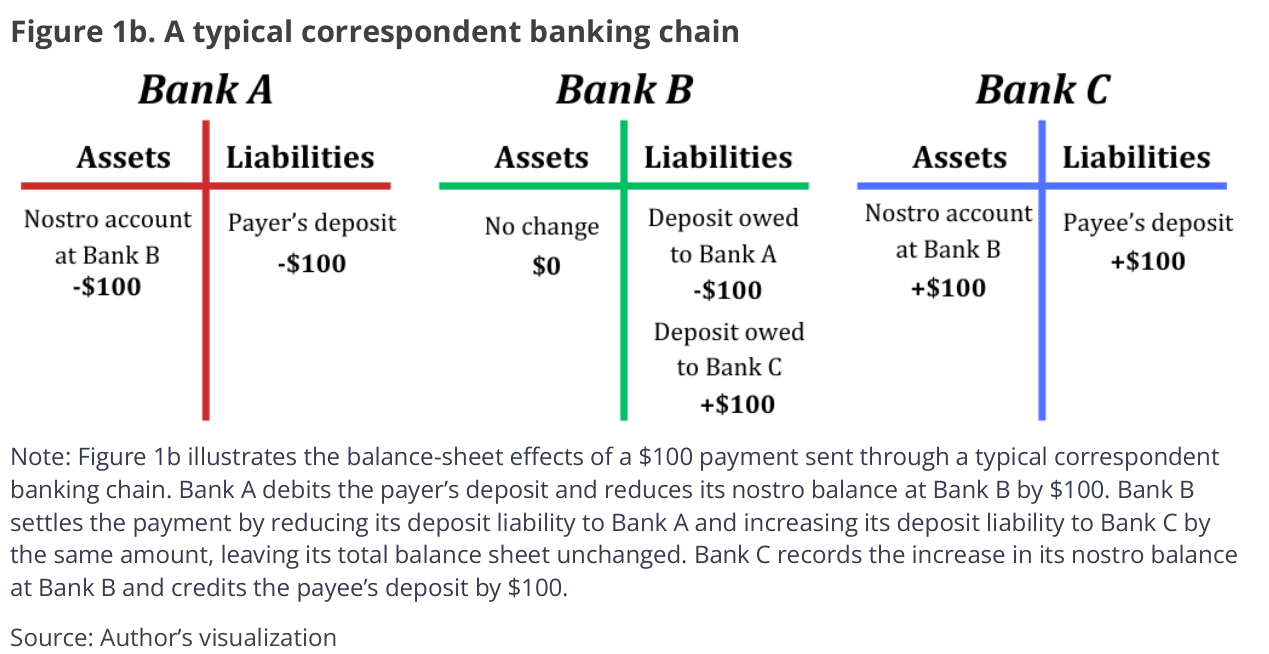
Read the diagram as text
- Read the payer’s bank: Bank A reduces the payer’s deposit liability by $100. Its nostro balance held at Bank B is an asset and also falls by $100.
- Check both deposits at the correspondent: Bank B owes Bank A $100 less and Bank C $100 more. Both entries change liabilities, so Bank B’s total assets and total liabilities are unchanged in the example.
- Read the payee’s bank: Bank C’s nostro asset held at Bank B increases by $100. Bank C’s liability to the payee increases by the same amount when it credits the deposit.
Based on official sources
This $100 example follows the same payment across three balance sheets. The study uses one currency and omits fees. The Bank of Canada publishes the paper as independent research.
Read the original at full size here
Use touch, a trackpad, or the arrow keys in the image area.
PLAIN WORDS · 1 in this section
- hop
- one step of a message's trip between machines
PICTURE IT
The picture is the one the lesson above opens with. The table below shows how each part of it matches the payment.
THE REAL JOB lets banks in different countries pay each other through accounts one bank keeps for another, as there is no world .
- One bank opens an account at another bank
- Both banks record that one account in their own books
- The correspondent books the account movement; the respondent checks its internal mirror against independent account evidence
- With no direct link, banks in the middle (intermediary agents) bridge the gap, one step (hop) at a time
- Each hop changes one account between two banks, and both banks' books must agree
HOW THE PICTURE MAPS
| In the picture | In the payment |
|---|---|
| Playing the part of a bank, you leave some money with a friend abroad | A bank opens an account at another bank: the respondent, whose money it is |
| The friend who holds your money and pays people there from it | The bank that keeps the account for the respondent: the correspondent |
| The place at your friend's home where your money is kept | The account the respondent has at the correspondent |
| Your message asking the friend to pay someone there | The instruction: a message asking the correspondent to change a balance |
| The friend hands over local cash | No cash moves: the bank changes a balance or passes the instruction on |
| The someone there, who is paid with the local cash | The person or firm being paid: the last bank adds the money to their account |
| The number that says how much of your money the friend still holds | The account balance, which falls when the correspondent pays for the respondent |
| Your own notebook: this is my money, left with my friend | The respondent's books: our account with you, a nostro |
| Your friend's notebook: the same money, held for you | The correspondent's books: your account with us, a vostro |
WHERE THIS PICTURE STOPS
- A friend hands over cash, but a bank pays by changing balances. The last bank in the chain adds the money to the account of the person or firm being paid. A message network can carry the instruction, but it moves no money. So a change at the first hop does not mean the payment has arrived. Each later hop must still change its own account.
- The picture has two people, and a real payment often has more. When the first bank and the last bank have no account with each other, banks in the middle pass the payment along. These are called intermediary agents. Each step along the chain is a hop. Each hop changes one account between two banks, so every extra link adds an account that two sets of books must agree on.
- A friend keeps your money safe and can pay out whenever you ask. A balance at a bank is a claim on that bank, meaning the bank owes you that amount. So it carries credit risk, the chance that the bank cannot pay you back. It is not cash in a vault.
- In the picture, you stand for a bank, not for a customer. The customer who asks a bank to pay is not shown, and the customers' own accounts change too, as well as the accounts between banks.
- A friend is always the same person, but correspondent and respondent are positions in one relationship, not kinds of bank. One bank can be the correspondent in one relationship and the respondent in another. The word respondent can also give the wrong idea: it is the bank that owns the money in the account, not the bank that answers.
- The picture does not show a third bank. Some teaching calls a third-bank viewpoint loro, but the ECB glossary uses loro as another name for the servicing bank’s vostro. Check the document’s convention and identify the account holder and servicing bank. A pronoun alone does not settle the meaning.
- A friend asks no questions. A real correspondent takes the payment onto its own books and applies its own checks. These include sanctions screening, which means checking names against sanctions lists. It may hold a payment for review. A hold is that check working, not the chain breaking, and the payment waits for a decision. A correspondent can also end a relationship, which can remove a route.
- A friend answers whenever you ask, but a bank has a cut-off, the last time in the day that it accepts payments for that day. A payment that arrives after the cut-off is not processed for that day, so what happens next is set by that bank's own rules. In the serial flow on this site the bank queues the payment and pays it with the next business day's date. This can happen even when the payment left the first bank on time.
- Fees can be taken out along the chain, so the amount delivered can be smaller than the amount sent. Each statement from a correspondent is reconciled, which means checked line by line against the bank's own records. A line that does not match becomes an investigation.
HOOK
Count the bank-to-bank accounts a payment changes, not the messages.
REMEMBER IT THIS WAY
A contrast: two neighbours told apart by one test.
Nostro means with you; vostro means with us. Check a document’s own loro convention before applying the third-bank pronoun mnemonic.
| In the trick | What it stands for |
|---|---|
| One account | described from each side, so a nostro and a vostro are usually not two accounts |
| Ours: nostro | our account on your books, said by the bank whose money it is |
| Yours: vostro | your account on our books, somebody else's money that the bank holds and services |
| Theirs: loro | A third-bank viewpoint in some teaching; the ECB instead uses loro as another name for vostro |
The ECB loro/vostro convention differs from this third-bank mnemonic; identify the actual holder and servicing bank, and keep mirror records distinct from deposits.
TELL A FRIEND
Banks in different countries pay each other when one bank keeps an account for another, like a trusted friend abroad who holds your money. Both banks record that one account in their books, and a payment changes balances instead of carrying money across the border.
OFTEN MIXED UP WITH Serial versus cover routing. This topic is the between banks. The serial and cover topic covers two ways a payment can travel across those relationships. In serial, successive customer-payment instructions pass from bank to bank. In cover, the customer message goes straight to the . A separate bank-to-bank message tells the banks that hold the accounts to move the funds.
SEE THE PAYMENT MOVE
PICTURE THE JOURNEY
Two supply counters, a supply house and a postal serviceOpen to read the picture, how it matches the payment and where it stops.
PICTURE IT
Two supply counters, a supply house and a postal service
Picture a toy-shop owner paying an overseas toy maker. Each keeps credit at a different supply counter, and both counters keep a page at one supply house. This invented case uses that shared house; other routes can have more intermediaries.
Her counter checks her order and lowers her credit. It posts a payment letter to the supply house. The postal service checks and carries the envelope; delivery itself changes nobody's credit. The house checks the instruction and available credit, then lowers her counter's page and raises the other counter's page. It sends a credit notice and an onward payment letter. The receiving counter checks the evidence and credits the toy maker.
The six forks have explicit assumptions. An agreed handling fee reduces the amount arriving; a shared-cost label alone does not authorize every deduction. An agreed conversion applies because the recipient's account accepts only another currency. A review pauses this case without an automatic report, but silence alone cannot identify the cause. In the duplicate fork, controls fail and the books actually show two transfers and two recipient credits; merely receiving two letters would not prove that outcome. Recovery needs a valid basis, authority and available credit, followed by a separate return. This case assumes the customer's agreement. The invalid-account fork assumes a full return through the same house. The late fork assumes the next eligible processing day, subject to calendars, funding and checks.
SYNTHETIC / TRAINING ONLY: the shops, counters, fee and conversion terms are invented; the historical message example is not a current universal service rule.
THE REAL JOB This historical serial MT103 example relays payment instructions while one changes its own account balances.
HOW THE PICTURE MAPS
| In the picture | In the payment |
|---|---|
| The toy-shop owner, who asks her counter to pay abroad | The ordering customer, who instructs Bank Alfa to pay a supplier abroad |
| Her local supply counter, which holds her credit | Bank Alfa, the ordering bank, which has no account with Cassia BankWho: Bank Alfa |
| The counter checks the order and names, then lowers her credit | Bank Alfa validates and screens, then debits the payer's account |
| The postal service: checks the envelope layout, keeps it safe, delivers it | Swift FIN, the message network, validates, stores and delivers; it settles nothing |
| The payment letter that her counter posts to the supply house | The MT103, a customer payment message, goes first to Meridian Bank |
| The supply house, where both counters keep a credit page | Meridian Bank, the correspondent that holds accounts for both banksWho: Meridian Bank |
| It checks the letter, the names, and that her counter's page holds enough | Meridian Bank screens the payment itself and checks Bank Alfa's account holds enoughWho: Meridian Bank |
| A minus on her counter's page, a plus on the other's | Book transfer: Meridian Bank debits Bank Alfa's account and credits Cassia Bank'sWho: Meridian Bank |
| A credit notice posted to the toy maker's counter | The MT910, which tells Cassia Bank its account at Meridian Bank was credited |
| An onward payment letter relays the instruction to the receiving counter | An onward MT103 relays the instruction to Cassia Bank in this historical example |
| The toy maker's counter, which checks the letter and the notice | Cassia Bank, the beneficiary bank, validates and screens before it creditsWho: Cassia Bank |
| The toy maker, whose credit rises | The beneficiary, credited by Cassia Bank |
| An agreed handling fee reduces the credit arriving at the other counter | An agreed intermediary fee is assumed; SHA alone does not authorize every deduction |
| His account accepts another currency and the agreed conversion applies | Cassia uses agreed automatic FX for this euro-only account; other arrangements differ |
| A review pauses this letter; no automatic report is assumed here | This case has a compliance hold; silence alone does not establish the cause |
| Her counter posts a short query note to the supply house | MT199, a free-format query message, asks a person at Meridian Bank to look |
| Controls fail; the books confirm two transfers and two recipient credits | Duplicate control failure and actual double posting are explicit assumptions, not message-arrival consequences |
| A recovery request needs authority; a separate return follows permitted customer recovery | Historical MT192 requests recovery; MT196 answers, but neither alone moves the returned funds |
| An invalid account leads to a separate return through the same house here | This invalid-account case assumes a full return via Meridian; actual routes and fees vary |
| The late letter waits until the next eligible processing day in this case | Actual cutoff, calendar, funding and checks govern processing; next-day value is not universal |
WHERE THIS PICTURE STOPS
- This case uses one shared correspondent's commercial-bank ledger: the account balances are claims on Meridian Bank, not central-bank money. There is no clearing house in this illustration; other serial routes can involve several intermediaries and settlement arrangements.
- A delivered instruction or credit advice is message evidence, not independent proof that the relevant settlement or customer credit occurred. Reconcile the applicable account entries and status evidence; the advice and settlement are distinct.
- An original settled entry remains recorded. A cancellation or recovery request is not a debit authority or completed return. Recovery depends on a valid basis, authority and available funds; customer consent is an explicit assumption in this positive example, not the only possible legal basis everywhere.
- The late fork assumes the next eligible processing day. Actual currency calendars, cutoffs, funding, checks and account arrangements determine processing and value dates; a late message does not universally get tomorrow's value date.
- Names are only a simplified picture of applicable validation and screening controls. A hold does not prove wrongdoing, and silence does not prove a compliance hold. Reporting can use automated or manual channels; this fork merely assumes no automatic report.
- The illustration's fee deduction and automatic currency conversion require its agreed terms. Shared charge allocation does not itself authorize every deduction, and a different account currency does not establish a universal conversion policy or rate.
- This is a historical
MT103example. Normal in-scope cross-border FI-to-FI coexistence has ended: nativeCBPR+instructions use the applicableISO 20022profile overFINplus. Selected MT conversion contingency is distinct, and other MT services were not globally retired. Current private message profiles were not reviewed here.
HOOK
Trace the instruction; verify the actual account entries.
REMEMBER IT THIS WAY
A sequence: the real steps, in order.
In this shared-correspondent case, trace instructions separately from the actual ledger postings.
| In the trick | What it stands for |
|---|---|
| Message path | the MT103 goes first to Meridian Bank, which holds accounts for both banks |
| Book transfer | Meridian Bank debits Bank Alfa's account and credits Cassia Bank's |
| Advice | the MT910 tells Cassia Bank its account at Meridian Bank was credited |
TELL A FRIEND
This serial example relays instructions through Meridian, which holds both banks’ accounts. Messages and advice describe the journey; actual ledger entries establish what was posted, including any duplicate.
OFTEN MIXED UP WITH Serial versus cover routing. Serial relays the customer instruction along the intermediary chain; cover separates the customer-instruction route from its funding route. This historical example uses MT103; current message and settlement rules depend on the applicable service and profile.
PRACTISE AND KEEP
IMPLEMENTATION RESOURCES
15 RESOURCES
EVIDENCE AT ARM'S REACH
Apply the base message definition first, then the scheme or infrastructure profile that governs this topic.
An XSD checks XML structure. A usage guideline adds profile rules, conditional fields, code restrictions, and business controls. XSD-valid does not mean scheme-compliant.
OPEN OFFICIAL SOURCE
PMPG correspondent-payment and reporting market practice
MT103 customer credit transfer — raw FIN
MT202 COV cover payment — raw FIN
MT103 rejection convention — raw FIN
MT103 return convention — raw FIN
MT legacy and migration lifecycle — ZIP pack
MT103 → pacs.008 implementation mapping
MT202 COV → pacs.009 COV implementation mapping
MT103 /REJT/ convention → pacs.002 implementation mapping
MT103 /RETN/ convention → pacs.004 implementation mapping
MT103 field matrix
MT202 COV field matrix
Payment lifecycle test cases
MT to MX migration notes
Sources for this topic — 11 sources
- Market practice
Correspondent banking (final report) ↗ — CPMI, Bank for International Settlements · correspondent banking model and decline in relationships
Published in July 2016; its statistics cover 2011-2015 and are dated, but the definitions and arrangement types remain widely used.
- Simplified educational illustration
Payments Signal editorial teaching models — Payments Signal
What this simplifies: The linked serial payment flow shows a three-bank chain with one intermediary; real chains vary in length, and fee deduction and funding timing differ by relationship and currency.
Used wherever diagrams, scenarios, figures, or example values are didactic constructions rather than sourced facts; every such use carries a simplifications disclosure. All people, companies, banks, and list entries in examples are fictional.
- Regulatory guidance
Cross-border payments ↗ — Bank of England · cost and delay added by correspondent hops, including processing and FX costs
Used for the commercial-mechanics layer only: intermediary processing cost, FX cost, chain length, and liquidity. It is an explanatory central-bank page rather than a rulebook and does not define any bank's tariff or contractual charging arrangement.
On 6 November 2026 the obsolete payment-and-settlement URL failed. The current payments/cross-border-payments page and its three account/message-route figures were opened. Source examples are not universal timings, tariffs or account designs.
- Market practice
Western Balkans Six — Report on B2B payment costs, second edition ↗ — World Bank · examples of correspondent cost layers including intermediary/lifting fees and FX margins
Regional evidence, not a universal tariff. The curriculum uses it to name cost components and explicitly avoids copying corridor prices or implying that every payment incurs every component.
- Market practice
Liquidity bridges across central banks for cross-border payments ↗ — Bank for International Settlements — Committee on Payments and Market Infrastructures · cost of holding liquidity and collateral across currencies and jurisdictions
Cited for the treasury trade-off created by pre-positioned cross-border liquidity. The lesson's cash-positioning and buffer language is an educational operating model, not a claim that CPMI prescribes one universal treasury algorithm.
- Market practice
A Primer on Federal Reserve Float ↗ — Federal Reserve Bank of New York · the plain meaning of float as a timing gap between a credit and a charge (search excerpt, page not opened)
Search excerpt, page not opened. Found by WebSearch on 2026-10-18 with a query on the meaning of float, limited to Federal Reserve and Bank for International Settlements domains. The paper is from 1975, so its mechanics are old and only the plain meaning is used. No source found defines float for nostro accounts, so that use is the way treasury teams carry the word over.
- Market practice
PMPG Cover Payments Market Practice Guidelines — version 4.1.1, April 2026 ↗ — Swift / Payments Market Practice Group · v4.1.1 April 2026 cover guidance
Public PDF opened on 5 November 2026. Edition 4.1.1, April 2026. Section 1.1 p7 distinguishes COV funding from camt.054 credit advice or camt.053 reconciliation at its creditor. Sections 1.1–1.2 distinguish pacs.009.001.08 ADV from COV. Sections 14–16 and FAQ1 explain policy-based early credit and an applicable wait-for-settlement agreement. Section 13 coordinates direct and cover cancellation and its footnote says an additional cover-chain request is not required. Market-practice guidance does not certify any bank implementation or replace effective usage guidelines.
- Market practice
Payments and markets glossary — loro account (vostro account) ↗ — European Central Bank · ECB Payments and markets glossary, live headword “loro account (vostro account)”: servicing-bank account versus customer-bank nostro; opened 6 November 2026. This is a source convention, not a universal legal definition.
Primary glossary page opened and read on 6 November 2026. No edition or publication date is assigned to the live headword. The ECB February 2017 Tenth survey on correspondent banking in euro 2016, section 1, printed page 6/PDF page 7, independently uses loro or vostro for the servicing-bank view. CPMI July 2016 Figure 1 also labels the serviced account loro.
- Scheme-specific rule
Global financial community completes switch to ISO 20022, paving the way for new levels of cross-border payment speed and innovation around the world ↗ — Swift · Swift press release, 25 November 2025: final switch to ISO 20022 for cross-border payment instructions completed the weekend of 22 November 2025; temporary conversion for remaining MT instructions (search excerpt, page not opened)
search excerpt, page not opened: returned by WebSearch on 2026-11-23 (the swift.com host could not be reached from this session). The 97 percent figure is Swift's own count for one day, not a standing rate. Read the page itself before quoting its exact words.
- Scheme-specific rule
MT to ISO 20022 conversion FAQ ↗ — Swift · Swift FAQ: MT103 and MT103 STP sent bank to bank go through contingency conversion to ISO 20022 (search excerpt, page not opened)
Read on the access date through the Internet Archive's copy of the publisher's own URL, snapshot of 15 February 2026, at HTTP 200 and 25,816 bytes. That is stated because it matters: swift.com itself still could not be reached outright, returning HTTP 000 with no response at all, so the archive is the only route and the text is as it stood in February.
The previous note said a full-page fetch was unavailable. That half is still true of the live site and is now recorded with the evidence.
Every claim the entry already made survives the archived text, including the list of negatively acknowledged message types, which matches word for word. The set that is converted rather than rejected is added, because the entry named only the rejected half and a reader could reasonably have inferred the rest were unaffected.
One label is dropped. The entry called this the end of CBPR+ coexistence; the page never uses that term, and describes the scope as cross-border institution-to-institution payment instructions. The page's own words are used above.
- Scheme-specific rule
ISO 20022: Corporates (Swift frequently asked questions) ↗ — Swift · Swift FAQ for corporates: SCORE and market-infrastructure closed user groups may keep exchanging MTs such as MT103 (search excerpt, written before the cutover, page not opened)
search excerpt, page not opened: returned by WebSearch on 2026-11-23 (the swift.com host could not be reached from this session). The wording was written before the cutover, so it says what Swift planned. It does not confirm that any group has since migrated. It covers closed-group and corporate traffic only. Bank-to-bank (FI-to-FI) MT payment instructions sent over the shared FIN service are covered by the MT to ISO 20022 conversion FAQ instead.
Deepest material on this page: L4 — Standards & sources. Where a topic stops short of implementation depth, that is a deliberate coverage decision, not an oversight — see coverage.