Cross-border payment networks beyond correspondent banking
Why sending money across borders is slow and opaque through correspondent chains, and how closed-loop networks and quote-then-pay APIs offer another route.
L1–L4 are part of the Pro pass
L0 Explain simply
Sending a payment across a border has, for most of banking history, worked rather like posting a parcel by hand. You give it to a neighbour, who hands it to their friend two towns over. That friend hands it to someone at the border, who passes it to a driver on the other side, and so on until it arrives.
Every handover costs a little, takes a little time, and adds one more place where you lose sight of the parcel. If it goes missing, you are not sure which handover dropped it — and neither is anybody else in the line.
Money crossing borders through banks has long worked the same way. Your bank does not reach the far country directly, so it passes the payment along a chain of other banks that do business with each other. That chain is why an international transfer can be slower, dearer and harder to track than a payment inside your own country.
Newer networks try a different shape. Instead of a long chain of strangers, a single operator plugs into the local payment systems of many countries at once, so your money takes one clear hop rather than several blind ones.
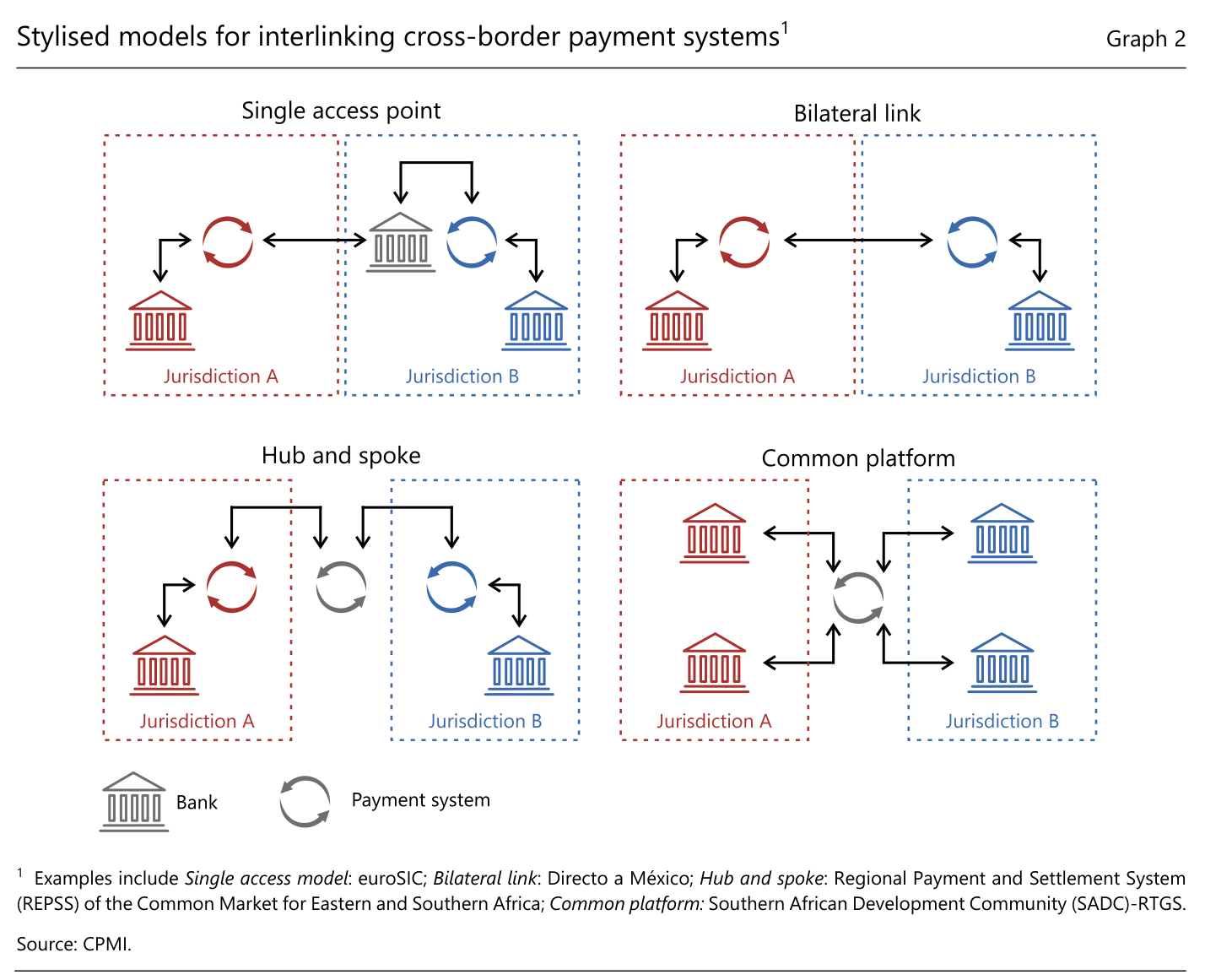
Read the diagram as text
- Single access point: One gateway participates in both systems. In the top-left panel, the gray bank in Jurisdiction B connects with the systems on both sides.
- Bilateral link: The two local systems link directly. Read the horizontal connection between the payment systems in the top-right panel.
- Hub and spoke: Both local systems connect to a shared hub. The middle symbol in the bottom-left panel shows the hub that links them.
- Common platform: Banks in both jurisdictions use one shared payment system. The gray symbol in the bottom-right panel is the central platform.
Follow the published figure step by step.
Read the original at full size here
Use touch, a trackpad, or the arrow keys in the image area.
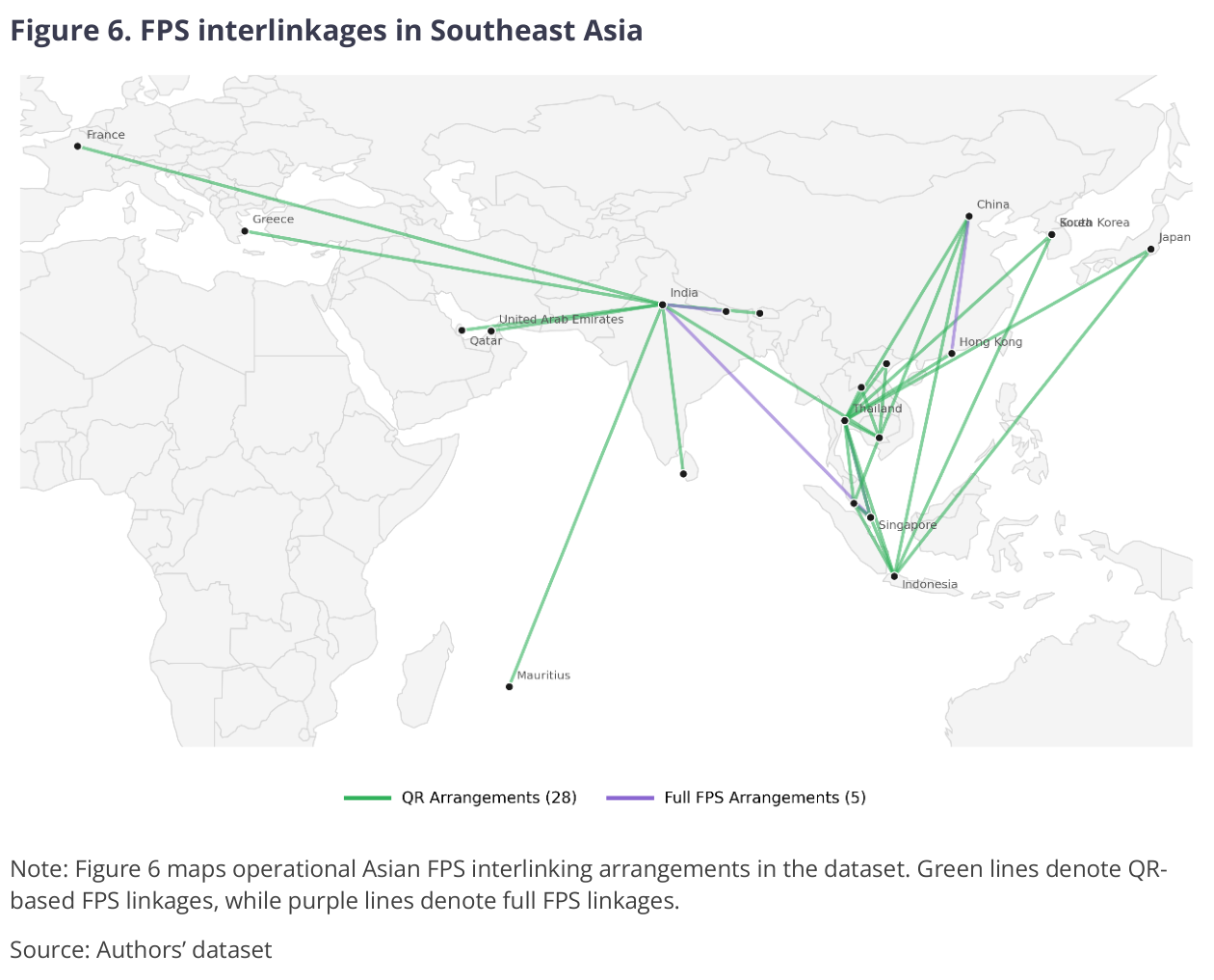
Read the diagram as text
- Read the two kinds of link: Green denotes a QR-based fast-payment link. Purple denotes a full fast-payment-system link. The numbers in parentheses count arrangements in the dataset, not transactions.
- Find links around Southeast Asia: Find the cluster around Thailand, Singapore and Indonesia. Several green and purple lines appear in the same region. The authors describe this as a web of separate bilateral arrangements.
- Check what an individual line can tell you: The green line between India and Mauritius is a QR example in the dataset. It shows a recorded arrangement. Check the operator for the countries, directions and payment types available to you.
Read the Bank of Canada’s original map step by step.
Read the original at full size here
Use touch, a trackpad, or the arrow keys in the image area.
Both shapes are in use, and neither is simply better than the other. As the detail arrives, keep asking the question that separates them: how many hands touch this payment, and does anybody see the whole journey?
PLAIN WORDS · 2 in this section
- handover
- passing a task or duty on to someone else
- hop
- one step of a message's trip between machines
PICTURE IT
A long trip by connecting buses, or one booked trip
A friend at home sends a traveller to a distant village and follows the trip by phone. The traveller stands for the sender's view of the payment, not for the money itself. In the first version the traveller takes one bus, changes to another company's bus at a junction, and changes again. Each time a new ticket is bought at that company's own desk, under its own timetable. The friend often cannot see where the next bus is. The total fare may only be clear at the end.
In the second version the friend books the whole trip with one tour operator. The operator shows the price and the expected arrival time before the friend agrees. A small local minibus is already waiting at the village to finish the last stretch. The operator arranged that minibus earlier and evens up its own accounts afterwards. How the fare reaches the operator varies. If something goes wrong, there is one office to ask.
THE REAL JOB A cross-border route moves a payment between countries, in one of two shapes that differ in parties and visibility.
- The sender asks the network for a quotation: rate, fees and expected delivery
- The sender accepts and sends a payment order against that quotation
- The operator often pays the recipient from money already placed on the local rail
- The operator settles between its own accounts as a separate step
HOW THE PICTURE MAPS
| In the picture | In the payment |
|---|---|
| The friend at home who sends the traveller | The sender |
| The traveller, as the friend follows the trip | The sender's view of the payment, not the money itself |
| Each bus company along the trip | Each bank in a chain of banks |
| Its own timetable, fare and ticket desk | Each bank's own clock, fee and exchange rate |
| A friend who often cannot see the next bus | A sender who often cannot see the payment or its final cost |
| The one tour operator who books the whole trip | The operator of a cross-border payment network |
| The price and arrival time shown before agreeing | The quotation, which the sender sees before paying |
| Saying yes to that booking | Sending a payment order against the quotation |
| A minibus already waiting at the village | Money placed ahead of time on the local payment rail |
WHERE THIS PICTURE STOPS
- In the lesson, one hop means one party to deal with, not one movement of money. The traveller stands for the sender's view of the payment. Do not read it as money riding every bus from start to end. The lesson opens with a parcel passed by hand, and this picture replaces it.
- In the lesson's pattern, the operator often pays the recipient from money it placed on the local rail earlier. It settles between its own accounts as a separate step. So the speed comes from how the money is set aside, not from a faster journey.
- The money the operator places ahead of time on local rails is the operator's own arrangement. It is not the same thing as the balances a sender's bank keeps with its correspondent banks in a chain. Both are ways of having money ready in advance. So having money ready in advance is not something only networks do, or something a chain never does.
- The sender still pays for the transfer, and the operator evens up its own accounts afterwards. How and when the sender's funds reach the operator varies by network and corridor. This is a plain version made by this site, not a scheme rule.
- A tour operator can only book trips to places where it has built a local connection. Correspondent banking still reaches the widest set of countries. The newer networks often run on top of it, or on local payment systems underneath. So the picture must not make the chain look out of date.
- The picture makes the booked trip look better, but neither shape is simply better. The sender relies on one operator instead of a chain of banks. A faster or clearer service is not automatically cheaper or better supervised on a given corridor.
- A bus ticket does not show that a quotation is held only for a short window. The quote-then-pay order and the pre-positioning are this site's editorial teaching model of how such networks usually work. They are not a rule from a scheme or regulator.
HOOK
Quick pay-outs mean money was already in place, not travelling fast.
REMEMBER IT THIS WAY
A contrast: two neighbours told apart by one test.
Ask what the sender sees first. One party showing rate, fees and delivery suggests a network; banks adding their own fees and rates suggest a chain.
| In the trick | What it stands for |
|---|---|
| Each bank adds its own clock, fee and rate | A chain of banks, where each link has its own time, fee and exchange rate |
| One party shows the quote | A network where one operator shows the exchange rate, the fees and the expected delivery time before the sender agrees |
| What the sender can see | Older routes show the cost later, and the sender often cannot see where the payment is now |
A network can run on top of correspondent banking, so one route can show both signs; treat the test as a first question.
TELL A FRIEND
Fast cross-border pay-outs often come from money set aside beforehand in the local , not from a faster journey. A is like changing buses; a network is like one booked trip.
OFTEN MIXED UP WITH Correspondent banking, nostro & vostro. passes a payment along a that each keep their own books. This topic covers networks that put one operator in the middle. They often run on top of the chain, so they do not replace it.
SEE THE PAYMENT MOVE
PICTURE THE JOURNEY
Two stores under one name, one ordering website and two separate ownersOpen to read the picture, how it matches the payment and where it stops.
PICTURE IT
Two stores under one name, one ordering website and two separate owners
Asha Traders wants to pay for an order that Northstar Components will collect. The order comes from a store brand with two stores, one in Asha's country and one in Northstar's. Both stores carry the same name, the same sign and the same ordering website. Each store belongs to a different owner. Each owner runs a separate company with its own cash box, its own book and its own licence to trade where the store stands.
Asha pays at the first store. Before anything moves, the first owner checks who owns the second store, because the shared sign does not answer that. The answer is a different company. The first owner puts Asha's money in the first cash box. In the first book the owner writes two lines: Asha's payment taken, and 'we owe the second store'. The shared website then carries the order across. It carries the order number, which company owns each store, the results of the first owner's checks and how the two owners will settle. It carries no goods and no cash.
The second owner treats the order as coming from another business. First the second owner runs the checks that the second country's rules require. Then the owner writes a line in the second book: 'the first store owes us'. Only then does Northstar collect the order. At the end of the day the two owners lay their books side by side. The line 'we owe' and the line 'they owe us' must show the same amount. The owners then settle it or record it, as their group has agreed.
Three things can change the story. If the shared website is down, the first owner sends the order by an ordinary courier, like any outside store. That takes longer and costs more, and the owners then settle by handing real money across. If the second owner's own check raises a doubt, the order waits at the second counter, although the first owner had passed it. If the two lines show different amounts, the owner whose book is wrong corrects it, and no central desk changes it for them. (SYNTHETIC / TRAINING ONLY: Asha Traders, Northstar Components and the store brand are invented.)
THE REAL JOB Two separate banks in one group carry a customer's payment, each posting its own books and settling or recording what they owe each other.
HOW THE PICTURE MAPS
| In the picture | In the payment |
|---|---|
| The business that pays at the first store | Asha Traders, the payer, who instructs the bank that holds its accountWho: Asha Traders |
| The first store's owner, a separate company | Bank Alfa's home entity, the legal bank that keeps the payer's accountWho: Bank Alfa |
| Checking who owns the second store, since the sign cannot say | The check of which legal bank owns the payee's account |
| Taking Asha's money and writing 'we owe the second store' | The home entity debits the payer and records a debt to the subsidiary |
| The shared sign and ordering website | The shared group gateway, which carries instructions and results; value is settled separately |
| The order passed across with its number and the first owner's check results | The hand-off with references, control results and the agreed way of settling |
| The second store's owner, another company under the same name | The foreign subsidiary, a separate legal bank in the same group |
| The second owner's checks, set by the second country's rules | The subsidiary's own inbound controls, including its own screening |
| Writing 'the first store owes us' and letting the order be collected | The subsidiary records a claim on the home entity and credits the payee |
| The business that collects the order at the second store | Northstar Components, the payee, whose account the subsidiary creditsWho: Northstar Components |
| The two books laid side by side at the end of the day | Reconciling the two mirrored positions so both entities show the same amount |
| The website is down, so the order goes by ordinary courier | Gateway unavailable (NOGW): the payment takes the ordinary outside route |
| The owners settle by handing real money across | In this flow, the outside route settles in central bank money |
| The second owner holds the order although the first owner passed it | The subsidiary's own alert (SCREEN) holds the credit; the value between the entities stands |
| The two 'owe' lines differ, and the owner of the wrong book fixes it | A mismatch (BREAK): the entity that made the error corrects its own books |
WHERE THIS PICTURE STOPS
- In the picture, an order is collected. In a payment nothing is collected: the payee's balance rises when the subsidiary posts its credit, and each bank only changes its own books.
- The picture shows a hand-over of real money as the settlement. In this flow's outside route, the entities settle in central bank money, which means balances held at the central bank. A real outside route may instead settle across correspondent accounts held at a commercial bank. The picture cannot show when that settlement becomes final. Finality depends on the rules of the system and on the law, which this flow does not draw.
- The picture's two owners follow the same kind of rule. Two banks in one group can be bound by different regulators and different lists, so one may hold a payment that the other cleared. That is a real result, not an error.
- The picture has two stores. A real group can have many banks, and which entities exist where is each group's own choice. Real groups may also use correspondents, external clearing systems or shared-service entities, and may treat the books differently in law and in accounting.
HOOK
One logo, two sets of books, two sets of checks.
REMEMBER IT THIS WAY
A contrast: two neighbours told apart by one test.
Ask which legal bank is acting. The home entity debits the payer, while the foreign subsidiary runs its own checks and credits the payee.
| In the trick | What it stands for |
|---|---|
| Home entity | the legal bank that keeps the payer's account, debits the payer and records a debt to the subsidiary |
| Subsidiary | a separate legal bank in the same group that runs its own inbound controls, records a claim on the home entity and credits the payee |
TELL A FRIEND
Two banks in one group are still two banks. Each posts its own books, runs its own checks and must match the other's record of what is owed.
OFTEN MIXED UP WITH The payment factory and the in-house bank. An is a group entity that keeps internal balances for its sister companies and records what each owes it. Here both entities are banks with their own customers, so each payment leaves something owed between two banks.
PRACTISE AND KEEP
Sources for this topic — 3 sources
- Market practice
Correspondent banking (final report) ↗ — CPMI, Bank for International Settlements · Committee on Payments and Market Infrastructures, correspondent banking report
Published in July 2016; its statistics cover 2011-2015 and are dated, but the definitions and arrangement types remain widely used.
- Market practice
Fast payments - enhancing the speed and availability of retail payments ↗ — CPMI, Bank for International Settlements · Committee on Payments and Market Infrastructures, fast payments material
Predates several major instant payment launches; this site uses it for concepts, not current statistics. Actual publisher PDF sections 4.1–4.2 and 5.2 opened and reviewed on 6 November 2026 for deferred inter-provider settlement and caps, collateral, loss sharing and prefunding distinctions; not a source for current operator parameters.
- Simplified educational illustration
Payments Signal editorial teaching models — Payments Signal
What this simplifies: The parcel-handover analogy and the fictional MeridianPay network stand in for a diverse and fast-changing set of real providers; named products are described only in general terms from public material.
Used wherever diagrams, scenarios, figures, or example values are didactic constructions rather than sourced facts; every such use carries a simplifications disclosure. All people, companies, banks, and list entries in examples are fictional.
Deepest material on this page: L4 — Standards & sources. Where a topic stops short of implementation depth, that is a deliberate coverage decision, not an oversight — see coverage.