Data that must travel: cross-border data rules, shared KYC, proxies and APIs
Why differing data rules slow cross-border payments, what the FSB recommends, and how shared customer checks, proxy registries and harmonised formats try to help.
L1–L4 are part of the Pro pass
L0 Explain simply
Ananya sends money from India to Marcus abroad. Her bank is Ganga Bank. His bank is Liberty Union Bank. (SYNTHETIC / TRAINING ONLY. Ananya, Marcus, Ganga Bank and Liberty Union Bank are invented.)
A payment is more than money. It carries information: who is paying, who is being paid, and why. Banks along the way use that information to check the payment is safe.
Each country has rules about how information may be collected, kept and sent abroad. The rules are written for good reasons, such as privacy and fighting crime.
Now suppose Liberty Union Bank asks for a detail about Ananya. Ganga Bank holds it. A rule in one country asks for the detail. A rule in the other country limits where it can go. The bank is caught between two rules.
Nobody is at fault. The payment waits while people work out which rule wins. This kind of clash is one reason cross-border payments cost more and take longer.
Several groups are trying to make the rules fit together, without weakening the reasons for them.
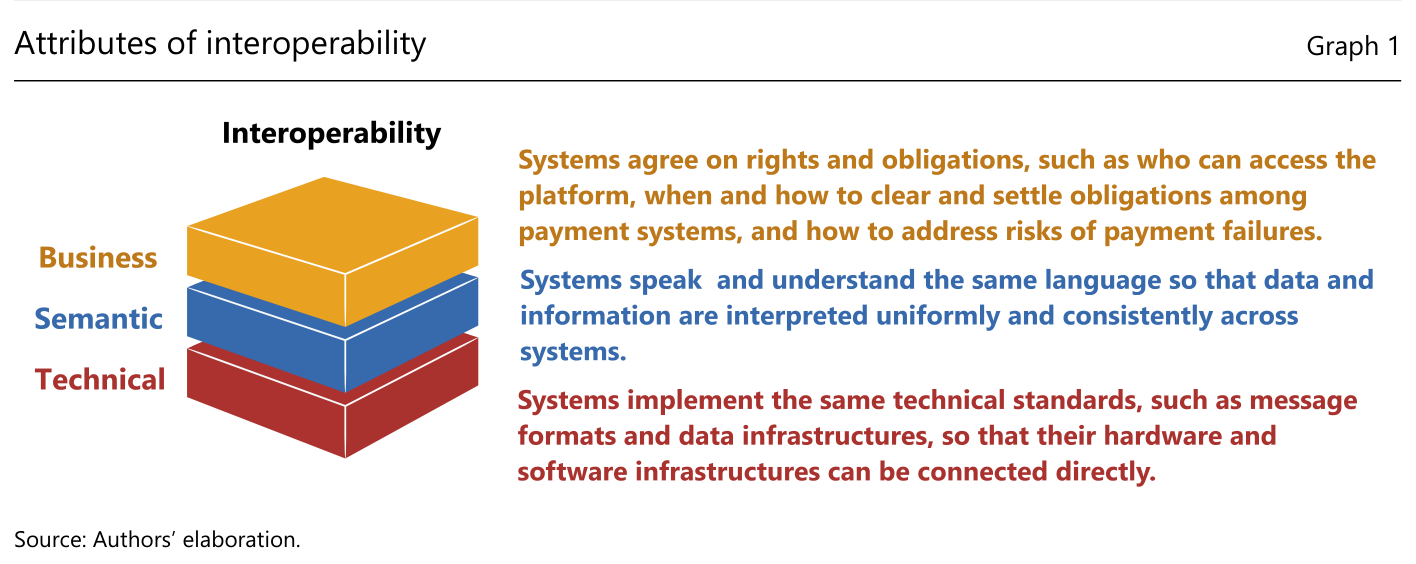
Read the diagram as text
- Connect the systems: The technical layer asks whether the systems can send and receive information in compatible forms. A connection lets a message travel.
- Agree on the meaning: The semantic layer asks whether both systems understand each piece of information in the same way. A field labelled address can still be interpreted differently.
- Agree on how to work together: The business layer sets shared rights and responsibilities. Who can use the link? Who handles a payment failure? Privacy and security obligations still apply.
Follow the published figure step by step.
Read the original at full size here
Use touch, a trackpad, or the arrow keys in the image area.
PICTURE IT
A parcel crossing borders with customs forms
Picture a parcel sent between two countries. Each country has its own customs form. One asks for the sender's full address. Another says that address must not leave the country. A parcel that satisfies one form can fail the other.
The post offices of the world agree to talk. They want forms that mean the same thing everywhere, a shared check of the sender's identity, and a simple code for finding the right address. They do not want to drop the reasons for the forms.
THE REAL JOB Aligned data rules, shared checks, proxy lookups and harmonised formats cut the friction of data that must cross a border.
- Two rules clash
- The payment waits
- Rules are aligned
- Checks are shared
- The payment crosses
HOW THE PICTURE MAPS
| In the picture | In the payment |
|---|---|
| The parcel | A cross-border payment |
| The customs form | The data that must accompany it |
| Two countries with different forms | Two data frameworks |
| A rule that the address must stay home | Data localisation |
| A shared identity check at the post office | A shared KYC facility |
| A simple code that finds the address | A proxy registryWho: Ananya |
WHERE THIS PICTURE STOPS
- A customs form is one page. A payment has many parties and several checks.
- Post offices can agree on forms. Banks must follow national law and cannot simply agree.
- The picture shows the clash. It does not say which rule is right.
- The groups that propose changes are not law-makers.
HOOK
Same data, same meaning, same safety.
REMEMBER IT THIS WAY
A chunk: a long list grouped so it is easier to hold.
Clash, align, share, look up.
| In the trick | What it stands for |
|---|---|
| clash | different data rules point in different directions |
| align | the call from the Financial Stability Board (FSB) to align frameworks without weakening their aims |
| share | shared KYC facilities, mostly regional |
| look up | proxy registries that find the right account |
The four words leave out who decides, because the bodies recommend and national law binds.
TELL A FRIEND
Countries have different rules about collecting and sending data, and the clash slows payments. International groups recommend aligning the rules without weakening privacy or crime checks, and they back tools such as shared checks and proxy lookups.
OFTEN MIXED UP WITH The G20 cross-border payments roadmap. The roadmap topic explains the whole programme and its targets. This topic covers one strand: the data and identity rules that cross borders.
CURRENT AS CHECKED
1 FIGURE
FSB Forum on Cross-Border Payments Data: establishment and role
The announced the Forum on Cross-Border Payments Data in
March 2025, following its recommendations of12 December 2024on data frameworks. The forum brings together public authorities for payments, /CFT, sanctions and data privacy. A private-sector advisory group was set up with it, per the FSB's October 2025 roadmap progress report. The forum first met on20-21 May 2025. None of the excerpts describes binding authority.Check the FSB's cross-border payments pages for current membership and work.
CHECKED 2026-10-11RECHECK BY 2027-03-31
Sources & standards — 2 sources
- Scheme-specific rule
FSB announces establishment of the Forum on Cross-Border Payments Data ↗ — Financial Stability Board · FSB announcement of March 2025 establishing the Forum on Cross-Border Payments Data: public-sector members covering payments, AML/CFT, sanctions and data privacy, a platform for dialogue and information exchange, with a private-sector advisory body announced (the October 2025 FSB roadmap report says an advisory group was established); first meeting held 20-21 May 2025 (FSB and FATF pages, search excerpts); none of the excerpts describes binding authority (search excerpts, page not opened)
Terms of reference were not found. Seen as WebSearch excerpts on the access date; the page was not opened.
- Scheme-specific rule
Recommendations to Promote Alignment and Interoperability Across Data Frameworks Related to Cross-border Payments: Final report ↗ — Financial Stability Board · FSB final report of 12 December 2024, Recommendations to promote alignment and interoperability across data frameworks related to cross-border payments: data frameworks mean the rules on collecting, storing, managing and transferring data, including retention, security and technical interoperability; the aim is to reduce unintended frictions without compromising AML/CFT, sanctions or data protection objectives; jurisdictions should consider how data localisation and data mirroring requirements affect cost, speed, transparency and access (search excerpts, page not opened)
The detailed recommendations were not seen. Seen as WebSearch excerpts on the access date; the page was not opened.
PRACTISE AND KEEP
Sources for this topic — 7 sources
- Scheme-specific rule
Recommendations to Promote Alignment and Interoperability Across Data Frameworks Related to Cross-border Payments: Final report ↗ — Financial Stability Board · FSB final report of 12 December 2024, Recommendations to promote alignment and interoperability across data frameworks related to cross-border payments: data frameworks mean the rules on collecting, storing, managing and transferring data, including retention, security and technical interoperability; the aim is to reduce unintended frictions without compromising AML/CFT, sanctions or data protection objectives; jurisdictions should consider how data localisation and data mirroring requirements affect cost, speed, transparency and access (search excerpts, page not opened)
The detailed recommendations were not seen. Seen as WebSearch excerpts on the access date; the page was not opened.
- Scheme-specific rule
Stocktake of International Data Standards Relevant to Cross-border Payments ↗ — Financial Stability Board · FSB stocktake of September 2023: fragmentation among data framework requirements, most notably the data that must accompany a cross-border payment, was a leading problem; implementation of FATF Recommendation 16 on wire transfers varies across jurisdictions (search excerpts, page not opened)
Only the summary was seen. Seen as WebSearch excerpts on the access date; the page was not opened.
- Scheme-specific rule
FSB announces establishment of the Forum on Cross-Border Payments Data ↗ — Financial Stability Board · FSB announcement of March 2025 establishing the Forum on Cross-Border Payments Data: public-sector members covering payments, AML/CFT, sanctions and data privacy, a platform for dialogue and information exchange, with a private-sector advisory body announced (the October 2025 FSB roadmap report says an advisory group was established); first meeting held 20-21 May 2025 (FSB and FATF pages, search excerpts); none of the excerpts describes binding authority (search excerpts, page not opened)
Terms of reference were not found. Seen as WebSearch excerpts on the access date; the page was not opened.
- Scheme-specific rule
Enhancing cross-border payments: building blocks of a global roadmap (Stage 2 report to the G20) ↗ — CPMI, Bank for International Settlements · CPMI Stage 2 report on the building blocks: fostering KYC and identity information sharing, where financial institutions in several jurisdictions have set up or are considering shared facilities for customer identification; such initiatives are likely to be regional rather than global and may need legal and regulatory change (search excerpts, page not opened)
CPMI Papers No 193, published 13 July 2020, with a technical background report issued alongside it as No 194.
Verified from independent web-search excerpts on the access date. The publisher's own domain cannot be fetched, so no text is quoted here from the publisher's own page. A failed fetch is not evidence about what the document provides.
- Scheme-specific rule
Enhancing Cross-border Payments: Stage 3 roadmap ↗ — Financial Stability Board (FSB) · FSB Stage 3 roadmap of October 2020: actions on KYC and identity information sharing include aligning and recognising identity requirements across borders and improving official identity databases; the World Bank was asked for a gap analysis and policy options on digital identity for cross-border KYC (search excerpts, page not opened)
Published 13 October 2020 as Stage 3 of a three-stage process the FSB coordinated: Stage 1 assessed the frictions, Stage 2 produced the building blocks, and Stage 3 is the roadmap itself.
An FSB roadmap binds nobody, and the site cites it with that strength and no more. Its activities are non-binding under the FSB's own articles of association, so an action here reaches an institution only once a standard-setter, a scheme owner or a national regulator has turned it into something a firm can be examined against.
Verified from independent web-search excerpts on the access date. The publisher's own domain cannot be fetched, so no text is quoted here from the publisher's own page. A failed fetch is not evidence about what the document provides.
- Scheme-specific rule
Harmonised ISO 20022 data requirements for enhancing cross-border payments (original report, October 2023) ↗ — Committee on Payments and Market Infrastructures (CPMI), Bank for International Settlements · CPMI report of October 2023 on harmonised ISO 20022 data requirements for cross-border payments (search excerpt, page not opened)
Verified from web-search excerpts only on the access date. The publisher's domain (bis.org) is blocked, so the page was not opened and no wording is quoted from it. The excerpts came from the Bank for International Settlements (BIS) publication list, the BIS press release and a European Central Bank copy of the report. Superseded in practice by the February 2026 update (cpmi-harmonised-iso20022-data-2026), but kept because it is the original text. Use at most the label market-practice from an excerpt-only source.
- Simplified educational illustration
Payments Signal editorial teaching models — Payments Signal
What this simplifies: Ananya, Marcus, Ganga Bank and Liberty Union Bank are invented, and the clash in the story is an illustration. The three frictions in level 1 are this site's grouping of the FSB's description. Level 4 is this site's reasoning. Every source was read as a search excerpt and no page was opened.
Used wherever diagrams, scenarios, figures, or example values are didactic constructions rather than sourced facts; every such use carries a simplifications disclosure. All people, companies, banks, and list entries in examples are fictional.
Deepest material on this page: L4 — Standards & sources. Where a topic stops short of implementation depth, that is a deliberate coverage decision, not an oversight — see coverage.