3-D Secure and strong customer authentication
3-D Secure adds an identity check to online card payments. How frictionless and challenge flows work, and what strong customer authentication requires.
L1–L4 are part of the Pro pass
L0 Explain simply
Online card payments may lack the terminal’s chip and cardholder-verification evidence. Typed digits can be copied; token-based remote payments can supply dynamic evidence too. gives the merchant a structured way to ask the issuer to authenticate the shopper before seeking payment authorization.
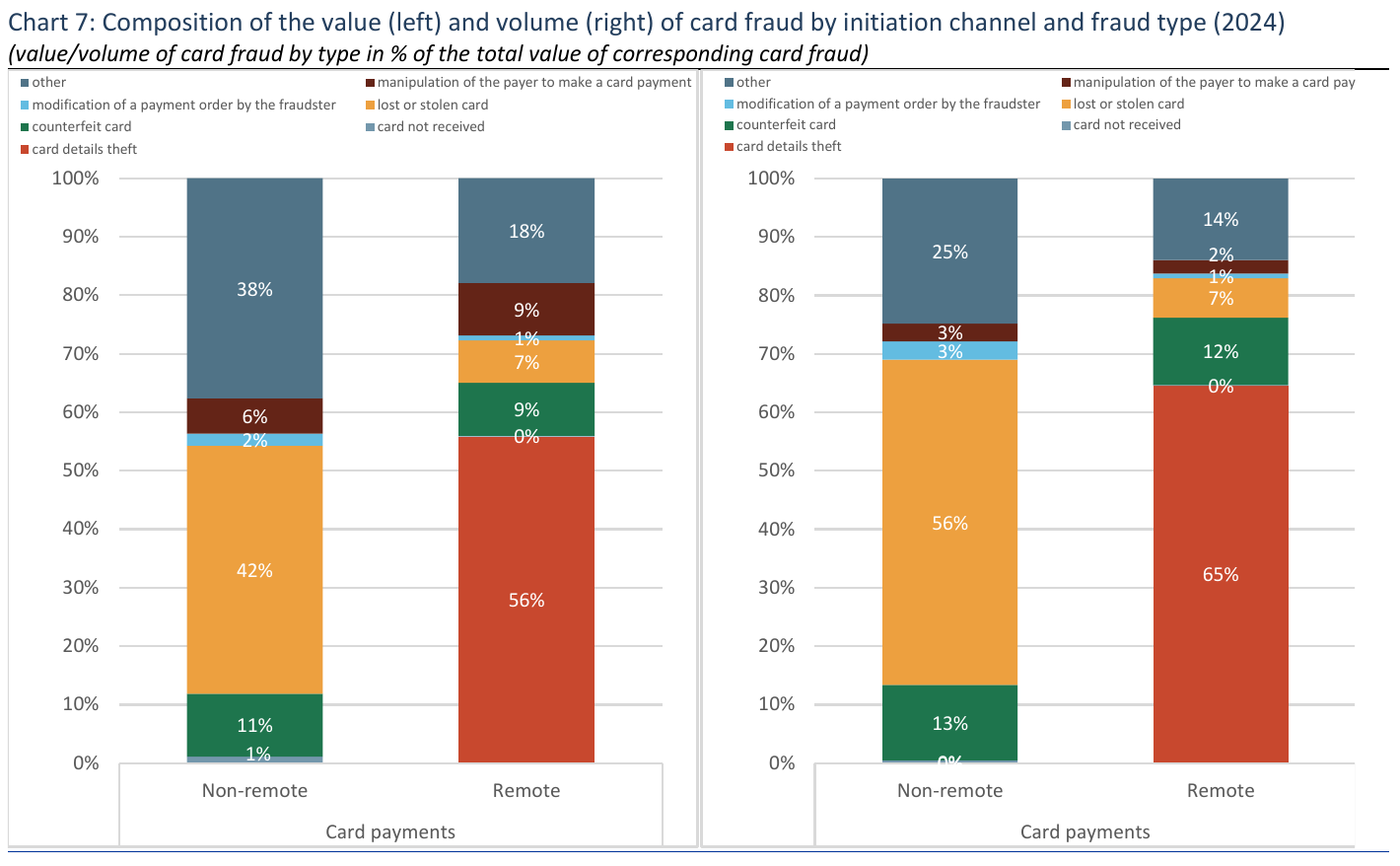
Read the diagram as text
- Find lost or stolen cards in the non-remote bar: In the left panel’s non-remote bar, the orange segment accounts for 42 percent of reported fraudulent payment value. In this example the stolen card can be used at a physical terminal.
- Find theft of card details in the remote bar: In the left panel’s remote bar, the large red segment is theft of card details. It accounts for 56 percent of reported remote card fraud by value.
- Change the measure to transaction count: Read the right panel for transaction count. Theft of card details accounts for about 65 percent of reported remote card fraud by count. Both panels count fractions of fraud in the channel, using different units.
Follow the published figure step by step.
Read the original at full size here
Use touch, a trackpad, or the arrow keys in the image area.
So the card world gave the shop a way to ring the issuer at the front door. Somebody claiming to be your customer is buying from me — have a look before I let them in.
In a frictionless example the issuer recognises enough from what it already sees. The device, the address, the pattern of past purchases. It waves the payment through and the shopper notices nothing at all.
Sometimes it wants more. Then the shopper is asked to confirm in their banking app, or to enter a sent to them.
Why not simply ask every time? Because every extra step loses some shoppers who were going to pay. A check that stops one fraudster and four honest customers has not made anyone better off.
Two different things are being named here, and beginners merge them. The standardised doorbell conversation is 3-D Secure, a protocol. The duty in some regions to actually run a strong check is strong customer authentication, a law.
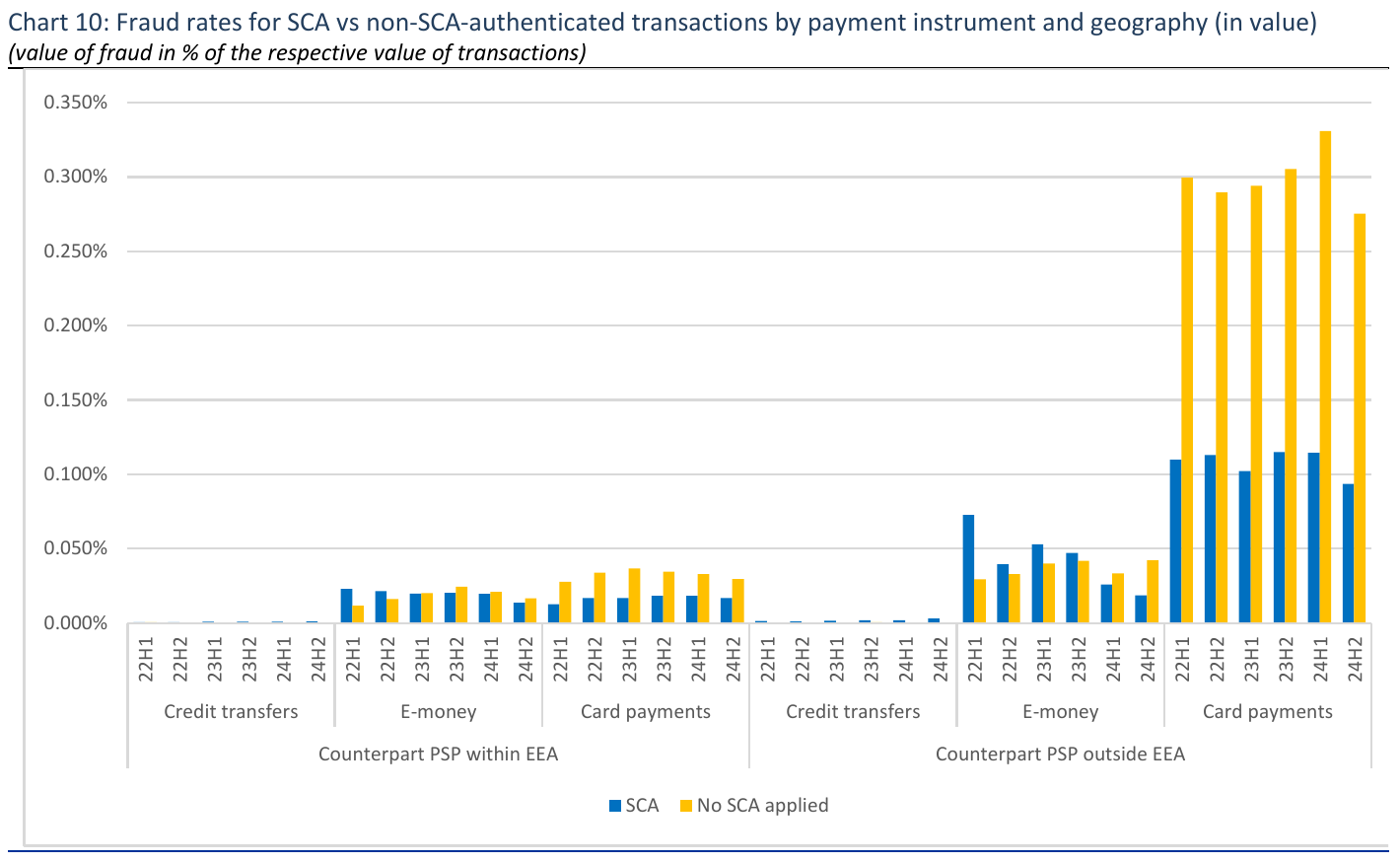
Read the diagram as text
- Find the authentication legend: Blue means strong customer authentication was applied. Yellow means it was not applied. The vertical axis shows reported fraud value as a percentage of payment value.
- Read card payments within the EEA: Look at the card group on the left side. It refers to a counterpart payment service provider within the European Economic Area. Compare the blue and yellow bars within the same half-year.
- Compare the group with a counterpart outside the EEA: On the far right, the yellow bars are much taller than the blue bars. The geographic group and authentication status both matter when interpreting the comparison.
Follow the published figure step by step.
Read the original at full size here
Use touch, a trackpad, or the arrow keys in the image area.
Keep asking which one a sentence is about as you read on. A protocol can be used where no law requires it, and a law can be met by means other than that protocol.
PLAIN WORDS · 3 in this section
- frictionless
- with no extra step or challenge for the customer
- fraudster
- a person who cheats others out of money
- doorbell
- a button by a door that rings a bell inside
CURRENT AS CHECKED
1 FIGURE
EU strong customer authentication exemption thresholds
Under Commission Delegated Regulation (EU) 2018/389, the on strong customer authentication, contactless payments at a terminal are exempt up to EUR 50 with cumulative counters (Article 11). Remote payments are exempt up to EUR 30 with cumulative counters (Article 16). The transaction risk analysis exemption (Article 18) has a ceiling of EUR 100, EUR 250 or EUR 500 according to the fraud rate the exempting provider can evidence. Each article carries conditions and counters not reproduced here, and national implementation differs.
CHECKED 2026-07-13RECHECK BY 2027-07-13
Sources & standards — 1 source
- Official requirement
PSD2 and the RTS on strong customer authentication and secure communication ↗ — European Banking Authority · Commission Delegated Regulation (EU) 2018/389 — Articles 11, 16 and 18 exemption thresholds
Referenced from the European Banking Authority's public short overviews, guidelines, and technical standards on payment services.
PRACTISE AND KEEP
Sources for this topic — 5 sources
- Official requirement
PSD2 and the RTS on strong customer authentication and secure communication ↗ — European Banking Authority
Referenced from the European Banking Authority's public short overviews, guidelines, and technical standards on payment services.
- Official requirementSuperseded — see The consolidated UK SCA-RTS as amended, most recently by the Technical Standards (SCA and CSC) (Amendment) Instrument 2025, in force 19 March 2026
UK technical standards on strong customer authentication and secure communication (SCA-RTS) ↗ — Financial Conduct Authority · the UK SCA-RTS made under the Payment Services Regulations 2017
Search excerpts only, page not opened. The FCA amends this instrument periodically, so any claim about a specific requirement should name the amending instrument and its date.
- Official requirement
EMV 3-D Secure documentation ↗ — EMVCo
Payments Signal links to the official documentation and does not reproduce licensed specifications. The architecture distinguishes 3-D Secure authentication from issuer authorisation.
- Market practiceSuperseded — see Glossary of payments and market infrastructure terminologyMarch 2003 edition
A glossary of terms used in payments and settlement systems ↗ — CPSS (now CPMI), Bank for International Settlements
Superseded for currency, not for coverage, and that distinction is the reason this entry stays. The live glossary at bis.org/cpmi/publ/d00b.htm is the current text. This edition remains the only published CPMI definition of ten headwords the live glossary does not carry.
Both editions were downloaded and compared on the access date. The 2003 PDF is 346,977 bytes; the generated PDF of the live glossary is 197,553 bytes. Four definitions this site teaches had moved. Six passages quoted the 2003 wording of netting in prose while attributing it to the CPMI glossary, and those now say which edition they are quoting.
Checks that returned nothing, recorded so they are not repeated. Singleness of money, payment token, electronic wallet and book transfer are headwords in neither edition. A citation for any of those was pointing at a document that does not contain the term.
- Simplified educational illustration
Payments Signal editorial teaching models — Payments Signal
What this simplifies: The frictionless-and-challenge framing and the fictional shopper are this site's presentation of two specifications it does not reproduce. Which exemptions an issuer actually applies, and the terms on which liability shifts, are set in documents outside the ones cited.
Used wherever diagrams, scenarios, figures, or example values are didactic constructions rather than sourced facts; every such use carries a simplifications disclosure. All people, companies, banks, and list entries in examples are fictional.
Deepest material on this page: L4 — Standards & sources. Where a topic stops short of implementation depth, that is a deliberate coverage decision, not an oversight — see coverage.