Disputes and chargebacks
What happens when a cardholder disputes a charge: reason codes, the chargeback, the merchant's representment, and where liability finally lands.
L1–L4 are part of the Pro pass
L0 Explain simply
A chargeback is the card system's built-in small-claims court, and the first surprising thing about it is where the customer goes. Maya Chen finds a charge from Demo Coffee Ltd she does not recognise. She does not chase the shop. She goes to her own bank. (SYNTHETIC / TRAINING ONLY — all names fictional.)
Bank Alfa, her issuer, can pull the money back through the Cardnet network — a fictional stand-in for Visa- or Mastercard-style networks — citing a numbered reason for the claim.
The claim lands on Meridian Bank, the acquirer, which passes it to the merchant with a choice: accept the loss, or answer with evidence.
Receipts, delivery notes and terminal records travel back the other way. Somebody weighs them. The loss finally comes to rest — on the cardholder, on the merchant, or on one of the banks.
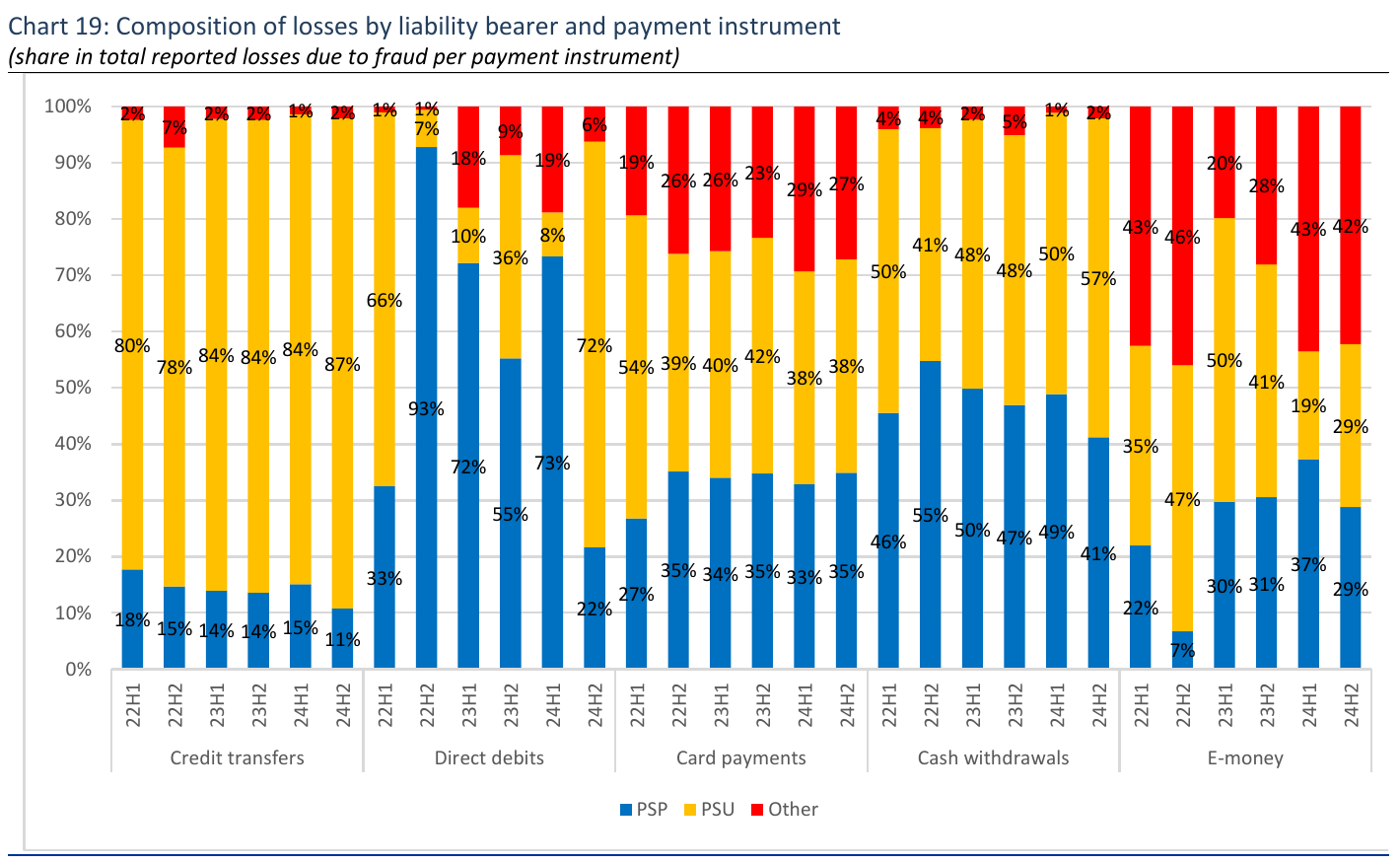
Read the diagram as text
- Read the three parties in the legend: Blue is the payment service provider. Yellow is the payment service user, such as a customer. Red covers other parties, which can include merchants.
- Find the card payments group: The central group is card payments. Each column totals 100 percent of reported fraud losses for that half-year, so a tall segment shows a bigger share within its own column.
- Compare credit transfers separately: The first group is credit transfers. The report estimates service users bore about 85 percent of their reported credit transfer fraud losses in 2024, compared with about 38 percent for card payments. Those instrument groups have different dispute and recovery arrangements.
Follow the published figure step by step.
Read the original at full size here
Use touch, a trackpad, or the arrow keys in the image area.
Money can be returned provisionally or debited through the scheme while evidence is considered, but the timing depends on consumer law, network procedure and the acquiring agreement. A cardholder credit and an acquirer-to-merchant recovery are distinct entries; do not assume both happen immediately in every case.
Why build it that way round? Because the cardholder is the party with the least information and the least power in the chain. Putting them back in funds first, and settling the argument between businesses afterwards, is a deliberate choice about who waits.
That path is the cardholder's safety net. The discipline it imposes on merchants — keep the receipts, keep the delivery proof, answer within the window — is the price of it.
PLAIN WORDS · 1 in this section
- mastercard
- a company that runs a card payment network
SEE THE PAYMENT MOVE
WHAT THIS PAGE CANNOT SHOW YOU
1 RAIL
These rails are explained here in words, and their message layout is not shown, because it is not something this site can honestly print. Each was looked for on the date given. Some specifications are issued only to a scheme’s own members; some are published openly and we could not retrieve a copy; and one or two we have not yet searched far enough to settle. Read what you have read above as an account of how each rail works, never as a specification you can build against.
Chargeback and representment — the dispute records exchanged through the networkPUBLISHED TO MEMBERS ONLY
The record layouts that carry a card payment's money and its disputes — Visa's BASE II clearing interchange formats and Mastercard's IPM clearing formats, including the presentment, chargeback and representment records
LOOKED FOR 2026-08-06
PRACTISE AND KEEP
Sources for this topic — 5 sources
- Market practiceSuperseded — see Glossary of payments and market infrastructure terminologyMarch 2003 edition
A glossary of terms used in payments and settlement systems ↗ — CPSS (now CPMI), Bank for International Settlements
Superseded for currency, not for coverage, and that distinction is the reason this entry stays. The live glossary at bis.org/cpmi/publ/d00b.htm is the current text. This edition remains the only published CPMI definition of ten headwords the live glossary does not carry.
Both editions were downloaded and compared on the access date. The 2003 PDF is 346,977 bytes; the generated PDF of the live glossary is 197,553 bytes. Four definitions this site teaches had moved. Six passages quoted the 2003 wording of netting in prose while attributing it to the CPMI glossary, and those now say which edition they are quoting.
Checks that returned nothing, recorded so they are not repeated. Singleness of money, payment token, electronic wallet and book transfer are headwords in neither edition. A citation for any of those was pointing at a document that does not contain the term.
- Scheme-specific rule
Mastercard Chargeback Guide — Merchant Edition ↗ — Mastercard · one network's published dispute rulebook — the reason-code structure, and second presentment as the merchant's formal answer
Verified from two independent web-search excerpts on the access date, both naming the document, its publisher-hosted URL and its second-presentment reason-code structure. www.mastercard.us is blocked, so no reason code, evidence requirement or time limit is quoted from it anywhere on this site.
One network's rules, and the vocabulary is not shared. This document says second presentment; Visa's process for the same step is called a dispute response, and the reason-code sets are not interchangeable between them. Anything on this site that describes the ladder generally says so, and names no code.
A merchant edition, so it states what a merchant must do rather than the full customer rules. That is the half a payments learner meets, and it is also less than the whole rulebook.
V11 audit, 6 November 2026: Retrieved publisher PDF is dated 13 May 2025. Read the general overview, chargeback cycles, second presentment and refund/duplicate-credit discussion (pp25–29). This does not establish the latest edition or every cash-dispute condition; Visa E1 supplies the specific ATM counterexample.
- Simplified educational illustration
Payments Signal editorial teaching models — Payments Signal
What this simplifies: The dispute ladder, the worked case and the fictional merchant are teaching constructions. Reason codes, evidence rules and time limits belong to each network's own regulations, and none is quoted here or invented to fill the gap.
Used wherever diagrams, scenarios, figures, or example values are didactic constructions rather than sourced facts; every such use carries a simplifications disclosure. All people, companies, banks, and list entries in examples are fictional.
- Scheme-specific rule18 April 2026 edition
Visa Core Rules and Visa Product and Service Rules ↗ — Visa · Dispute conditions distinguishing a stranger's unauthorised use from a genuine cardholder's own disputed purchase, and the evidence standard for each
The previous note recorded that this PDF could not be opened and that no sentence of the rulebook was quoted anywhere on this site. That is no longer true. On the access date the document downloaded in full over a plain request with a browser user agent, and the rules cited above are read from it.
That correction is worth keeping visible. A recorded access failure ages into a standing belief that a publisher is unreachable, and the belief then decides what the site is willing to claim. Re-test before repeating one.
Every rule carries its own identifier and an edition stamp, and the two differ: the rules cited here are stamped Edition Apr 2026 with Last Updated Apr 2023. Quote both, because the edition date says when the book was published and the update date says when the rule last moved.
V11 audit, 6 November 2026: Publisher PDF retrieved, dated 24 October 2026. Read the public introduction, selected authorization/FX material, US surcharge summary, §11.8.5.3 fraud invalid-dispute conditions and §11.11.10.1–4 ATM non-receipt conditions. These include authentication/ECI/CAVV conditions and cash-not-received rights. This is not certification of all 936 pages. Public rules omit proprietary/security details.
- Official requirement18 April 2026 edition
Visa Core Rules and Visa Product and Service Rules ↗ — Visa · 24October2026 edition §11.8.5.3: fraud-dispute eligibility and specified authentication conditions, not a universal chip/delivery defence.
The previous note recorded that this PDF could not be opened and that no sentence of the rulebook was quoted anywhere on this site. That is no longer true. On the access date the document downloaded in full over a plain request with a browser user agent, and the rules cited above are read from it.
That correction is worth keeping visible. A recorded access failure ages into a standing belief that a publisher is unreachable, and the belief then decides what the site is willing to claim. Re-test before repeating one.
Every rule carries its own identifier and an edition stamp, and the two differ: the rules cited here are stamped Edition Apr 2026 with Last Updated Apr 2023. Quote both, because the edition date says when the book was published and the update date says when the rule last moved.
V11 audit, 6 November 2026: Publisher PDF retrieved, dated 24 October 2026. Read the public introduction, selected authorization/FX material, US surcharge summary, §11.8.5.3 fraud invalid-dispute conditions and §11.11.10.1–4 ATM non-receipt conditions. These include authentication/ECI/CAVV conditions and cash-not-received rights. This is not certification of all 936 pages. Public rules omit proprietary/security details.
Deepest material on this page: L4 — Standards & sources. Where a topic stops short of implementation depth, that is a deliberate coverage decision, not an oversight — see coverage.