When the vendor is the risk: third-party information and communication technology (ICT) risk under Digital Operational Resilience Act (DORA)
A payment platform often runs on another firm's cloud yet stays responsible. Register, concentration, exit, oversight: what the Digital Operational Resilience Act (DORA) asks.
L1–L4 are part of the Pro pass
L0 Explain simply
On a Saturday morning, Riya tries to pay her rent through an app. The payment hangs. Her landlord Arjun is still waiting.
(SYNTHETIC / TRAINING ONLY: Riya, Arjun and Larkpay are invented, and so is this fault.)
Inside Larkpay, the licensed payment firm behind the app, nothing in its own code is broken. Its runs on a cloud host, a company that rents computing power by the hour. The cloud host has a fault, and every payment that passes through it stops.
Here is the plain idea. Larkpay chose to rent that computing power. It did not hand the duty over to the cloud host. If payments stop, Riya and the supervisor will ask Larkpay what happened, and not the cloud host.
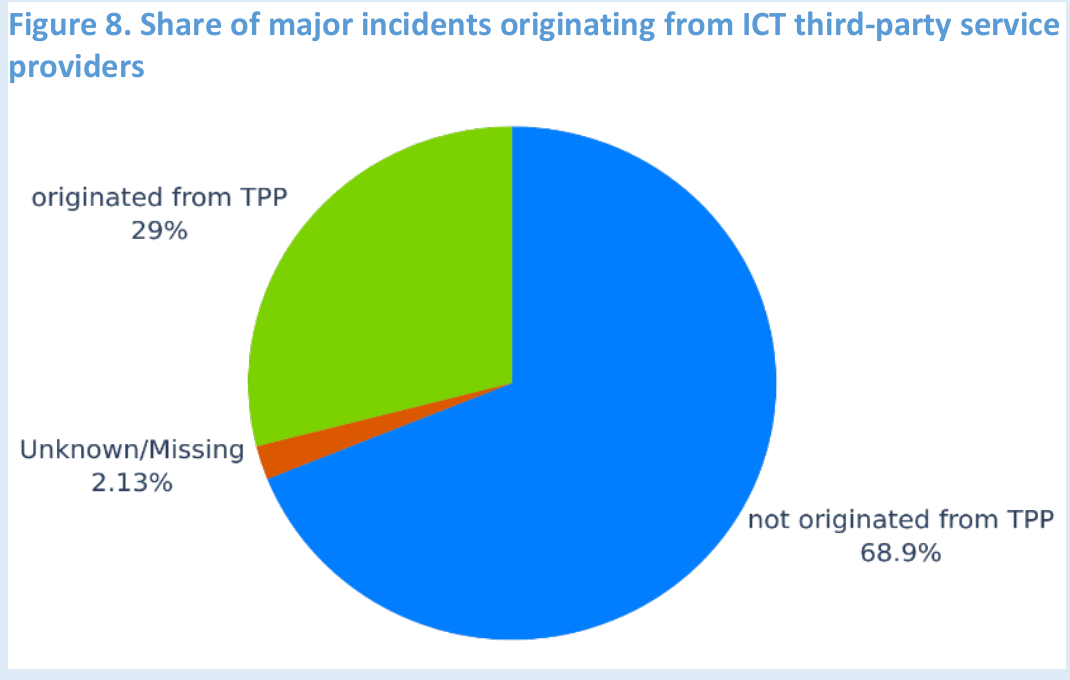
Read the diagram as text
- Find reported provider origins: The green segment is the share traced to an ICT third-party service provider. It accounts for 29 percent of the reported incidents in the chart.
- Read the remaining reported cases: The blue segment shows 68.9 percent were reported as not originating at a provider. The categories describe incident origin across the reporting sample.
- Keep unknown cases visible: The small orange segment means the provider origin was unknown or unreported. The status stays visible so it is not mistaken for incidents confirmed to have started elsewhere.
Follow the published figure step by step.
Read the original at full size here
Use touch, a trackpad, or the arrow keys in the image area.
The European Union (EU) wrote this idea into law. The law is the , or DORA. Its job is to make a firm's technology safe enough to rely on. It has a whole chapter on suppliers of technology.
That chapter asks four calm questions. Do you know every supplier you depend on? Do too many of your services sit with one supplier? Could you leave a supplier without stopping? And are the biggest suppliers watched by an authority, not only by their customers?
A supplier that is a problem is not a scandal. Renting is normal. The rules only ask that the firm knows what it rents, has thought about the bad day, and has practised the way out.
Article 28(1)(a) expressly says the financial entity remains responsible for its obligations. This is not merely an inference from the contract checklist. A provider can also have its own contractual or legal duties without taking over the firm's obligations.
PLAIN WORDS · 1 in this section
- inference
- a conclusion reached from clues or evidence
PICTURE IT
Hiring a builder to mend the roof of your own house
Picture a house owner who hires a builder to mend the roof. The builder does the work, but the house is still the owner's. If the rain comes in, the neighbours and the council ask the owner. A careful owner keeps a list of every worker on the property. The owner also checks that the whole house does not hang on one builder, and knows how to hire another if this one leaves.
THE REAL JOB The (DORA) asks a firm to list its technology suppliers, check how much rests on one, and plan its exit.
- The register records ICT arrangements, including within the group
- It checks how much rests on one provider
- The contract records termination rights and a transition period
- The exit plan is practised
- Critical providers are examined by a Lead Overseer
HOW THE PICTURE MAPS
| In the picture | In the payment |
|---|---|
| The house owner | Larkpay, the invented payment firm that stays answerableWho: Larkpay |
| The builder who mends the roof | The outside technology provider, such as a cloud host |
| The owner's list of every worker | The register of information |
| Using one builder for roof, walls and wiring | Concentration risk, many services resting on one supplier |
| A written and practised way to hire another builder | The tested exit strategy |
| The council inspecting a builder that works on many houses | A Lead Overseer examining a designated critical provider |
WHERE THIS PICTURE STOPS
- A house owner can usually watch the builder at work. A firm often cannot see inside a provider, which is why the rules ask for contract rights and evidence.
- One builder serves one house at a time. A cloud host serves thousands of firms at once, so one fault can reach many of them together.
- Changing builders is slow but simple. Moving payment services and data to a new provider needs a transition period and a plan. A plan never tested may not work.
- A council inspector visits a building site. A Lead Overseer examines the provider, but the firm still keeps its own register, assessment and exit plan.
- A transition clause may not be deliverable after sudden provider failure. Test alternatives and data access; designation retains firm duties and does not prove the service is safe.
HOOK
You can outsource the service, never the responsibility.
TELL A FRIEND
If a payment firm rents its technology, it is still answerable for it. The (DORA) asks it to list every supplier, avoid resting too much on one, and practise leaving.
OFTEN MIXED UP WITH How long can you be down before it matters (operational resilience, DORA). sets how long a service may be down before customers are harmed. Third-party risk is narrower. It looks at the suppliers beneath the service. Does the firm know them, depend too much on one, and can it leave?
Sources & standards — 1 source
- Official requirement
Regulation (EU) 2022/2554 on digital operational resilience for the financial sector (DORA) ↗ — European Union (EUR-Lex) · Articles 28(1)(a), 28(3), 28(8), 29, 30(2)–(3) and 31(2); official OJ text read 6 November 2026
A regulation rather than a directive, so it applies in the same words in every member state with no national transposition; the penalties for breaching it are still set by each member state's own law.
It was published in the Official Journal on 27 December 2022, at OJ L 333. It enters into force on the twentieth day after publication, which is 16 January 2023, and its closing article states that it applies from 17 January 2025.
The third-party chapter begins at Article 28. Article 29 makes a financial entity weigh, before contracting, whether the provider would be easy to swap and whether it already holds several arrangements with the same or closely connected providers. Articles 31 onwards carry the designation of critical providers and the Lead Overseer that follows it, with powers to request information, investigate and inspect the provider itself.
The detail of threat-led penetration testing sits in a delegated regulation rather than in DORA itself, and is not quoted here.
This entry absorbs eu-dora-regulation, which registered the same Regulation under a second id at the language-neutral form of the same ELI. One document registered twice splits its citations, so a correction lands on one copy and silently misses the other. The id kept is the bare short form, following eu-mica, which is how this registry names an acronym-titled EU instrument.
The previous notes on both entries said the publisher's own domain could not be fetched (a reachability gap, not a statement about the publisher). It can: the English text was read at HTTP 200 on the access date, and every claim above is read from it.
CURRENT AS CHECKED
3 FIGURES
Regulation (EU) 2022/2554 — application date and testing frequencies
The entered into force on 16 January 2023 and has applied since 17 January 2025. Financial entities test their ICT business continuity plans and their response and recovery plans at least yearly and on any substantive change to the systems supporting critical or important functions. The entities identified for threat-led penetration testing undergo it at least every three years.
CHECKED 2026-08-13RECHECK BY 2027-02-13
Sources & standards — 1 source
- Official requirement
Regulation (EU) 2022/2554 on digital operational resilience for the financial sector (DORA) ↗ — European Union (EUR-Lex) · Entry into force and date of application; Article 11 response and recovery and Article 12 backup and restoration, and the testing frequencies attached to them
A regulation rather than a directive, so it applies in the same words in every member state with no national transposition; the penalties for breaching it are still set by each member state's own law.
It was published in the Official Journal on 27 December 2022, at OJ L 333. It enters into force on the twentieth day after publication, which is 16 January 2023, and its closing article states that it applies from 17 January 2025.
The third-party chapter begins at Article 28. Article 29 makes a financial entity weigh, before contracting, whether the provider would be easy to swap and whether it already holds several arrangements with the same or closely connected providers. Articles 31 onwards carry the designation of critical providers and the Lead Overseer that follows it, with powers to request information, investigate and inspect the provider itself.
The detail of threat-led penetration testing sits in a delegated regulation rather than in DORA itself, and is not quoted here.
This entry absorbs eu-dora-regulation, which registered the same Regulation under a second id at the language-neutral form of the same ELI. One document registered twice splits its citations, so a correction lands on one copy and silently misses the other. The id kept is the bare short form, following eu-mica, which is how this registry names an acronym-titled EU instrument.
The previous notes on both entries said the publisher's own domain could not be fetched (a reachability gap, not a statement about the publisher). It can: the English text was read at HTTP 200 on the access date, and every claim above is read from it.
Regulation (EU) 2022/2554 — designation and oversight of critical ICT third-party service providers
has applied since 17 January 2025. On 18 November 2025 the European Supervisory Authorities published a first list of 19 critical technology providers. Each of those providers now has a able to request information, investigate and inspect the provider directly, rather than its resilience being reachable only through each financial entity's own contract with it.
CHECKED 2026-08-13RECHECK BY 2027-02-13
Sources & standards — 2 sources
- Official requirement
Regulation (EU) 2022/2554 on digital operational resilience for the financial sector (DORA) ↗ — European Union (EUR-Lex) · Application from 17 January 2025; Articles 31 onwards — designation of critical ICT third-party service providers, the Lead Overseer, and its powers of information, investigation and inspection
A regulation rather than a directive, so it applies in the same words in every member state with no national transposition; the penalties for breaching it are still set by each member state's own law.
It was published in the Official Journal on 27 December 2022, at OJ L 333. It enters into force on the twentieth day after publication, which is 16 January 2023, and its closing article states that it applies from 17 January 2025.
The third-party chapter begins at Article 28. Article 29 makes a financial entity weigh, before contracting, whether the provider would be easy to swap and whether it already holds several arrangements with the same or closely connected providers. Articles 31 onwards carry the designation of critical providers and the Lead Overseer that follows it, with powers to request information, investigate and inspect the provider itself.
The detail of threat-led penetration testing sits in a delegated regulation rather than in DORA itself, and is not quoted here.
This entry absorbs eu-dora-regulation, which registered the same Regulation under a second id at the language-neutral form of the same ELI. One document registered twice splits its citations, so a correction lands on one copy and silently misses the other. The id kept is the bare short form, following eu-mica, which is how this registry names an acronym-titled EU instrument.
The previous notes on both entries said the publisher's own domain could not be fetched (a reachability gap, not a statement about the publisher). It can: the English text was read at HTTP 200 on the access date, and every claim above is read from it.
- Regulatory guidance
The European Supervisory Authorities designate critical ICT third-party providers under the Digital Operational Resilience Act ↗ — European Supervisory Authorities (European Banking Authority, EIOPA and ESMA) · The first designation list, published 18 November 2025, and the four criteria applied to reach it
The designation was assembled from the registers of information that financial entities have to keep under DORA, which is the mechanism that turns thousands of separate supplier relationships into a sector-wide picture of where reliance has piled up.
An authorities' announcement rather than the rule: the designation power and its criteria are in the Regulation, and this document records that the power has been used and against how many providers.
Search excerpts only, page not opened: verified from two independent web-search excerpts on the access date.
Commission Implementing Regulation (EU) 2024/2956 — templates for the register of information and the first collection
Commission Implementing Regulation (EU) 2024/2956 of 29 November 2024 sets the standard templates for the that financial entities keep under the (DORA). It entered into force on 22 December 2024, the twentieth day after its publication on 2 December 2024. National competent authorities collect the registers from firms and pass them to the European Supervisory Authorities; submission deadlines and formats are set nationally, so check the relevant authority.
CHECKED 2026-10-11RECHECK BY 2027-04-11
Sources & standards — 1 source
- Scheme-specific ruleImplementing Regulation (EU) 2024/2956 of 29 November 2024
Commission Implementing Regulation (EU) 2024/2956 laying down implementing technical standards for the standard templates for the register of information under the Digital Operational Resilience Act (DORA) ↗ — European Commission, EUR-Lex · Article 7 entry into force; standard templates; authorities pass registers to the European Supervisory Authorities (search excerpts of EUR-Lex and law-firm summaries, pages not opened)
Verified by search: the EUR-Lex listing (search excerpt, page not opened) gives the title, adoption on 29 November 2024 and Official Journal reference OJ L, 2.12.2024. It also gives Article 7, in force on the twentieth day after publication, so 22 December 2024 by counting. The ESAs' statements, found by search, say the Commission adopted the register standards on 29 November. A 30 April 2025 first reporting date from national authorities to the ESAs was later confirmed by an European Banking Authority (EBA) search excerpt (page not opened), but the topic text does not state it.
PRACTISE AND KEEP
Sources for this topic — 5 sources
- Official requirement
Regulation (EU) 2022/2554 on digital operational resilience for the financial sector (DORA) ↗ — European Union (EUR-Lex) · Chapter V, Article 29: the preliminary assessment before contracting, asking whether the provider is easily substitutable and whether the firm already holds several arrangements with the same or closely connected providers; Articles 31 onwards: designation of critical ICT third-party service providers, the Lead Overseer and its powers to request information, investigate and inspect
A regulation rather than a directive, so it applies in the same words in every member state with no national transposition; the penalties for breaching it are still set by each member state's own law.
It was published in the Official Journal on 27 December 2022, at OJ L 333. It enters into force on the twentieth day after publication, which is 16 January 2023, and its closing article states that it applies from 17 January 2025.
The third-party chapter begins at Article 28. Article 29 makes a financial entity weigh, before contracting, whether the provider would be easy to swap and whether it already holds several arrangements with the same or closely connected providers. Articles 31 onwards carry the designation of critical providers and the Lead Overseer that follows it, with powers to request information, investigate and inspect the provider itself.
The detail of threat-led penetration testing sits in a delegated regulation rather than in DORA itself, and is not quoted here.
This entry absorbs eu-dora-regulation, which registered the same Regulation under a second id at the language-neutral form of the same ELI. One document registered twice splits its citations, so a correction lands on one copy and silently misses the other. The id kept is the bare short form, following eu-mica, which is how this registry names an acronym-titled EU instrument.
The previous notes on both entries said the publisher's own domain could not be fetched (a reachability gap, not a statement about the publisher). It can: the English text was read at HTTP 200 on the access date, and every claim above is read from it.
- Official requirement
Regulation (EU) 2022/2554 on digital operational resilience for the financial sector (DORA) ↗ — European Union (EUR-Lex) · Regulation (EU) 2022/2554, selected Articles 12, 19–26, 28–31 and 45; official OJ PDF opened 6 November 2026
A regulation rather than a directive, so it applies in the same words in every member state with no national transposition; the penalties for breaching it are still set by each member state's own law.
It was published in the Official Journal on 27 December 2022, at OJ L 333. It enters into force on the twentieth day after publication, which is 16 January 2023, and its closing article states that it applies from 17 January 2025.
The third-party chapter begins at Article 28. Article 29 makes a financial entity weigh, before contracting, whether the provider would be easy to swap and whether it already holds several arrangements with the same or closely connected providers. Articles 31 onwards carry the designation of critical providers and the Lead Overseer that follows it, with powers to request information, investigate and inspect the provider itself.
The detail of threat-led penetration testing sits in a delegated regulation rather than in DORA itself, and is not quoted here.
This entry absorbs eu-dora-regulation, which registered the same Regulation under a second id at the language-neutral form of the same ELI. One document registered twice splits its citations, so a correction lands on one copy and silently misses the other. The id kept is the bare short form, following eu-mica, which is how this registry names an acronym-titled EU instrument.
The previous notes on both entries said the publisher's own domain could not be fetched (a reachability gap, not a statement about the publisher). It can: the English text was read at HTTP 200 on the access date, and every claim above is read from it.
- Scheme-specific ruleImplementing Regulation (EU) 2024/2956 of 29 November 2024
Commission Implementing Regulation (EU) 2024/2956 laying down implementing technical standards for the standard templates for the register of information under the Digital Operational Resilience Act (DORA) ↗ — European Commission, EUR-Lex · Commission Implementing Regulation (EU) 2024/2956 sets the standard templates for the register of information; national authorities pass registers to the European Supervisory Authorities (search excerpt of the EUR-Lex result, page not opened)
Verified by search: the EUR-Lex listing (search excerpt, page not opened) gives the title, adoption on 29 November 2024 and Official Journal reference OJ L, 2.12.2024. It also gives Article 7, in force on the twentieth day after publication, so 22 December 2024 by counting. The ESAs' statements, found by search, say the Commission adopted the register standards on 29 November. A 30 April 2025 first reporting date from national authorities to the ESAs was later confirmed by an European Banking Authority (EBA) search excerpt (page not opened), but the topic text does not state it.
- Regulatory guidance
The European Supervisory Authorities designate critical ICT third-party providers under the Digital Operational Resilience Act ↗ — European Supervisory Authorities (European Banking Authority, EIOPA and ESMA) · The first designation of critical ICT third-party providers and the four criteria applied: systemic impact, systemic importance of dependent entities, concentration of reliance, and substitutability
The designation was assembled from the registers of information that financial entities have to keep under DORA, which is the mechanism that turns thousands of separate supplier relationships into a sector-wide picture of where reliance has piled up.
An authorities' announcement rather than the rule: the designation power and its criteria are in the Regulation, and this document records that the power has been used and against how many providers.
Search excerpts only, page not opened: verified from two independent web-search excerpts on the access date.
- Simplified educational illustration
Payments Signal editorial teaching models — Payments Signal · This site's own teaching summary of Chapter V as a four-stop lifecycle
What this simplifies: Larkpay, Riya, Arjun and the cloud fault are fictional. The lifecycle is an editorial teaching order. Selected Articles 28–31 were checked in the official text, including express retained responsibility in Article 28(1)(a). The drawing and story are not a contract template or a guarantee of uninterrupted exit.
Used wherever diagrams, scenarios, figures, or example values are didactic constructions rather than sourced facts; every such use carries a simplifications disclosure. All people, companies, banks, and list entries in examples are fictional.
Deepest material on this page: L4 — Standards & sources. Where a topic stops short of implementation depth, that is a deliberate coverage decision, not an oversight — see coverage.