The day the rail does not come back (contingency and recovery)
A scheme is down, or your own hub is. What a contingency arrangement actually does, why the cut-off moves, how the backlog gets sequenced, and what tomorrow costs.
L1–L4 are part of the Pro pass
L0 Explain simply
It is eleven in the morning, nothing at Bank Alfa is broken, and the rail has not settled a payment since nine.
The hub is up. The messages validate. The is funded. And the system at the other end of the line is not answering.
(SYNTHETIC / TRAINING ONLY — Bank Alfa is invented. The contingency arrangements described in this topic are real, and are cited at the end.)
Maya's queue is filling at the rate the day normally drains it. Nobody on the floor can fix the cause, and every minute makes the afternoon harder.
This is the situation payment operations trains for and rarely meets. It has a shape, and the shape is worth knowing before you are standing in it.
There are four moves. Somebody declares that this is an incident rather than a slow morning. The scheme's contingency arrangement is switched on, if there is one and if your payments qualify. The operator may change deadlines. The team then checks each process and customer promise that depends on them. Then the backlog is worked, in an order somebody has to choose.
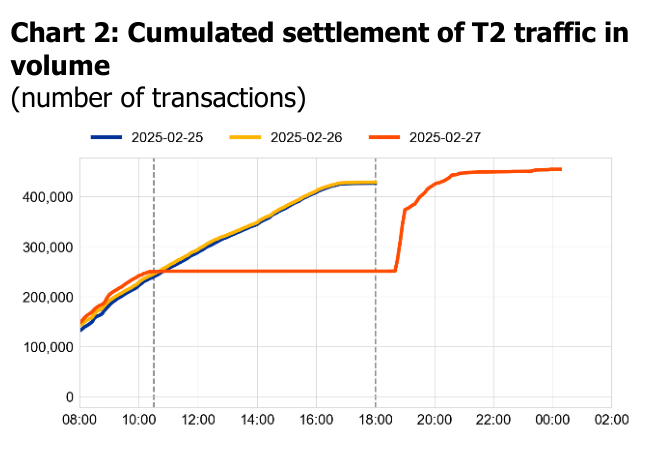
Read the diagram as text
- Find the incident day: The red-orange line represents 27 February 2025. The other two lines show the two preceding days for comparison.
- Follow the flat part: The incident-day count changes little for several hours while the comparison days keep accumulating settlements. The flat part shows how much activity was no longer settling on the earlier timetable.
- Read the catch-up after operations resumed: The line climbs again after 18:00. The post-mortem reports comparable final-day count and value. It also reports that some salary and pension credits may have reached customers on the next day.
This real T2 outage shows why recovery includes clearing the queue. The ECB provides the full incident report free of charge. The chart counts settlement between institutions, while customer credits follow their own records.
Read the original at full size here
Use touch, a trackpad, or the arrow keys in the image area.
This topic answers three questions. What is a contingency arrangement actually for, and who is it not for? What breaks when a cut-off moves? And why is we will process it tomorrow a decision with a price rather than a quiet non-event?
PICTURE IT
A flooded main road and a hill track
Picture a town whose main road floods on a busy morning. Nothing is wrong with the trucks or the drivers. The road simply cannot be used, and the queue of waiting traffic grows every minute.
A council officer decides this is an incident, not a slow morning, and opens a hill track. The track runs over different ground, so it has a different exposure to the flood. It is narrow and slow. Only ambulances and food deliveries may use it, and a marshal at the top waves each vehicle through one at a time.
The market stays open later than usual so that traders can still finish the day. But every printed timetable in town was built for the usual hours, so each one has to be checked against the changed hours. When the road reopens, the waiting vehicles do not leave in the order they arrived. Someone chooses the order, and a notice that says come back tomorrow has a cost for the people it is given to.
THE REAL JOB A contingency arrangement can keep settlement running while the original service is unavailable; actual scope, capacity, funding and invocation rules differ by system.
- Somebody declares an incident
- The contingency arrangement is switched on, if your payments qualify
- Deadlines move, and so does everything tied to them
- The backlog is worked in a chosen order
- Each side's records are checked and agreed afterwards
HOW THE PICTURE MAPS
| In the picture | In the payment |
|---|---|
| The main road floods | The normal payment system cannot settle payments |
| A council officer declares an incident | A person decides this is an incident and asks for contingency processing |
| The hill track over different ground | Contingency settlement on separate systems, so the same fault cannot stop both |
| Only ambulances and food deliveries allowed | Only payments the central banks identify as critical are carried |
| The marshal who waves each vehicle through | The central bank accepting each payment into contingency processing |
| The market staying open later | The cut-off being extended so the day can be finished |
| Printed timetables built for the usual hours | Accounting date, liquidity forecast and customer promises tied to the ordinary clock |
| Waiting vehicles let out in a chosen order | The backlog sequenced by choices about deadlines, value dates and liquidity |
| A come-back-tomorrow notice | A changed value date, which is a term of the payment and has a price |
WHERE THIS PICTURE STOPS
- A hill track carries vehicles, so a late arrival is only a delay. A payment carries a value date, the date money takes effect, and that date is a term of the payment. Saying tomorrow changes the terms, which the picture cannot show.
- A flood hits every driver in the same way. A payment breakdown can belong to the scheme, to your own hub or to a third party. Who can act is different in each case. The picture shows only the first.
- One council officer can open the track. In payments, the operator and the national central banks together decide that contingency processing is needed. A bank on the floor cannot switch it on alone, and the picture hides that.
- A track is only a narrower road. The real arrangement can run across several business days in a row, so a day can be closed properly and value dates can change. The picture cannot show that.
- Roads have no rule that says the day must still be finished. The standards ask firms to plan so that settlement finishes by the end of the disruption day. That is a stronger goal than reopening the road.
- The narrow hill track illustrates ECONS, not every contingency service. MIRS can settle peak CHAPS volumes and net retail settlements, but omits the liquidity-saving mechanism and requires reconciliation at invocation.
HOOK
Recovering the system is not the goal; finishing the day is.
REMEMBER IT THIS WAY
A sequence: the real steps, in order.
Say five verbs in a row: declare, switch, extend, sequence, reconcile. At every verb ask one question: who decides this?
| In the trick | What it stands for |
|---|---|
| Declare | somebody decides this is an incident rather than a slow morning |
| Switch | the scheme's contingency arrangement is switched on, if there is one and your payments qualify |
| Extend | deadlines move, and everything tied to them moves as well |
| Sequence | the backlog is worked in an order somebody has to choose |
| Reconcile | the last step in the topic's order, when records are checked and agreed afterwards |
The checklist is editorial and some tasks run in parallel; MIRS requires reconciliation at invocation, not only after the backlog; different systems have different eligibility and capacity.
TELL A FRIEND
Read the actual backup service: ECONS accepts critical payments, while MIRS can handle peak volumes. Confirm invocation, reconcile balances and in-flight payments, then manage liquidity and the backlog safely.
OFTEN MIXED UP WITH How long can you be down before it matters (operational resilience, DORA). asks how long a service can be down before it does real harm. It makes a firm show it can stay inside that limit. This topic is the day itself: who declares, what the contingency arrangement carries, how deadlines move and what the backlog costs. One sets the limit before the failure, and the other is what you do while it lasts.
CURRENT AS CHECKED
7 FIGURES
CPMI-IOSCO, cyber resilience toolkit for financial market infrastructures (consultation, September 2026)
On 8 September 2026 the Committee on Payments and Market Infrastructures () and the International Organization of Securities Commissions () published for consultation a cyber resilience toolkit for financial market infrastructures. It has four tools: governance of cyber risk and resilience; scenario identification and design; response, resumption and recovery plans; and testing and exercising.
The toolkit is voluntary and non-binding. It adds no standards beyond the Principles for financial market infrastructures, as informed by the 2016 cyber guidance. Comments were due on 1 December 2026, so the final text may differ.
CHECKED 2026-10-25RECHECK BY 2026-12-15
Sources & standards — 1 source
- Scheme-specific ruleDraft, not in force
Cyber resilience toolkit: practical considerations for financial market infrastructures (CPMI-IOSCO consultative report, 8 September 2026) ↗ — Committee on Payments and Market Infrastructures and IOSCO (Bank for International Settlements) · published 8 September 2026 for consultation; four tools; voluntary and non-binding; comments due 1 December 2026; complements the 2016 cyber resilience guidance (search excerpts of the BIS press release and cover note, page not opened)
Known from WebSearch excerpts on the access date (search excerpt, page not opened). A consultation, so the text may change. Comments were due on 1 December 2026. A companion discussion paper on FMIs' reliance on third-party service providers came out the same day.
Regulation (EU) 2022/2554 — application date and testing frequencies
The entered into force on 16 January 2023 and has applied since 17 January 2025. Financial entities test their ICT business continuity plans and their response and recovery plans at least yearly and on any substantive change to the systems supporting critical or important functions. The entities identified for threat-led penetration testing undergo it at least every three years.
CHECKED 2026-08-13RECHECK BY 2027-02-13
Sources & standards — 1 source
- Official requirement
Regulation (EU) 2022/2554 on digital operational resilience for the financial sector (DORA) ↗ — European Union (EUR-Lex) · Entry into force and date of application; Article 11 response and recovery and Article 12 backup and restoration, and the testing frequencies attached to them
A regulation rather than a directive, so it applies in the same words in every member state with no national transposition; the penalties for breaching it are still set by each member state's own law.
It was published in the Official Journal on 27 December 2022, at OJ L 333. It enters into force on the twentieth day after publication, which is 16 January 2023, and its closing article states that it applies from 17 January 2025.
The third-party chapter begins at Article 28. Article 29 makes a financial entity weigh, before contracting, whether the provider would be easy to swap and whether it already holds several arrangements with the same or closely connected providers. Articles 31 onwards carry the designation of critical providers and the Lead Overseer that follows it, with powers to request information, investigate and inspect the provider itself.
The detail of threat-led penetration testing sits in a delegated regulation rather than in DORA itself, and is not quoted here.
This entry absorbs eu-dora-regulation, which registered the same Regulation under a second id at the language-neutral form of the same ELI. One document registered twice splits its citations, so a correction lands on one copy and silently misses the other. The id kept is the bare short form, following eu-mica, which is how this registry names an acronym-titled EU instrument.
The previous notes on both entries said the publisher's own domain could not be fetched (a reachability gap, not a statement about the publisher). It can: the English text was read at HTTP 200 on the access date, and every claim above is read from it.
United Kingdom operational resilience requirements for firms in scope of the FCA's and the PRA's 2021 policy
The transitional period under the 's rules and the PRA's supervisory statement ended on 31 March 2025.
By 31 March 2022 firms had to identify their important business services and set an for each. Mapping and scenario testing were required by that date only to the level of complexity needed to do those two things and to identify vulnerabilities.
SYSC TP 10 then gave firms until 31 March 2025 to continue mapping and testing with a view to remaining within impact tolerances. From the end of the transition they must be able to remain within those tolerances through severe but plausible disruption. Reading the 31 March 2022 milestone as the completion date pulls that work three years early.
CHECKED 2026-08-25RECHECK BY 2027-02-13
Sources & standards — 1 source
- Regulatory guidance
PS21/3 — Building operational resilience: feedback to CP19/32 and final rules ↗ — Financial Conduct Authority · The transitional provision SYSC TP 10 — mapping and scenario testing by 31 March 2022 only to the level of sophistication needed to identify important business services, set impact tolerances and identify vulnerabilities, and until 31 March 2025 to continue with a view to remaining within those tolerances; and the instrument's own commencement date of 31 March 2022
A policy statement records a decision and the rules made under it. The binding text is the authority's own handbook. There, an important business service is a service provided to clients which, if disrupted, could cause intolerable levels of harm to any one or more of them. It is also one that could pose a risk to the soundness, stability or resilience of the UK financial system or the orderly operation of the financial markets. And an impact tolerance is the maximum tolerable level of disruption to such a service.
The authority's guidance is explicit that a recovery time objective is not an impact tolerance and should sit well inside it.
Cited for the regime rather than as the obligation itself, which is why every citation to it here carries the regulatory-guidance label.
This entry absorbs fca-operational-resilience, which registered the same policy statement at the same URL under a second id, a shorter title and a coarser publication date. Two ids for one document split its citations, so a correction lands on one and misses the other. The id kept is the one that names the document rather than the topic, because the FCA publishes more than one thing on operational resilience.
The date is now the page's own: first published 29 March 2021, last updated 31 March 2022. The previous notes on both entries said the publisher's own domain could not be fetched (a reachability gap, not a statement about the publisher). It can: the page was read at HTTP 200 on the access date, and the policy statement behind it carries the title above on its cover.
CPMI-IOSCO PFMI Principle 17, key consideration 6 — financial market infrastructures
Principle 17 of the Principles for Financial Market Infrastructures asks that business continuity plans be designed so that critical information technology systems can resume operations within two hours of a disruptive event.
Separately, key consideration 6 asks that the plans be designed to enable the infrastructure to complete settlement by the end of the day on which the disruption happened, even in case of extreme circumstances.
CHECKED 2026-08-25RECHECK BY 2027-08-13
Sources & standards — 1 source
- Official requirement
Principles for financial market infrastructures ↗ — CPMI and IOSCO (Bank for International Settlements) · Principle 17, key consideration 6: resumption of critical IT systems within two hours of disruptive events, and completion of settlement by the end of the day of the disruption
V40 actual primary PDF read at https://www.bis.org/publications/principles-financial-market-infrastructures.pdf :complete3.4.1–3.4.7,3.8.1–3.8.8 and AnnexD payment designs through liquidity-saving discussion (printed38–40,64–66,148–149). Cover/title verified;not full188page reading. Specific credit/liquidity/finality/design statements here use these sections. Earlier registry scope/history:Published by the CPSS (now CPMI) and IOSCO; contains 24 principles plus responsibilities for authorities. This site uses it only for high-level concepts such as settlement finality.
Eurosystem TARGET Services — the 27 February 2025 outage
In the incident of 27 February 2025, was unavailable for about 10 hours and T2S for about 8, while TIPS saw partial disruption of about an hour as a consequence. The cause was a hardware component failure affecting application-to-application communication. Contingency measures were activated in T2 to settle critical payments, and the Eurosystem ran crisis calls during the day. T2 resumed normal operation around 18:00, and the number and total value of payments settled that day came out comparable to previous days.
CHECKED 2026-08-13RECHECK BY 2027-08-13
Sources & standards — 1 source
- Market practice
TARGET Services incident of 27 February 2025 ↗ — European Central Bank (Eurosystem) · Duration by service, the hardware cause, the activation of contingency measures, resumption around 18:00, and the day's settled volumes and values
A topical paper in the ECB's market infrastructure and payments series, published in November 2025. It is a post-incident report rather than a rule: it describes one incident and requires nobody to do anything, which is why citations to it here carry the market-practice label.
Search excerpts only, page not opened: verified from web-search excerpts on the access date.
CPMI-IOSCO Level 3 implementation monitoring — the two assessments reporting against the two-hour recovery time objective
Two - Level 3 assessments report against that two-hour objective. They are separate reports with separate findings, and the findings are often merged.
The business continuity planning assessment of July 2021 raised one serious issue of concern: the business continuity management of "some, and potentially many" infrastructures does not seem to aim for timely recovery. Its narrower cyber issue was that a few gave no specific continuity objectives for cyber risk.
The cyber resilience assessment of November 2022 is the source of the other finding. A small number of infrastructures had not yet developed cyber response and recovery plans meeting the two-hour . Attributing that sentence to the 2021 report both names the wrong instrument and understates what the 2021 report said.
CHECKED 2026-08-25RECHECK BY 2027-08-13
Sources & standards — 2 sources
- Regulatory guidance
Implementation monitoring of PFMI: Level 3 assessment of FMIs' business continuity planning ↗ — CPMI and IOSCO (Bank for International Settlements) · Section 1.2.1, the serious issue of concern on timely recovery, and section 1.2.2, the separate and narrower cyber issue of concern
Registered because a finding from the 2022 cyber assessment had been attributed to this report on this site, which both named the wrong instrument and played down what this report says. Registering both assessments separately is what stops the two being merged again.
Downloaded and read on the access date. The PDF at https://www.bis.org/cpmi/publ/d197.pdf serves to a plain request with a browser user agent, so the passages cited are quoted from the document rather than from commentary. A note elsewhere in this registry that BIS blocks direct PDF requests did not hold when tested.
The phrase "a small number of FMIs" does appear in this report, but never as the cyber and two-hour finding. It is used for alternative arrangements, third sites and review cadence, which is how the wrong credit survived a text search.
- Regulatory guidance
Implementation monitoring of the PFMI: Level 3 assessment on Financial Market Infrastructures' Cyber Resilience ↗ — CPMI and IOSCO (Bank for International Settlements) · Serious issue of concern 1 — infrastructures that had not yet developed cyber response and recovery plans meeting the two-hour recovery time objective
Registered alongside the 2021 business continuity assessment because this site had attributed this report's finding to that one. Keeping both entries is what makes the attribution checkable.
Downloaded and read on the access date from https://www.bis.org/cpmi/publ/d212.pdf, which serves to a plain request with a browser user agent.
Not to be confused with the 2016 guidance on cyber resilience for financial market infrastructures, registered here as bis-cpmi-cyber-resilience. That document sets expectations; this one reports how far they were met.
Bank of England CHAPS — Monday-to-Friday settlement hours, closing times, the contingency extension and the 2026 decisions on longer hours
currently settles from Monday to Friday, 06:00 to 18:00. Customer payments must be sent by 5.40 pm and financial institution payments by 6 pm. The can extend CHAPS operating hours to 8 pm in extremis, so that payment service providers can make maximum use of the operating day and still give end users same-day value.
In February 2026 the Bank decided to open CHAPS settlement at 01:30 instead of 06:00, Monday to Friday, with the aim of starting in September 2027. Sending during the early window is optional for direct participants, but all direct participants must be able to receive settlement into their accounts. Customer availability remains a separate policy and legal question. The planned start is subject to final timeline confirmation. It also decided not to take forward a longer evening contingency window at this stage.
On 18 May 2026 the Bank consulted on adding Sunday and bank-holiday settlement, not before 2029, and on longer settlement days after that, not before 2031. The consultation closed on 10 August 2026. The Bank has not said when it will publish its response, so those two steps are proposals and not rules.
CHECKED 2026-11-07RECHECK BY 2027-09-01
Sources & standards — 3 sources
- Scheme-specific rule
Background information about invoking the Market Infrastructure Resiliency Service (MIRS) as a contingency solution for RTGS and CHAPS settlement ↗ — Bank of England · Normal CHAPS closing times, and the extension of CHAPS operating hours in extremis
A correction, recorded rather than quietly replaced. The previous note said the publisher's own domain could not be fetched (a reachability gap, not a statement about the publisher). The real fault was a dead address, and two claims did not survive the page.
The registered URL sat under /payment-and-settlement/, a path the Bank has retired in favour of /payments/, and it answers HTTP 404. The equivalent live page is registered above and was read at HTTP 200 and 15,547 bytes.
Two claims are dropped. The entry said the arrangement was introduced in 2014; "2014" does not occur on the page. The note said the Bank intends to evolve or replace the third-site solution and is consulting on longer settlement hours; the words "evolve", "replace" and "consult" do not occur either. Both may be true elsewhere, but they are not this document's.
One duty on participants is added because it is operationally load-bearing. On invocation, direct participants must reconcile their expected account balances and the status of payments in flight.
Primary page reopened 6 November 2026: paragraphs 5–7 expressly state MIRS can settle peak CHAPS volumes and net retail settlements, omits the liquidity-saving mechanism, and requires participants to reconcile expected balances and in-flight payments at invocation. Do not generalise ECONS critical-payment scope or slower acceptance to MIRS.
- Scheme-specific rule
Extending RTGS (real-time gross settlement) and CHAPS (Clearing House Automated Payment System) settlement hours – early morning extension ↗ — Bank of England · Actual February2026 policy statement selectedbody0–110 read:01:30targetSeptember2027,optionalsendingbutallDPsreceiveRTGSsettlement;currenthoursunchangeduntilgo-live.
Known from web-search excerpts on the access date. The Bank's own domain cannot be fetched from this authoring environment, so the page was not opened and nothing is quoted from it.
Two search results dated the policy statement to 24 February 2026. The excerpts gave the move from 06:00 to 01:30, the September 2027 aim and the optional participation model.
A search summary said the Bank would not take the evening contingency window further at this stage. It did not make clear whether this paper or the later consultation paper says so. The fact citing both papers keeps that point open.
- Scheme-specific ruleDraft, not in force
Extending RTGS (real-time gross settlement) and CHAPS (Clearing House Automated Payment System) settlement hours – next steps towards near 24x7 settlement ↗ — Bank of England · Consultation of 18 May 2026 on Sunday and bank-holiday settlement and longer settlement days, a proposal and not a rule; search excerpt, page not opened. A search summary placed the evening contingency window decision in the Bank's 2026 papers without saying which one
Known from web-search excerpts on the access date. The Bank's own domain cannot be fetched from this authoring environment, so the page was not opened.
Several search results gave 18 May 2026 as the publication date and 10 August 2026 as the closing date. The excerpts also gave the proposed order of steps: weekend and bank-holiday settlement first, then longer settlement days from Monday to Friday and on one weekend day. They gave two longer-term options, and this entry does not rely on them.
Standing is draft because the paper asks questions and decides nothing.
PRACTISE AND KEEP
Sources for this topic — 10 sources
- Official requirement
Principles for financial market infrastructures ↗ — CPMI and IOSCO (Bank for International Settlements) · Principle 17, operational risk: identification of plausible sources of operational risk, and business continuity planning designed for resumption of critical systems and for completing settlement by the end of the day of the disruption
V40 actual primary PDF read at https://www.bis.org/publications/principles-financial-market-infrastructures.pdf :complete3.4.1–3.4.7,3.8.1–3.8.8 and AnnexD payment designs through liquidity-saving discussion (printed38–40,64–66,148–149). Cover/title verified;not full188page reading. Specific credit/liquidity/finality/design statements here use these sections. Earlier registry scope/history:Published by the CPSS (now CPMI) and IOSCO; contains 24 principles plus responsibilities for authorities. This site uses it only for high-level concepts such as settlement finality.
- Scheme-specific rule
T2 business continuity management and the Enhanced Contingency Solution (ECONS II) ↗ — European Central Bank (Eurosystem) · The Enhanced Contingency Solution: separate infrastructure and region, a different risk profile from T2, operation across consecutive business days, submission by participants and acceptance by the relevant central bank, for (very) critical payments
Contingency processing is for (very) critical payments. The national central banks identify them, and the published examples are CLS pay-ins and central-counterparty margin calls, so ordinary customer traffic is not carried.
The ECONS II user detailed functional specifications are published separately by the Eurosystem, and no element-level behaviour is quoted here from them.
Search excerpts only, page not opened: verified from web-search excerpts on the access date.
- Market practice
TARGET Services incident of 27 February 2025 ↗ — European Central Bank (Eurosystem) · The 27 February 2025 outage: duration by service, the crisis call at which contingency processing was requested, and the day's settled numbers and values compared with previous days
A topical paper in the ECB's market infrastructure and payments series, published in November 2025. It is a post-incident report rather than a rule: it describes one incident and requires nobody to do anything, which is why citations to it here carry the market-practice label.
Search excerpts only, page not opened: verified from web-search excerpts on the access date.
- Scheme-specific rule
Background information about invoking the Market Infrastructure Resiliency Service (MIRS) as a contingency solution for RTGS and CHAPS settlement ↗ — Bank of England · The third-site contingency service for RTGS and CHAPS, supplied by an outside party; and the extension of CHAPS operating hours in extremis so participants can make maximum use of the operating day
A correction, recorded rather than quietly replaced. The previous note said the publisher's own domain could not be fetched (a reachability gap, not a statement about the publisher). The real fault was a dead address, and two claims did not survive the page.
The registered URL sat under /payment-and-settlement/, a path the Bank has retired in favour of /payments/, and it answers HTTP 404. The equivalent live page is registered above and was read at HTTP 200 and 15,547 bytes.
Two claims are dropped. The entry said the arrangement was introduced in 2014; "2014" does not occur on the page. The note said the Bank intends to evolve or replace the third-site solution and is consulting on longer settlement hours; the words "evolve", "replace" and "consult" do not occur either. Both may be true elsewhere, but they are not this document's.
One duty on participants is added because it is operationally load-bearing. On invocation, direct participants must reconcile their expected account balances and the status of payments in flight.
Primary page reopened 6 November 2026: paragraphs 5–7 expressly state MIRS can settle peak CHAPS volumes and net retail settlements, omits the liquidity-saving mechanism, and requires participants to reconcile expected balances and in-flight payments at invocation. Do not generalise ECONS critical-payment scope or slower acceptance to MIRS.
- Official requirement
Regulation (EU) 2022/2554 on digital operational resilience for the financial sector (DORA) ↗ — European Union (EUR-Lex) · The ICT business continuity policy, Article 11 response and recovery, Article 12 backup and restoration, and the testing frequencies including threat-led penetration testing
A regulation rather than a directive, so it applies in the same words in every member state with no national transposition; the penalties for breaching it are still set by each member state's own law.
It was published in the Official Journal on 27 December 2022, at OJ L 333. It enters into force on the twentieth day after publication, which is 16 January 2023, and its closing article states that it applies from 17 January 2025.
The third-party chapter begins at Article 28. Article 29 makes a financial entity weigh, before contracting, whether the provider would be easy to swap and whether it already holds several arrangements with the same or closely connected providers. Articles 31 onwards carry the designation of critical providers and the Lead Overseer that follows it, with powers to request information, investigate and inspect the provider itself.
The detail of threat-led penetration testing sits in a delegated regulation rather than in DORA itself, and is not quoted here.
This entry absorbs eu-dora-regulation, which registered the same Regulation under a second id at the language-neutral form of the same ELI. One document registered twice splits its citations, so a correction lands on one copy and silently misses the other. The id kept is the bare short form, following eu-mica, which is how this registry names an acronym-titled EU instrument.
The previous notes on both entries said the publisher's own domain could not be fetched (a reachability gap, not a statement about the publisher). It can: the English text was read at HTTP 200 on the access date, and every claim above is read from it.
- Regulatory guidance
PS21/3 — Building operational resilience: feedback to CP19/32 and final rules ↗ — Financial Conduct Authority · Important business services, impact tolerances, mapping and scenario testing, and the transitional period that has now ended
A policy statement records a decision and the rules made under it. The binding text is the authority's own handbook. There, an important business service is a service provided to clients which, if disrupted, could cause intolerable levels of harm to any one or more of them. It is also one that could pose a risk to the soundness, stability or resilience of the UK financial system or the orderly operation of the financial markets. And an impact tolerance is the maximum tolerable level of disruption to such a service.
The authority's guidance is explicit that a recovery time objective is not an impact tolerance and should sit well inside it.
Cited for the regime rather than as the obligation itself, which is why every citation to it here carries the regulatory-guidance label.
This entry absorbs fca-operational-resilience, which registered the same policy statement at the same URL under a second id, a shorter title and a coarser publication date. Two ids for one document split its citations, so a correction lands on one and misses the other. The id kept is the one that names the document rather than the topic, because the FCA publishes more than one thing on operational resilience.
The date is now the page's own: first published 29 March 2021, last updated 31 March 2022. The previous notes on both entries said the publisher's own domain could not be fetched (a reachability gap, not a statement about the publisher). It can: the page was read at HTTP 200 on the access date, and the policy statement behind it carries the title above on its cover.
- Regulatory guidance
Guidance on cyber resilience for financial market infrastructures ↗ — Committee on Payments and Market Infrastructures / IOSCO · Expectations on response, recovery, testing and situational awareness at financial market infrastructures, translated by a bank into its own context
The guidance applies to financial market infrastructures. A bank or payment-service provider should translate the control outcomes into its own regulatory, risk, and operating context.
- Simplified educational illustration
Payments Signal editorial teaching models — Payments Signal
What this simplifies: Bank Alfa's morning is a teaching construction and the institution is invented; the contingency arrangements described are real and are cited. The four moves — declare, switch, extend, sequence — are this site's summary of what the cited arrangements describe, and no operator states them that way. The costs listed for a deferred payment are the kinds of consequence a value-date change can carry, not a claim about what any particular contract or scheme provides. No operator's crisis procedures are reproduced here. The three components and five categories come from search excerpts of the 2016 guidance, and the 2022 findings and the 2026 toolkit from BIS press material. The guidance is written for operators of financial market infrastructures. A bank or payment firm should read it as a model, not as its own rule. The toolkit is a consultation and may change.
Used wherever diagrams, scenarios, figures, or example values are didactic constructions rather than sourced facts; every such use carries a simplifications disclosure. All people, companies, banks, and list entries in examples are fictional.
- Scheme-specific rule
Implementation monitoring of the PFMI: Level 3 assessment on Financial Market Infrastructures' Cyber Resilience ↗ — CPMI and IOSCO (Bank for International Settlements) · November 2022 assessment: reasonably high adoption; one serious issue (a small number of FMIs had not developed cyber response and recovery plans meeting the two-hour recovery time objective) and four issues of concern (weak plans under extreme scenarios, no testing after major system changes, too little scenario-based testing, limited stakeholder involvement in testing) (search excerpt of the BIS press release, page not opened)
Registered alongside the 2021 business continuity assessment because this site had attributed this report's finding to that one. Keeping both entries is what makes the attribution checkable.
Downloaded and read on the access date from https://www.bis.org/cpmi/publ/d212.pdf, which serves to a plain request with a browser user agent.
Not to be confused with the 2016 guidance on cyber resilience for financial market infrastructures, registered here as bis-cpmi-cyber-resilience. That document sets expectations; this one reports how far they were met.
- Scheme-specific ruleDraft, not in force
Cyber resilience toolkit: practical considerations for financial market infrastructures (CPMI-IOSCO consultative report, 8 September 2026) ↗ — Committee on Payments and Market Infrastructures and IOSCO (Bank for International Settlements) · toolkit published for consultation on 8 September 2026; four tools; voluntary and non-binding; comments due 1 December 2026 (search excerpts, page not opened)
Known from WebSearch excerpts on the access date (search excerpt, page not opened). A consultation, so the text may change. Comments were due on 1 December 2026. A companion discussion paper on FMIs' reliance on third-party service providers came out the same day.
Deepest material on this page: L4 — Standards & sources. Where a topic stops short of implementation depth, that is a deliberate coverage decision, not an oversight — see coverage.