When it breaks and the regulator must hear (incident handling and regulator notification)
Fixing the fault is one job. Deciding it is major, then telling the supervisor and customers in stages, is a second job with its own clock.
L1–L4 are part of the Pro pass
L0 Explain simply
Late on a Saturday morning, Riya tries to pay her rent through an app. The app sends her payment through Larkpay's gateway. The payment hangs. She tries again, and it hangs again.
(SYNTHETIC / TRAINING ONLY — Riya, Larkpay and this fault are invented.)
Inside Larkpay, an on-call engineer sees payments failing for many customers at once. Two jobs start at the same moment. The first job is to fix the fault. The second job is to decide who must be told, and by when. People new to payments usually think only of the first job.
The second job exists because Larkpay is a licensed payment firm. A licence comes with a promise to its supervisor, the public body that watches over the firm. When something breaks badly, the supervisor should hear it from the firm, early, and not from the news.
The words badly enough matter. Every firm has small faults every week. If the firm reported all of them, the supervisor could not tell a bad day from a normal one. So the rules ask for a decision. Does this incident count as major? Until somebody decides yes, the formal report has not started. After yes, the applicable notification clock runs. Awareness also matters to the ordinary deadline. The detailed rule has a specific exception for later classification, not permission to delay deciding.
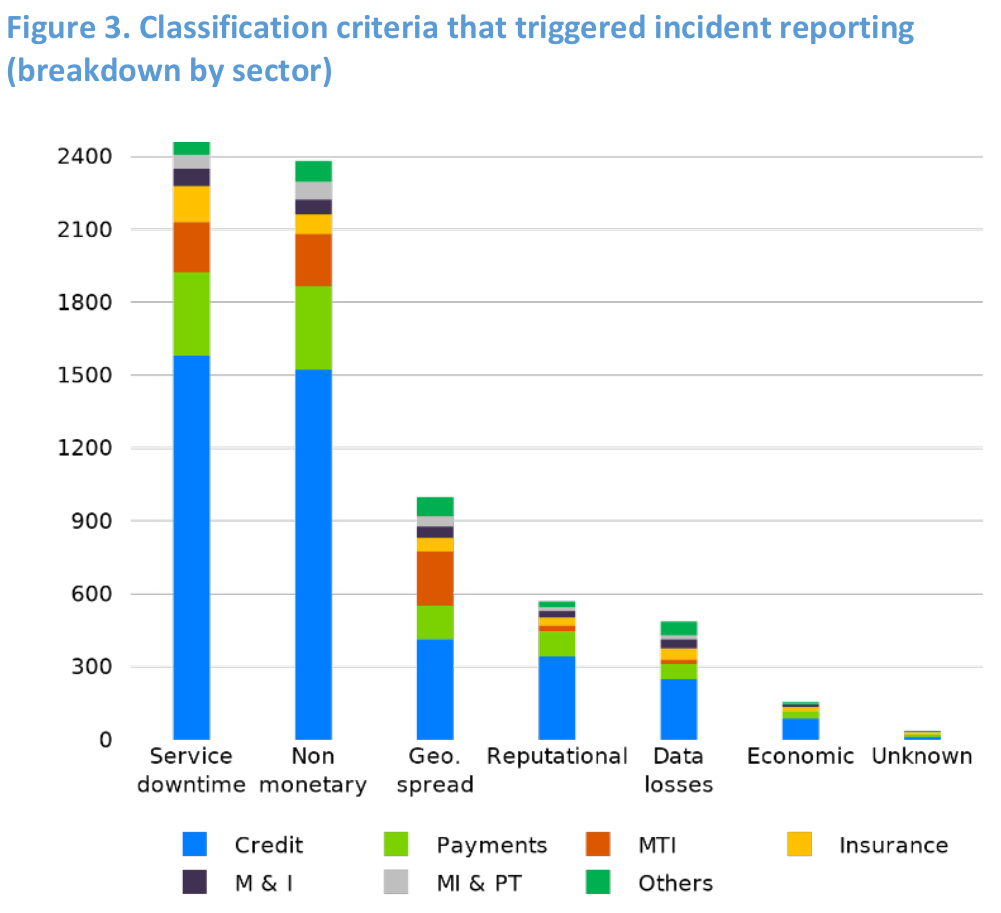
Read the diagram as text
- Find the service downtime bar: Service downtime and incident duration were among the most frequently triggered criteria. A firm checks the conditions and thresholds in the regulation for its own incident.
- Read the non-monetary impact group: The next bar groups the impact on clients, financial counterparties and transactions. The colours split case counts by sector, with payments shown in green.
- Compare the other criteria: The chart also records geographical spread, reputational impact, data loss and economic impact. An incident can trigger more than one criterion, so the bar totals should not be used to count unique incidents.
Follow the published figure step by step.
Read the original at full size here
Use touch, a trackpad, or the arrow keys in the image area.
Then come the messages. A quick first notice goes to the supervisor. It is short and unfinished, because speed matters more than detail at this point. A fuller update follows. A final report comes last, once the cause is understood. Customers who could lose money are told as well, in plain words, with what they can do.
Calm matters here. A breakdown is not a scandal. A firm that says early we do not know the cause yet is doing what the rules ask. The risky part is staying quiet while the clock runs. The rest of this topic covers the decision, the stages, and the people who must be told.
This topic follows the European Union reporting regime. The applicable law, firm type and circumstances determine the deadline; a Saturday alone does not tell you whether timing relief is available.
PICTURE IT
A town water company and a burst pipe
Picture a town water company. Most days a small leak is fixed by the crew, and nobody outside the company is told. A rule written in advance says which bursts count as serious, for example one that cuts water to many homes. When the manager decides a burst is serious, she phones the regional water office. The first call is short. It says what is known and what is not. An update call follows. After the repair, a written report names the cause. A van with a speaker tells the streets without water what to do.
THE REAL JOB Incident reporting makes a payment firm tell its supervisor, in stages, about a serious technology failure, and tell the customers whose money is affected.
- Record when the incident became known
- Classify it under the applicable rules
- Authority: initial, intermediate, final reports
- Affected customers: communicate without waiting for the final report
- Recovery: continue restoring service alongside reporting
HOW THE PICTURE MAPS
| In the picture | In the payment |
|---|---|
| Water reaching every home | The payment service customers rely on |
| The rule that says which bursts count as serious | Incident classification, the test for a major incident |
| The manager deciding this burst is serious | Classifying the incident as major, which starts a reporting clock |
| The short first call with what is known and not known | The initial notification, sent before the cause is known |
| The update call | The intermediate report |
| The written report after the repair, naming the cause | The final report with the root cause |
| The regional water office | The competent authority, the supervisor the firm reports to |
| The speaker van for streets without water | A separate message to the customers whose money is affected |
WHERE THIS PICTURE STOPS
- A water manager decides alone what counts as serious. A payment firm applies a test set by rule, using criteria such as how many customers were affected and how long it lasted.
- The picture shows phone calls and no time limits. The real stages run on limits counted from classification and from awareness, and the exact figures are in the dated facts.
- A water office is one office. Which authority receives a payment firm's reports depends on the firm's type and country, and this lesson covers the European Union only.
- The picture has no supplier. When a payment firm's fault comes from a supplier, the duty to report is still the firm's.
- The ordinary awareness cap is subject to the Commission delegated regulation on reporting time limits: later-than
24-hour major classification has a four-hour notification clock from classification. This does not justify delaying a supported decision.
HOOK
Know it is major, tell early, then tell fully.
REMEMBER IT THIS WAY
A chunk: a long list grouped so it is easier to hold.
Two audiences run alongside recovery: the authority gets staged reports; affected customers get timely, useful information.
| In the trick | What it stands for |
|---|---|
| Authority | initial notification, intermediate report and final report under the applicable deadlines |
| Customers | communicate when their financial interests are affected; do not wait for the final report |
| Clocks | record awareness and classification times; do not wait for a completed investigation |
TELL A FRIEND
Report what is known within the applicable deadlines while recovery continues. Customer communication has its own duty and does not wait for the final regulatory report.
OFTEN MIXED UP WITH The day the rail does not come back (contingency and recovery). Contingency and recovery is the work of getting payments moving again. Incident reporting is the work of telling the supervisor and the customers. Both run at the same time, and neither replaces the other.
Sources & standards — 1 source
- Official requirementCommission Delegated Regulation (EU) 2025/301
Commission Delegated Regulation (EU) 2025/301 — content and time limits for the initial notification, intermediate report and final report on major information and communication technology (ICT)-related incidents (DORA) ↗ — European Commission (EUR-Lex) · Regulation 2025/301, Article 5(1)–(6), OJ 20 February 2025; authentic IVASS-hosted OJ PDF read 6 November 2026
Verified from web-search excerpts on the access date. The sources were the EUR-Lex listing for the regulation (the European Legislation Identifier (ELI) URL below is the one the search returned), a legal-text mirror of Article 5, and practitioner summaries. The EUR-Lex page was not opened, so nothing here is quoted from a page that was opened.
The excerpts for Article 5 agree that the final report is due no later than one month after the submission of the intermediate or updated intermediate report. The earlier doubt about a classification anchor is resolved by the Article 5 text returned in search. The registered fact states that anchor. A reader relying on it should still check Article 5 in the Official Journal.
Special timing for some firms on weekends and bank holidays exists and is deliberately not taught here; a supervisor's notice on it appeared in the search results.
6 November 2026: full five-page authentic English OJ copy downloaded and read via IVASS: https://www.ivass.it/normativa/internazionale/internazionale-ue/regolamenti-europei/rd-2025-301/Commission_Delegated_Regulation_EU_2025_301_of_23_october_2024.pdf?language_id=3 . A later major classification is an express legal case, not permission to delay supported classification.
CURRENT AS CHECKED
4 FIGURES
Regulation (EU) 2022/2554 — application date and testing frequencies
The entered into force on 16 January 2023 and has applied since 17 January 2025. Financial entities test their ICT business continuity plans and their response and recovery plans at least yearly and on any substantive change to the systems supporting critical or important functions. The entities identified for threat-led penetration testing undergo it at least every three years.
CHECKED 2026-08-13RECHECK BY 2027-02-13
Sources & standards — 1 source
- Official requirement
Regulation (EU) 2022/2554 on digital operational resilience for the financial sector (DORA) ↗ — European Union (EUR-Lex) · Entry into force and date of application; Article 11 response and recovery and Article 12 backup and restoration, and the testing frequencies attached to them
A regulation rather than a directive, so it applies in the same words in every member state with no national transposition; the penalties for breaching it are still set by each member state's own law.
It was published in the Official Journal on 27 December 2022, at OJ L 333. It enters into force on the twentieth day after publication, which is 16 January 2023, and its closing article states that it applies from 17 January 2025.
The third-party chapter begins at Article 28. Article 29 makes a financial entity weigh, before contracting, whether the provider would be easy to swap and whether it already holds several arrangements with the same or closely connected providers. Articles 31 onwards carry the designation of critical providers and the Lead Overseer that follows it, with powers to request information, investigate and inspect the provider itself.
The detail of threat-led penetration testing sits in a delegated regulation rather than in DORA itself, and is not quoted here.
This entry absorbs eu-dora-regulation, which registered the same Regulation under a second id at the language-neutral form of the same ELI. One document registered twice splits its citations, so a correction lands on one copy and silently misses the other. The id kept is the bare short form, following eu-mica, which is how this registry names an acronym-titled EU instrument.
The previous notes on both entries said the publisher's own domain could not be fetched (a reachability gap, not a statement about the publisher). It can: the English text was read at HTTP 200 on the access date, and every claim above is read from it.
Commission Delegated Regulation (EU) 2025/301 — time limits for the initial notification, intermediate report and final report
Under Regulation (EU) 2025/301 Article 5, initial notification is as early as possible, ordinarily within 4 hours of major classification and no later than 24 hours after awareness. Article 5(2) expressly covers major classification later than 24 hours after awareness: notify within 4 hours of that classification. The intermediate report is due within hours of the initial notification, with updates without undue delay and on recovery. Final reporting is due within one month of the intermediate report or latest updated intermediate report. Article 5(3) requires notice with reasons if a deadline cannot be met. Weekend and bank-holiday relief under 5(4) is subject to the entity restrictions in 5(5)–(6).
CHECKED 2026-11-06RECHECK BY 2027-04-04
Sources & standards — 1 source
- Official requirementCommission Delegated Regulation (EU) 2025/301
Commission Delegated Regulation (EU) 2025/301 — content and time limits for the initial notification, intermediate report and final report on major information and communication technology (ICT)-related incidents (DORA) ↗ — European Commission (EUR-Lex) · Article 5(1)–(6), authentic OJ copy hosted by IVASS, read 6 November 2026
Verified from web-search excerpts on the access date. The sources were the EUR-Lex listing for the regulation (the European Legislation Identifier (ELI) URL below is the one the search returned), a legal-text mirror of Article 5, and practitioner summaries. The EUR-Lex page was not opened, so nothing here is quoted from a page that was opened.
The excerpts for Article 5 agree that the final report is due no later than one month after the submission of the intermediate or updated intermediate report. The earlier doubt about a classification anchor is resolved by the Article 5 text returned in search. The registered fact states that anchor. A reader relying on it should still check Article 5 in the Official Journal.
Special timing for some firms on weekends and bank holidays exists and is deliberately not taught here; a supervisor's notice on it appeared in the search results.
6 November 2026: full five-page authentic English OJ copy downloaded and read via IVASS: https://www.ivass.it/normativa/internazionale/internazionale-ue/regolamenti-europei/rd-2025-301/Commission_Delegated_Regulation_EU_2025_301_of_23_october_2024.pdf?language_id=3 . A later major classification is an express legal case, not permission to delay supported classification.
Commission Delegated Regulation (EU) 2024/1772 — the test for a major incident
An information and communication technology (ICT) incident is major under the (DORA) when it has affected critical services. In addition, either a successful malicious unauthorised access with possible data loss is established, or at least two of the other classification criteria reach their thresholds. The criteria include the number of clients affected and the duration of the incident.
CHECKED 2026-10-04RECHECK BY 2027-04-04
Sources & standards — 1 source
- Scheme-specific ruleCommission Delegated Regulation (EU) 2024/1772
Commission Delegated Regulation (EU) 2024/1772 — criteria for the classification of information and communication technology (ICT)-related incidents and significant cyber threats (DORA) ↗ — European Commission (EUR-Lex) · The classification test: affected critical services, and either malicious unauthorised access with possible data loss or at least two of the other criteria reaching their thresholds
Verified from web-search excerpts on the access date, including the EUR-Lex listing for the regulation and two practitioner summaries of its major-incident article. The page itself was not opened. The excerpts did not list every criterion or any threshold, so none is cited.
6 November 2026: authentic nine-page English OJ copy downloaded from IVASS and Articles 6, 8 and 9 read: https://www.ivass.it/normativa/internazionale/internazionale-ue/regolamenti-europei/rd-2024-1772/Delegated_Regulation_2024_1772_of_13_march_2024.pdf?language_id=3 . Article 8(2) recurring incidents requires at least twice within six months, same apparent root cause, collective major criteria and monthly assessment; it does not apply to microenterprises or Article 16(1) entities.
European Banking Authority guideline 2021/03 — repeal and the providers still under the Second Payment Services Directive (PSD2) reporting
The European Banking Authority repealed its guidelines on reporting under Second Payment Services Directive () with effect from 17 January 2025. That is when the incident reporting of the Digital Operational Resilience Act (DORA) began to apply to most payment service providers. PSD2 incident reporting still applies to the few provider types DORA does not cover.
CHECKED 2026-10-04RECHECK BY 2027-04-04
Sources & standards — 1 source
- Scheme-specific ruleRepealed — see Regulation (EU) 2022/2554 (Digital Operational Resilience Act (DORA)) incident reporting, applying from 17 January 2025EBA/GL/2021/03 (repealed)
Guidelines on major incident reporting under the Second Payment Services Directive (PSD2), European Banking Authority (EBA) guidelines of 2021 — repealed ↗ — European Banking Authority · Repeal of the Second Payment Services Directive (PSD2) major-incident reporting guidelines from 17 January 2025 because the reporting of the Digital Operational Resilience Act (DORA) applies to most payment service providers; PSD2 reporting still applies to providers DORA does not cover
Verified from web-search excerpts on the access date. The sources were the Authority's own press release on the repeal, the Authority's pages for the revised guidelines, and several law-firm and news summaries. The press release ties the repeal to Digital Operational Resilience Act (DORA) applying from 17 January 2025, and says PSD2 reporting still applies to other payment service providers. The pages were not opened in full.
The guidelines are cited as history. They are not a current requirement for a firm in DORA's scope.
PRACTISE AND KEEP
Sources for this topic — 7 sources
- Official requirement
Regulation (EU) 2022/2554 on digital operational resilience for the financial sector (DORA) ↗ — European Union (EUR-Lex) · Regulation (EU) 2022/2554, selected Articles 12, 19–26, 28–31 and 45; official OJ PDF opened 6 November 2026
A regulation rather than a directive, so it applies in the same words in every member state with no national transposition; the penalties for breaching it are still set by each member state's own law.
It was published in the Official Journal on 27 December 2022, at OJ L 333. It enters into force on the twentieth day after publication, which is 16 January 2023, and its closing article states that it applies from 17 January 2025.
The third-party chapter begins at Article 28. Article 29 makes a financial entity weigh, before contracting, whether the provider would be easy to swap and whether it already holds several arrangements with the same or closely connected providers. Articles 31 onwards carry the designation of critical providers and the Lead Overseer that follows it, with powers to request information, investigate and inspect the provider itself.
The detail of threat-led penetration testing sits in a delegated regulation rather than in DORA itself, and is not quoted here.
This entry absorbs eu-dora-regulation, which registered the same Regulation under a second id at the language-neutral form of the same ELI. One document registered twice splits its citations, so a correction lands on one copy and silently misses the other. The id kept is the bare short form, following eu-mica, which is how this registry names an acronym-titled EU instrument.
The previous notes on both entries said the publisher's own domain could not be fetched (a reachability gap, not a statement about the publisher). It can: the English text was read at HTTP 200 on the access date, and every claim above is read from it.
- Scheme-specific ruleCommission Delegated Regulation (EU) 2025/301
Commission Delegated Regulation (EU) 2025/301 — content and time limits for the initial notification, intermediate report and final report on major information and communication technology (ICT)-related incidents (DORA) ↗ — European Commission (EUR-Lex) · The initial notification, the intermediate report and the final report: what each carries and the time limits, with the first notice running from classification and from awareness
Verified from web-search excerpts on the access date. The sources were the EUR-Lex listing for the regulation (the European Legislation Identifier (ELI) URL below is the one the search returned), a legal-text mirror of Article 5, and practitioner summaries. The EUR-Lex page was not opened, so nothing here is quoted from a page that was opened.
The excerpts for Article 5 agree that the final report is due no later than one month after the submission of the intermediate or updated intermediate report. The earlier doubt about a classification anchor is resolved by the Article 5 text returned in search. The registered fact states that anchor. A reader relying on it should still check Article 5 in the Official Journal.
Special timing for some firms on weekends and bank holidays exists and is deliberately not taught here; a supervisor's notice on it appeared in the search results.
6 November 2026: full five-page authentic English OJ copy downloaded and read via IVASS: https://www.ivass.it/normativa/internazionale/internazionale-ue/regolamenti-europei/rd-2025-301/Commission_Delegated_Regulation_EU_2025_301_of_23_october_2024.pdf?language_id=3 . A later major classification is an express legal case, not permission to delay supported classification.
- Scheme-specific ruleCommission Delegated Regulation (EU) 2024/1772
Commission Delegated Regulation (EU) 2024/1772 — criteria for the classification of information and communication technology (ICT)-related incidents and significant cyber threats (DORA) ↗ — European Commission (EUR-Lex) · The classification test: affected critical services, and either malicious unauthorised access with possible data loss or at least two of the other criteria reaching their thresholds
Verified from web-search excerpts on the access date, including the EUR-Lex listing for the regulation and two practitioner summaries of its major-incident article. The page itself was not opened. The excerpts did not list every criterion or any threshold, so none is cited.
6 November 2026: authentic nine-page English OJ copy downloaded from IVASS and Articles 6, 8 and 9 read: https://www.ivass.it/normativa/internazionale/internazionale-ue/regolamenti-europei/rd-2024-1772/Delegated_Regulation_2024_1772_of_13_march_2024.pdf?language_id=3 . Article 8(2) recurring incidents requires at least twice within six months, same apparent root cause, collective major criteria and monthly assessment; it does not apply to microenterprises or Article 16(1) entities.
- Official requirement
Directive (EU) 2015/2366 on payment services in the internal market (PSD2) ↗ — European Union (EUR-Lex) · Article 96(1): notify the home competent authority of a major operational or security incident without delay, and inform users whose financial interests are affected
A directive binds member states to a result, and the words a firm actually obeys sit in its own country's implementing law, so this is cited for the obligation's shape rather than as the text a provider is examined against. Search excerpts only, page not opened: verified from two independent web-search excerpts on the access date.
- Scheme-specific ruleRepealed — see Regulation (EU) 2022/2554 (Digital Operational Resilience Act (DORA)) incident reporting, applying from 17 January 2025EBA/GL/2021/03 (repealed)
Guidelines on major incident reporting under the Second Payment Services Directive (PSD2), European Banking Authority (EBA) guidelines of 2021 — repealed ↗ — European Banking Authority · Repeal of the Second Payment Services Directive (PSD2) major-incident reporting guidelines from 17 January 2025 because the reporting of the Digital Operational Resilience Act (DORA) applies to most payment service providers; PSD2 reporting still applies to providers DORA does not cover
Verified from web-search excerpts on the access date. The sources were the Authority's own press release on the repeal, the Authority's pages for the revised guidelines, and several law-firm and news summaries. The press release ties the repeal to Digital Operational Resilience Act (DORA) applying from 17 January 2025, and says PSD2 reporting still applies to other payment service providers. The pages were not opened in full.
The guidelines are cited as history. They are not a current requirement for a firm in DORA's scope.
- Simplified educational illustration
Payments Signal editorial teaching models — Payments Signal
What this simplifies: Larkpay's gateway fault, the clock times and the duty manager's decision are invented. The four-step shape (fix, decide, tell the supervisor in stages, tell customers) is this site's summary of what the cited rules describe, and no regulator states it that way. The topic covers the European Union only and leaves out special timing for some firms and some weekends and bank holidays.
Used wherever diagrams, scenarios, figures, or example values are didactic constructions rather than sourced facts; every such use carries a simplifications disclosure. All people, companies, banks, and list entries in examples are fictional.
- Official requirement
PSD2 and the RTS on strong customer authentication and secure communication ↗ — European Banking Authority · PSD2 as the payment services rules currently in force
Referenced from the European Banking Authority's public short overviews, guidelines, and technical standards on payment services.
Deepest material on this page: L4 — Standards & sources. Where a topic stops short of implementation depth, that is a deliberate coverage decision, not an oversight — see coverage.