Reporting a payment incident under DORA: the three reports, the template and the move away from the old payment-services rule
Payment firms in the EU now report big technology failures through one set of forms. See what moved from the old rule, what each report holds, and what is still undecided.
L1–L4 are part of the Pro pass
L0 Explain simply
An incident-desk analyst at Larkpay works for a payment firm in the European Union (EU). On a Monday morning card payments fail for two hours. Customers cannot pay, and the support line fills up.
(SYNTHETIC / TRAINING ONLY. The analyst, Larkpay and this outage are invented. The rules in this topic are real and are cited at the end.)
Fixing the fault is the first job. The second job is a duty to tell the supervisor, the public body that watches over the firm. The firm must say what happened, in a fixed shape, by a fixed time.
Before 2025 payment firms did this under a payment-services rule. From 17 January 2025 most of them report under a newer law, the (DORA). The old rule was switched off for them.
Another topic on this site explains how a firm decides that an incident is major. This topic starts after that decision. It asks what Larkpay actually sends, which form it uses, and what changed for payment firms.
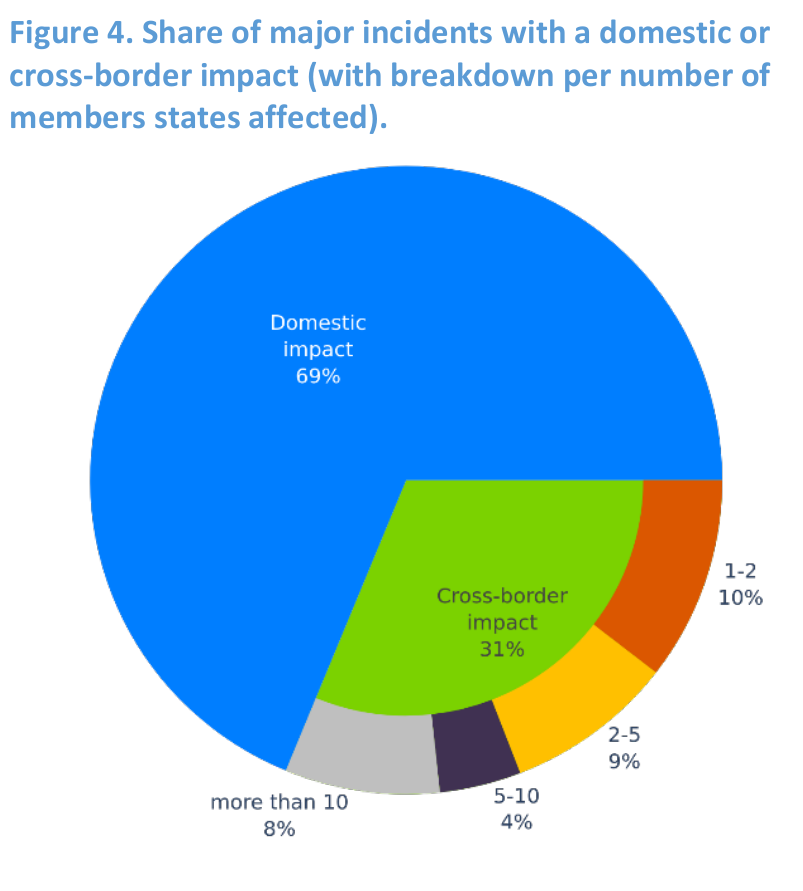
Read the diagram as text
- Find the domestic share: The large blue segment represents incidents with domestic impact. It accounts for 69 percent of the cases in the chart.
- Find the cross-border share: The green segment marks the group with cross-border impact. It accounts for 31 percent of the cases shown.
- Read the breakout for affected countries: The coloured outer pieces divide cross-border cases by the number of Member States affected. Reports need to distinguish where the notice was filed from where effects were felt.
Follow the published figure step by step.
Read the original at full size here
Use touch, a trackpad, or the arrow keys in the image area.
The outage length alone does not establish major status. Scope and the classification criteria come first. A report may use estimates, but its classification still needs recorded evidence.
PLAIN WORDS · 1 in this section
- outage
- a time when a service is not working
A SHORT CASE
Maya Chen at Larkpay sees card payments fail for two hours. Larkpay is a in the EU, so after classifying the outage as major she reports it under , not under the old payment-services rule.
She sends an initial notice inside the clock, then an update, then a final report with the cause. Each one uses the same template. Her team's own review is kept as a separate learning record. All of this is synthetic.
This is a rule about which door to use and which form to fill, with dated clocks. A picture such as a postbox would hide that there are three reports.
THE REAL JOB A payment firm in the EU reports a major technology incident through , using one template for the initial, intermediate and final reports.
- Classify the incident
- Send the initial notice
- Send the intermediate update
- Send the final report
WHERE THIS CASE STOPS
- This shows the reporting pattern, not every template field. The authentic OJ template was checked for stage-specific requirements, secure channels, combined reports and reclassification.
- The clocks and the dates sit in dated facts, and the national authority decides how reports are submitted.
- One template has different required fields by stage. Combined submissions are permitted only under Article
2conditions and deadlines; recovery alone does not justify reclassification as never major.
HOOK
Classify, then three reports, one template.
TELL A FRIEND
Payment firms in the EU now report big incidents under , in three steps with one template. The old payment-services guidelines were repealed for them.
OFTEN MIXED UP WITH When it breaks and the regulator must hear (incident handling and regulator notification). That topic covers how a firm decides an incident is major and who must be told. This one covers the forms and the move away from the old payment-services rule.
CURRENT AS CHECKED
3 FIGURES
Commission Delegated Regulation (EU) 2025/301 — time limits for the initial notification, intermediate report and final report
Under Regulation (EU) 2025/301 Article 5, initial notification is as early as possible, ordinarily within 4 hours of major classification and no later than 24 hours after awareness. Article 5(2) expressly covers major classification later than 24 hours after awareness: notify within 4 hours of that classification. The intermediate report is due within hours of the initial notification, with updates without undue delay and on recovery. Final reporting is due within one month of the intermediate report or latest updated intermediate report. Article 5(3) requires notice with reasons if a deadline cannot be met. Weekend and bank-holiday relief under 5(4) is subject to the entity restrictions in 5(5)–(6).
CHECKED 2026-11-06RECHECK BY 2027-04-04
Sources & standards — 1 source
- Official requirementCommission Delegated Regulation (EU) 2025/301
Commission Delegated Regulation (EU) 2025/301 — content and time limits for the initial notification, intermediate report and final report on major information and communication technology (ICT)-related incidents (DORA) ↗ — European Commission (EUR-Lex) · Article 5(1)–(6), authentic OJ copy hosted by IVASS, read 6 November 2026
Verified from web-search excerpts on the access date. The sources were the EUR-Lex listing for the regulation (the European Legislation Identifier (ELI) URL below is the one the search returned), a legal-text mirror of Article 5, and practitioner summaries. The EUR-Lex page was not opened, so nothing here is quoted from a page that was opened.
The excerpts for Article 5 agree that the final report is due no later than one month after the submission of the intermediate or updated intermediate report. The earlier doubt about a classification anchor is resolved by the Article 5 text returned in search. The registered fact states that anchor. A reader relying on it should still check Article 5 in the Official Journal.
Special timing for some firms on weekends and bank holidays exists and is deliberately not taught here; a supervisor's notice on it appeared in the search results.
6 November 2026: full five-page authentic English OJ copy downloaded and read via IVASS: https://www.ivass.it/normativa/internazionale/internazionale-ue/regolamenti-europei/rd-2025-301/Commission_Delegated_Regulation_EU_2025_301_of_23_october_2024.pdf?language_id=3 . A later major classification is an express legal case, not permission to delay supported classification.
European Banking Authority guideline 2021/03 — repeal and the providers still under the Second Payment Services Directive (PSD2) reporting
The European Banking Authority repealed its guidelines on reporting under Second Payment Services Directive () with effect from 17 January 2025. That is when the incident reporting of the Digital Operational Resilience Act (DORA) began to apply to most payment service providers. PSD2 incident reporting still applies to the few provider types DORA does not cover.
CHECKED 2026-10-04RECHECK BY 2027-04-04
Sources & standards — 1 source
- Scheme-specific ruleRepealed — see Regulation (EU) 2022/2554 (Digital Operational Resilience Act (DORA)) incident reporting, applying from 17 January 2025EBA/GL/2021/03 (repealed)
Guidelines on major incident reporting under the Second Payment Services Directive (PSD2), European Banking Authority (EBA) guidelines of 2021 — repealed ↗ — European Banking Authority · Repeal of the Second Payment Services Directive (PSD2) major-incident reporting guidelines from 17 January 2025 because the reporting of the Digital Operational Resilience Act (DORA) applies to most payment service providers; PSD2 reporting still applies to providers DORA does not cover
Verified from web-search excerpts on the access date. The sources were the Authority's own press release on the repeal, the Authority's pages for the revised guidelines, and several law-firm and news summaries. The press release ties the repeal to Digital Operational Resilience Act (DORA) applying from 17 January 2025, and says PSD2 reporting still applies to other payment service providers. The pages were not opened in full.
The guidelines are cited as history. They are not a current requirement for a firm in DORA's scope.
DORA: reporting templates (Regulation 2025/302)
Commission Implementing Regulation (EU) 2025/302, adopted 23 October 2024 and published in the Official Journal on 20 February 2025, entered into force on 12 March 2025 under Article 9. Annex I supplies the common major-incident template; Annex II supplies its instructions and glossary. Article 1 requires stage-specific information, Article 2 permits combined reports under its conditions without extending deadlines, Article 4 governs secure submission and agreed fallback, and Article 5 governs reclassification where major criteria were never met.
CHECKED 2026-11-06RECHECK BY 2027-04-12
Sources & standards — 1 source
- Official requirement
Commission Implementing Regulation (EU) 2025/302 — DORA incident-report templates and procedures ↗ — European Commission / Official Journal of the European Union · Articles 1–5 and 9; Annexes I–II; authentic OJ copy read 6 November 2026
Authentic English OJ copy downloaded and read from Italian supervisor IVASS: https://www.ivass.it/normativa/internazionale/internazionale-ue/its/2025/its-2025-302/Commission_Implementing_Regulation_EU_2025_302_of_23_October_2024.pdf?language_id=3 . EUR-Lex HTML intermittently returned an anti-bot page. Selected legal articles and annex fields were checked, not every field or national portal. The Springlex annotated copy remains separately registered as market practice.
PRACTISE AND KEEP
Sources for this topic — 6 sources
- Official requirement
Regulation (EU) 2022/2554 on digital operational resilience for the financial sector (DORA) ↗ — European Union (EUR-Lex) · Article 19 incident reporting and Article 23 payment-related incidents
A regulation rather than a directive, so it applies in the same words in every member state with no national transposition; the penalties for breaching it are still set by each member state's own law.
It was published in the Official Journal on 27 December 2022, at OJ L 333. It enters into force on the twentieth day after publication, which is 16 January 2023, and its closing article states that it applies from 17 January 2025.
The third-party chapter begins at Article 28. Article 29 makes a financial entity weigh, before contracting, whether the provider would be easy to swap and whether it already holds several arrangements with the same or closely connected providers. Articles 31 onwards carry the designation of critical providers and the Lead Overseer that follows it, with powers to request information, investigate and inspect the provider itself.
The detail of threat-led penetration testing sits in a delegated regulation rather than in DORA itself, and is not quoted here.
This entry absorbs eu-dora-regulation, which registered the same Regulation under a second id at the language-neutral form of the same ELI. One document registered twice splits its citations, so a correction lands on one copy and silently misses the other. The id kept is the bare short form, following eu-mica, which is how this registry names an acronym-titled EU instrument.
The previous notes on both entries said the publisher's own domain could not be fetched (a reachability gap, not a statement about the publisher). It can: the English text was read at HTTP 200 on the access date, and every claim above is read from it.
- Official requirementCommission Delegated Regulation (EU) 2025/301
Commission Delegated Regulation (EU) 2025/301 — content and time limits for the initial notification, intermediate report and final report on major information and communication technology (ICT)-related incidents (DORA) ↗ — European Commission (EUR-Lex) · Delegated Regulation 2025/301: report content and time limits
Verified from web-search excerpts on the access date. The sources were the EUR-Lex listing for the regulation (the European Legislation Identifier (ELI) URL below is the one the search returned), a legal-text mirror of Article 5, and practitioner summaries. The EUR-Lex page was not opened, so nothing here is quoted from a page that was opened.
The excerpts for Article 5 agree that the final report is due no later than one month after the submission of the intermediate or updated intermediate report. The earlier doubt about a classification anchor is resolved by the Article 5 text returned in search. The registered fact states that anchor. A reader relying on it should still check Article 5 in the Official Journal.
Special timing for some firms on weekends and bank holidays exists and is deliberately not taught here; a supervisor's notice on it appeared in the search results.
6 November 2026: full five-page authentic English OJ copy downloaded and read via IVASS: https://www.ivass.it/normativa/internazionale/internazionale-ue/regolamenti-europei/rd-2025-301/Commission_Delegated_Regulation_EU_2025_301_of_23_october_2024.pdf?language_id=3 . A later major classification is an express legal case, not permission to delay supported classification.
- Official requirementCommission Delegated Regulation (EU) 2024/1772
Commission Delegated Regulation (EU) 2024/1772 — criteria for the classification of information and communication technology (ICT)-related incidents and significant cyber threats (DORA) ↗ — European Commission (EUR-Lex) · Delegated Regulation 2024/1772: the test for a major incident
Verified from web-search excerpts on the access date, including the EUR-Lex listing for the regulation and two practitioner summaries of its major-incident article. The page itself was not opened. The excerpts did not list every criterion or any threshold, so none is cited.
6 November 2026: authentic nine-page English OJ copy downloaded from IVASS and Articles 6, 8 and 9 read: https://www.ivass.it/normativa/internazionale/internazionale-ue/regolamenti-europei/rd-2024-1772/Delegated_Regulation_2024_1772_of_13_march_2024.pdf?language_id=3 . Article 8(2) recurring incidents requires at least twice within six months, same apparent root cause, collective major criteria and monthly assessment; it does not apply to microenterprises or Article 16(1) entities.
- Market practice
Commission Implementing Regulation (EU) 2025/302 (annotated text) ↗ — Springlex · Implementing Regulation 2025/302: forms and templates (search excerpt, page not opened)
Seen as a search excerpt on 12 October 2026; the page was not opened, because the authoring container could not resolve this host name (a reachability gap that says nothing about the publisher).
- Market practice
Regulation (EU) 2022/2554, Article 23 (annotated text) ↗ — Springlex · Article 23 on payment-related incidents (search excerpt, page not opened)
Seen as a search excerpt on 12 October 2026; the page was not opened, because the authoring container could not resolve this host name (a reachability gap that says nothing about the publisher).
- Scheme-specific ruleRepealed — see Regulation (EU) 2022/2554 (Digital Operational Resilience Act (DORA)) incident reporting, applying from 17 January 2025EBA/GL/2021/03 (repealed)
Guidelines on major incident reporting under the Second Payment Services Directive (PSD2), European Banking Authority (EBA) guidelines of 2021 — repealed ↗ — European Banking Authority · Old payment-services guidelines repealed from 17 January 2025 (search excerpt, page not opened)
Verified from web-search excerpts on the access date. The sources were the Authority's own press release on the repeal, the Authority's pages for the revised guidelines, and several law-firm and news summaries. The press release ties the repeal to Digital Operational Resilience Act (DORA) applying from 17 January 2025, and says PSD2 reporting still applies to other payment service providers. The pages were not opened in full.
The guidelines are cited as history. They are not a current requirement for a firm in DORA's scope.
Deepest material on this page: L4 — Standards & sources. Where a topic stops short of implementation depth, that is a deliberate coverage decision, not an oversight — see coverage.