Clearing and settlement for cards
Authorisation moves no money. Clearing files and net settlement do — with interchange applied on the way. The second journey of a card payment.
L1–L4 are part of the Pro pass
L0 Explain simply
If authorisation was the phone call, clearing is the paperwork and settlement is payday. The tap that said approved this morning has not yet moved a cent, and this topic is about the journey that does. (SYNTHETIC / TRAINING ONLY — all names fictional.)
Through the day, Demo Coffee Ltd collects approved taps the way a waiter collects signed bills. Promises, stacked up by the till. Not cash.
At closing time the batch goes to Meridian Bank, the acquirer, which files each transaction with the Cardnet network — a fictional stand-in for Visa- or Mastercard-style networks.
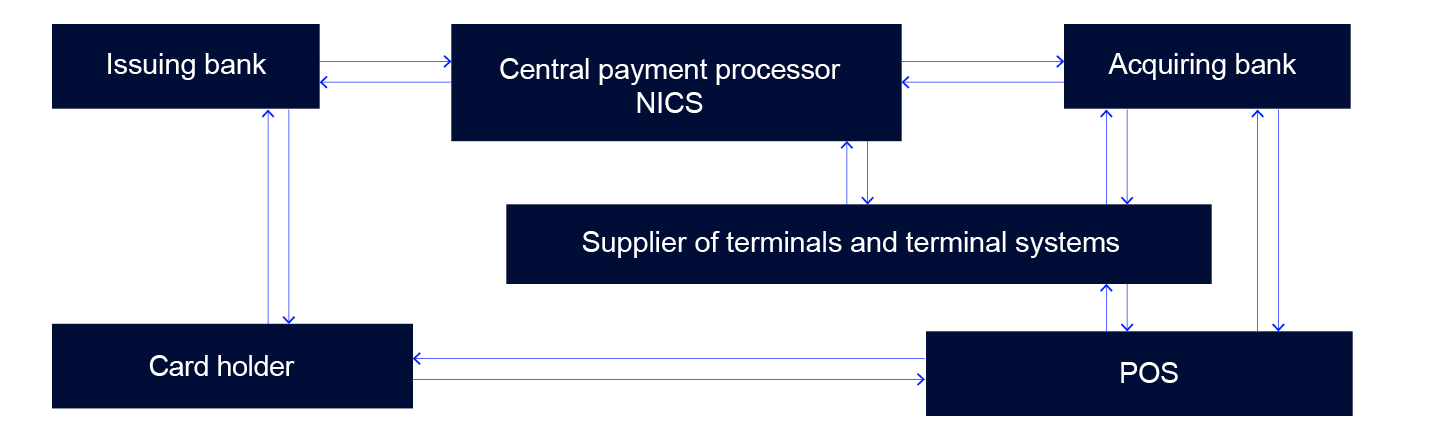
Read the diagram as text
- Start at the point of sale: POS is the point of sale. The report describes a BankAxept payment where the cardholder enters a PIN and the terminal creates an authorisation request.
- Route the authorisation request: The central payment processor checks the PIN and where the request came from, then sends the request to the cardholder’s issuing bank.
- Read the issuer’s decision: The issuing bank checks the card and available funds. Its yes or no response goes back through the processor to the terminal. For an approved payment, the amount remains on hold until settlement.
- Follow clearing to the merchant’s bank: The report describes five weekday NICS clearings sent to Norges Bank for settlement. After settlement, NICS sends data to the acquiring bank to credit the merchant and to the issuing bank to debit the payer.
Follow the Norges Bank diagram step by step.
Read the original at full size here
Use touch, a trackpad, or the arrow keys in the image area.
Overnight the network plays accountant. It sorts every record to the issuer that must pay for it. It works out what each bank owes and what each bank is owed. Then it has only the differences moved between them.
Why only the differences? Because Bank Alfa's cardholders bought from many merchants that day, and Meridian Bank's merchants were paid by many cardholders. Moving every single amount separately would be thousands of tiny transfers where one figure will do.
On their own posting and payout schedules, the two banks square up with their customers. Bank Alfa turns Maya Chen's hold into a real debit. Meridian Bank pays the coffee shop — slightly less than the tap amount, because the fees come out on the way through.
Hold on to the shape of it before the vocabulary arrives. Records travel first, money follows, and this example contributes to a net interbank cycle rather than a separate transfer for each coffee.
PLAIN WORDS · 4 in this section
- authorisation
- deciding what a person is allowed to do
- mastercard
- a company that runs a card payment network
- cardholders
- people who hold a payment card
- payout
- money paid out to the person receiving it
CURRENT AS CHECKED
1 FIGURE
Regulation (EU) 2015/751 — EEA consumer card interchange caps
Regulation (EU) 2015/751 caps consumer interchange in the at 0.2% of transaction value for debit card transactions and 0.3% for credit card transactions, in Articles 3 and 4. Commercial cards sit outside these caps. A three-party scheme can be treated as four-party where Article 1(5) applies, including specified licensing, co-branding or agency arrangements. The consolidated text on EUR-Lex carries the current wording together with any national derogations, so a domestic figure can differ from the headline ceiling.
CHECKED 2026-07-28RECHECK BY 2027-07-28
Sources & standards — 1 source
- Official requirement
Regulation (EU) 2015/751 on interchange fees for card-based payment transactions ↗ — European Union (EUR-Lex) · Articles 3 and 4 — consumer debit and consumer credit interchange fee caps
Commonly called the Interchange Fee Regulation. Articles 3 and 4 set the consumer debit and consumer credit caps; Article 9 requires acquirers to offer unblended merchant service charges unless the merchant asks in writing for blending. Article 12 governs the transaction information the acquirer gives the merchant. Commercial cards and three-party schemes sit outside the caps' scope. Consult the consolidated text on EUR-Lex for the current wording and any national derogations.
Follow-up8 November2026: actual original Articles1–4/9/12 read. Pure three-party exclusions must be read with Article1(5); legal ceilings, merchant total charges, unblended offers and written merchant-request qualifications are distinct. Current national choices not fully certified.
SEE THE PAYMENT MOVE
WHAT THIS PAGE CANNOT SHOW YOU
1 RAIL
These rails are explained here in words, and their message layout is not shown, because it is not something this site can honestly print. Each was looked for on the date given. Some specifications are issued only to a scheme’s own members; some are published openly and we could not retrieve a copy; and one or two we have not yet searched far enough to settle. Read what you have read above as an account of how each rail works, never as a specification you can build against.
Card clearing — the presentment record the network prices and sorts to the issuerPUBLISHED TO MEMBERS ONLY
The record layouts that carry a card payment's money and its disputes — Visa's BASE II clearing interchange formats and Mastercard's IPM clearing formats, including the presentment, chargeback and representment records
LOOKED FOR 2026-08-06
PRACTISE AND KEEP
Sources for this topic — 5 sources
- Official requirement
Regulation (EU) 2015/751 on interchange fees for card-based payment transactions ↗ — European Union (EUR-Lex) · Articles 3 and 4 — consumer debit and consumer credit interchange fee caps
Commonly called the Interchange Fee Regulation. Articles 3 and 4 set the consumer debit and consumer credit caps; Article 9 requires acquirers to offer unblended merchant service charges unless the merchant asks in writing for blending. Article 12 governs the transaction information the acquirer gives the merchant. Commercial cards and three-party schemes sit outside the caps' scope. Consult the consolidated text on EUR-Lex for the current wording and any national derogations.
Follow-up8 November2026: actual original Articles1–4/9/12 read. Pure three-party exclusions must be read with Article1(5); legal ceilings, merchant total charges, unblended offers and written merchant-request qualifications are distinct. Current national choices not fully certified.
- Market practiceSuperseded — see Glossary of payments and market infrastructure terminologyMarch 2003 edition
A glossary of terms used in payments and settlement systems ↗ — CPSS (now CPMI), Bank for International Settlements
Superseded for currency, not for coverage, and that distinction is the reason this entry stays. The live glossary at bis.org/cpmi/publ/d00b.htm is the current text. This edition remains the only published CPMI definition of ten headwords the live glossary does not carry.
Both editions were downloaded and compared on the access date. The 2003 PDF is 346,977 bytes; the generated PDF of the live glossary is 197,553 bytes. Four definitions this site teaches had moved. Six passages quoted the 2003 wording of netting in prose while attributing it to the CPMI glossary, and those now say which edition they are quoting.
Checks that returned nothing, recorded so they are not repeated. Singleness of money, payment token, electronic wallet and book transfer are headwords in neither edition. A citation for any of those was pointing at a document that does not contain the term.
- Scheme-specific rule
Mastercard Switching explained: authorisation, clearing and settlement ↗ — Mastercard · Clearing defined as the exchange that supports posting to the cardholder's account; settlement as the exchange of funds (search excerpt, page not opened)
Known from web-search excerpts on the access date, page not opened. One network's description, not a rule that binds every card scheme.
- Simplified educational illustration
Payments Signal editorial teaching models — Payments Signal
What this simplifies: The overnight clearing-and-settlement picture, and the worked figures inside it, are illustrative. Real cycles, cut-offs, interchange schedules and settlement arrangements come from network operating regulations, so the topic states the mechanism and leaves every number to the scheme that sets it.
Used wherever diagrams, scenarios, figures, or example values are didactic constructions rather than sourced facts; every such use carries a simplifications disclosure. All people, companies, banks, and list entries in examples are fictional.
- Official requirement
Mastercard Transaction Processing Rules — 9 June 2026 ↗ — Mastercard · 9June2026 edition §§2.1,2.2.2,2.18.1: selected message, authorization and dual-message clearing provisions; not a universal card-service timetable.
Verified from two independent web-search excerpts on the access date, both naming the document, its publisher-hosted URL and the Stand-In Processing Service section within it. www.mastercard.us is blocked, so no clause, limit or section number is quoted from it anywhere on this site.
One network's rules, and the site says so wherever they are cited. Visa, American Express, and every domestic scheme write their own, and the mechanisms carry different names and different parameters. A claim that reads as though all card networks worked this way is not what this document supports.
The rest of the card material on this site deliberately does not lean on scheme rulebooks, because most are member-only contracts. Where a card topic teaches the shape of an exchange rather than a clause, that is the reason.
V11 audit, 6 November 2026: Current official rules landing links the 9 June 2026, 436-page PDF. Read §2.1 MTIs, §2.2.2 authorization processing (pp46–48) and §2.18.1 dual-message clearing (pp68–69). The legacy public/na URL serves 10 June 2025; do not identify that edition as current.
Deepest material on this page: L4 — Standards & sources. Where a topic stops short of implementation depth, that is a deliberate coverage decision, not an oversight — see coverage.