Settlement models in instant systems: gross, net and prefunded
Every instant system pays the customer in seconds. What differs is how the banks behind it settle: one by one, as a net batch, or from money set aside first.
L1–L4 are part of the Pro pass
L0 Explain simply
Riya sends Arjun 500 on a quiet Sunday morning. A few seconds later Arjun sees the money in his account and can spend it. (SYNTHETIC / TRAINING ONLY: Riya, Arjun and the amount are made up.) That speed is what makes a instant for the customer.
Interbank settlement is the discharge of the banks’ obligation under the system’s rules. It may occur before or alongside customer availability in a gross-, or later in a deferred-settlement fast-payment example. The customer screen alone does not establish that ordering.
Start with two dimensions. Gross versus net describes whether individual obligations or net balances settle. Real-time versus deferred describes timing. Prefunding describes where liquidity is placed beforehand; it is not a mutually exclusive third alternative to gross and net.
The second is a batch of differences. The system adds up what each bank owes and is owed, sets the two against each other, and moves only the difference at set times. The proper name is net settlement, and the delayed kind is , or DNS. in the United Kingdom and UPI (Unified Payments Interface) in India are examples of the delayed kind. This is a simplified picture: every one of those systems has its own timetable.
Money put aside in advance can support different settlement designs. Depending on the service, it may be in an individual account or a participant position backed by a joint account. Ask which claim the participant actually holds.
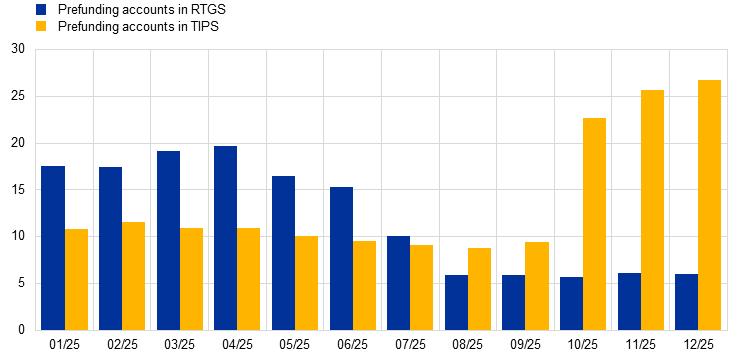
Read the diagram as text
- Read the account groups: The bars show daily-average euro amounts in the distinct account groups. Identify which group is attributed to real-time gross settlement and which to TIPS.
- Compare year-end balances: The TIPS prefunding bar is much higher in December. The ECB reports more than 80% of the measured liquidity in TIPS by then.
Read the actual 2025 evidence in the ECB chart.
Read the original at full size here
Use touch, a trackpad, or the arrow keys in the image area.
Why should a beginner care? The customer cannot see any of this. Yet it decides two things for the banks. One is how much ready money a bank must keep at every hour of the day. The other is who is left owed money if a bank fails before the money moves. Neither model is the clever answer. Each one pays one of those bills so that the other stays small.
A wait or a hold in these systems is the control working, not breaking. A payment that waits for funds is the system protecting the banks behind it. This topic puts six real instant systems side by side so you can see which bill each one chose to pay. The earlier topic on (real-time gross settlement) versus deferred net settlement teaches the basic trade-off. This one applies it to .
PLAIN WORDS · 1 in this section
- prefunding
- putting money in ahead of time so it is there
PICTURE IT
Friends who take turns paying for lunch
Picture three friends who eat lunch together every day and take turns to pay the bill. The cook is paid at once, and everyone eats. The cook does not care how the friends settle with each other afterwards.
The friends can settle in three ways. In the first way, each friend pays back the one who paid, straight away, every time. In the second way, they write down who owes what. They cancel the amounts that go both ways. At the end of the week they pay only the small differences. In the third way, everyone puts some money in a shared jar first, and each bill is taken from what that friend put in.
The lunch is the same in all three ways. Only the paying back changes.
THE REAL JOB A decides when money moves between banks and what stands behind a payment until then.
- Bank keeps ready money, or money set aside
- Payer sends the payment
- Sending bank takes the money from the payer
- Receiving bank credits the payee in seconds
- Banks settle: one by one, or as a net difference
HOW THE PICTURE MAPS
| In the picture | In the payment |
|---|---|
| The cook, who is paid at once | The payee, who has the money in secondsWho: Arjun |
| The friend who paid the cook and waits to be paid back | The receiving bank, which credited its customer and waits to be settledWho: Nordbank |
| Paying back the friend straight away, every time | Gross settlement: each payment moves between banks on its own, at once |
| A list of who owes what, settled weekly | Net settlement: only the difference moves, at set times |
| The shared jar, filled before lunch | Prefunding: money set aside before the payments that will use it |
| A rule that nobody may owe more than they put in the jar | A limit on the net amount a bank may owe before it must fund more |
| A friend who keeps cash ready every single day | A bank that must keep enough ready money in its account at every hour |
WHERE THIS PICTURE STOPS
- Friends trust each other and can talk. Banks settle by the rules of a system, across accounts at the central bank, and the picture does not show why central bank money matters.
- Friends can argue about a bill later. A settlement in a real system has finality, which means that under the system's rules it cannot be undone.
- The picture does not determine ownership: a participant may use an individual account, correspondent or position backed by a joint account, depending on the service.
HOOK
Customers get paid now; banks pay each other now, later, or ahead.
REMEMBER IT THIS WAY
A rule of thumb: if you see this, think that.
Ask two questions: when does the money between banks move, and what stands behind it until then?
| In the trick | What it stands for |
|---|---|
| When does the money between banks move? | one payment at a time (gross) or as a net batch at set times |
| What stands behind it until then? | ready money in the account, money set aside in advance, or a limit on what a bank may owe |
It sorts systems into designs but gives no timetable, limit or fee, which each system publishes and changes.
TELL A FRIEND
Two instant systems can both pay the customer in seconds yet settle between the banks differently: one payment at a time, as a net total later, or against money set aside in advance. Ask which model the system uses before saying when the banks are square.
OFTEN MIXED UP WITH RTGS versus deferred net settlement. That topic teaches the basic choice between settling each payment on its own and settling the net difference. This topic applies the choice to six instant systems and adds a second question, what stands behind the payment, which is where prefunding comes in.
SEE THE PAYMENT MOVE
PICTURE THE JOURNEY
Capsule pipes and a central office that never closesOpen to read the picture, how it matches the payment and where it stops.
PICTURE IT
Capsule pipes and a central office that never closes
Riya wants to pay Arjun on a public holiday. They keep savings at desks joined by capsule pipes to a central office. Customer notebooks stay at the desks. The office keeps separate settlement pages for desks, or an approved desk acting for another.
Riya asks her desk to send the payment. The request alone settles nothing. Her desk performs its checks. In the chosen outbound-stop case it withholds the instruction before submission and has not debited her. That is one bank process, not a rule that every screening concern has the same outcome.
In the ordinary successful case, the desk sends a payment note. The note carries information. The office asks the receiving desk for its response, then records the final inter-desk transfer when conditions permit. The desks separately update their customer notebooks. This example gives Arjun access promptly after the ordinary acceptance.
A different reviewed response accepts without posting. The office's settlement can already be final while Arjun's desk investigates before giving him access. A later customer-status note does not undo the office's settled transfer.
If the sender hears nothing, it waits for the processing timeout and allowance before using the inquiry process. It can also consult the permitted search and report tools. It checks whether it needs the office's settlement result or the receiving desk's latest customer-posting result. Silence is not proof of failure, so it does not send an uncontrolled duplicate.
A mistaken settled payment may need a separate recovery. In this toy refusal case, customer consent is the assumed available authority and is not obtained. Other reasons, duties and legal remedies are not ruled out. A return request is not returned money. (SYNTHETIC / TRAINING ONLY: Riya, Arjun and the desks are invented.)
THE REAL JOB The settles eligible individual transfers in master accounts around the clock, while customer posting remains a separate event.
HOW THE PICTURE MAPS
| In the picture | In the payment |
|---|---|
| Riya asks her savings desk to send the gift | Riya instructs a payment; it is only a request and nothing has movedWho: Riya |
| Her desk checks her notebook page and the may-not-serve list | Bank Alfa checks funds and screens the payment before sending anythingWho: Bank Alfa |
| This chosen outbound check stops the instruction before submission | Alfa withholds this selected payment; other screening and receiver outcomes have their own rules |
| The capsule holds a note about the gift, not the gift | A pacs.008 payment message asks for settlement and carries no money |
| The brass pipe and the central office that never closes | FedNow, run by the Federal Reserve, works every hour of every day |
| The office opens each capsule at once, on its own | FedNow processes each payment on arrival, with no batching |
| The office keeps settlement pages, including an approved representative desk | Settlement uses participant or correspondent master accounts, separate from customer accounts |
| The office asks Arjun's desk whether it can take the gift | FedNow asks Nordbank whether it can apply the payment to Arjun's account |
| The receiving desk provides its response | A receiver pacs.002 may accept, reject or accept without posting (ACWP)Who: Nordbank |
| A closed page brings back a no, and the big book is untouched | A pacs.002 status report saying RJCT, reason AC04; nothing settles, so nothing is undone |
| Two lines in ink at the same moment, one down and one up | Settlement: one debit and one credit for this payment, final and irrevocable |
| A capsule goes back to say the lines are written | A pacs.002 status report with ACSC; it is evidence of settlement, not the money |
| The desks reconcile their own customer notebooks separately | Customer debits and credits require separate records; interbank settlement does not establish every posting |
| In the ordinary main case, Arjun can use the credited gift | Ordinary availability is shown; ACWP can withhold customer posting despite final interbank settlementWho: Arjun |
| After the timeout, the sender investigates the missing response | Use eligible pacs.028 inquiry or search/report tools; distinguish settlement from receiver posting |
| A recovery request asks for a separate transfer | A camt.056 request does not move funds; reasons, duties and authority govern the response |
| The office cannot find the desk's own page or the arrangement behind it | FedNow cannot validate the settlement arrangement and rejects with a pacs.002 status report |
WHERE THIS PICTURE STOPS
- The ink analogy does not establish legal rules. The reviewed procedures distinguish final interbank settlement from later customer posting. They do not erase every underlying legal claim.
- The toy refusal assumes consent is the available authority for that debit. It is not a universal rule. Return duties depend on the actual reason and applicable rules or law.
- A master-account balance is central-bank money, not the customer's deposit record. A participant may settle through a correspondent. A customer hold or debit requires separate reconciliation.
- Accept Without Posting (
ACWP) can settle the interbank transfer while customer access is withheld for investigation. Its resolution duties and updates follow the reviewed procedures and applicable law. - The message sender matters. A service settlement status can differ from a receiver's later posting status. The inquiry destination must match the question being investigated.
- Use the status process after the applicable timeout and processing allowance. Permitted search and report tools also exist. Confirmed not-found or rejected outcomes can permit a controlled new-ID submission; silence alone cannot.
HOOK
Resolve the actual outcome before considering a replacement payment.
REMEMBER IT THIS WAY
A sequence: the real steps, in order.
Ask whose status you have: the service's settled transfer or the receiver's customer posting.
| In the trick | What it stands for |
|---|---|
| Screen | The chosen outbound control, separate from receiver-side investigation |
| Ask | A receiver response may include accept without posting |
| Settle | Interbank finality is separate from the customer-account update |
| Report | Service and participant status reports answer different questions |
TELL A FRIEND
FedNow settles between master accounts, while banks keep separate customer records. The ordinary path posts promptly; accept-without-posting can instead withhold access after settlement.
OFTEN MIXED UP WITH The United States: five rails and no single operator. FedNow is an instant central-bank settlement service; instant interbank finality does not prove every customer has already received usable funds.
PRACTISE AND KEEP
Sources for this topic — 14 sources
- Market practice
Enhancing cross-border payments: fast payment system interlinking ↗ — Bank for International Settlements, Committee on Payments and Market Infrastructures · Fast payment systems may use a variety of settlement and funding models (for example pre-funding, multilateral deferred net settlement); end users are typically credited for good within seconds or minutes though interbank settlement may be deferred
Known from a web search excerpt only (query: Bank for International Settlements (BIS) Committee on Payments and Market Infrastructures (CPMI) fast payments report settlement models real-time gross settlement deferred net settlement prefunded accounts instant payment systems), page not opened. The document is dated February 2026 and sits under the CPMI payments interlinking task force on bis.org. Label no higher than market-practice until the page is read.
- Market practice
Fast payments: design and adoption (Bank for International Settlements (BIS) Quarterly Review, March 2024) ↗ — Bank for International Settlements · RTGS versus DNS: liquidity needs, risk that netting does not take place as expected, effect on cost structure and incentives to participate
Known from a web search excerpt only (same query as bis-cpmi-fps-interlinking-2026), page not opened. Quarterly Review of March 2024. Label no higher than market-practice until the page is read.
- Market practice
The quest for speed in payments (Bank for International Settlements (BIS) Quarterly Review, March 2017) ↗ — Bank for International Settlements · Credit risk in deferred settlement because the payee's PSP advances funds; mitigants prefunding, net debit limits and collateral
Known from a web search excerpt only (same query as bis-cpmi-fps-interlinking-2026), page not opened. Quarterly Review of March 2017, so it describes the mechanism rather than any current system. Label no higher than market-practice until the page is read.
- Official requirement
Principles for financial market infrastructures ↗ — CPMI and IOSCO (Bank for International Settlements) · Principle 4 (Credit risk); Principle 7 (Liquidity risk); Principle 8 (Settlement finality)
V40 actual primary PDF read at https://www.bis.org/publications/principles-financial-market-infrastructures.pdf :complete3.4.1–3.4.7,3.8.1–3.8.8 and AnnexD payment designs through liquidity-saving discussion (printed38–40,64–66,148–149). Cover/title verified;not full188page reading. Specific credit/liquidity/finality/design statements here use these sections. Earlier registry scope/history:Published by the CPSS (now CPMI) and IOSCO; contains 24 principles plus responsibilities for authorities. This site uses it only for high-level concepts such as settlement finality.
- Scheme-specific rule
FedNow Service Product Sheet ↗ — Federal Reserve Financial Services · Real-time gross settlement in a participant master account, final, no prefunding required
Participants still manage master-account liquidity, intraday credit, limits and operational availability. Do not turn that liquidity obligation into a false FedNow prefunding requirement. Re-verified 2026-09-20 for the ISO 20022 fact: corroborated by the Federal Reserve's own FedNow ISO 20022 readiness guide and FAQ pages, independently of this product sheet.
The pacs.028/pacs.002 status-request pairing and the AC04 reason code are corroborated by the FedNow ISO 20022 readiness guide and independent industry material on pacs.002/pacs.028 usage, verified from web-search excerpts rather than opened directly. The camt.056 Request for Return of Funds is corroborated across two independent searches. One is a Treasury Department Credit Gateway guidance page and one a payment-system directory page, and both name it explicitly as "FedNow message type Camt.056" — the same camt.056/camt.029 pairing already established for Fedwire and RTP in this registry.
- Scheme-specific rule
FedNow features: Settlement, reporting and liquidity management ↗ — Federal Reserve Financial Services · Gross settlement per transaction at master-account level; liquidity management transfers between master accounts
Known from a web search excerpt only (query: FedNow Service settlement real-time gross participants master account liquidity; TIPS (the Eurosystem's instant payment settlement service) settles in central bank money ...), page not opened. Operator blog, not an operating procedure: the operating procedures in the registry (fednow-operating-procedures-2026) rule where they differ. Label no higher than scheme-specific-rule.
- Scheme-specific rule
What is TIPS? (TARGET Instant Payment Settlement) ↗ — European Central Bank · TIPS settles instant payments in central bank money around the clock
TIPS also settles instant payments in Swedish krona and Danish krone. This page names the currencies and does not publish their go-live dates. The Danish-krone date and the statement that the Swedish krona was onboarded in 2024 are cited from
ecb-dkk-target-press-2025. Detailed user documentation is published separately by the ECB. - Official requirementR2026.JUN
TIPS professional-use documents, release specifications and message examples ↗ — European Central Bank · TIPS dedicated cash account and liquidity transfers from the main cash account
R2026.JUN is the current production release at the review date. R2026.NOV is published for review and scheduled later; implementations must select the release effective for their test and go-live window.
- Scheme-specific rule
Pix, the Instant Payment System (SPI) and the Reserve Transfer System (STR) ↗ — Banco Central do Brasil · Pix transfers settle individually and one-to-one over the SPI, an RTGS, final and irrevocable
Pix settles over the SPI (RTGS) in about three seconds; the STR is the wholesale reserve-transfer RTGS operated by the BCB.
- Scheme-specific rule
Faster Payment System (FPS) ↗ — Pay.UK · Faster Payments cleared in real time and settled on a deferred net basis across Bank of England settlement accounts
Interbank settlement in FPS is deferred net at the Bank of England — the customer experience is instant, but the banks settle net at defined cycles, not payment-by-payment. Not an RTGS system.
The pacs.004 mandatory-data fact is verified from a web-search excerpt of Pay.UK's own "Mandatory data in our ISO 20022 messages" publication, not opened directly.
The Bank of England's Real-Time Gross Settlement Service: Service Description ↗ — Bank of England · Prefunding and net sender caps for deferred net settlement systems (source flagged superseded in the registry)
The cover reads October 2017, which is the fact this entry previously did not carry. The Bank replaced the platform it describes with RT2 on 28 April 2025. This site's own dated fact uk-rt2-live says material describing the previous platform should not be used for current behaviour.
Which claim goes to which successor. The RTGS Rules are the current readable account of the service and of its processing points. The access policy is the current account of accounts and prefunding. The CHAPS Reference Manual is the current account of the liquidity saving mechanism.
The internal reference printed in this extract is dead. It points at bankofengland.co.uk/markets/Documents/paymentsystem/rtgspfmisa.pdf. The full 2017 self-assessment is served instead at bankofengland.co.uk/-/media/boe/files/payments/rtgs-pfmi-self-assessment-october-2017.pdf.
Two changes under the covers are worth naming. The list of systems settling in RTGS is no longer the seven named here: Cheque and Credit has gone, and CLS, the Sterling Fnality Payment System, LCH Limited, Mastercard and PEXA have been added. And access is not the simple opposite of SWIFT-only that a reader might infer. The RTGS Rules say Sailpoint, BERTI and application programming interfaces are all parts of the service accessed via Swift.
- Scheme-specific rule
UPI Settlement Process ↗ — National Payments Corporation of India (NPCI) · NPCI as clearing and settlement agency; net positions settled in members' RTGS settlement accounts at the RBI
Known from a web search excerpt only (query: Unified Payments Interface (UPI) National Payments Corporation of India (NPCI) settlement net settlement Reserve Bank of India (RBI) real-time gross settlement (RTGS) settlement account cycles), page not opened. The excerpt also mentioned an older NPCI circular (24 January 2019) that set four intraday cycles; whether those times are still current was not verified, so no cycle count is used. Label no higher than scheme-specific-rule until the page is read.
- Simplified educational illustration
Payments Signal editorial teaching models — Payments Signal
What this simplifies: Riya, Arjun, Bank Alfa and Nordbank are invented. The 60 and 55 payments, the 40 payments in the exercise, and the limit of 1,000 are invented round numbers. The topic names one settlement model per system and gives no timetable, cycle count, limit or fee, because those change and each system publishes its own. Real systems net across many banks and cycles. How Pix participants fund their accounts is not stated, because no source read states it.
Used wherever diagrams, scenarios, figures, or example values are didactic constructions rather than sourced facts; every such use carries a simplifications disclosure. All people, companies, banks, and list entries in examples are fictional.
- Scheme-specific rule
Unified Payments Interface (UPI) ↗ — National Payments Corporation of India (NPCI) · The National Payments Corporation of India's overview of UPI, cited only for what UPI is (search excerpt, page not opened)
NPCI is an RBI-regulated entity. UPI is built over IMPS and uses a VPA rather than raw account details.
Deepest material on this page: L4 — Standards & sources. Where a topic stops short of implementation depth, that is a deliberate coverage decision, not an oversight — see coverage.