Canada: the notification is not the money
Lynx settles wire payments with real-time finality and the retail batch rule set covers cheques and automated funds transfers; which one carries an e-Transfer, no cited page says.
L1–L4 are part of the Pro pass
L0 Explain simply
A Canadian sends money to a friend by email address, and the friend has it in minutes. Interac runs that service. Its own disclosure says customers can instantly send, request and receive money between accounts using an email address or a mobile number.
Now pull apart two things the app shows you as one. A message carries the notice. Interac's help pages then say the financial institutions use existing payment networks to move the money.
That is two journeys, not one. The notice is quick because a message is quick. The money is a separate question, and the screen the sender is looking at does not answer it.
Payments Canada operates three national payment systems. Lynx settles high-value wires. The (ACSS) clears retail batches. The went live on 9 November 2026 for eligible real-time payments.
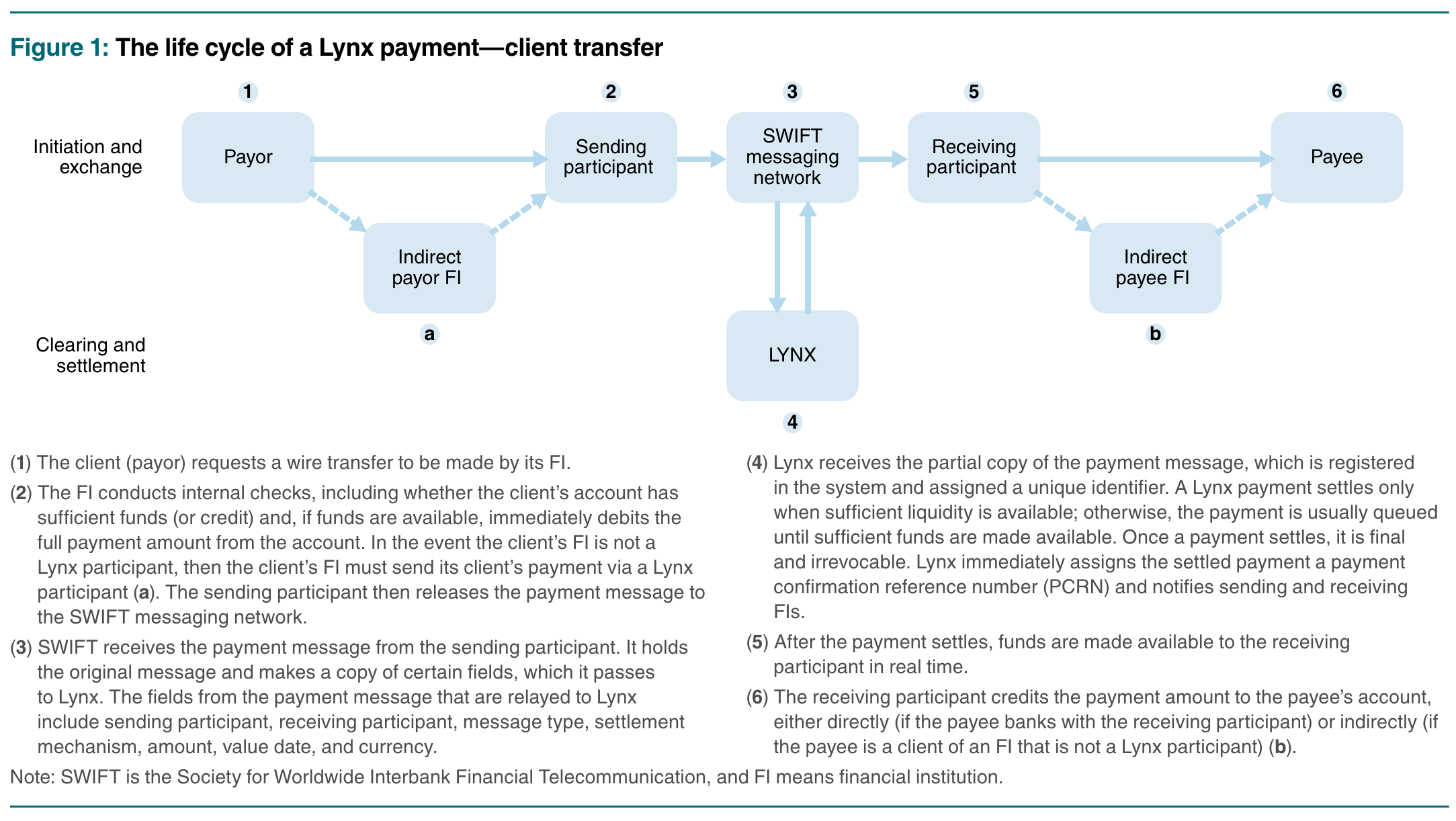
Read the diagram as text
- Start at the sending side: The payer asks their bank to make a wire transfer. If their bank is not a Lynx participant, it goes through a participant as shown by the branch labelled a.
- Find the instruction on Swift: The sending participant releases the payment message to Swift. Swift sends the relevant message fields to Lynx for settlement.
- Find interbank settlement in Lynx: Lynx settles the payment when sufficient liquidity is available and assigns a payment confirmation reference number. The settled payment is final and irrevocable in Lynx.
- Follow the credit to the payee: The receiving participant gets the settled funds. It credits the payee directly or works through the payee’s financial institution, as shown by the branch labelled b.
Based on official sources
Follow the published figure step by step.
Read the original at full size here
Use touch, a trackpad, or the arrow keys in the image area.
So which one moved your friend's money? Hold on to that question. None of the sources this topic cites names it. When a source does not answer a question, the honest thing is to say so and stop, rather than fill the gap with a plausible one.
By the end of this topic you should be able to name Canada's systems, say what each one is for, and say why a service that feels instant proves nothing on its own about how two banks settled.
PICTURE IT
A postcard that announces a parcel, and the parcel itself
Picture a friend who sends you a postcard saying a parcel is on its way. The postcard is written and posted in a minute. The parcel is a separate thing. It reaches you by its own route, and the postcard does not say which route it took.
The postcard is written and sold at a small shop counter. The shop does not carry parcels itself. Behind the counter, two depots handle parcels. One depot hands over each parcel on its own, the moment it arrives. The other depot gathers many parcels and hands them over together. Both depots keep their reserve in the strongbox of the post authority.
If you only read the postcard, you cannot say which depot the parcel used.
THE REAL JOB Canada's payment systems let banks move money between each other, while a service such as sends the customer a quick notice about it.
- The sender taps send in the app
- Journey one: a message carries the notice to the friend
- Journey two: the banks move the money by a system the cited pages do not name
HOW THE PICTURE MAPS
| In the picture | In the payment |
|---|---|
| The postcard announcing the parcel | The email or text message that carries the notification |
| The parcel itself | The money, which the financial institutions move over existing payment networks |
| The depot that hands over each parcel on its own as it arrives | Lynx, the high-value system, where each payment settles as it arrives |
| The depot that gathers many parcels and hands them over together | The retail batch payment system, whose rule set is the Automated Clearing Settlement System (ACSS) |
| The shop counter that writes and sells the postcard | Interac e-Transfer, a service and not a settlement system |
| The post authority's strongbox that holds each depot's reserve | The settlement account at the Bank of Canada, behind both systems |
WHERE THIS PICTURE STOPS
- A postcard can arrive before or after its parcel. An e-Transfer notice is only a message, and it shows nothing about when or how the banks settled.
- The picture suggests you could follow the parcel to one depot. In Canada the sources this topic cites do not name which system carries an e-Transfer. So the picture must not be used to guess it.
- A parcel in the post can often be stopped before it is delivered. A Lynx payment cannot be taken back once it settles, because the operator calls such wire payments irrevocable with real-time settlement finality.
- The picture ends when the parcel is handed over. It does not show how each bank decides when to credit its own customer, which the participating banks and the service rules govern.
HOOK
The notice is quick; the money is a separate journey.
REMEMBER IT THIS WAY
A contrast: two neighbours told apart by one test.
Ask one question of any Canadian payment: is this the notice, or the money? Then ask: one by one, or together?
| In the trick | What it stands for |
|---|---|
| Notice or money? | a message carries the notice, while the financial institutions move the money over existing payment networks |
| One by one | Lynx, where each payment settles on its own as it arrives |
| Together | the retail batch payment system, which handles many payments together |
The second question names the two systems but cannot say which one carries an e-Transfer, because the cited pages do not name it.
TELL A FRIEND
In Canada an e-Transfer notice travels by message, and the banks move the money separately. Lynx settles large payments one by one, the retail batch system handles many together, and the sources do not say which carries an e-Transfer.
OFTEN MIXED UP WITH Reading a country's payment stack. Reading a market gives the questions to ask of any country. This topic applies them to Canada. Shows that an honest answer to one of them can be that the cited sources do not say.
CURRENT AS CHECKED
2 FIGURES
Bank of Canada — Real-Time Rail settlement accounts
Under the Bank of Canada's access policy for the Real-Time Rail, each direct participant holds a settlement account at the Bank of Canada that is funded and defunded by Lynx payments in that participant's name. Delivery timetables for the RTR have moved more than once and no live date should be quoted from an older document.
CHECKED 2026-08-03RECHECK BY 2027-02-03
Sources & standards — 1 source
- Regulatory guidance
Settlement account access policy for the Real-Time Rail ↗ — Bank of Canada · RTR settlement accounts funded and defunded by Lynx payments
Opened and read on the access date — HTTP 200, 27,434 bytes. The previous note said a full-page fetch was unavailable. It answers now.
The funding claim survives the text exactly, and the page's sentence is reproduced in the applicability wording above. One tense was wrong and is corrected. The policy says accounts "will be funded and defunded", and it describes "the planned Real-Time Rail", so this entry no longer reads as a description of a live system.
Delivery dates for the Real-Time Rail have moved more than once, are not on this page, and are still not quoted here.
Additional actual selected review 7 November 2026: current page says updated 31 July 2026. Read introduction, account classes/agent approval, payment capacity and funding/agreement sections. This remains an account-access policy, not legislation, and uses planned-RTR wording; no independent launch-status verification claimed.
Payments Canada Lynx and Real-Time Rail message specifications
Payments Canada's Lynx companion document for core messages is at version 1.5 dated March 2026, after version 1.4 of March 2025 and version 1.2 of March 2022 and a corporate-to-bank companion at version 1.0 dated March 2024. The Real-Time Rail usage guideline states restrictions to base message pacs.008.001.08. Document versions move; read the version in force rather than this one.
CHECKED 2026-08-04RECHECK BY 2027-02-04
Sources & standards — 2 sources
- Scheme-specific rule
Lynx ISO 20022 message specification — companion document for core messages, and companion document for corporate-to-bank messages ↗ — Payments Canada · Lynx ISO 20022 message specification companion documents — versions and dates
Search excerpts only, page not opened. The documents were named, dated and versioned from independent search results across more than one release, which is what makes the publication claim safe; nothing was opened and no element restriction is quoted anywhere on the site. Distinct from payments-canada-lynx, which describes the system rather than its messages. The version numbers live in the current fact canada-message-specification-versions, not in prose.
- Scheme-specific rulecompanion document version 1.4 (30 May 2025); FI-to-FI customer credit transfer usage guideline RTR_Exchange_UG2025_v1.3 (03 June 2025)
Real-Time Rail ISO 20022 message specification companion document and per-message usage guidelines ↗ — Payments Canada · RTR_FIToFICustomerCreditTransfer usage guideline — base message pacs.008.001.08
This entry recorded payments.ca as 403 and said nothing had been opened. Retested on the access date: the host answers 200, and both documents were downloaded and read in full with pdftotext. The claims above are now quoted from the documents rather than corroborated from search excerpts.
The same stale boundary is still recorded on payments-canada-lynx-message-specification and payments-canada-standard-005, and has not been retested for those. A note nobody retests reads exactly like an evidence limit without being one.
Version numbers are carried in the current fact canada-message-specification-versions and not in prose. Distinct from bank-of-canada-rtr, which is a settlement-account access policy and carries no message content.
SEE THE PAYMENT MOVE
PICTURE THE JOURNEY
A forms office, a books office and a waiting trayOpen to read the picture, how it matches the payment and where it stops.
PICTURE IT
A forms office, a books office and a waiting tray
Picture many firms in one country. Each firm keeps an account book in a books office that every firm trusts. One page in the book shows how much money the firm has left with the office. Only the clerk at the books office may write in the books.
Across the road stands a forms office. The first firm wants to pay the second firm a large sum, so it hands in a form there. The form has a big box where the firm can write a full note about the invoice.
The forms clerk checks the first firm's page in the books office. If the page holds enough for the whole sum, the form goes on to the stamp window. There the books clerk writes the whole sum out of one page and into the other, in ink. Each sum is stamped on its own, never in parts. The forms office then sends a copy of the stamped form to the second firm, which writes the sum in its own records.
If the first page holds too little, the clerk will not stamp the form. The form waits in a tray until money arrives on that page. Sometimes two forms in the tray wait for each other. Then the clerk stamps both in one go, each in full. A firm can also take its own form out of the tray, to free money for a more urgent form. If the offices close with a form still in the tray, it is handed back marked unpaid. The firm must hand in a new form on a later working day. A form that names a firm with no account book is refused at the desk.
THE REAL JOB Lynx, Payments Canada's real-time gross settlement system, settles each large Canadian dollar wire on its own, in , and the result is final.
HOW THE PICTURE MAPS
| In the picture | In the payment |
|---|---|
| The first firm, which hands in the form to pay a large sum | Bank Alfa, the sending bank, submits the wireWho: Bank Alfa |
| The form, with a big box for a full invoice note | pacs.008, the payment message that carries rich payment details |
| The forms office that checks each form and keeps the tray | Lynx, the system that checks each payment and holds the queue |
| The books office that keeps every firm's account book | The Bank of Canada, which keeps each bank's settlement account |
| One firm's page in the account book | A bank's settlement account at the Bank of Canada |
| The forms clerk checking that the page holds enough | The clearing check: the balance must cover the whole payment |
| Writing the whole sum out of one page and into the other, in ink | Settlement in central bank money: one debit, one credit, real-time and final |
| The copy of the stamped form sent to the second firm | Lynx passes the same payment message, pacs.008, on to say it is final |
| The second firm, which writes the sum in its own records | Nordbank, the receiving bank, books the funds itselfWho: Nordbank |
| A form waiting in the tray because the page holds too little | Not enough balance (NOBAL): the wire is queued until the account is covered |
| Two forms in the tray, each waiting for the other | Gridlock (GRIDLOCK): both settle together, each one in full |
| A firm taking its own form back out of the tray | The sender withdraws a queued wire (WITHDRAW) before it settles |
| A form still in the tray when the offices close | Still queued at the close (CUTOFF): returned unsettled with a pacs.002 status RJCT (rejected) |
| A form naming a firm with no account book | The receiver is not a settlement participant (NOPARTY): refused before settlement |
WHERE THIS PICTURE STOPS
- Ink looks permanent, but the real finality of a settled wire comes from the system's rules and the law behind them. The picture cannot show where those rules draw the line.
- The books in the picture hold plain money. In life the accounts hold central bank money, which is a bank's balance at the Bank of Canada. An ordinary bank balance is a different thing.
- The picture simply closes the offices. It gives no real opening hours or cut-off times, which are Lynx's own rules. A payment still queued at the close could be rejected back, carried to the next day, or swept into an end-of-day process. This flow draws only the rejected-back outcome.
- Stamping two forms in one go looks like cancelling one sum against the other. It is not netting. Each wire is still settled in full, and only the test for enough money is applied to the pair.
- The picture shows one tray and two firms. Real Lynx has many participants and a queue that is watched all day. It also has a second path with no queue, where a payment short of money is rejected. A bank may withdraw or re-order a queued payment where the rules allow it.
HOOK
Check the page, stamp it whole, then tell the receiver.
REMEMBER IT THIS WAY
A chunk: a long list grouped so it is easier to hold.
Group the queue words by what happens to a held wire: it waits, settles together with another, leaves, or comes back.
| In the trick | What it stands for |
|---|---|
| NOBAL | the wire is queued until the account is covered |
| GRIDLOCK | both settle together, each one in full |
| WITHDRAW | the sender withdraws a queued wire before it settles |
| CUTOFF | returned unsettled with a pacs.002 rejection status (RJCT) |
TELL A FRIEND
Before a large Canadian wire settles, Lynx checks that the 's account at the Bank of Canada can cover all of it. Then the wire settles in full and the result is final, and a short account makes the wire wait in a queue.
OFTEN MIXED UP WITH RTGS versus deferred net settlement. That topic sets paying one payment at a time against settling netted totals later. Here even the gridlock fix pays each wire in full, so the journey stays on the one-at-a-time side.
WHAT THIS PAGE CANNOT SHOW YOU
1 RAIL
These rails are explained here in words, and their message layout is not shown, because it is not something this site can honestly print. Each was looked for on the date given. Some specifications are issued only to a scheme’s own members; some are published openly and we could not retrieve a copy; and one or two we have not yet searched far enough to settle. Read what you have read above as an account of how each rail works, never as a specification you can build against.
Interac e-TransferPUBLISHED TO MEMBERS ONLY
The message or API specification behind Interac e-Transfer
LOOKED FOR 2026-10-12
PRACTISE AND KEEP
IMPLEMENTATION RESOURCES
6 RESOURCES
EVIDENCE AT ARM'S REACH
Apply the base message definition first, then the scheme or infrastructure profile that governs this topic.
An XSD checks XML structure. A usage guideline adds profile rules, conditional fields, code restrictions, and business controls. XSD-valid does not mean scheme-compliant.
Sources for this topic — 9 sources
- Scheme-specific rule
Lynx (high-value payment system) ↗ — Payments Canada · Lynx high-value payment system — the RTGS model and real-time settlement finality, the participation criteria, and the Bank of Canada's oversight responsibility for the core payment systems Payments Canada owns and operates
Lynx is Canadas RTGS wire system, overseen by the Bank of Canada, settling in central bank money with finality.
- Scheme-specific rule
Rules and documentation — the ACSS and Lynx rule sets ↗ — Payments Canada · Rules & documentation — the retail batch rule set Payments Canada publishes: Rule A3 paper items, Rule B5 intermember cheque exchanges, Rule F1 and Rule F4 Automated Funds Transfer, Rule H1 Pre-Authorized Debits, Rule E2 electronic on-line payment items, Rule H6 bill payment remittances, Rule A4 returned and redirected items
A correction, recorded rather than quietly replaced. The previous note said a full-page fetch was unavailable. The page answers HTTP 200 at 17,108 bytes, and reading it shows the entry was claiming more than the page holds.
The previous applicability said the retail system exchanges and settles "cheques, pre-authorised debits, electronic funds transfers and Interac e-Transfer obligations", and that "final settlement for both occurs on settlement accounts at the Bank of Canada". Checked here rather than taken on report: the words "Bank of Canada", "Interac", "pre-authorized" and "real-time gross" occur nowhere in the page, in the rendered text or in the raw markup. Only "cheque" occurs. Those claims may well be true, but they are not this document's, and the entry no longer offers them.
Two records elsewhere in the corpus rest on this source for the same missing fact. They are reported rather than edited here, because their files belong to other authors.
- Regulatory guidance
Settlement account access policy for the Real-Time Rail ↗ — Bank of Canada · Real-Time Rail settlement account access policy, and the existing Lynx and ACSS settlement accounts at the Bank of Canada that it recognises
Opened and read on the access date — HTTP 200, 27,434 bytes. The previous note said a full-page fetch was unavailable. It answers now.
The funding claim survives the text exactly, and the page's sentence is reproduced in the applicability wording above. One tense was wrong and is corrected. The policy says accounts "will be funded and defunded", and it describes "the planned Real-Time Rail", so this entry no longer reads as a description of a live system.
Delivery dates for the Real-Time Rail have moved more than once, are not on this page, and are still not quoted here.
Additional actual selected review 7 November 2026: current page says updated 31 July 2026. Read introduction, account classes/agent approval, payment capacity and funding/agreement sections. This remains an account-access policy, not legislation, and uses planned-RTR wording; no independent launch-status verification claimed.
- Market practice
Interac e-Transfer Public Disclosure ↗ — Interac Corp. · Interac e-Transfer public disclosure — the service, its participant model and its designation; it carries no settlement mechanism, and its entry records that participant settlement arrangements remain governed by the institutions and the service rules
Interac operates the service but does not hold customer bank accounts. Customer posting treatment and detailed participant settlement arrangements remain governed by participating financial institutions and the service rules.
- Market practice
Interac e-Transfer Help Topics ↗ — Interac Corp. · Notification, Autodeposit, the security question, decline, expiry and sender reclaim — and the statement that the financial institutions use existing payment networks to transfer the money
Customer-facing guidance; participating financial institutions may present different screens and account-posting details.
- Scheme-specific rule
Lynx ISO 20022 message specification — companion document for core messages, and companion document for corporate-to-bank messages ↗ — Payments Canada · the Lynx ISO 20022 message specification companion documents
Search excerpts only, page not opened. The documents were named, dated and versioned from independent search results across more than one release, which is what makes the publication claim safe; nothing was opened and no element restriction is quoted anywhere on the site. Distinct from payments-canada-lynx, which describes the system rather than its messages. The version numbers live in the current fact canada-message-specification-versions, not in prose.
- Scheme-specific rulecompanion document version 1.4 (30 May 2025); FI-to-FI customer credit transfer usage guideline RTR_Exchange_UG2025_v1.3 (03 June 2025)
Real-Time Rail ISO 20022 message specification companion document and per-message usage guidelines ↗ — Payments Canada · the Real-Time Rail ISO 20022 companion document and per-message usage guidelines
This entry recorded payments.ca as 403 and said nothing had been opened. Retested on the access date: the host answers 200, and both documents were downloaded and read in full with pdftotext. The claims above are now quoted from the documents rather than corroborated from search excerpts.
The same stale boundary is still recorded on payments-canada-lynx-message-specification and payments-canada-standard-005, and has not been retested for those. A note nobody retests reads exactly like an evidence limit without being one.
Version numbers are carried in the current fact canada-message-specification-versions and not in prose. Distinct from bank-of-canada-rtr, which is a settlement-account access policy and carries no message content.
- Scheme-specific rule
Interac e-Transfer disclosure against the Bank of Canada's prominent payment system standards (2025) ↗ — Interac Corp. · The service's own message standard is being replaced with ISO 20022 over time, and the timing differs by product (search excerpt, page not opened)
Known from web-search excerpts on the access date, page not opened. Two separate searches returned the same statements. The excerpts also gave a share of the market able to receive ISO 20022 messages; that figure can go stale and is not used. The disclosure names no message, version or field. It is a different document from the older public disclosure page already registered as interac-etransfer.
- Regulatory guidance9 November 2026 launch release
Canada launches the Real-Time Rail, bringing 24/7 payment infrastructure to the national economy ↗ — Payments Canada · 9 November 2026 launch and at-launch participant sections. RTR is live; other participants continue to onboard.
Deepest material on this page: L4 — Standards & sources. Where a topic stops short of implementation depth, that is a deliberate coverage decision, not an oversight — see coverage.