Reading the whole Cross-Border Payments and Reporting Plus (CBPR+) payment diagram, station by station
One payment, 20 stations on the main road, two lines to follow at each one (the message and the money) and a map of all 94 side roads.
L1–L4 are part of the Pro pass
L0 Explain simply
Use case: Asha Traders must pay Northstar Components USD 125,000.00 for a delivery of parts. Can you follow that one payment through every desk it touches, and say what each desk sends and what happens to the money? SYNTHETIC / TRAINING ONLY: every person, bank and amount here is invented.
This lesson teaches one picture. It is the lifecycle diagram on this site, the one at /explore/cbpr-corporate-lifecycle. The diagram has seven lanes, one for each party. It has numbered stations on the main road, the payment that goes right. It also has many side roads, the ways a payment can stop, turn back or need a question asked. Cross-Border Payments and Reporting Plus () is the Swift rulebook for the bank-to-bank messages in the middle of that road.
Here is the whole story in six sentences. Asha asks its bank, Bank Alfa, to pay Northstar. Bank Alfa checks the request, says yes, and takes the money from Asha's account. Bank Alfa has no account at Northstar's bank, Nordbank, so it sends the payment through Meridian Bank, which holds accounts for both banks. Meridian moves the money between those two accounts and passes the payment on. Nordbank adds the money to Northstar's account. Then notes travel back, and Asha's bank reports the account.
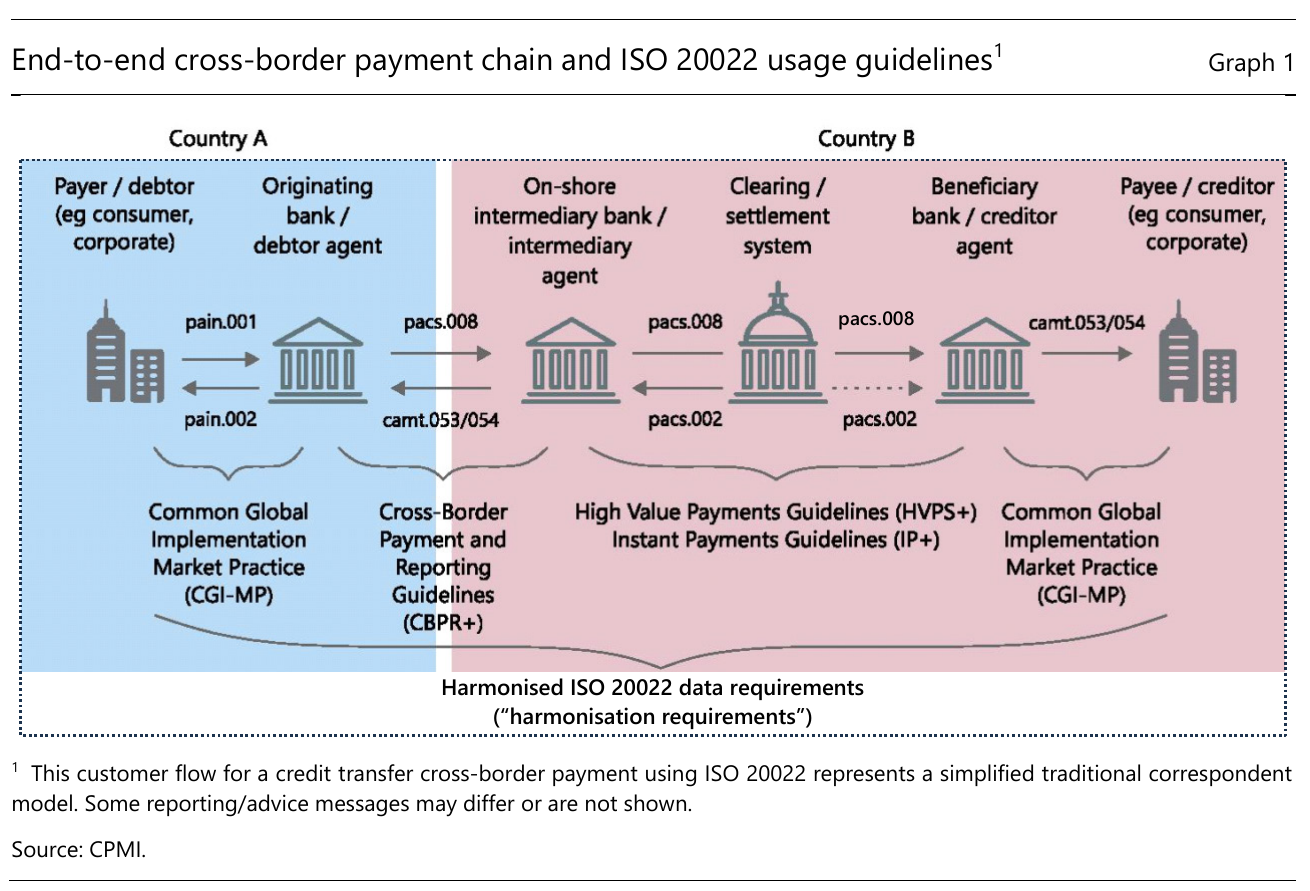
Read the diagram as text
- Customer request: The payer asks the bank to make a payment. The bank’s status message reports how it handled the request.
- Cross-border handoff: Follow pacs.008 from the originating bank to the intermediary. It is the bank-to-bank instruction to carry the customer’s payment forward.
- Local processing: Track what the instruction asks the banks to do. In this graph, the middle system differs from Meridian Bank’s internal settlement in the lesson.
- Account reports: A statement or entry notice describes what a bank booked. Read it separately from the instruction and the ledger entry it describes.
Based on official sources
Follow the customer’s request, the bank-to-bank instruction, the local system and the final account report.
Read the original at full size here
Use touch, a trackpad, or the arrow keys in the image area.
One diagram of a family. This site draws several diagrams of cross-border payments and of payments inside a bank. Four of them form a ladder: a single serial transfer, the , a payment stage by stage, and this full lifecycle. This lesson is the top rung. Level 1 gives the map of the whole family and the order to take it in.
Two lines to follow at every station. The first is the . Which message moves, who sends it and who reads it? The second is the money line. Whose books change at this station, if anyone's? Most stations have a message and no money movement. Only three stations move money: the debit at Bank Alfa, the settlement at Meridian and the credit at Nordbank. If you can say which line a station is on, you will not mistake a note about money for the money.
Pause and predict. Bank Alfa has just told Asha 'accepted'. Has Northstar been paid? Decide before you read on. The answer is no, not necessarily. 'Accepted' only says the request passed the first bank's first checks. No money has reached Northstar, and none may even have left Asha yet. The rest of this lesson is the story of what happens in the gap between 'accepted' and 'paid'.
How the lesson is built. Level 1 walks every station in plain words. Each card follows one fixed order. It asks who acts, what arrives, what they check and what they send. Then it asks what the money does and what can go wrong. Level 2 opens the fields and codes at each station and gives you a chooser for picking the right message. Level 3 sorts the side roads into families, with the rules for telling them apart, and ends with planted faults to find. Level 4 gives the message versions, the limits of the rulebook and what the diagram leaves out. Two companion lessons teach every side road in turn.
Check yourself. Name the three stations where money moves. Then say which line a status message is on. A status message is on the message line. It reports on money and moves none.
PLAIN WORDS · 1 in this section
- rung
- one step of a ladder, or a level in rank
PICTURE IT
This topic uses the same picture as The Cross-Border Payments and Reporting Plus (CBPR+) corporate payment, start to finish. This lesson walks the same relay one hand-over post at a time. It keeps the baton and the scoreboard and adds numbered posts, a bag of coins and side tracks.
THE REAL JOB The walk-through gives every station of the payment diagram a and a money line, so a learner can place any problem on the map.
- Posts one to five: the customer asks and the bank checks
- Posts six and seven: the instruction leaves the bank
- Posts eight to ten: the middle bank checks and settles
- Posts eleven to thirteen: the last bank checks and credits
- Posts fourteen to eighteen: the answers travel back
- Posts nineteen and twenty: the reports describe the account
HOW THE PICTURE MAPS
| In the picture | In the payment |
|---|---|
| A numbered hand-over post on the track | One of the twenty stations on the main road |
| The baton passing between runners | A message such as a pacs.008 moving between banks |
| The bag of coins that changes hands | The money line: the debit, the settlement and the credit |
| The judge's flag at a post | A status message such as a pacs.002 or a pain.002 |
| A side track that leaves the main track | One of the ninety-four side roads: a reject, a return or a question |
| The scoreboard at the end | The reports: camt.052, camt.053 and camt.054 |
WHERE THIS PICTURE STOPS
- A relay has one baton. A payment has many copies of messages, and a message that arrives moves no money.
- Coins change hands at only three posts. Every other post passes a baton, checks something or reports.
- A side track is an alternative ending drawn one at a time. Real faults can arrive together.
- The scoreboard shows one runner's view. Asha's statement cannot show Northstar's credit.
HOOK
Baton for the message, coins for the money.
REMEMBER IT THIS WAY
A contrast: two neighbours told apart by one test.
Baton or coins? At every station, ask whether a message moves or money moves.
| In the trick | What it stands for |
|---|---|
| Baton | the message line, which says which message moves |
| Coins | the money line, which says whose books change |
A pacs.004 return is a message that also brings money back, so it sits on both lines.
TELL A FRIEND
The diagram is a track with posts, and at each post you ask whether a message moves and whether money moves. Money moves at only three posts, and the rest are batons, checks and reports.
OFTEN MIXED UP WITH The Cross-Border Payments and Reporting Plus (CBPR+) corporate payment, start to finish. The overview tells the eight-step story in short form. This lesson walks every station and maps every side road. Test question: am I asking what happens, or where exactly on the diagram it happens?
CURRENT AS CHECKED
3 FIGURES
Swift CBPR+ FI-to-FI payment instructions
Swift coexistence for in-scope -to-FI payment instructions ended on 22 November 2025; that deadline did not retire every MT reporting, initiation, investigation or correspondence message.
CHECKED 2026-10-11RECHECK BY 2027-01-05
Sources & standards — 2 sources
- Official requirement
ISO 20022 Standards (Swift ISO 20022 adoption programme) ↗ — Swift · End of coexistence — 22 November 2025
Do not generalise the payment-instruction deadline to every FIN message. Swift publishes differentiated NAK, contingency-conversion, reporting, initiation and exceptions-and-investigations treatment.
- Official requirementJune 2026 edition read in full; September 2026 edition seen as search excerpts only
CBPR+ roadmap beyond November 2025 ↗ — Swift · Message-specific roadmap beyond November 2025
Roadmap dates and message treatment are service-specific and can change. Recheck the current document before using a milestone in delivery planning.
The June 2026 download (swift.com/swift-resource/252463/download) is the same programme this document-centre page points at. It lists, under exceptions and investigations, MT199 / MT299 / MT999 as retired for E&I in favour of camt.110 and camt.111, and it separately sends non-E&I MT199/MT299 use cases to admi.024 by November 2027. That pairing is what the MT999 record's ISO counterpart note now cites. The document-centre URL stays the registered address because it is the publisher's standing location for the current file.
Re-checked on 2026-10-04 by web search. The roadmap now has a September 2026 edition at swift.com/swift-resource/252463/download, and only search excerpts of it were seen; the page was not opened.
The excerpts said the exceptions and investigations changes were deferred, and that the mandate to receive a camt.110 would come with the deferred part of Standards Release 2026. They also said the roadmap's dates might be out of date until the scope and timeline of that release, and of Standards Release 2027, are confirmed. Other lines of the same roadmap still gave November 2026 for receiving a camt.110, so the excerpts disagree with each other. The fact swift-exceptions-investigations-migration-milestones records both readings.
Swift CBPR+ account reporting messages
The published (Cross-Border Payments and Reporting Plus) update from ING (a large Dutch bank) gives a plan for payment reporting. The end of (message type) and camt coexistence for reporting (MT940 (customer statement) and MT950 with camt.053) is planned for November 2028.
Swift's roadmap labels this step
SR 2028. Its exact month was not confirmed from Swift's own page. Receiving is planned to become mandatory from November 2027. Swift's March 2026 roadmap shows these dates as planned, not final. Until then the MT reports keep running on (Swift's messaging network).CHECKED 2026-10-11RECHECK BY 2027-01-05
Sources & standards — 1 source
- Scheme-specific ruleJune 2026 edition read in full; September 2026 edition seen as search excerpts only
CBPR+ roadmap beyond November 2025 ↗ — Swift · Statement and reporting messages, planned end of coexistence in SR 2028 (Swift roadmap); November 2028 month from The published CBPR+ update; evidence is a search excerpt, page not opened
Roadmap dates and message treatment are service-specific and can change. Recheck the current document before using a milestone in delivery planning.
The June 2026 download (swift.com/swift-resource/252463/download) is the same programme this document-centre page points at. It lists, under exceptions and investigations, MT199 / MT299 / MT999 as retired for E&I in favour of camt.110 and camt.111, and it separately sends non-E&I MT199/MT299 use cases to admi.024 by November 2027. That pairing is what the MT999 record's ISO counterpart note now cites. The document-centre URL stays the registered address because it is the publisher's standing location for the current file.
Re-checked on 2026-10-04 by web search. The roadmap now has a September 2026 edition at swift.com/swift-resource/252463/download, and only search excerpts of it were seen; the page was not opened.
The excerpts said the exceptions and investigations changes were deferred, and that the mandate to receive a camt.110 would come with the deferred part of Standards Release 2026. They also said the roadmap's dates might be out of date until the scope and timeline of that release, and of Standards Release 2027, are confirmed. Other lines of the same roadmap still gave November 2026 for receiving a camt.110, so the excerpts disagree with each other. The fact swift-exceptions-investigations-migration-milestones records both readings.
Swift Case Management, in-flow translation of the camt.110 investigation request and Stop and Recall for payment cancellations
Swift's public pages give different dates for receiving , the investigation request. On 5 November 2026 its page still says November 2026. Its translation FAQ explicitly says June 2027 for all banks to receive a camt.110 with an embedded Message Type (MT) 199. Both pages were opened.
Swift's release announcement, updated 21 September 2026 and opened again on 5 November, schedules the deferred 2026 package for 12 June 2027. Its scope includes exceptions and investigations messages. That package date does not by itself settle every service obligation. The translation FAQ supplies the explicit June 2027 receive wording.
The Case Management page gives November 2027 for full investigation exchange through Case Management and cancellation exchange through , over FINplus. The earlier November 2026 receive date must not be taught as an uncontested current mandate. Confirm the effective obligation with Swift before setting a production deadline. A bank's own readiness schedule does not set the network rule.
CHECKED 2026-11-05RECHECK BY 2027-01-05
Sources & standards — 3 sources
- Scheme-specific rule
Swift Case Management ↗ — Swift · Live page opened 5 November 2026: November 2026 receive wording; November 2027 full exchange
Public Swift Case Management page opened on 5 November 2026. Its Other E&I timeline still states November 2026 for camt.110 receive and November 2027 for full camt.110/camt.111 exchange. This conflicts with the live translation FAQ, which explicitly says June 2027 for receiving camt.110. The September 2026 release update places the deferred E&I message package on 12 June 2027. Do not present the product-page date as an uncontested current mandate.
- Scheme-specific rule
ISO 20022 to older message type translation — frequently asked questions ↗ — Swift · Live public FAQ opened 5 November 2026: explicit June 2027 camt.110 receive wording and non-participant MT199 workflow
Public Swift FAQ opened on 5 November 2026 at https://www.swift.com/de/node/308151. It explicitly gives June 2027 for receiving camt.110 with embedded MT199. The live Case Management product page still states November 2026. Preserve this official-source conflict and confirm the effective service obligation with Swift. The FAQ also distinguishes in-flow translation, Transaction Manager, local software and sender contingency processing. Full service documentation and usage guidelines were not opened.
- Official requirement
Swift accepts community request to extend structured address migration for ISO 20022 payment messages ↗ — Swift · 21 September 2026 update, opened 5 November: deferred E&I message package 12 June 2027; separate address timetable
Publisher page opened again on 5 November 2026. The 27 August announcement and 21 September update remain visible. Deferred SR2026 message changes include E&I and go live on 12 June 2027. It does not set 12 June 2027 as the new structured-address deadline. The explicit camt.110 receive wording is on the separate translation FAQ; compare the older Case Management page before asserting a date. No closed Knowledge Centre detail was inferred.
Re-checked 12 November 2026: no November 2026 SR2026 activation; deferred non-payments package still listed for 12 June 2027; payments changes still deferred with December 2026 update horizon.
SEE THE PAYMENT MOVE
PICTURE THE JOURNEY
A holiday cottage reserved through two agencies and a middle companyOpen to read the picture, how it matches the payment and where it stops.
PICTURE IT
A holiday cottage reserved through two agencies and a middle company
Picture a small trading firm that wants to rent a holiday cottage abroad for a visiting partner. The cottage has an owner who lives there. The firm and the owner never deal with each other. Each uses a local agency, and both agencies keep a balance with one large middle company.
The firm fills in a form and asks its agency to pay the rent. The agency checks that the form can be read. It checks that the firm may order it and that the money is there. It also checks that no name is on a list of people and firms nobody may deal with. Then it marks the form as accepted. That mark means only that the agency will work on it. The agency then takes the rent from the firm's balance and gives a receipt. The rent has left the firm, but the owner has not been paid.
The agency sends the request over a shared network, with one reference number on it. The network checks that the form is laid out correctly and passes it on. It holds no money. The middle company reads the request and checks it again, for itself. If it is satisfied, it lowers the firm's agency balance and raises the owner's agency balance, in its own book. That entry is the moment the rent really changes hands.
The middle company passes the request to the owner's agency. That agency runs its own checks too, because a pass at the first agency does not bind it. If all is well, it adds the rent to the owner's account and can tell the owner. A confirmation can travel back, and a tracking page shows the last known state for the reference number. The firm's agency may also send a noon sheet and a closing sheet. They list the entries on the firm's balance. They show that the rent left. They do not show that the owner was paid.
Some turns are possible. If an agency or the middle company rejects the form before the entry, the firm's rent is released or given back. Nothing has to be undone between the agencies. If the entry was made but the owner's agency cannot use the rent, the rent comes back as a second, separate entry the other way. If the firm later asks for the rent back, that is only a request, and the owner's agency can refuse. If no news comes, the agency checks the tracking page before it sends anything again. The middle company may also keep a handling fee, so the owner receives a little less than the quoted rent.
THE REAL JOB It lets a company pay a supplier at another bank, with checks along the way and a record at each end.
HOW THE PICTURE MAPS
| In the picture | In the payment |
|---|---|
| The firm fills in a form asking its agency to pay the rent | Asha Traders sends its bank a customer payment request, pain.001Who: Asha Traders |
| The agency checks the form, the firm's authority, the money and the banned list | Bank Alfa validates and screens the instruction before it releases anythingWho: Bank Alfa |
| The agency marks the form accepted, meaning it will work on it | The accepted status report, pain.002, says processing will start, not that anyone is paid |
| The agency takes the rent from the firm's balance and gives a receipt | Bank Alfa debits the customer account; where offered, an entry notice, camt.054, reports itWho: Bank Alfa |
| The shared network carries the request and holds no money | Swift FINplus carries the interbank payment message pacs.008 and holds no account |
| One reference number follows the reservation, while each form has its own number | The unique end-to-end transaction reference (UETR) follows the payment; messages have their own ids |
| The middle company checks the request again, for itself | Meridian Bank checks and screens for itself; an earlier pass does not bind itWho: Meridian Bank |
| The middle company moves the balances in its own book, then passes the request on | Meridian Bank debits Bank Alfa's account, credits Nordbank's, then forwards the paymentWho: Meridian Bank |
| The owner's agency runs its own checks, then adds the rent to the owner's account | Nordbank validates, screens and credits the account of Northstar ComponentsWho: Nordbank |
| The owner receives a note that the rent has arrived | If subscribed, Northstar Components sees the credit in an entry notice from its own bankWho: Northstar Components |
| A tracking page shows the last known state for the reference number | Swift payment Tracker records the outcome that Nordbank reports; it settles nothing |
| The firm's agency may send a noon sheet and a closing sheet of entries | Bank Alfa reports the entries in an intraday report, camt.052, and a statement, camt.053Who: Bank Alfa |
| A check rejects the form before the entry, and the firm's rent is released | A reject before settlement: Bank Alfa restores the customer debit and no return is needed |
| The rent comes back as a second entry the other way | A return after settlement: pacs.004 starts a new, separate settlement the other way |
| The firm asks the owner's agency to give the rent back | A recall request, camt.056; the supplier's bank may refuse |
| No news arrives from the agencies | No status: trace with the tracking reference before any resend |
| The middle company keeps a handling fee, so the owner gets a little less | Charges deducted in transit: the supplier receives less than the invoice |
WHERE THIS PICTURE STOPS
- In the picture the middle company is one firm with its own book. In this journey the correspondent settles in commercial bank money on its own books, and other payments settle through other correspondents or shared payment systems.
- In the picture the firm could phone the owner and get the rent back. A settled payment is not undone. Money returns only as a new return that settles on its own. A recall is only a request, and the supplier's bank can refuse it. A yes to a recall is not the money itself.
- The picture shows one list check per agency. In the journey each bank decides for itself, so an earlier pass does not bind a later bank. A hold is the control working, and a legal block follows the law that applies, not an automatic return.
- A confirmed reservation is followed by a stay on a later day. A payment has no such later step. Once the supplier's bank credits the account, the journey ends, although a hold can still make the credit unavailable.
- The picture has one reference number and no message ids. In the journey the unique end-to-end transaction reference (UETR) follows the payment, each message also has its own id, and a missing status proves nothing.
- The picture shows one route with one middle company. Real routes can have more banks, and the branches in this journey are alternative outcomes, not events that all happen to one payment. A separate journey teaches the cover method, where the instruction and its funding travel apart.
HOOK
Messages ask and report. A book transfer moves the money between banks.
REMEMBER IT THIS WAY
A sequence: the real steps, in order.
Say the journey as four verbs in order: ask, book, credit, report.
| In the trick | What it stands for |
|---|---|
| ask | Asha Traders sends its bank a customer payment request, pain.001 |
| book | Meridian Bank debits Bank Alfa's account, credits Nordbank's, then forwards the payment |
| credit | Nordbank validates, screens and credits the account of Northstar Components |
| report | Bank Alfa reports the entries in an intraday report, camt.052, and a statement, camt.053 |
TELL A FRIEND
The customer's bank checks and debits first, then the banks pass messages and a middle bank changes its books. Messages and reports only describe what happened; that book entry moves the money between banks.
OFTEN MIXED UP WITH Reporting on a payment. That topic teaches how to read one status message and its . This journey lays every status, notice and report beside the one entry that moves the money.
PRACTISE AND KEEP
IMPLEMENTATION RESOURCES
90 RESOURCES
EVIDENCE AT ARM'S REACH
Apply the base message definition first, then the scheme or infrastructure profile that governs this topic.
An XSD checks XML structure. A usage guideline adds profile rules, conditional fields, code restrictions, and business controls. XSD-valid does not mean scheme-compliant.
OPEN OFFICIAL SOURCE
CBPR+ usage guidelines
HVPS+ usage guidelines
PMPG correspondent-payment and reporting market practice
SEPA Credit Transfer rulebook
SEPA Credit Transfer implementation guidelines
SEPA Instant Credit Transfer rulebook
SEPA Instant Credit Transfer implementation guidelines and XSDs
SEPA Direct Debit Core rulebook
SEPA Direct Debit Core implementation guidelines and XSDs
SEPA Direct Debit B2B rulebook
SEPA Direct Debit B2B implementation guidelines and XSDs
T2 functional specifications, validation rules, and binding XSDs
TIPS release specifications and professional-use documentation
CHAPS and RTGS ISO 20022 handbook and schema access
Fedwire Funds Service ISO 20022 implementation and technical documents
CHIPS ISO 20022 usage-guideline resources and rules
pain.001 customer initiation — raw XML
pain.002 customer payment status — raw XML
pacs.008 FI-to-FI credit transfer — raw XML
pacs.002 payment status — raw XML
pacs.008 cover announcement — COVE — raw XML
pacs.002 payment status — rejection — raw XML
head.001 business application header — a reply that points back — raw XML
trck.001 universal confirmation — raw XML
camt.052 intraday account report — raw XML
camt.053 account statement — raw XML
camt.054 debit notification — raw XML
Corporate MX positive lifecycle — ZIP pack
MX cancellation, return, reversal, and investigation lifecycle — ZIP pack
MT103 → pacs.008 implementation mapping
MT101 → pain.001 implementation mapping
MT103 /REJT/ convention → pacs.002 implementation mapping
MT900 → camt.054 implementation mapping
MT910 → camt.054 implementation mapping
MT941 → camt.052 implementation mapping
MT942 → camt.052 implementation mapping
MT940 → camt.053 implementation mapping
MT950 → camt.053 implementation mapping
MT102 → N × pacs.008 (batch decomposition) implementation mapping
pain.001 field matrix
pain.002 field matrix
pacs.008 field matrix
pacs.002 field matrix
camt.052 field matrix
camt.053 field matrix
camt.054 field matrix
head.001 field matrix
trck.001 field matrix
Payment lifecycle test cases
MT to MX migration notes
T2 RTGS implementation pack field and process matrix
T2 RTGS implementation pack test cases
T2 RTGS implementation pack BA checklist
T2 RTGS implementation pack acceptance criteria
T2 RTGS implementation pack migration notes
T2 RTGS implementation pack restricted and release-specific gaps
TIPS instant-settlement implementation pack field and process matrix
TIPS instant-settlement implementation pack test cases
TIPS instant-settlement implementation pack BA checklist
TIPS instant-settlement implementation pack acceptance criteria
TIPS instant-settlement implementation pack migration notes
TIPS instant-settlement implementation pack restricted and release-specific gaps
CHAPS RTGS implementation pack field and process matrix
CHAPS RTGS implementation pack test cases
CHAPS RTGS implementation pack BA checklist
CHAPS RTGS implementation pack acceptance criteria
CHAPS RTGS implementation pack migration notes
CHAPS RTGS implementation pack restricted and release-specific gaps
Fedwire Funds Service implementation pack field and process matrix
Fedwire Funds Service implementation pack test cases
Fedwire Funds Service implementation pack BA checklist
Fedwire Funds Service implementation pack acceptance criteria
Fedwire Funds Service implementation pack migration notes
Fedwire Funds Service implementation pack restricted and release-specific gaps
CHIPS implementation pack field and process matrix
CHIPS implementation pack test cases
CHIPS implementation pack BA checklist
CHIPS implementation pack acceptance criteria
CHIPS implementation pack migration notes
CHIPS implementation pack restricted and release-specific gaps
CBPR+ implementation pack
SEPA credit-transfer implementation pack
SEPA direct-debit implementation pack
High-value payments implementation pack
T2 RTGS implementation pack
TIPS instant-settlement implementation pack
CHAPS RTGS implementation pack
Fedwire Funds Service implementation pack
CHIPS implementation pack
Sources for this topic — 23 sources
- Official requirement
ISO 20022 Catalogue of messages ↗ — ISO 20022 Registration Authority · pain.001, pain.002, pacs.008, pacs.002, pacs.004, camt.052, camt.053, camt.054, head.001 and trck.001 message definitions and versions
Each message set is described by a Message Definition Report; earlier versions remain available in the ISO 20022 messages archive.
- Scheme-specific rule
Cross-Border Payments and Reporting Plus (CBPR+) usage guidelines ↗ — Swift (CBPR+ working group) · CBPR+ usage guidelines for pacs.008, pacs.002 and pacs.004; negative pacs.002 on rejection and positive pacs.002 by bilateral agreement (known from search excerpts, page not opened)
Full guidelines require MyStandards access. Public guidance had set 14 November 2026 as the date after which fully unstructured addresses would be removed for in-scope CBPR+ traffic. The explicit message exceptions included admi.024, camt.025, camt.052, camt.053, camt.054 and camt.060. Swift has since deferred that requirement and set no replacement date. The current fact
swift-cbpr-unstructured-address-removalcarries the position. - Market practice
CGI-MP implementation guidelines for corporate-to-bank ISO 20022 messages ↗ — Common Global Implementation — Market Practice (CGI-MP) · Corporate-to-bank pain.001, pain.002 and camt reporting messages; the customer channel follows the bank agreement, not CBPR+
Search excerpts only, page not opened. CGI-MP publishes versioned guidelines per message; any statement about a specific element's presence should name the guideline version it came from.
- Scheme-specific rule
Swift Universal Confirmations ↗ — Swift · Universal Confirmations: a receiving bank reports what it did with a payment to the Tracker (search excerpt, page not opened)
Public summary only. The message definition itself sits in MyStandards behind a Swift account, which is why the trck.001 element paths this site carries are reconstructed from vendor documentation and labelled as market practice rather than as an official requirement.
- Market practice
What is a UETR? — Swift ↗ — Swift · the UETR is a 36-character reference carried in payment messages, stored in field 121 of an MT103 (search excerpt, page not opened)
search excerpt, page not opened: returned by WebSearch on 2026-10-26. It describes the reference in general terms and does not cover how an ISO 20022 message carries it. Put it in your own words and do not quote it. Open the page and confirm what it says before relying on any detail.
- Market practice
Business Application Header (head.001) — Swift training ↗ — Swift · head.001 business application header used under CBPR+ (search excerpt, page not opened)
Read as web-search excerpts on the access date; the page itself was not opened. Only the catalogue entry was seen. It gives no validation rules for a wrong service name.
- Market practice
Payment initiation for cross-border payments — bank developer page ↗ — Goldman Sachs · the business service element of the header is a fixed value for the service (search excerpt, page not opened)
Read as web-search excerpts on the access date; the page itself was not opened. Only a search excerpt was seen. One bank's instructions for its own channel, not the Swift rule.
- Market practice
Payments Market Practice Group (PMPG) Best Practice Guidance for the Return of Funds and Rejects of Payments ↗ — Swift / Payments Market Practice Group · Rejection before settlement versus return after settlement, applied per interbank leg
Public PDF opened through web search. Applied per interbank leg, not as a single status for the entire customer journey. Bank service rules still govern permitted messages and responses.
- Market practice
ISO 20022 learning guides — module 6, a deep dive on pacs.004 and pacs.002 ↗ — The Bank of New York Mellon Corporation (BNY) · The status report mainly rejects an unsettled payment; a return is a separate message after settlement (search excerpt, page not opened)
Downloaded and read in full from the publisher's own domain on the access date: eight pages, read with pdftotext, so nothing cited from it rests on a search excerpt.
It is a bank's teaching material rather than a standard or a scheme rule, so citations to it carry the market-practice label. Every ISO element address and every presence flag on the mapping tables it supports is read from the published XSD instead, never from this guide.
Where it describes what CBPR+ requires it is reporting a usage guideline this site does not reproduce. Nothing is quoted from those passages and no CBPR+ rule is asserted from them.
One tension in the document is worth recording rather than smoothing over. It describes the MT return convention as sending the original message back unchanged with a return code in field 72. And then says in the next section that the resulting ambiguity — whether the parties listed are the original's or the return's — is exactly what the return chain was added to remove. Both halves are taken together, because the first read alone would suggest the convention was settled when the document's own point is that it was not.
- Market practice
ISO 20022 Learning Guide, module 9 — A Deep Dive on camt.054 ↗ — BNY (The Bank of New York Mellon Corporation) · camt.054 as the notification of one debit or credit entry
Downloaded and read in full from the publisher's own domain on the access date: HTTP 200, 452,581 bytes, eight pages, converted with pdftotext -layout, so nothing cited from it rests on a search excerpt. Dated 1/2025 on the disclaimer page.
Explanatory prose plus three figures, not a field-level mapping table. It is used here to confirm that a pairing is real and to say why a field matters, never to list out rows. Every ISO element address and every presence flag on the tables it supports is read from the published XSD instead.
It describes camt.054.001.08 and CBPR+ usage, and in one place that matters the two have since diverged from the base definition. It calls the account identification a mandatory field, which is true of the CashAccount type used in camt.054.001.08 and not of camt.054.001.14, where the element is minOccurs=0 so an account may be identified by a proxy instead. Presence on this site is read from the published XSD, so that statement is not carried into any row.
It also reads field 52A as the debtor party rather than as the debtor agent, which is a defensible reading for a bank-to-bank payment and not the one the MT910 table takes. Both readings are recorded on the MT900 table rather than one of them being smoothed away.
- Market practice
Swift gpi (global payments innovation) ↗ — Swift · The Tracker follows one payment end to end by its UETR
Only public short overviews are used here; the full service definition and rulebook sit behind a swift.com account.
- Market practice
Goldman Sachs Developer — payment status reason codes ↗ — Goldman Sachs · One bank's wording of the five G-codes under the interim accepted status (search excerpt, page not opened)
Read as web-search excerpts on the access date; the page itself was not opened. The wording of G000 and G001 differs from ISO's change request. It is cited for that difference. It describes one bank's implementation.
- Scheme-specific rule
ISO 20022 change request CR0737 — gpi status reasons G000 to G004 ↗ — ISO 20022 Registration Authority · ISO change request from the Swift gpi group: G000, G003 and G004 (search excerpt, page not opened)
Read as web-search excerpts on the access date; the page itself was not opened. The wording of G000 and G001 differs between this request, a later reference and a bank's table. This site records the difference and does not choose.
- Market practice
Oracle Banking Payments — Swift gpi status and reason code mapping (G001 to G004) ↗ — Oracle · A vendor's mapping of G001 to G004, which differs from other sources on G003 and G004 (search excerpt, page not opened)
search excerpt, page not opened: returned by WebSearch on 2026-10-26. It is one implementation, and its G003 and G004 wording differs from another bank's page. It is cited for that difference. Put it in your own words and do not quote it. Open the page and confirm what it says before relying on any detail.
- Market practice
J.P. Morgan developer documentation — payment status track and trace with gpi ↗ — J.P. Morgan · A bank's developer page that words G000 and G003 differently (search excerpt, page not opened)
search excerpt, page not opened: returned by WebSearch on 2026-10-26. It is one bank's wording, cited for the disagreement between sources on the G-codes. Put it in your own words and do not quote it. Open the page and confirm what it says before relying on any detail.
- Market practice
Swift gpi financial institution application profile 2024 (as shown in a search excerpt) ↗ — Swift · A Swift profile that lists ACSP with G000 to G004 as supported for gpi payments (search excerpt, page not opened)
search excerpt, page not opened: returned by WebSearch on 2026-10-26. The page title was not seen, so the title above is a description. The profile was reached through a Swift media download link. Put it in your own words and do not quote it. Open the page and confirm what it says before relying on any detail.
- Scheme-specific rule
OFAC Frequently Asked Questions ↗ — US Department of the Treasury, Office of Foreign Assets Control · FAQs 36 and 53: blocking and rejection differ; a jurisdiction-specific example, not a global rule (search excerpt, page not opened)
FAQs are added, amended, and renumbered over time; always check the live page for current numbering and text. FAQ 122, 124, 125, 398 and 401 were fetched and read on 2026-08-25. A failed fetch is not a finding about these pages. Additional primary pages5,249,250,892 opened6 November 2026: matching review, initial retrieval/two scoring techniques, threshold choice and2021algorithm update.
- Simplified educational illustration
Payments Signal editorial teaching models — Payments Signal
What this simplifies: One synthetic USD payment through one shared correspondent stands in for real practice. The banks, names, amounts and controls are teaching illustrations. Real outcomes depend on the bank agreement, the Cross-Border Payments and Reporting Plus (CBPR+) usage guidelines in force and the facts of the case. The diagram shows one side road at a time, and real faults can arrive together.
Used wherever diagrams, scenarios, figures, or example values are didactic constructions rather than sourced facts; every such use carries a simplifications disclosure. All people, companies, banks, and list entries in examples are fictional.
- Market practice
Swift services and message types ↗ — Numeral · business service values by message in the 2025 guideline sets, including the straight-through, advice and cover forms (search excerpt, page not opened)
Known from web-search excerpts on the access date; the page itself was not opened, because the fetch failed.
- Market practice
IBM Financial Transaction Manager community idea FTMSWIFT-I-158 — gpi message versions ↗ — IBM · trck.001.001.02 listed against gpi service types (search excerpt, page not opened)
search excerpt, page not opened: returned by WebSearch on 2026-10-26. A user request thread, not the message definition. Put it in your own words and do not quote it. Open the page and confirm what it says before relying on any detail.
- Scheme-specific rule
Standards MX November 2025 FINplus Updated High-Level Information ↗ — Swift · CBPR+ usage guidelines are used with the request subtype, also called the business service (search excerpt, page not opened)
search excerpt, page not opened: returned by WebSearch on 2026-10-26. Only the excerpt about the request subtype was seen. Put it in your own words and do not quote it. Open the page and confirm what it says before relying on any detail.
- Market practice
iso20022-external-code-sets — TypeScript and JSON versions of the ISO 20022 external code sets ↗ — TransactionAuthorizationProtocol (community mirror) · G000 to G006 wording in the status reason list (file opened)
Opened on 2026-10-26: the ReturnReason and StatusReason files were read and each lists FR01 with that meaning. A community mirror, not ISO. The repository's own content/generated/iso-external-code-sets.json, taken from the 3Q2025 release, also lists FR01 on both lists.
- Market practice
Swift Standards Release 2026 (International Business Machines (IBM) documentation listing) ↗ — IBM · camt.107, camt.108 and camt.109 at 001.01 with the swift.cbprplus.03 business service (search excerpt, page not opened)
Known only from search excerpts on 2026-10-11 (re-confirmed by a second search the same day): the page was not opened. The table does not say what changed, so nothing in the topic depends on the content of the update. A vendor listing is secondary to Swift's own MyStandards, which is member-only.
Deepest material on this page: L4 — Standards & sources. Where a topic stops short of implementation depth, that is a deliberate coverage decision, not an oversight — see coverage.