Interlinking: connecting domestic payment systems
Bilateral links and multilateral designs connect systems under specific access, FX, settlement and exception arrangements.
L1–L4 are part of the Pro pass
L0 Explain simply
Interlinking connects payment systems so a payer using one can reach a recipient using another. A bilateral link joins two; a multilateral arrangement can connect several through a common design. India is an important participant in this field, not the definition of interlinking.
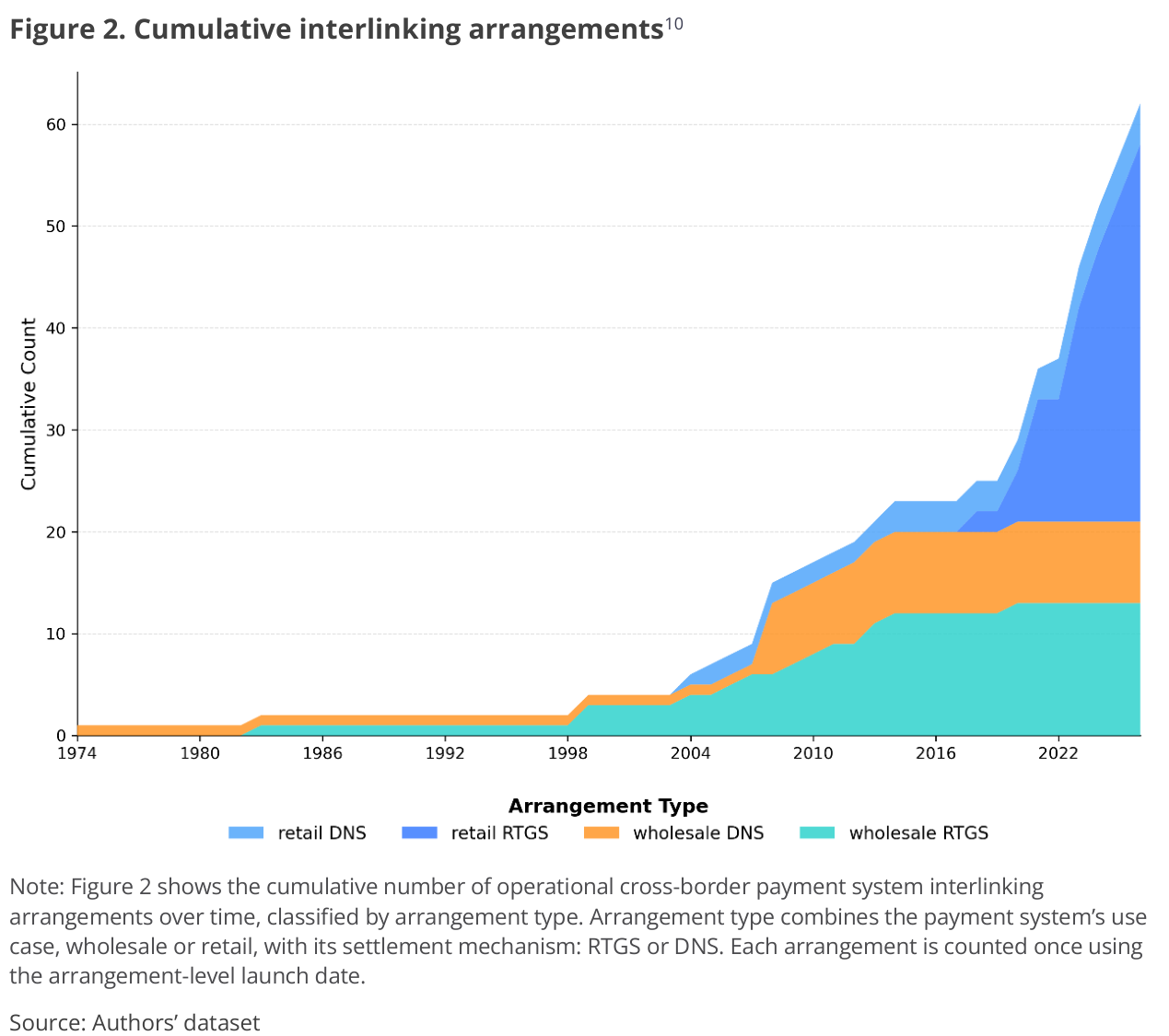
Read the diagram as text
- Read the unit: The vertical scale counts operational arrangements cumulatively. It measures arrangements over time, separate from the number or value of transfers.
- Use both parts of the legend: The legend pairs a retail or wholesale use case with real-time gross settlement (RTGS) or deferred net settlement (DNS). It lets you compare the adoption of different design choices.
- Compare the recent growth: The blue retail RTGS area grows sharply at the recent end of the series. The paper attributes much of the expansion to links between fast payment systems. Each arrangement counts once, even when it includes several jurisdictions.
The dataset counts operational arrangements once, using the launch date of the arrangement. Its lines and areas summarise research categories. Check each operator for whether your own corridor is available.
Read the original at full size here
Use touch, a trackpad, or the arrow keys in the image area.
A link may support remittances, merchant payments or another specified service. A QR acceptance arrangement and an account-to-account remittance link do not automatically share participants, limits or a settlement mechanism.
The customer may see one fast journey while institutions handle separate local-currency obligations and foreign exchange. “Instant across borders” does not alone establish simultaneous settlement or a universal refund right.
Start with the actual corridor, direction and permitted use. Then identify the providers and what each completion message proves.
PLAIN WORDS · 1 in this section
- remittances
- money sent to someone, often in another country
PICTURE IT
A transfer desk joining different local delivery systems
A customer uses one transfer desk, while local delivery systems perform different parts of the journey. Some desks connect a pair; a shared arrangement can connect several. Currency conversion and recovery need assigned providers. A single receipt cannot be assumed to prove every leg completed.
THE REAL JOB Interlinking can be bilateral or multilateral; Domestic operators, PSPs and any /funding roles retain distinct responsibilities; customer speed does not establish atomic cross-currency settlement.
- Sender uses a handle in the home system
- Sending participant screens its own leg
- Link hands the payment across
- Receiving participant screens its own leg
- Receiver is found by mobile number
HOW THE PICTURE MAPS
| In the picture | In the payment |
|---|---|
| Local delivery systems | Domestic IPSs with their own rules |
| Conversion/funding desks | FX and settlement-access providers where applicable |
| Journey references | Evidence linking source and destination outcomes |
WHERE THIS PICTURE STOPS
- A QR acceptance arrangement and a remittance link have different service permissions. One compatible code or country list does not establish universal reachability.
- A settled local obligation is not proof that every foreign leg settled simultaneously. Recovery follows the actual corridor/direction responsibilities.
- Current ABS material describes named live PayNow links, while current Nexus documentation describes a prospective service.
HOOK
Connect the evidence as well as the systems.
REMEMBER IT THIS WAY
A rule of thumb: if you see this, think that.
Trace each domestic leg and the /funding responsibilities before reconciling the end-to-end result.
| In the trick | What it stands for |
|---|---|
| Local delivery systems | Domestic IPSs with their own rules |
| Conversion/funding desks | FX and settlement-access providers where applicable |
| Journey references | Evidence linking source and destination outcomes |
A QR acceptance arrangement and a remittance link have different service permissions; one compatible code or country list does not establish universal reachability.
TELL A FRIEND
Interlinking can be bilateral or multilateral. Domestic operators, PSPs and any /funding roles retain distinct responsibilities; customer speed does not establish atomic cross-currency settlement.
OFTEN MIXED UP WITH Regional systems: paying across a continent without a correspondent. A bilateral live link and a prospective multilateral design differ in scope and status; neither makes every domestic endpoint universally reachable.
Sources & standards — 2 sources
- Scheme-specific rule
FAST and PayNow ↗ — Association of Banks in Singapore · Named PayNow links
FAST clears in real time but settles net via MEPS+; PayNow is an addressing overlay on FAST, not a separate settlement system.
- Scheme-specific ruleCurrent documentation reviewed 6 November 2026
Nexus current design documentation ↗ — Nexus Global Payments / BIS Innovation Hub · Interlinking design and current launch status
Design evidence, not deployed service certification. Rights page separately reviewed: limited excerpt/figure allowance with publication-share condition; no blanket permission for public restyles.
CURRENT AS CHECKED
4 FIGURES
Project Nexus membership and implementing entity, as described on the BIS Innovation Hub's own page
’s actual About Nexus page identifies India, Malaysia, the Philippines, Singapore and Thailand as the five founding jurisdictions in 2025, with Indonesia becoming the sixth in 2026. Bank Indonesia’s 2 February 2026 release confirms the membership/preparation milestone; membership is not proof of an operational corridor. The current NGP introduction explicitly says Nexus is not yet operational. This specific chronology must not be replaced by a broad summary implying six founders in 2025.
CHECKED 2026-11-06RECHECK BY 2027-02-24
Sources & standards — 4 sources
- Market practice
About Nexus Global Payments ↗ — Nexus Global Payments · Actual complete About Nexus page: five founding jurisdictions in2025 and Indonesia joining in2026
Known only from a web-search excerpt on 2026-10-13 (page not opened). Search write-ups disagreed on which central banks set up the company and on when Indonesia took part. Membership is therefore taken from the registered fact nexus-membership-2025 and not from this page.
- Market practice
Bank Indonesia on joining Project Nexus (search excerpt) ↗ — Bank Indonesia · Actual complete BI release No.28/24/DKom,2February2026: Indonesia member and preparation to connect BI-FAST; not a launch notice
Search excerpt, page not opened. The page address comes from a search result on 2026-10-13.
- Scheme-specific ruleCurrent documentation reviewed 6 November 2026
Nexus current design documentation ↗ — Nexus Global Payments / BIS Innovation Hub · Actual current introduction: explicitly not yet operational; accessed6November2026
Design evidence, not deployed service certification. Rights page separately reviewed: limited excerpt/figure allowance with publication-share condition; no blanket permission for public restyles.
- Market practice
Fintech News Singapore on Nexus membership (search excerpt) ↗ — Fintech News Singapore · Founding five and Indonesia joining as a member on 1 February 2026 (search excerpt, page not opened)
Search excerpt, page not opened. The page address comes from a search result on 2026-10-13. Trade press, so corroboration for the central bank source, not a rule.
UPI–PayNow corridor participants as evidenced by the dated RBI FAQ and the July 2025 NIPL expansion; not a live transfer directory
The Reserve Bank of India () –PayNow FAQ dated 21 February 2023 named six receiving and four sending Indian banks, plus DBS Bank Singapore and Liquid Group. That FAQ remains a dated historical participant snapshot and anticipates expansion.
’s 16 July 2025 release states that 13 further Indian banks were added, taking participating Indian banks to 19 from 17 July 2025. The receiving set named there is Axis Bank, Bank of Baroda, Bank of India, Canara Bank, of India, DBS Bank India, Federal Bank, HDFC Bank, ICICI Bank, IDFC FIRST Bank, Indian Bank, Indian Overseas Bank, IndusInd Bank, Karur Vysya Bank, Kotak Mahindra Bank, Punjab National Bank, South Indian Bank, State Bank of India and UCO Bank. India-to-Singapore sending is described as available through Canara Bank, HDFC Bank, Karur Vysya Bank, ICICI Bank, Indian Bank, Indian Overseas Bank and State Bank of India. Singapore participants remain DBS SG and Liquid Group in that release. Provider pages checked on 12 November 2026 republish the same 19-bank receiving set.
These are published participant lists, not a complete verified live routing directory for every app, handle or direction on the day of a transfer. Confirm current participating-provider evidence for the sending and receiving direction before relying on a bank name alone.
CHECKED 2026-11-12RECHECK BY 2027-02-28
Sources & standards — 2 sources
- Regulatory guidance
Frequently Asked Questions — UPI-PayNow Linkage ↗ — Reserve Bank of India · Dated 21 February 2023 FAQ participant question — historical counts only; re-checked 12 November 2026.
Opened on the publisher's own site on the access date and read in full. HTTP 200, 65,000 bytes of markup fetched with curl and read as extracted text. All thirteen questions were in what was read.
The membership lists are dated, and the page says so about itself. Six Indian banks are listed for receiving and four for sending, and question 12 says the linkage can be expected to cover more banks and institutions. Two Singapore participants are named, DBS Bank Singapore and Liquid Group. Carry each list as a dated fact with a review date.
The limit belongs in the same category. Question 7 gives a daily transaction limit of ₹60,000 in a day, described as equivalent to around SGD 1,000.
The page closes with the Reserve Bank's own disclaimer, that the answers are for information and general guidance purposes only. Nothing here is drafted as an operative instruction. Cite it for how the linkage works rather than as the rule that makes it work.
What is absent is the interbank leg. The page says nothing about how the two systems settle with each other, nothing about the exchange rate or who sets it, and nothing about which party bears the conversion. The Monetary Authority of Singapore's media release on the launch was tried twice on the access date. Both attempts returned that publisher's own service-unavailable page. That is a fact about those two attempts and not about what the publisher offers.
Membership is dated. The entry records the Indian banks live on the linkage at the time it was read, and NPCI has since onboarded more. Cite it for how the linkage works — handles on both sides, the cross-border switch, the permitted purposes and the opt-in — and never for who is on it. A participant list is a fact that moves every quarter.
Re-checked 12 November 2026: still the dated February 2023 FAQ; participant counts there are historical relative to the July 2025 NIPL expansion.
- Market practice
NPCI International Expands UPI-PayNow Linkage to Drive Cross-Border Remittances ↗ — NPCI International Payments Limited · NIPL PDF 16 July 2025: 19 Indian receiving banks from 17 July 2025; seven India→Singapore senders; DBS SG and Liquid Group.
Opened via web search 12 November 2026. Operator/provider pages (DBS, Liquid) republish the same 19-bank receiving set as of this check.
The PayNow-PromptPay linkage at launch, and what is known of its status since
The PayNow-PromptPay linkage between Singapore and Thailand was launched on 29 April 2021 by the Monetary Authority of Singapore and the Bank of Thailand. Customers of participating banks could send up to S$1,000 or THB 25,000 a day, person to person, using only a mobile number. Three Singapore banks and four Thai banks took part at launch.
Both said they would add participants and extend the transfer limits to cover business payments. No source found by 25 October 2026 confirms that the limit was raised or that business payments were added. The amount sent depends on the exchange rate at the time of sending.
CHECKED 2026-10-25RECHECK BY 2027-04-25
Sources & standards — 2 sources
- Scheme-specific rule
Singapore and Thailand Launch World's First Linkage of Real-time Payment Systems ↗ — Monetary Authority of Singapore · Joint release of 29 April 2021: launch, limit of S$1,000 or THB 25,000 a day, three Singapore and four Thai banks, plan to add participants and extend limits (search excerpt, page not opened)
Known from WebSearch excerpts on the access date (search excerpt, page not opened). An earlier attempt to fetch this release returned the publisher's service-unavailable page (see the sourcing negative on UPI linkages). It says nothing seen about who provides the currency conversion or how the two systems settle. The launch limit and bank count are carried in the dated fact paynow-promptpay-launch-2021.
- Scheme-specific rule
Thailand and Singapore Launch World's First Linkage of Real-time Payment Systems (joint BOT-MAS media release) ↗ — Bank of Thailand · Bank of Thailand copy of the joint release: daily limit, fees benchmarked and shown to the sender before confirming, plan to scale the linkage (search excerpt, page not opened)
Known from WebSearch excerpts on the access date (search excerpt, page not opened). The Bank of Thailand's wording says daily and omits the Monetary Authority of Singapore's footnote that the limits are system-imposed. A later Bank of Thailand page on cross-border payment linkages repeats the aim to scale; no source found confirms that the limit was raised.
RBI UPI-PayNow outbound daily limit: dated source and separate provider, direction and exchange-rate conditions
The Reserve Bank of India () -PayNow FAQ dated 21 February 2023 describes an outbound daily limit of INR 60,000, approximately SGD 1,000. Preserve its sending direction, daily basis and source date. The approximate currency equivalence is not a guaranteed exchange rate.
Confirm current provider limits, supported direction, fees and exchange rate before a live transaction. Do not apply this one FAQ number to merchant acceptance, every inward remittance or another international corridor.
CHECKED 2026-11-07RECHECK BY 2027-08-24
Sources & standards — 1 source
- Regulatory guidance
Frequently Asked Questions — UPI-PayNow Linkage ↗ — Reserve Bank of India · Actually reviewed FAQdated21February2023,Question7; outbounddailyINR60k and approximateSGD1k, not universalallcorridor or fixedFXquote.
Opened on the publisher's own site on the access date and read in full. HTTP 200, 65,000 bytes of markup fetched with curl and read as extracted text. All thirteen questions were in what was read.
The membership lists are dated, and the page says so about itself. Six Indian banks are listed for receiving and four for sending, and question 12 says the linkage can be expected to cover more banks and institutions. Two Singapore participants are named, DBS Bank Singapore and Liquid Group. Carry each list as a dated fact with a review date.
The limit belongs in the same category. Question 7 gives a daily transaction limit of ₹60,000 in a day, described as equivalent to around SGD 1,000.
The page closes with the Reserve Bank's own disclaimer, that the answers are for information and general guidance purposes only. Nothing here is drafted as an operative instruction. Cite it for how the linkage works rather than as the rule that makes it work.
What is absent is the interbank leg. The page says nothing about how the two systems settle with each other, nothing about the exchange rate or who sets it, and nothing about which party bears the conversion. The Monetary Authority of Singapore's media release on the launch was tried twice on the access date. Both attempts returned that publisher's own service-unavailable page. That is a fact about those two attempts and not about what the publisher offers.
Membership is dated. The entry records the Indian banks live on the linkage at the time it was read, and NPCI has since onboarded more. Cite it for how the linkage works — handles on both sides, the cross-border switch, the permitted purposes and the opt-in — and never for who is on it. A participant list is a fact that moves every quarter.
Re-checked 12 November 2026: still the dated February 2023 FAQ; participant counts there are historical relative to the July 2025 NIPL expansion.
PRACTISE AND KEEP
Sources for this topic — 5 sources
- Scheme-specific rule
FAST and PayNow ↗ — Association of Banks in Singapore · Service-specific reachability
FAST clears in real time but settles net via MEPS+; PayNow is an addressing overlay on FAST, not a separate settlement system.
- Scheme-specific ruleCurrent documentation reviewed 6 November 2026
Nexus current design documentation ↗ — Nexus Global Payments / BIS Innovation Hub · Domestic mechanisms, ISO, law and participant duties
Design evidence, not deployed service certification. Rights page separately reviewed: limited excerpt/figure allowance with publication-share condition; no blanket permission for public restyles.
- Scheme-specific ruleNPCI/UPI/CC/01, Version 1.0, issued 18 September 2026
UPI Consolidated Circular, Version 1.0 ↗ — National Payments Corporation of India · Version scope and international products
Foundation selected sections and the India review together cover the complete 54-page Version 1.0 circular, including all operative sections 1–35 and Annexes A–G. Read on 6 November 2026. Section2.1 permits banks in specified roles, eligible PPI issuers as issuer/PSP members or sub-members, and NBFC sub-member issuer/beneficiary roles; a TPAP is not automatically a PSP member. Sections2.13–2.15 prescribe registered/validated beneficiary-name display and prohibit QR/user-supplied names as the transaction beneficiary name.
The consolidation preserves underlying effective dates and does not replace the separately applicable PG, OSG, technical specifications or law. This is not certification of those entire separate documents. APAC independently reviewed section1, international section23 and AnnexB pp.44–47 of the same54-page circular. Those country/provider lists are not proof that every provider or merchant is live; separate global, reverse and international-mobile-code services retain their own scope.
- Regulatory guidance
Thailand and Singapore Launch World's First Linkage of Real-time Payment Systems (joint BOT-MAS media release) ↗ — Bank of Thailand · Joint BOT–MAS release of 29 April 2021, opened 21 November 2026: pre-confirmation paragraph on sender fees and exchange charges, plus footnote 2 on the exchange rate at sending. Launch design, not current fee/participation terms.
Known from WebSearch excerpts on the access date (search excerpt, page not opened). The Bank of Thailand's wording says daily and omits the Monetary Authority of Singapore's footnote that the limits are system-imposed. A later Bank of Thailand page on cross-border payment linkages repeats the aim to scale; no source found confirms that the limit was raised.
- Scheme-specific rule
Unified Payments Interface (UPI) ↗ — National Payments Corporation of India (NPCI) · NPCI's own UPI page: real-time retail payments addressed by VPA over IMPS; operator description, not the circulars.
NPCI is an RBI-regulated entity. UPI is built over IMPS and uses a VPA rather than raw account details.
Deepest material on this page: L4 — Standards & sources. Where a topic stops short of implementation depth, that is a deliberate coverage decision, not an oversight — see coverage.