CNAPS: distinct systems for gross, bulk and online payments
HVPS, BEPS and IBPS have different roles; amount alone does not determine every route, and CIPS has its own cross-border scope.
L1–L4 are part of the Pro pass
L0 Explain simply
China's infrastructure includes the High Value (HVPS), Bulk Electronic Payment System (BEPS) and Internet Banking Payment System (IBPS). Their functions and processing mechanisms differ. Do not route every payment using only an amount threshold.
HVPS supports individual gross settlement and urgent payments, including eligible smaller-value instructions. BEPS handles bulk debit and credit business under its rules. IBPS supports online retail payment services. A customer's fast confirmation does not identify the underlying cash settlement event.
serves cross-border renminbi clearing and settlement. It is not a new name for all domestic (China National Advanced Payment System) traffic or a rule that every RMB (renminbi) payment takes one international route.
Start by identifying the service, instruction type and participant route. Amount, urgency, customer channel and the applicable rules all matter.
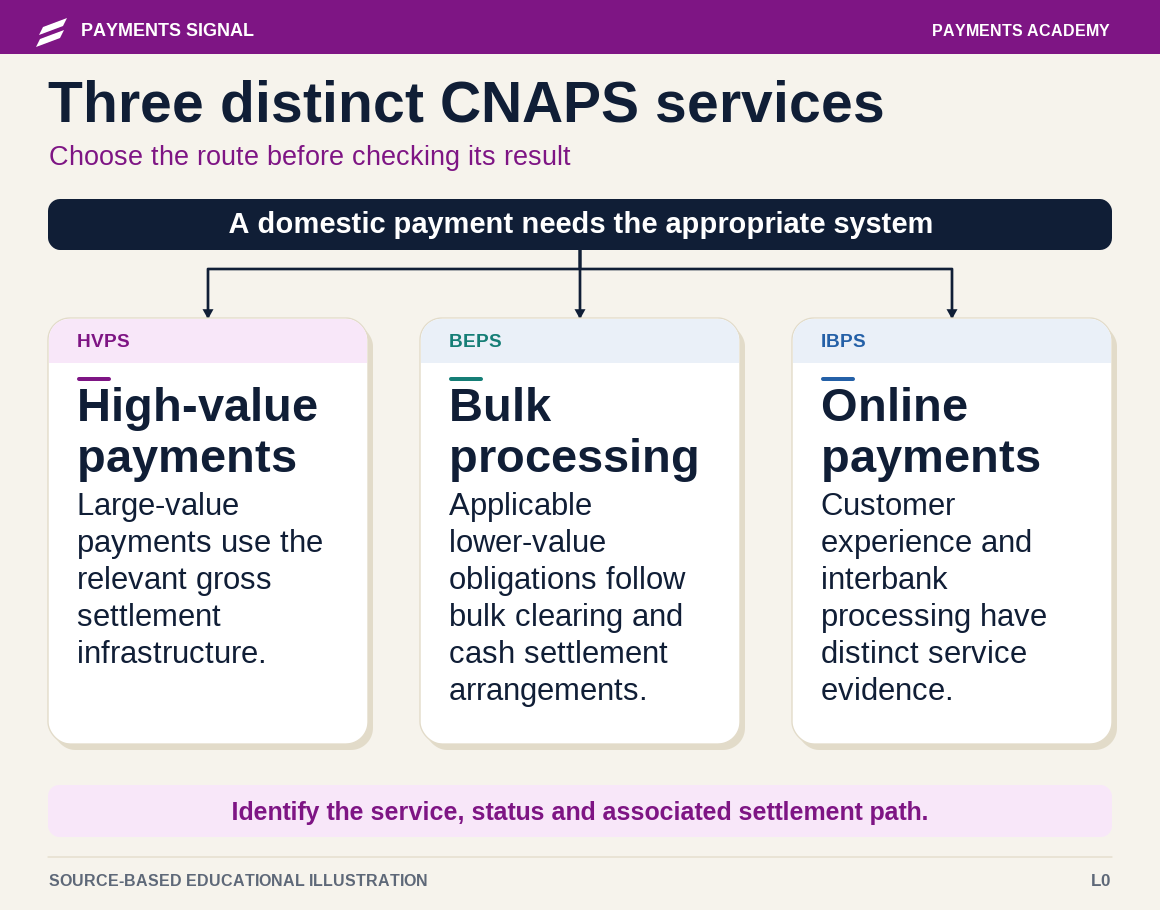
Read the diagram as text
- Scenario: A domestic payment needs the appropriate system.
- High-value payments: Large-value payments use the relevant gross settlement infrastructure.
- Bulk processing: Applicable lower-value obligations follow bulk clearing and cash settlement arrangements.
- Online payments: Customer experience and interbank processing have distinct service evidence.
- Reading the figure: Identify the service, status and associated settlement path.
Overview of mainland domestic infrastructure. The source for one service does not establish current operating hours or legal finality for another. CIPS is a distinct comparison.
PICTURE IT
Different service counters, not one amount sorter
A payment office has different counters for gross, bulk and online business. The instruction's permitted service and rules matter as well as its amount. In the historical bulk arrangement, intercity and same-city processing have assigned centers; this is not a machine that offsets every item twice.
THE REAL JOB HVPS, BEPS and IBPS have distinct functions; amount alone is not a complete route rule; Historical BEPS locality responsibilities do not establish two successive offset passes for every payment.
- A payment reaches China's payment system and is checked
- Its value places it on the high-value or low-value side
- High value: the High-Value Payment System settles it alone, in real time
- Low value: the Bulk Electronic Payment System nets it, within a city clearing processing centre or across centres at the National Processing Centre
- Each level submits its own net amounts to the high-value system, which settles them
HOW THE PICTURE MAPS
| In the picture | In the payment |
|---|---|
| Gross/urgent counter | HVPS, including eligible smaller urgent business |
| Bulk counter | BEPS and its named clearing/cash-settlement arrangements |
| Other service counter | IBPS; CIPS has distinct cross-border RMB scope |
WHERE THIS PICTURE STOPS
- The actual CNCC
2026notice changes HVPS hours and business-date boundaries; those parameters are not CIPS's timetable or universal24/7availability. - Historical BEPS Article
44assigns intercity NPC and same-city CCPC netting; Article51addresses output for national cash settlement. Current private limits are not inferred. - CIPS's
18 July 2026hours FAQ has its own schedule/holiday qualification and cross-border scope.
HOOK
Name the service and locality; do not invent a second pass.
REMEMBER IT THIS WAY
A rule of thumb: if you see this, think that.
Choose HVPS, BEPS or IBPS by the actual business and identify the applicable local or national processing responsibility.
| In the trick | What it stands for |
|---|---|
| Gross/urgent counter | HVPS, including eligible smaller urgent business |
| Bulk counter | BEPS and its named clearing/cash-settlement arrangements |
| Other service counter | IBPS; CIPS has distinct cross-border RMB scope |
The actual CNCC 2026 notice changes HVPS hours and business-date boundaries; those parameters are not CIPS's timetable or universal 24/7 availability.
TELL A FRIEND
HVPS, BEPS and IBPS have distinct functions; amount alone is not a complete route rule. Historical BEPS locality responsibilities do not establish two successive offset passes for every payment.
OFTEN MIXED UP WITH RTGS versus deferred net settlement. Japan's named threshold/Center sequence is not a universal model for China; actual services and business rules determine the route.
Sources & standards — 1 source
- Scheme-specific rule11 June 2018 historical introduction
Introduction to payment and clearing systems ↗ — China National Clearing Center · Historical HVPS/BEPS/IBPS functions
Historical background, not verification of current hours or private limits.
CURRENT AS CHECKED
1 FIGURE
China HVPS October 2026 operating change, distinct from other systems and provider hours
The actual China National Clearing Center (CNCC) notice dated 28 July 2026 expands HVPS operating time from 17 October 2026 to 5×22.5 hours plus 13.5 hours. From 19 October, the specified legal-business-day start changes from 20:30 on the previous day to 19:00 on the previous day; the current-day end remains 17:30. Weekend and statutory-holiday special-day arrangements continue.
This is the High Value ’s operating notice, not proof every Chinese payment service runs 24/7 or every bank offers the full system window. Record the applicable business date as well as the wall-clock timestamp.
CHECKED 2026-11-07RECHECK BY 2027-04-12
Sources & standards — 1 source
- Scheme-specific rule28 July 2026; changes effective 17/19 October 2026
Notice on adjustment of HVPS operating time ↗ — China National Clearing Center · Actual complete28July2026notice re-read7November2026:17Octoberexpansion,19Octoberweekdaystart20:30→19:00previousday,unchanged17:30end; specialscontinue.
HVPS only; not CIPS or all Chinese payment availability.
SEE THE PAYMENT MOVE
PICTURE THE JOURNEY
An arcade of shops, a steward and a rule on the wallOpen to read the picture, how it matches the payment and where it stops.
PICTURE IT
An arcade of shops, a steward and a rule on the wall
Picture an arcade whose shops keep balances in numbered boxes managed by a steward. The shops stand for banks in a selected clearing arrangement, not a complete map of their customers’ accounts. An order asks for a payment; submitting it does not itself move the balances.
The paying shop first establishes which service is permitted. In the main story it chooses an eligible individual-payment hatch. The steward settles the funded order in full between the boxes. A small urgent order can also be eligible for that service: size alone is not the . The separately verifies its customer posting.
A different, explicitly historical bulk-payment example uses a netting desk. Intercity business is handled by the national desk and same-city business by the local desk. This is a choice of responsibility, not an instruction that every order must be offset locally and then nationally.
In that historical rule, once a payment is included in netting it is final and cannot be withdrawn. The receiving shop acts on the prescribed netted information to credit its customer. The resulting net cash obligation between banks is settled separately under the applicable arrangement. A later cash-clearing event is not the only possible meaning of payment finality or customer credit.
The desks have eligibility and funding controls. Some instructions can wait for netting while others can be rejected under their own rules. Customer debits do not universally remain untouched until a cash cycle ends. The picture gives neither a current threshold nor a private message profile, and does not turn historical rules into a current operating promise.
THE REAL JOB Identify the actual domestic service: individual HVPS processing differs from the explicitly historical BEPS netting example.
HOW THE PICTURE MAPS
| In the picture | In the payment |
|---|---|
| The paying shop, which hands in an order for a large sum | Bank Alfa, the paying bank, submits the payment on its customer's behalfWho: Bank Alfa |
| The written order, which is only a request | A payment instruction message, a request that moves no money yet |
| The front hatch and the steward behind it | The China National Advanced Payment System (CNAPS), which the People's Bank of China runs |
| The steward's single check of the order | The chosen service applies its actual format, participant and acceptance controls |
| The permitted-service choice, rather than one size rule on the wall | Select permitted service and participant route; amount alone does not decide |
| The left hatch, where one large order is handled alone | This selected eligible HVPS obligation settles individually in central-bank money |
| The full sum moving from one box to the other, never undone | Final settlement in central bank money, debiting one bank's account and crediting the other's |
| The receiving shop, which is told and may use the sum | Nordbank verifies and books its customer credit separately from interbank settlementWho: Nordbank |
| The right tray, where a small order waits | BELOWTHRESH is a local teaching identifier for a separately selected historical BEPS example |
| The national desk for intercity business or the local desk for same-city business | Historical NPC handles intercity netting; CCPC handles same-city netting, not two successive passes |
| Each leftover handed to the left hatch as a large order | The historical net obligation enters the prescribed national cash-settlement arrangement |
| An included netted payment is final while its net cash obligation follows separately | Historical payment finality at netting differs from later net cash settlement |
| The receiving shop credits on the prescribed netted information | Historical receiver credit follows receipt of prescribed netted information, not necessarily later cash settlementWho: Nordbank |
WHERE THIS PICTURE STOPS
- The boxes represent the selected banks’ central-bank settlement accounts. Direct, indirect and special participant roles differ; the composite lane does not prove every provider holds its own account.
- The main path selects an eligible funded HVPS instruction. HVPS can also handle eligible urgent small credit business; a shared infrastructure name does not automatically route every small item to BEPS.
- The alternate example explicitly teaches a historical BEPS text. It separates finality of an included netted payment, receipt of netted information, customer credit and later cash settlement of net obligations.
- Historical NPC and CCPC responsibilities depend on intercity versus same-city business. The picture must not be read as two successive netting passes for every payment.
- A pending instruction is not already netted. The historical rules distinguish withdrawal before netting from a separately requested return afterwards; this does not certify current universal cancellation or refund rights.
- The current operator calendar is service-specific. Staff coverage, customer service, netting and cash settlement are different; no universal around-the-clock settlement or exact cutoff is promised.
- IBPS and cross-border CIPS have separate functions and rules. The sources do not establish a current private message profile or a universal national use of an ISO message merely because a vendor names it.
HOOK
Choose the service; separate netting finality, cash settlement and customer credit.
REMEMBER IT THIS WAY
A contrast: two neighbours told apart by one test.
Compare service, netting responsibility, payment finality and cash settlement as separate questions.
| In the trick | What it stands for |
|---|---|
| High-Value Payment System | settles each payment individually in real time |
| Bulk Electronic Payment System | historical national intercity or local same-city netting; payment finality differs from later net cash settlement |
The comparison is not an automatic amount classifier or certification of current private operating rules.
TELL A FRIEND
An eligible HVPS instruction follows the selected individual . In the historical BEPS example, locality determines netting responsibility and the prescribed netted information can establish payment finality and customer credit before later net cash settlement.
OFTEN MIXED UP WITH RTGS versus deferred net settlement. The neighbouring topic compares gross and concepts. This journey selects one HVPS path and a separate historical BEPS mechanism, whose payment-finality rule must be distinguished from later net cash settlement.
WHAT THIS PAGE CANNOT SHOW YOU
1 RAIL
These rails are explained here in words, and their message layout is not shown, because it is not something this site can honestly print. Each was looked for on the date given. Some specifications are issued only to a scheme’s own members; some are published openly and we could not retrieve a copy; and one or two we have not yet searched far enough to settle. Read what you have read above as an account of how each rail works, never as a specification you can build against.
CNAPS — HVPS and BEPSSEARCHED, NO VERDICT YET
CNAPS2 high-value and bulk message formats
LOOKED FOR 2026-10-12
PRACTISE AND KEEP
Sources for this topic — 5 sources
- Scheme-specific rule11 June 2018 historical introduction
Introduction to payment and clearing systems ↗ — China National Clearing Center · Historical function boundaries; no current private IBPS profile
Historical background, not verification of current hours or private limits.
- Scheme-specific rule28 July 2026; changes effective 17/19 October 2026
Notice on adjustment of HVPS operating time ↗ — China National Clearing Center · Distinct HVPS schedule
HVPS only; not CIPS or all Chinese payment availability.
- Scheme-specific ruleUndated historical public PDF
BEPS business processing measures ↗ — People's Bank of China · Historical Articles 44 and 51: local/national netting and cash settlement; historical Articles 11 and 16 finality/customer-credit versus separate cash settlement; selected reread 8 November 2026.
Historical instrument used for mechanism, not current effective limits or a two-successive-passes claim.
8 November 2026 nested CNAPS follow-up: actual 17-page historical public PDF downloaded and selected complete Articles 2–16 and 31–61 reread, SHA256 0c1a6de4b1bfe5318b3edae526f69af2ba36da3c85e299bf02f21ae759659426. The earlier V40 whole-document read remains its historical review record; this follow-up is selected, not a new full 69-article or current-law certification.
Article 11 gives payment finality at inclusion in netting and receiver credit on prescribed netted information, distinct from later cash settlement; Article 16 separates continuous processing and cash-clearing hours. Articles 34–37 distinguish withdrawal/return, Article 44 locality responsibilities, and 46–52 controls/output. Current 2016-revision participant rules and complete 2026 amendment consolidation were not obtained; a 2025 consultation draft is not final law. Do not promote this historical instrument into current private thresholds, clocks, message profiles or universal refund rights.
- Scheme-specific rule18 July 2026
CIPS operating-hours FAQ ↗ — Cross-border Interbank Payment System · 18 July 2026 hours FAQ and holiday qualification
CIPS schedule, not HVPS schedule; not universal 24/7.
- Scheme-specific rule
CIPS (Cross-border Interbank Payment System) ↗ — Cross-border Interbank Payment System (CIPS Co., Ltd.) · CIPS operator description: wholesale RMB cross-border clearing and settlement system; not the operating rules.
CIPS clears and settles cross-border RMB; it uses SWIFT messaging alongside its own network and settles onshore under PBoC oversight.
Deepest material on this page: L4 — Standards & sources. Where a topic stops short of implementation depth, that is a deliberate coverage decision, not an oversight — see coverage.