Reading the Code of Federal Regulations
A US rule is cited by address: title, part, section. Learn to read the address, and to tell the daily eCFR copy from the official yearly edition before you quote either.
L1–L4 are part of the Pro pass
L0 Explain simply
Maya Chen is a payments operations analyst on Bank Alfa's exceptions queue. A requirement she has been given says a record of each transfer must be kept "under 31 1010.410". Nobody told her where to look that up.
(SYNTHETIC / TRAINING ONLY — Maya and Bank Alfa are invented. The rules this topic describes are real, and they are cited at the end.)
Here is the plain idea. The United States government writes rules through many agencies. All of those rules are gathered into one numbered reference work, called the Code of Federal Regulations, or CFR. Think of it as a very large reference book with a street-address system. A citation such as 31 CFR 1010.410 is an address. The 31 is the title, which is one volume-sized topic area of the Code. The 1010.410 points to one section inside it.
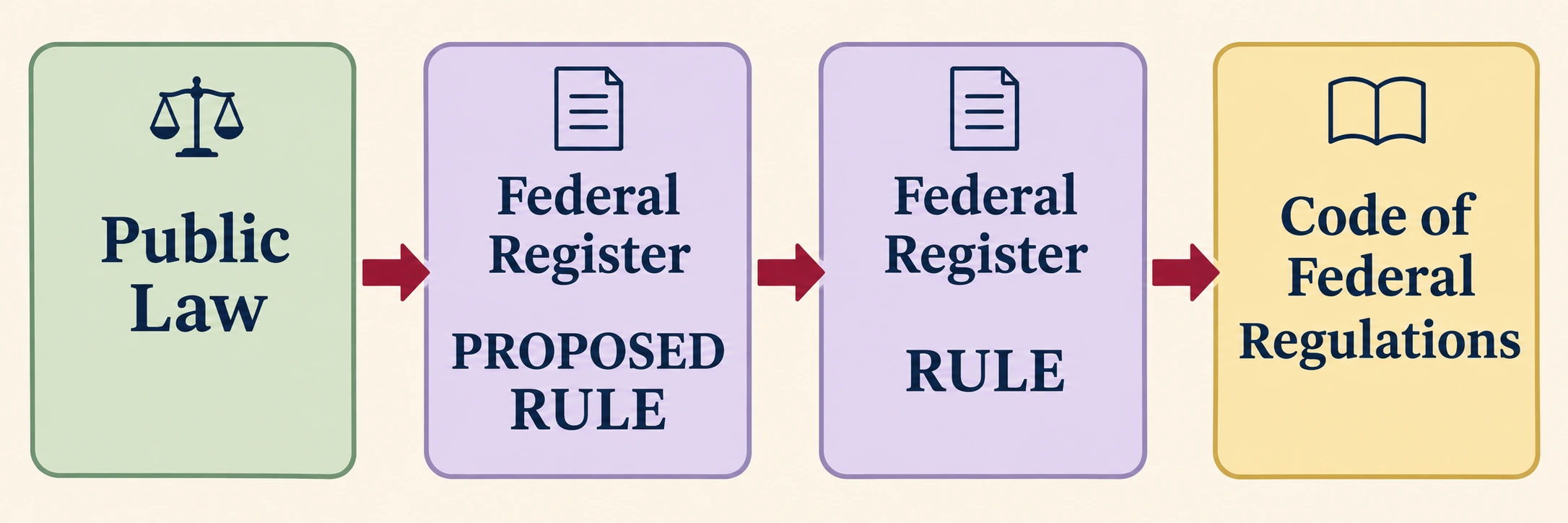
Read the diagram as text
- Start with authority in law: A public law can give an agency authority to make rules for a defined subject. The agency must act within that authority.
- Read the proposal: The Federal Register publishes the proposed rule in a typical notice-and-comment proceeding. The notice explains the proposal and usually invites the public to comment.
- Find the published rule: The Federal Register publishes the final rule. Read its date provisions separately to find when it takes effect or when organisations must comply.
- Find the codified change: The Code of Federal Regulations (CFR) organises applicable rule text by subject. Keep the Federal Register document for the change history and date provisions.
Trace the sequence in this simplified example of U.S. notice-and-comment rulemaking. Different procedures and effective dates can apply.
Read the adapted figure at full size here
Use touch, a trackpad, or the arrow keys in the image area.
There is a second thing to know. The Code is printed in official yearly editions. There is also a website called the , or eCFR. It is easy to search and it is updated every day. But it is a convenience copy. It is not the official edition.
So a careful reader keeps two questions apart. What does the rule say today? And which copy may I rely on if the exact words matter?
This topic answers three questions. How do you read the address? Why are there two kinds of copy? And what should Maya do before she quotes either one?
PICTURE IT
A street address and the city map
Picture a big city with a street-address system. The official city register is printed once a year. It lists every street and every house number, and it says the date it is correct as of.
There is also a map app on your phone. It is updated every day and it is easy to search. When a street changes, the app shows it first.
If you only want to find a house, the app is perfect. If you must prove an address in a court, you bring the printed register and check the notices of changes since it was printed. Either way, you write down the street and house number you used, and the date.
THE REAL JOB A citation like 31 CFR 1010.410 is an address in a numbered book of federal rules, read on a daily online copy and relied on in the official yearly edition.
- Read the address
- Open the eCFR
- Do the exact words matter?
- Check the official edition
- Check Federal Register amendments
- Note copy and date
HOW THE PICTURE MAPS
| In the picture | In the payment |
|---|---|
| The house number on a street | The section number inside a part, such as 1010.410 |
| The street the house stands on | The part, such as 1010 |
| The district the street belongs to | The title, such as 31, Money and Finance: Treasury |
| The printed yearly city register | The official yearly edition on GovInfo |
| The map app updated every day | The eCFR, current and easy to search but not official |
| Notices of street changes | Amendments published in the Federal Register |
WHERE THIS PICTURE STOPS
- A city register lists every street in the same way. Some titles of the Code add steps, such as an extra level between title and chapter, that an address skips.
- A map app and a register are made by different offices. The eCFR and the Code come from the same federal offices, and the eCFR is built from the Code and its amendments.
- The picture says nothing about which copy a court or agency will accept. That is a legal question.
HOOK
Address to find it. Official edition to rely on it.
REMEMBER IT THIS WAY
A rule of thumb: if you see this, think that.
If the exact words matter, leave the eCFR and open the yearly edition.
| In the trick | What it stands for |
|---|---|
| Read on the eCFR | use the daily-updated online compilation to find and read a rule today |
| Rely on the yearly edition | use the official edition on GovInfo, plus Federal Register amendments, when the exact words matter |
No legal reliance is needed, so for a quick briefing the eCFR alone is enough.
TELL A FRIEND
A US federal rule has an address of title, part and section. Read it on the daily eCFR, rely on the official yearly edition, and write down which you used.
OFTEN MIXED UP WITH Reading a rule that has moved. That topic teaches that a document does not say if it is in force. This one covers the US Code of Federal Regulations, how to read an address, and which copy to rely on.
CURRENT AS CHECKED
1 FIGURE
United States Code of Federal Regulations: number of titles, yearly revision calendar, and the status of the eCFR
of Federal Regulations is divided into 50 titles. Its yearly editions are revised on a phased calendar. Titles 1 to 16 are revised as of January 1, titles 17 to 27 as of April 1, titles 28 to 41 as of July 1, and titles 42 to 50 as of October 1. The yearly editions on GovInfo are the official editions. The eCFR is updated daily and is not an official legal edition.
CHECKED 2026-10-11RECHECK BY 2027-07-11
Sources & standards — 2 sources
- Scheme-specific rule
Code of Federal Regulations (GovInfo help) ↗ — US Government Publishing Office (GovInfo) · Fifty titles; yearly editions on GovInfo are the official editions (search excerpt, page not opened)
Search excerpt, page not opened: found by WebSearch on 2026-10-11 (allowed domains govinfo.gov, archives.gov, ecfr.gov, federalregister.gov). The same search also returned the GovInfo annual-edition collection page. GovInfo does not offer whole titles as a single download.
Follow-up: full official HTML opened 6 November 2026, page last updated3December2024. Sections About/When updated/How organised were checked. Annual edition and Federal Register/List of CFR Sections Affected remain distinct.
- Scheme-specific rule
About the Code of Federal Regulations ↗ — National Archives, Office of the Federal Register · Revision dates by group of titles: 1 to 16 on January 1, 17 to 27 on April 1, 28 to 41 on July 1, 42 to 50 on October 1 (search excerpt, page not opened). No scheduled event anchors the review date, so reviewBy is a plain interval and is not a freshness signal; check the National Archives page when it is next revised.
Search excerpt, page not opened: found by WebSearch on 2026-10-11. The calendar (titles 1-16 January 1, 17-27 April 1, 28-41 July 1, 42-50 October 1) is held in the facts register, not in lesson prose. Confirmed again by a second search on 2026-10-11: fifty titles, and the same four revision dates.
PRACTISE AND KEEP
Sources for this topic — 7 sources
- Scheme-specific rule
Code of Federal Regulations (GovInfo help) ↗ — US Government Publishing Office (GovInfo) · GovInfo help page for the Code of Federal Regulations: the Code is divided into titles for broad areas of federal regulation, and the annual editions on GovInfo are the official editions (search excerpt, page not opened)
Search excerpt, page not opened: found by WebSearch on 2026-10-11 (allowed domains govinfo.gov, archives.gov, ecfr.gov, federalregister.gov). The same search also returned the GovInfo annual-edition collection page. GovInfo does not offer whole titles as a single download.
Follow-up: full official HTML opened 6 November 2026, page last updated3December2024. Sections About/When updated/How organised were checked. Annual edition and Federal Register/List of CFR Sections Affected remain distinct.
- Scheme-specific rule
About the Code of Federal Regulations ↗ — National Archives, Office of the Federal Register · About the Code of Federal Regulations: annual editions are revised on a staggered calendar through the year, and the annual editions are the official editions under 1 CFR part 8 (search excerpt, page not opened)
Search excerpt, page not opened: found by WebSearch on 2026-10-11. The calendar (titles 1-16 January 1, 17-27 April 1, 28-41 July 1, 42-50 October 1) is held in the facts register, not in lesson prose. Confirmed again by a second search on 2026-10-11: fifty titles, and the same four revision dates.
- Scheme-specific rule
About the Electronic Code of Federal Regulations ↗ — National Archives, Office of the Federal Register · About the Electronic Code of Federal Regulations: an unofficial editorial compilation of CFR material and Federal Register amendments, updated daily, that does not give legal notice or judicial notice (search excerpt, page not opened)
Search excerpt, page not opened: the URL and title were returned by a WebSearch on 2026-10-11 (allowed domains archives.gov, ecfr.gov, govinfo.gov), and the excerpt gave the same wording. It is a daily-updated online version, built and maintained by the Office of the Federal Register with the Government Publishing Office. It is not an official legal edition and gives no legal or judicial notice.
Follow-up: full official About eCFR HTML opened 6 November 2026. The legal-status section confirms the unofficial editorial compilation and verification against the annual CFR, Federal Register and List of CFR Sections Affected. Earlier excerpt-only access was historical, not a current access limit.
- Official requirement
31 CFR 1010.410, Records to be made and retained by financial institutions ↗ — US Government (eCFR) · 31 CFR 1010.410 as the worked address: Title 31, Subtitle B, Chapter X, Part 1010, Subpart D, section 1010.410 (read through the eCFR renderer)
Cited for the structure of the two paragraphs and for the fact that the intermediary obligation is expressed as forwarding information it received rather than as obtaining information it did not. The dollar threshold is deliberately not stated here: it is a figure that rots, it lives in content/standards/current-facts.json with its own dates.
A rule-writing by regulators had proposed lowering the cross-border threshold to $250. It was withdrawn on 16 April 2025, recorded in the Unified Agenda rather than in the Federal Register — see treasury-unified-agenda-rin-1506-ab41. Its withdrawal was found only there; the Federal Register carries no notice of it at all, which is worth keeping in mind before trusting a Federal Register search alone to show a rulemaking is dead.
Downloaded and read via the eCFR renderer on the access date; paragraphs (e) and (f) both read "a transmittal of funds in the amount of $3,000 or more". A previous note here said the publisher's own domain could not be fetched (a reachability gap, not a statement about the publisher); that did not hold when re-tested.
- Official requirement
12 CFR Part 229, Availability of Funds and Collection of Checks (Regulation CC) ↗ — US Government (eCFR) · 12 CFR Part 229 as a second address: Title 12, Chapter II, Subchapter A, Part 229
Availability and loss are different questions and this site keeps them apart: subpart B says when a depositor may spend the money. And subpart D is the part that allocates a loss when a substitute cheque was not properly charged or a warranty was broken. Section 229.54 says in its own terms that a recredit does not absolve a bank of liability under other law, so it is a route rather than the whole of a depositor's rights.
No availability schedule, hold period or dollar threshold is stated here or anywhere in this site's prose: those are figures that rot.
Subpart structure and the three subpart D section numbers verified from at least two independent search excerpts on the access date, one of them the eCFR listing for subpart D.
Search excerpts only, page not opened: verified from independent web-search excerpts on the access date, so no text is quoted here from the publisher's own page. A failed fetch is not evidence about what the document provides.
- Official requirement
12 CFR Part 210, Collection of Checks and Other Items by Federal Reserve Banks and Funds Transfers Through the Fedwire Funds Service and the FedNow Service (Regulation J) ↗ — US Government (eCFR) · 12 CFR Part 210, subpart B, which incorporates a printed version of UCC Article 4A for Fedwire
The relationship to consumer law is the reason this entry exists rather than a general Fedwire description. Regulation E does not apply to a funds transfer through the Fedwire Funds Service, except that section 919 of the Electronic Fund Transfer Act may govern one that is a remittance transfer. A FedNow transfer from a consumer originator, or to a consumer beneficiary, may be subject to that Act and to Regulation E; it stays governed by subpart C, and where the two are inconsistent the Act prevails.
Article 4A itself is a uniform act: it is law only where a state has enacted it, and versions vary between states. The appendix to this part is the version this federal rule applies, which is why a citation to it is not a citation to any state's enacted text.
Verified from independent search excerpts on the access date, including the Federal Reserve Board's own rulemaking document at federalreserve.gov and the eCFR listings for the part, its two subparts and Appendix A. The official comments to Article 4A are not incorporated by subpart B.
Search excerpts only, page not opened: verified from independent web-search excerpts on the access date, so no text is quoted here from the publisher's own page. A failed fetch is not evidence about what the document provides.
- Simplified educational illustration
Payments Signal editorial teaching models — Payments Signal · This site's own teaching frame for reading a CFR citation and choosing between the two copies
What this simplifies: Maya Chen and Bank Alfa are invented, and the requirement she is handed is a teaching construction. The way to read an address (title, part, section) is a simplification: some titles add a subtitle, a chapter or a subpart in the trail, and the address skips them. The four moves for choosing a copy are this site's own compact reading discipline, and no cited body publishes them as a checklist. The statement that the eCFR can be newer than the annual edition is this site's reasoning from the two sources' own descriptions (daily updates against a yearly edition, released in parts). Whether a particular court or agency accepts a copy is a legal question this topic does not answer.
Used wherever diagrams, scenarios, figures, or example values are didactic constructions rather than sourced facts; every such use carries a simplifications disclosure. All people, companies, banks, and list entries in examples are fictional.
Deepest material on this page: L4 — Standards & sources. Where a topic stops short of implementation depth, that is a deliberate coverage decision, not an oversight — see coverage.