Where does this payment go? Book transfer, local clearing or correspondent
A bank sends each payment through one of three doors: its own books, a local clearing system, or a chain of correspondent banks. The sending bank decides. Swift gpi only tracks.
L1–L4 are part of the Pro pass
L0 Explain simply
It is Monday morning at Bank Alfa. Maya Chen, a payments operations analyst, looks at three payments waiting to leave. Asha Traders wants to move EUR 12,000.00 into its own tax-, also at Bank Alfa. Riya wants to pay her rent, EUR 850.00, to Arjun, who banks at Nordbank. Asha Traders also wants to pay a supplier, Kestrel Fittings s.r.o., USD 18,400.00. Its account is at Nordbank too.
Two of the three payments go to Nordbank, yet they leave by different doors. Nobody asks the customer which door to use. Bank Alfa decides, payment by payment. It asks a few questions, in the same order, every time.
The three doors. The first door is a : both accounts sit at Bank Alfa, so the bank only changes its own records. The second is a clearing system, a shared service that passes payments between its member banks. The third is a correspondent bank, a bank in the middle that holds accounts for other banks and passes the payment on.
Why the currency matters more than the map. Clearing System Delta clears euros for banks in several countries. Riya's euros reach Arjun through Delta, even if Nordbank is in another country. Dollars cannot use Delta. So the dollars for Kestrel Fittings need a bank in the middle, even though the is the same Nordbank. The deciding facts are the currency and who can reach whom. Distance is not one of them.
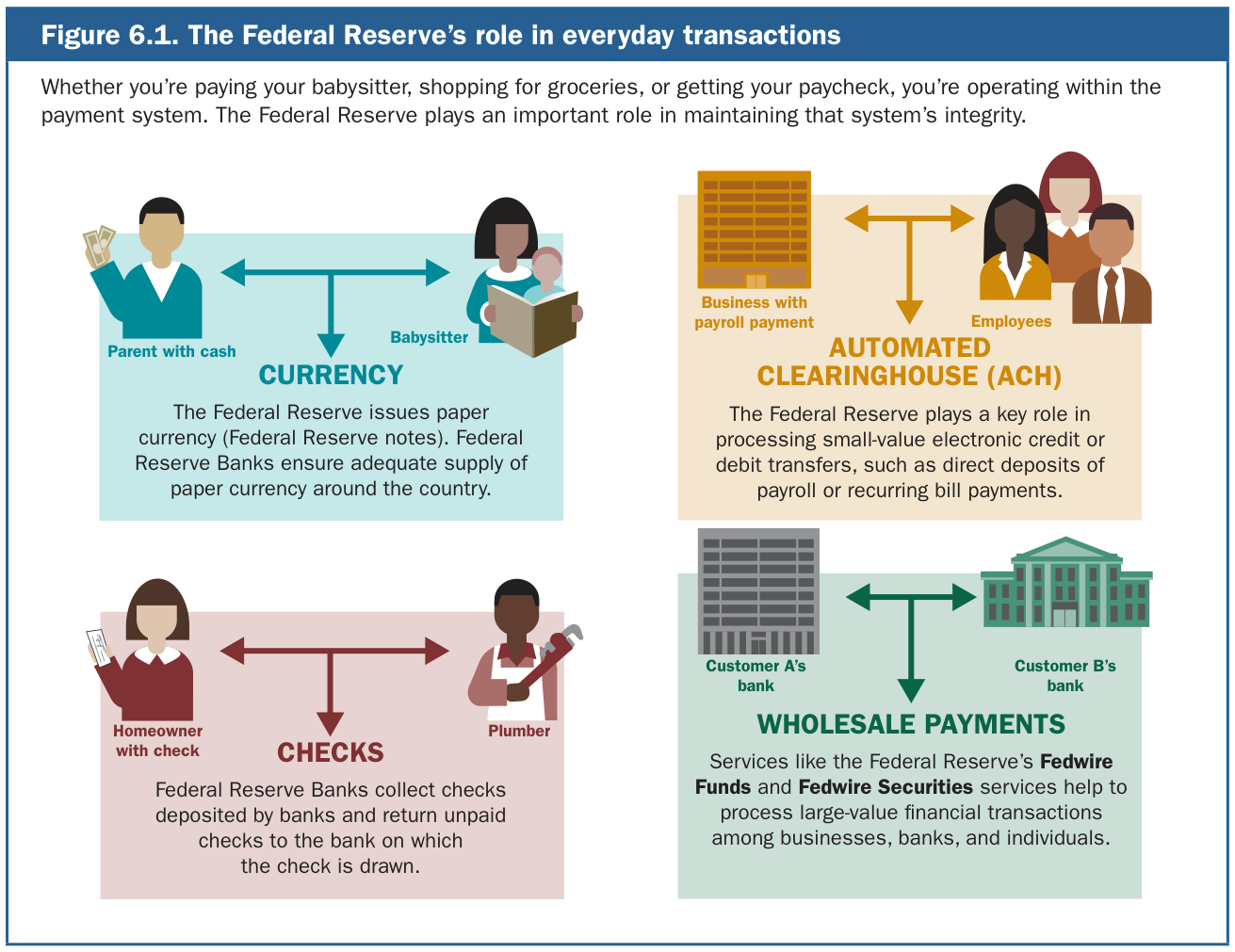
Read the diagram as text
- Pay directly with cash: A parent gives the babysitter cash. Federal Reserve Banks distribute paper currency. The payment itself can happen directly between the two people.
- Send payroll to employees’ accounts: A business pays employees by direct deposit. ACH also handles electronic debits such as recurring bills. The Federal Reserve operates one of the U.S. ACH services.
- Pay with a check: A homeowner gives the plumber a check. The plumber can deposit it at a bank. The Federal Reserve Banks collect checks for banks and return unpaid checks to the bank on which they were drawn.
- Move funds or securities between institutions: The two bank icons show the wholesale example. Fedwire Funds transfers funds between eligible participants. Fedwire Securities handles transfers of eligible book-entry securities.
The Federal Reserve’s 2021 figure compares four services in the U.S. payment system. Use it to compare the jobs those services do. The examples cover cash, checks, ACH, and wholesale payments.
Read the original at full size here
Use touch, a trackpad, or the arrow keys in the image area.
Analogy: a package sorting office. A package for someone in the same building goes on the internal trolley. A package for the same city goes with the local courier. A package for another country goes to an international carrier, which passes it on from depot to depot. The sorting office picks the door. The sender does not, and neither does the tracking website.
Who decides. is the tracking website of this story. It shows where a payment is. It does not choose where the payment goes. That choice is made earlier, inside the , by its own rules and the lists of bank details those rules read.
Four questions carry the rest of this topic. What does the bank ask first, and in what order? What changes when it must use a bank in the middle? Does the instruction travel along the chain, or go straight to the end while the money takes the chain? And what goes wrong when the bank's lists are out of date? (SYNTHETIC / TRAINING ONLY — every person and firm named in this topic is invented.)
PICTURE IT
The picture is the one the lesson above opens with. The table below shows how each part of it matches the payment.
THE REAL JOB The sends each payment out by one of three doors, and the , not the tracking service, picks the door.
- Is the receiving account held at this bank? Then it is a book transfer
- Can a clearing system for the currency reach the receiver before cut-off? Then use local clearing
- If neither fits, build a correspondent chain from both ends
- Choose serial or cover for the instruction
- Swift gpi tracks the payment after release and does not choose its route
HOW THE PICTURE MAPS
| In the picture | In the payment |
|---|---|
| Mail for someone in the same building | A book transfer between two accounts at Bank AlfaWho: Bank Alfa |
| The local courier for the same city | Local clearing, such as Clearing System Delta clearing euros for its membersWho: Clearing System Delta |
| The international carrier | A chain of correspondent banks, such as Meridian Bank for dollarsWho: Meridian Bank |
| Depot passes the package to the next depot | Each middle bank passes the payment to the next bank |
| One depot that serves both sender and receiver | A shared correspondent, so one middle bank is enough |
| The tracking website | Swift gpi, which shows where the payment is and does not pick the route |
| An old depot list | A stale record of which bank serves the receiving bank |
WHERE THIS PICTURE STOPS
- A sorting office picks a carrier for one package. A bank also keeps a stored settlement record for each currency and checks it again before release. The picture has no place for that record.
- A package travels from place to place. A payment does not carry money along. Banks change balances on accounts that they keep with each other.
- A sorting office picks by size and destination. A bank picks by currency, by reach and by the clock. This order of questions is a teaching model, and real banks change it.
- A package has one label. A cover payment sends the instruction and the money apart and joins them with a shared tracking number. The picture has nothing like that.
HOOK
Currency and reach pick the door; gpi only watches.
REMEMBER IT THIS WAY
A sequence: the real steps, in order.
Ask in order: same bank, then a clearing system for the currency, then middle banks. Then choose serial or cover, and let gpi watch.
| In the trick | What it stands for |
|---|---|
| Same bank | Both accounts held at the bank give a book transfer |
| Clearing system | A clearing system for the currency that reaches the receiving bank before cut-off |
| Middle banks | A correspondent chain is built from both ends for that currency |
| Serial or cover | The instruction goes bank to bank, or direct while the money takes the chain |
| gpi watches | gpi tracks the payment and does not choose the route |
This order is a teaching model, since real banks ask their questions in their own order and add steps of their own.
TELL A FRIEND
A bank sends each payment out by one of three doors: its own books, a shared local system, or a in the middle. The picks the door, and Swift gpi only tracks the payment.
OFTEN MIXED UP WITH Choosing the correspondent chain (SSI). That topic is how a correspondent chain is chosen and kept safe. This topic comes one step before it: does the payment need a chain at all, or can it be booked or cleared locally?
PRACTISE AND KEEP
Sources for this topic — 23 sources
- Market practice
Correspondent banking (final report) ↗ — CPMI, Bank for International Settlements · Search excerpt, page not opened: correspondent and respondent roles, nostro and vostro accounts, and the point that direct access to payment systems has long been limited to domestic banks and generally needs a central bank settlement account
Published in July 2016; its statistics cover 2011-2015 and are dated, but the definitions and arrangement types remain widely used.
- Regulatory guidance
Enhancing Cross-border Payments: Stage 1 report to the G20 ↗ — Financial Stability Board (FSB) · The seven frictions behind cost and speed, including long transaction chains and funding costs
Published 9 April 2020 as Stage 1 of the three-stage process the FSB coordinated for the G20, with a technical background report issued alongside it. Stage 2 produced the building blocks and Stage 3 the roadmap; both are already in this registry.
An FSB assessment binds nobody. It reaches an institution only through whatever a standard-setter, a scheme owner or a national regulator has since made of it, and the site cites it with that strength and no more.
Verified from independent web-search excerpts on the access date. The publisher's own domain cannot be fetched, so no text is quoted here from the publisher's own page. A failed fetch is not evidence about what the document provides.
- Official requirement
SwiftRef reference data services ↗ — Swift · The Standing Settlement Instructions Directory: where counterparties want funds settled
Used for public short overviews of the SwiftRef directories and their delivery through files, a web application, and application programming interfaces. Product names in older teaching prose (Bank Directory Plus, IBAN Plus, SEPA Routing Directory) describe the same jobs under the names Swift used before the portfolio evolution.
The full and delta file options were re-read as web-search excerpts of the product page on 2026-10-18; the page was not opened. How Swift numbers or dates a delta file was not shown in any excerpt.
- Market practice
Swift gpi (global payments innovation) ↗ — Swift · Search excerpt, page not opened: gpi gives each payment a unique end-to-end transaction reference and a status trail in the Tracker. The pages describe tracking and service commitments, and none seen says gpi chooses the correspondents
Only public short overviews are used here; the full service definition and rulebook sit behind a swift.com account.
- Market practice
Swift gpi Directory Frequently Asked Questions ↗ — Swift · Search excerpt, page not opened: the gpi Directory lists members with their currencies, cut-off times and intermediary role, and its routing information supplements a bank's other routing data
Verified from web-search excerpts; the publisher page was not opened (search excerpt, page not opened). Every gpi member bank is listed. Eligibility conditions were not found in excerpts.
- Market practice
Information paper: Relationship Management Application (RMA) and RMA Plus, managing your correspondent connections ↗ — Swift · Search excerpt, page not opened: a receiving institution grants authorisation to a counterparty before it receives that counterparty's messages
Known from web-search excerpts on 2026-10-17, page not opened. Two Swift search results, this paper and a Swift news page of the same title, described the filter and its finer form. The excerpts did not show what error a sender sees when no authorisation exists. A third-party help page made a claim about rejection that this site does not use. How the Relationship Management Application works outside FIN, the classic Swift messaging service, was not established.
Follow-up 7 November 2026: actual historic 8-page PDF opened through normal web; printed pages 4–6 seen and core page 4 read for covered end-to-end-signature FIN messages (most, not all), receiver-granted directional authorisation, non-customer RMA possible and RMA Plus granularity. Publication date was not established from selected text. This is historical FIN evidence, not the latest FINplus rules, complete exception list or native rejection codes.
- Market practice
PMPG Cover Payments Market Practice Guidelines — version 4.1.1, April 2026 ↗ — Swift / Payments Market Practice Group · Search excerpt, page not opened: cover linkage through a shared UETR, and the cover message orders the funds for one underlying customer credit transfer
Public PDF opened on 5 November 2026. Edition 4.1.1, April 2026. Section 1.1 p7 distinguishes COV funding from camt.054 credit advice or camt.053 reconciliation at its creditor. Sections 1.1–1.2 distinguish pacs.009.001.08 ADV from COV. Sections 14–16 and FAQ1 explain policy-based early credit and an applicable wait-for-settlement agreement. Section 13 coordinates direct and cover cancellation and its footnote says an additional cover-chain request is not required. Market-practice guidance does not certify any bank implementation or replace effective usage guidelines.
- Market practice
Market Practice Guidelines for use of the MT (message type) 202 COV (PMPG) ↗ — Swift / Payments Market Practice Group · Search excerpt, page not opened: crediting the beneficiary on the MT103 before the cover arrives is a credit policy decision of the institution
Known from web search excerpts only; the PDF was not opened. Excerpts show the scope sentence: the MT (message type) 202 COV (cover) orders funds for one underlying customer credit transfer sent with the cover method, and must not be used for other interbank transfers. A search summary citing its FAQ also says that crediting a beneficiary on an MT 103 (customer payment) without the cover is a credit policy decision of the institution.
The version 4.0 cover payments guidance (February 2024) was reported in the same searches as saying the same, so the sentence rests on two PMPG (Payments Market Practice Group) texts, both known from excerpts. Use beside pmpg-cover-payments-2026, which supersedes it for the ISO 20022 era. Fresh search 2026-10-11 (excerpt, pages not opened): the v4.0 text says a delay is flagged through the gpi tracker or MT 299 (free-format message) with an MT 296 to the previous agent. A re-check on 2026-10-11 did not find MT 195 (query) in the excerpts, so the MT 195 chase is not attributed to PMPG.
V4.1.1 changes the mechanism and says the instructing agent should tell the creditor agent.
- Market practice
Cross-Border Payments and Reporting Plus (CBPR+) usage guidelines ↗ — Swift (CBPR+ working group) · Search excerpt, page not opened: the pacs.008 with settlement method COVE and the pacs.009 COV in the CBPR+ usage guidelines; the guidelines sit on MyStandards and were not read
Full guidelines require MyStandards access. Public guidance had set 14 November 2026 as the date after which fully unstructured addresses would be removed for in-scope CBPR+ traffic. The explicit message exceptions included admi.024, camt.025, camt.052, camt.053, camt.054 and camt.060. Swift has since deferred that requirement and set no replacement date. The current fact
swift-cbpr-unstructured-address-removalcarries the position. - Market practice
ISO 20022 Learning Guide, module 5 — A Deep Dive on pacs.009 ↗ — BNY (The Bank of New York Mellon Corporation) · Bank training material naming pacs.009.001.08 for CBPR+ and the underlying customer credit transfer block that marks a COV
Downloaded and read in full from the publisher's own domain on the access date: HTTP 200, 279,826 bytes, six pages, converted with pdftotext -layout, so nothing cited from it rests on a search excerpt. The document dates itself February 2021.
It is a bank's teaching material rather than a standard or a scheme rule, so citations to it carry the market-practice label. Every ISO element address and every presence flag on the tables it supports is read from the published XSD instead, never from this guide.
Where it describes what CBPR+ requires it is reporting a usage guideline this site does not reproduce. Nothing is quoted from those passages and no CBPR+ rule is asserted from them.
Two boundaries are worth recording rather than smoothing over. Its statement that the reimbursement agents exist only in the advice usage is a statement about the CBPR+ usage guidelines and not about the base message definition, where all three elements are present and optional. The tables say so where they map field 53a, and read presence from the schema. And its three message-flow figures carry no text layer at all, so nothing on this site is sourced from them.
It says nothing about the MT200 or the MT205 beyond naming them in the list of messages pacs.009 replaces. Every row on those two tables that turns on something specific to those message types is sourced from the Swift Standards MT specification and marked as a reading rather than attributed here. Those rows are the absent field 21, the absent field 13C, the absent field 54a, and the sender standing as its own creditor.
- Market practice
Mini Series and Reference Guide, Part 2, from Citi (pacs.008 and pacs.009 element guide) ↗ — Citi Treasury and Trade Solutions · Search excerpt, page not opened: the intermediary agent elements of the bank-to-bank customer credit transfer; agent 1 sits between the debtor agent and agent 2
Known from a web-search excerpt only (page not opened). The excerpts gave four points. The instructing agent is the message sender and the instructed agent the message receiver. Intermediary agents 1 to 3 sit in sequence between the debtor agent and the creditor agent. The debtor agent account is optional in the customer and bank-to-bank transfer messages. The cover version of the bank-to-bank message carries the underlying customer credit transfer, and its parties change role. Treat as market-practice, not as the ISO definition text.
- Official requirement
Swift Standards MT (annual standards releases) ↗ — Swift · MT103 and MT202 bank fields 53a to 57a; the older format has one intermediary field (page behind a login, not opened)
Full field-level specifications live in the Swift Knowledge Centre User Handbook behind a swift.com login. Coexistence for in-scope FI-to-FI payment instructions ended on 22 November 2025, but treatment differs by MT: some instructions are NAKed and selected messages can enter temporary, chargeable contingency conversion. Reporting, initiation, investigations and correspondence follow separate roadmaps.
Re-checked on 2026-10-04 by web search for the schedule of Standards Release 2026. Only search excerpts of the Standards Releases page were seen; the page was not opened. They said the deferred part of the release, which holds MT messages outside category 1, ISO 20022 securities and funds messages, tracker messages and exceptions and investigations messages, now has a date of 12 June 2027. They said the first target was the first quarter of 2027, and that the later date follows industry feedback about other change work, including the European move to T+1 settlement. An audit note in docs/research dated 29 September 2026 recorded the same date from the same page.
Re-checked 12 November 2026 via Swift Standards Releases schedule: SR2025 remains the in-force annual MT release pending the deferred SR2026 package.
- Market practice
Oracle Banking Payments: Routing Rule, Routing Rule Basis Elements and Currency Correspondent Rules (payments core and cross-border user guides, releases 14.7 and 14.8) ↗ — Oracle · Search excerpt, page not opened: routing rules run by priority and the first match wins; the actions are to change the correspondent or reject; the inputs include creditor country, transfer currency, whether the currency changes, intermediary BIC and whether a cut-off has passed
search excerpt, page not opened: returned by WebSearch on 2026-10-26 for the Routing Rule, Routing Rule Basis Elements and Currency Correspondent Rules pages (release 14.7 and 14.8 guides) and for the Cross Border Payments user guide. It describes one product, so it is cited as market practice and never as a rule that banks follow. Element lists and screen names differ between releases. No bank's own routing table was seen. Open the page for the release you use before relying on any detail.
- Market practice
Oracle Banking Payments: Routing Rule, Routing Rule Basis Elements and Currency Correspondent Rules (payments core and cross-border user guides, releases 14.7 and 14.8) ↗ — Oracle · Search excerpt, page not opened: currency correspondent rules pick one of several correspondents for a currency, for example by channel; for a clearing-system network the nostro account comes from the network and currency set-up, and for a cross-border network the correspondent BIC and account are mandatory
search excerpt, page not opened: returned by WebSearch on 2026-10-26 for the Routing Rule, Routing Rule Basis Elements and Currency Correspondent Rules pages (release 14.7 and 14.8 guides) and for the Cross Border Payments user guide. It describes one product, so it is cited as market practice and never as a rule that banks follow. Element lists and screen names differ between releases. No bank's own routing table was seen. Open the page for the release you use before relying on any detail.
- Market practice
Cross-border retail payments (Committee on Payments and Market Infrastructures Papers No 173, February 2018) ↗ — Bank for International Settlements (CPMI) · Search excerpt, page not opened: correspondent banks still handled most clearing and settlement for cross-border retail payments in 2018
search excerpt, page not opened: returned by WebSearch on 2026-10-26 from the Bank for International Settlements (BIS) page and its press release. The report is dated 2018, so it supports the shape of the arrangement and not today's share of payments. No figure is taken from it. The excerpts did not show its passages on domestic systems, currencies or final settlement.
- Market practiceSuperseded — see Glossary of payments and market infrastructure terminologyMarch 2003 edition
A glossary of terms used in payments and settlement systems ↗ — CPSS (now CPMI), Bank for International Settlements
Superseded for currency, not for coverage, and that distinction is the reason this entry stays. The live glossary at bis.org/cpmi/publ/d00b.htm is the current text. This edition remains the only published CPMI definition of ten headwords the live glossary does not carry.
Both editions were downloaded and compared on the access date. The 2003 PDF is 346,977 bytes; the generated PDF of the live glossary is 197,553 bytes. Four definitions this site teaches had moved. Six passages quoted the 2003 wording of netting in prose while attributing it to the CPMI glossary, and those now say which edition they are quoting.
Checks that returned nothing, recorded so they are not repeated. Singleness of money, payment token, electronic wallet and book transfer are headwords in neither edition. A citation for any of those was pointing at a document that does not contain the term.
- Market practice
Intelligent Routing module (Finastra product sheet and Sibos 2025 announcement) ↗ — Finastra · Search excerpt, page not opened: a routing module that works across book transfers, high-value, bulk, instant and cross-border payments, weighs cost, speed, schemes and regulation, and helps check clearing memberships and build correspondent chains
search excerpt, page not opened: returned by WebSearch on 2026-10-26 for the factsheet and the Sibos 2025 announcement. A marketing document from the vendor. One summary of the factsheet also mentioned checks on Relationship Management Application relationships and serial or cover choices based on standing settlement instructions, but a second search did not confirm that, so it is not used. A vendor figure for the share of payments processed without manual touch is not used.
- Market practice
Payments without borders (Bank for International Settlements Quarterly Review, March 2020) ↗ — Bank for International Settlements (BIS) · Search excerpt, page not opened: most payment systems are domestic in scope and settle in a single currency, and correspondent relationships are the main link between them
search excerpt, page not opened: returned by WebSearch on 2026-10-26 among Bank for International Settlements (BIS) Quarterly Review pages of March 2020. The summary did not show which of the neighbouring March 2020 articles carries each sentence, so the point is attributed to the Review issue and this article's address, and the page must be opened to confirm it. The data in the issue are from 2018 and earlier. No figure is taken from it.
- Market practice
Swift gpi (product page) ↗ — Swift · Search excerpt, page not opened: the Tracker lets banks follow a payment's status, and each payment carries a unique end-to-end transaction reference
Verified from a web-search excerpt on the access date; the page was not opened.
- Market practice
Standards MX (ISO 20022 messages) FINplus Standards Advance Information, November 2024 ↗ — Swift · Search excerpt, page not opened: pacs.008.001.08 under swift.cbprplus.stp.02, and pacs.009.001.08 under the core, advice and cover guidelines of CBPR+
Known only from a web-search excerpt, returned by two independent searches; the page was not opened. This is the November 2024 edition. A later edition may differ, and these versions are not confirmed for Standards Release 2025 or 2026.
- Market practice
Cross-Border Payments and Reporting Plus (CBPR+) usage guideline for the financial institution credit transfer (pacs.009), SR2025 combined collection, bank copy ↗ — A Polish bank's published copy of a Swift MyStandards export · Search excerpt, page not opened: a bank's copy of the CBPR+ pacs.009 guideline, which restricts the base message pacs.009.001.08, with a cover form on the same version
Known only from web-search excerpts on the access date; the page was not opened. Two searches returned neighbouring items from the same host (a pacs.008 customer credit transfer guideline dated 13 December 2024 and another pacs.009 credit transfer item), so which item number carries which guideline was not fully established. A bank's copy, not Swift's own page, and Swift's MyStandards is member-only.
A later search showed the same host carrying an item titled CBPRPlus-pacs.009.001.08_COV_FinancialInstitutionCreditTransfer, with the text that it restricts the base message pacs.009.001.08. That fits the cover form on version 08. The page was still not opened.
- Market practice
Standard Chartered ISO 20022 message formatting guideline for pacs.009 (bank-to-bank credit transfer) ↗ — Standard Chartered · Search excerpt, page not opened: a bank's CBPR+ based guideline for pacs.009 with a cover form that carries the underlying customer credit transfer
search excerpt, page not opened: returned by WebSearch on 2026-10-26. A bank's guide for its own incoming instructions, not the Swift rule. The bank's separate milestone document refers to a version 8 pacs.009 cover migration, which matches pacs.009.001.08, but the guideline's own version line and date were not shown. Element paths were not read.
- Simplified educational illustration
Payments Signal editorial teaching models — Payments Signal
What this simplifies: The three doors and the order of the questions are this site's teaching model; the sources held do not rank them and describe no bank's own rules. The vendor guides describe one product. The cover and serial choice is simplified to the permission to message the far bank and the agreements between banks.
Used wherever diagrams, scenarios, figures, or example values are didactic constructions rather than sourced facts; every such use carries a simplifications disclosure. All people, companies, banks, and list entries in examples are fictional.
Deepest material on this page: L4 — Standards & sources. Where a topic stops short of implementation depth, that is a deliberate coverage decision, not an oversight — see coverage.