Banking through an agent: business correspondents, micro-ATMs and AePS
Who runs the counter, who holds the account and how the banks distinguish authentication, approval and actual cash delivery.
L1–L4 are part of the Pro pass
L0 Explain simply
SYNTHETIC / TRAINING ONLY. Meera wants ₹2,000 from her bank account, but the nearest branch is far away. She visits an authorised shop counter. The operator enters the withdrawal, selects her bank and uses the supported Aadhaar . After a confirmed approval, the operator hands her cash and gives the transaction evidence.
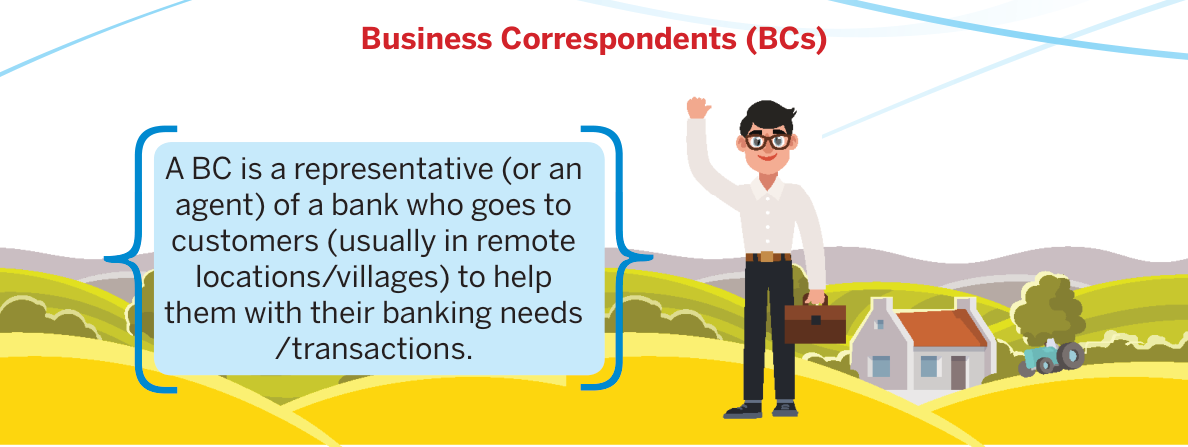
Read the diagram as text
- Original title: Business Correspondents (BCs)
- Complete original callout: A BC is a representative (or an agent) of a bank who goes to customers (usually in remote locations/villages) to help them with their banking needs /transactions.
- Artwork and scope: One illustrated BC, two callout braces and a rural landscape with a house and tractor. No arrows, process-step numbers or transaction limits. The service list and consumer-advice NOTE below the illustration in the original page are outside this excerpt.
Reserve Bank of India, Financial Awareness Messages (FAME), fourth edition February 2024, printed page 8 / PDF page 14. Design: Kaushik Ramachandran. Publisher illustration extracted from the PDF; exact selected artwork retained, surrounding service list and consumer-advice box excluded. It illustrates a BC’s representative role only, not a complete AePS authentication, cash-delivery or settlement flow, or every current service. The source book permits reproduction provided the source is acknowledged. The original PDF is available free.
This is one cash-withdrawal example. (National Payments Corporation of India) operates the network. The customer’s bank holds her account; the acquiring bank provides the counter’s connection and is responsible for its touchpoint operators. A business correspondent is an agent engaged to provide banking services, rather than a separate bank holding this account.
The small terminal is often called a micro-ATM. That is a device/channel description, not a promise that every service on it uses AePS or the same authentication. cash withdrawal is a different route.
Two things must agree: the account-side result and the cash actually delivered. A debit or a success-looking screen alone is not proof that Meera received her cash. An unanswered request needs investigation, not an immediate second withdrawal.
PLAIN WORDS · 3 in this section
- biometric
- using body features like fingerprints to identify
- touchpoint
- a place where a customer meets a service
- unanswered
- not yet given a reply
PICTURE IT
A shop counter that works as a bank window
Picture a village shop acting as an authorised bank counter. The operator records the requested withdrawal, initiates the supported identity and account checks, and waits for a confirmed approval before handing over cash.
The operator has real duties: the action, amount, location and receipt must match. The banks also need evidence of the account result and cash delivery.
THE REAL JOB AePS provides specified Aadhaar-authenticated services through approved touchpoints; the issuer owns account controls and the acquirer owns its operator and terminal duties.
- Customer gives Aadhaar number and finger
- Counter device sends the request to the acquiring bank
- NPCI routes it to the issuing bank
- Issuing bank checks and approves
- Correspondent hands over cash
HOW THE PICTURE MAPS
| In the picture | In the payment |
|---|---|
| The shop with the window | A business correspondent, the bank's agent |
| The handheld reader | A micro-ATM |
| Her identity number and finger | An Aadhaar number and a biometric |
| The line down to the bank | The AePS service run by NPCI |
| The bank that holds her account | The issuing bank |
| The bank that signed the shop up | The acquiring bank, which owes due diligence on the operator |
| The bank saying yes | A confirmed account-side approval; actual cash delivery still needs its own evidence |
| The shopkeeper's own till | The cash that the correspondent holds |
WHERE THIS PICTURE STOPS
- The scene is a biometric AePS withdrawal, not every micro-ATM or UPI cash journey. Above ₹
5,000, current Annex D adds OTP to biometric authentication for cash withdrawal and BHIM Aadhaar Pay. - A confirmed account result is not proof that the physical cash was delivered. The account, terminal action and receipt must agree.
- The acquirer and issuer may be different banks. NPCI connects the participants; complete member wire details are outside this analogy.
- A timeout needs referenced status/reconciliation evidence, not an immediate duplicate withdrawal. Current public rules describe operator and service controls, while the complete member schema and device certification need separate verification.
HOOK
The shop pays out. The bank says yes.
TELL A FRIEND
A shopkeeper acting for a bank can pay you cash from your own account after the bank approves, using your and fingerprint. The bank stays responsible for him.
OFTEN MIXED UP WITH India: five selected payment systems and their different jobs. This topic is about reaching your own account at a counter with Aadhaar. India's payment stack covers how money moves between accounts, on named systems such as the .
Sources & standards — 4 sources
- Scheme-specific ruleNPCI/AePS/CC/01Version1.0issued31October2026;incorporatesOCs31August2026
AePS Consolidated Circular, Version1.0 ↗ — National Payments Corporation of India · Version1.0,31October2026: §§1–7/AnnexD: participants, services, issuer/acquirer duties and scoped controls; AnnexE: settlement cycles.
Full32pages and all annexes read. Assisted bank-led services, issuer/acquirer/ATO duties, consent/enable-disable exceptions, biometric cash and scoped biometric-plus-OTP step-up, geography/retention/monitoring, sponsor settlement and dispute controls. AnnexB/D acquirer-count wording has a documented ambiguity; original OC96 effective date not independently established.
- Official requirement
Directions on due diligence of AePS touchpoint operators ↗ — Reserve Bank of India · 27June2025, effective1January2026: complete covering letter/Annex definitions and §§2–3; acquiring-bank diligence, inactivity and monitoring.
Actual RBI covering letter and complete Annex definitions/§§2–3 read6November2026. This replaces the former excerpt-only evidence status. An existing BC/sub-agent due-diligence check may be adopted; the broad ATO definition does not establish OTP-only authorisation for every AePS cash service. Current NPCI product authentication controls must also be read.
- Official requirement
Harmonisation of Turn Around Time (TAT) and customer compensation for failed transactions using authorised Payment Systems ↗ — Reserve Bank of India · 20September2019 Annex general instructions and §5: domestic AePS/Aadhaar Pay failed transactions and T+5 reversal/compensation.
Opened and read on the access date at HTTP 200. The quoted passages above are from the circular's own text.
The rule that timelines are outer limits is stated in the circular in those words: the prescribed TAT is the outer limit for resolution of failed transactions, and participants shall endeavour towards quicker resolution. Nothing in what was read says whether a participant may contract for a shorter timeline with its own customers, so this site does not claim either way.
Figures in a compensation schedule rot, and this one is already several years old. The amounts and windows are carried on this site as dated facts with review dates rather than written into prose, so that a later circular restating or superseding them forces a check rather than passing unnoticed.
The circular covers many more scenarios than the two summarised here — among them automated teller machine withdrawals, card-not-present transactions, prepaid instruments and immediate payment service transfers. Cite the annex row for the scenario in hand rather than reasoning from these two.
Authority correction (6 November 2026): this is a statutory direction issued under PSS Act section 10(2) read with section 18, not merely explanatory guidance. Scope is domestic transactions where originator and beneficiary are within India. Paragraphs 4–5 distinguish outer limits and automatic compensation.
- Regulatory guidanceFourth edition, February2024; selected BC illustration printedp8/PDFp14
Financial Awareness Messages (FAME), fourth edition ↗ — Reserve Bank of India, Financial Inclusion and Development Department · Fourth edition February2024, printedp8/PDFp14: original standalone BC-role illustration; copyright permission/design credit PDFp2. Surrounding services/advice not reproduced; not a complete AePS flow.
Actual complete60-page PDF validated (6908732bytes, SHA2567acec04a8e3e3ad6428dfb50f5586136f30e1e991cd32dd8472c97b15129bd80). Actual copyrightp2 and complete BCp14 read/viewed. Book-specific permission: Reproduction is permitted provided the source is acknowledged. Design credited to Kaushik Ramachandran. Selected remittance/UPI pages also read but rejected as current-rule visuals due historical shorthand/collect guidance. Not a licence for all RBI/NPCI publications.
CURRENT AS CHECKED
2 FIGURES
AePStouchpoint operators—actual acquirer requirements
’s actual 27 June 2025 direction applies from 1 January 2026. Acquirers perform the specified onboarding due diligence, periodic KYC and KYC before resuming after three continuous months without financial/nonfinancial customer transactions. The stated existing BC/subagent check can be adopted. Location, volumes/velocity and AePS-only API integration controls are separate from issuer account checks and customer authentication.
CHECKED 2026-11-06RECHECK BY 2027-04-11
Sources & standards — 2 sources
- Official requirement
Directions on due diligence of AePS touchpoint operators ↗ — Reserve Bank of India · Actual fullcover/definitions/Annex2–3;PSS10(2)/18direction.
Actual RBI covering letter and complete Annex definitions/§§2–3 read6November2026. This replaces the former excerpt-only evidence status. An existing BC/sub-agent due-diligence check may be adopted; the broad ATO definition does not establish OTP-only authorisation for every AePS cash service. Current NPCI product authentication controls must also be read.
- Scheme-specific ruleNPCI/AePS/CC/01Version1.0issued31October2026;incorporatesOCs31August2026
AePS Consolidated Circular, Version1.0 ↗ — National Payments Corporation of India · Actual full31October2026consolidation,§5/AnnexD: terminal/operator data,consent,PAN/AgentID and service-specific authentication; fullmember schema separate.
Full32pages and all annexes read. Assisted bank-led services, issuer/acquirer/ATO duties, consent/enable-disable exceptions, biometric cash and scoped biometric-plus-OTP step-up, geography/retention/monitoring, sponsor settlement and dispute controls. AnnexB/D acquirer-count wording has a documented ambiguity; original OC96 effective date not independently established.
UPICashPoint—verified authority/funding/channel controls; unverified secondary numeric caps not endorsed
Current section 21.1 supports cash withdrawal at authorised BC touchpoints using the specified dynamic QR and required AFA. The stated flow does not permit or credit-account funding. Merchant cash withdrawal, UPI ATM/ICCW and UPI cash deposit are separate services with their own controls. This selected public section does not certify every numeric cap quoted in older secondary summaries; use the actual applicable profile before configuring amounts.
CHECKED 2026-11-06RECHECK BY 2027-04-11
Sources & standards — 1 source
- Scheme-specific ruleNPCI/UPI/CC/01, Version 1.0, issued 18 September 2026
UPI Consolidated Circular, Version 1.0 ↗ — National Payments Corporation of India · Actual full§21.1–21.4: BCCashPoint/merchantcash/ATM-ICCW/deposit distinctions and requiredcontrols.
Foundation selected sections and the India review together cover the complete 54-page Version 1.0 circular, including all operative sections 1–35 and Annexes A–G. Read on 6 November 2026. Section2.1 permits banks in specified roles, eligible PPI issuers as issuer/PSP members or sub-members, and NBFC sub-member issuer/beneficiary roles; a TPAP is not automatically a PSP member. Sections2.13–2.15 prescribe registered/validated beneficiary-name display and prohibit QR/user-supplied names as the transaction beneficiary name.
The consolidation preserves underlying effective dates and does not replace the separately applicable PG, OSG, technical specifications or law. This is not certification of those entire separate documents. APAC independently reviewed section1, international section23 and AnnexB pp.44–47 of the same54-page circular. Those country/provider lists are not proof that every provider or merchant is live; separate global, reverse and international-mobile-code services retain their own scope.
SEE THE PAYMENT MOVE
PICTURE THE JOURNEY
A village stall that acts for a distant bank, with a thumb on an ink padOpen to read the picture, how it matches the payment and where it stops.
PICTURE IT
A village stall that acts for a distant bank, with a thumb on an ink pad
Picture a village with no bank branch. A shopkeeper acts for a bank in a far town and keeps a till of his own cash. A villager walks up with no card. She gives her identity number and presses her thumb on an ink pad.
The shopkeeper passes the thumb print to the bank that hired him. That bank hands it to a central sorting hall. The hall reads which bank the villager named and sends the request on to that bank, which holds her account book.
The thumb print is tested against a national identity file. The account bank checks the account is open and holds enough. It then writes the debit in its own book. Its yes travels back along the same road, through the hall and the hiring bank, to the stall.
Only when the yes reaches the stall does the shopkeeper count cash from his own till. If the print does not match, a no comes back instead. The account book is not touched and the till stays shut.
THE REAL JOB An AePS withdrawal proves a customer by and fingerprint, so a shop can pay her cash.
HOW THE PICTURE MAPS
| In the picture | In the payment |
|---|---|
| The villager who gives an identity number and a thumb | The customer, who gives her Aadhaar number and a fingerprint instead of a card |
| The shopkeeper who acts for a distant bank | The business correspondent, who serves customers for a bank at a shop counter |
| The bank that hired the shopkeeper | The acquiring bank, which signed up the correspondent and is answerable for it |
| The central sorting hall | The AePS switch run by NPCI, which routes the request to the customer's bank |
| The far bank that holds her account book | The issuing bank, which holds the account and books the debit |
| The thumb print tested against the file | The identity check, described by National Payments Corporation of India (NPCI) as Aadhaar authentication |
| A yes travelling back along the same road | The approval returns through the switch to the acquiring bank and the counter device |
| Cash counted from the shopkeeper's own till | The correspondent pays out cash only after the approval arrives |
| A no comes back and the till stays shut | BIOMETRIC_MISMATCH: a teaching label, not a real AePS code; no debit, no cash |
WHERE THIS PICTURE STOPS
- The picture tests the thumb against a national identity file, not at the account bank. Where that check sits in the order is not public, so the picture must not be read as the real order.
- The shopkeeper's own till looks like a simple loan. The sources read do not establish how the correspondent is paid back or how the banks settle, so the picture stops there.
- The picture has a clear yes or no. A late or missing answer from the account bank is not drawn, because the sources read do not establish it.
BIOMETRIC_MISMATCHis this site's teaching label. The real decline codes are not drawn.
HOOK
Cash leaves the till only after the approval comes back.
REMEMBER IT THIS WAY
A sequence: the real steps, in order.
Think prove, route, approve, pay: the cash comes last, after the approval.
| In the trick | What it stands for |
|---|---|
| Prove | the customer gives her Aadhaar number and a fingerprint |
| Route | the acquiring bank passes the request to NPCI, which routes it to the bank named by the customer |
| Approve | the approval travels back through the switch to the acquiring bank |
| Pay | the correspondent hands over the cash from his own till |
TELL A FRIEND
A customer proves who she is with her and a fingerprint, and her own bank approves. Only then does a shopkeeper acting for a bank hand over cash.
OFTEN MIXED UP WITH India: five selected payment systems and their different jobs. That topic compares India's main systems, built for speed or for volume. This flow is a cash withdrawal at a shop counter, where identity is proved by Aadhaar and a fingerprint.
WHAT THIS PAGE CANNOT SHOW YOU
2 RAILS
These rails are explained here in words, and their message layout is not shown, because it is not something this site can honestly print. Each was looked for on the date given. Some specifications are issued only to a scheme’s own members; some are published openly and we could not retrieve a copy; and one or two we have not yet searched far enough to settle. Read what you have read above as an account of how each rail works, never as a specification you can build against.
AePS (cash withdrawal at a business correspondent)PUBLISHED TO MEMBERS ONLY
NPCI's AePS interface specification — the ISO 8583 structure carrying an Aadhaar-authenticated bank transaction at a business correspondent
LOOKED FOR 2026-10-11
Micro-ATM devicePUBLISHED, BUT WE COULD NOT RETRIEVE IT
The Micro-ATM standard a business correspondent's terminal is built and certified against — the device, message and interoperability rules at the version banks are held to, rather than the 2010 working-group draft that preceded it
LOOKED FOR 2026-10-11
PRACTISE AND KEEP
Sources for this topic — 7 sources
- Scheme-specific ruleNPCI/AePS/CC/01Version1.0issued31October2026;incorporatesOCs31August2026
AePS Consolidated Circular, Version1.0 ↗ — National Payments Corporation of India · Version1.0,31October2026: §§1–7/AnnexD: participants, services, issuer/acquirer duties and scoped controls; AnnexE: settlement cycles.
Full32pages and all annexes read. Assisted bank-led services, issuer/acquirer/ATO duties, consent/enable-disable exceptions, biometric cash and scoped biometric-plus-OTP step-up, geography/retention/monitoring, sponsor settlement and dispute controls. AnnexB/D acquirer-count wording has a documented ambiguity; original OC96 effective date not independently established.
- Official requirement
Directions on due diligence of AePS touchpoint operators ↗ — Reserve Bank of India · 27June2025, effective1January2026: complete covering letter/Annex definitions and §§2–3; acquiring-bank diligence, inactivity and monitoring.
Actual RBI covering letter and complete Annex definitions/§§2–3 read6November2026. This replaces the former excerpt-only evidence status. An existing BC/sub-agent due-diligence check may be adopted; the broad ATO definition does not establish OTP-only authorisation for every AePS cash service. Current NPCI product authentication controls must also be read.
- Official requirement
Harmonisation of Turn Around Time (TAT) and customer compensation for failed transactions using authorised Payment Systems ↗ — Reserve Bank of India · 20September2019 Annex general instructions and §5: domestic AePS/Aadhaar Pay failed transactions and T+5 reversal/compensation.
Opened and read on the access date at HTTP 200. The quoted passages above are from the circular's own text.
The rule that timelines are outer limits is stated in the circular in those words: the prescribed TAT is the outer limit for resolution of failed transactions, and participants shall endeavour towards quicker resolution. Nothing in what was read says whether a participant may contract for a shorter timeline with its own customers, so this site does not claim either way.
Figures in a compensation schedule rot, and this one is already several years old. The amounts and windows are carried on this site as dated facts with review dates rather than written into prose, so that a later circular restating or superseding them forces a check rather than passing unnoticed.
The circular covers many more scenarios than the two summarised here — among them automated teller machine withdrawals, card-not-present transactions, prepaid instruments and immediate payment service transfers. Cite the annex row for the scenario in hand rather than reasoning from these two.
Authority correction (6 November 2026): this is a statutory direction issued under PSS Act section 10(2) read with section 18, not merely explanatory guidance. Scope is domestic transactions where originator and beneficiary are within India. Paragraphs 4–5 distinguish outer limits and automatic compensation.
- Regulatory guidanceFourth edition, February2024; selected BC illustration printedp8/PDFp14
Financial Awareness Messages (FAME), fourth edition ↗ — Reserve Bank of India, Financial Inclusion and Development Department · Fourth edition February2024, printedp8/PDFp14: original standalone BC-role illustration; copyright permission/design credit PDFp2. Surrounding services/advice not reproduced; not a complete AePS flow.
Actual complete60-page PDF validated (6908732bytes, SHA2567acec04a8e3e3ad6428dfb50f5586136f30e1e991cd32dd8472c97b15129bd80). Actual copyrightp2 and complete BCp14 read/viewed. Book-specific permission: Reproduction is permitted provided the source is acknowledged. Design credited to Kaushik Ramachandran. Selected remittance/UPI pages also read but rejected as current-rule visuals due historical shorthand/collect guidance. Not a licence for all RBI/NPCI publications.
- Regulatory guidance
Reserve Bank of India press release of 8 March 2022 on the launch of UPI123PAY for feature phones ↗ — Reserve Bank of India · 8 March 2022 launch release, options 1–4: feature-phone app, missed-call callback with UPI PIN, predefined IVR line after onboarding, and nearby sound-based data transfer. Launch design, not a current provider/availability list.
Known from WebSearch excerpts on the access date (search excerpt, page not opened). Sources give 8 or 9 March 2022 for the launch day, so the topic says March 2022. No transaction limit is taken from this release.
- Scheme-specific rule
Unified Payments Interface (UPI) ↗ — National Payments Corporation of India (NPCI) · NPCI's own UPI page: real-time retail payments addressed by VPA over IMPS; operator description, not the circulars.
NPCI is an RBI-regulated entity. UPI is built over IMPS and uses a VPA rather than raw account details.
- Market practice
NPCI notified regarding the sun-setting of ISO 8583 messaging structure and migration to XML common code platform for AePS services (TeamLease RegTech summary) ↗ — TeamLease RegTech · TeamLease RegTech summary of NPCI notification of 27 February 2023: ISO 8583 sunset for AePS on 31 March 2023, replaced by the XML common code platform (search excerpt, page not opened). Secondary source.
Read through two web-search excerpts on the access date; the page and the notification were not opened. The summary gives the notification number as
NPCI/2022-23/AePS/008and its date as 27 February 2023. Neither is repeated in lesson prose. Replace with the operator's own text when it can be read.
Deepest material on this page: L4 — Standards & sources. Where a topic stops short of implementation depth, that is a deliberate coverage decision, not an oversight — see coverage.