Which roles each message carries
Each message family has its own guest list. Learn which roles to expect in pain, pacs, camt and head messages, and which are missing on purpose.
L1–L4 are part of the Pro pass
L0 Explain simply
Analogy: four rooms, each with its own guest list. Picture a building with four rooms. The first room is for talks between a company and its bank. The second is for talks between banks. The third is for reports and cases. The fourth is only the envelope. Each room has its own guest list, so a role that sits in one room may be missing from the next.
The rooms match the families of messages. ISO 20022 is the international standard for payment messages. The pain family is the company-to-bank room. The pacs family is the bank-to-bank room. The camt family is the room for reports, notices and cases. The header head.001 is the envelope.
Here is the short guest list. (SYNTHETIC / TRAINING ONLY: every firm in this topic is invented.) In the pain room, Demo Holdings Ltd and Demo Trading Ltd talk to Bank Alfa. The guests are the , the debtor, the debtor's account, the creditor and the , the bank of the payer. In the pacs room, Bank Alfa talks to Meridian Bank. The guests now include the instructing and instructed agents, the banks that send and receive the message, any intermediary agents, and the creditor agent, the bank of the payee.
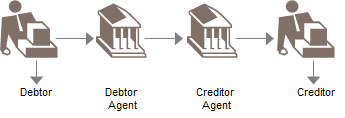
Read the diagram as text
- Start: Read left to right from debtor to debtor agent, then creditor agent and creditor.
- Follow the arrows: The debtor is the payer. The creditor is the person or company being paid.
- Check the result: The two agents act for their respective customers.
Based on official sources
Identify the two end parties and their agents in the simplest source arrangement.
In the camt room, Bank Alfa reports to its customer. The guests are the and the , the bank that keeps the account, plus the other side of each entry. In a case message, they are the assigner and the assignee.
The envelope names only the sending and receiving endpoints.
Why does this matter? Many mistakes are a role looked for in the wrong room. A reader who knows which room a message lives in knows which roles to expect, and which to stop searching for. Later levels give the guest list for each message.
PLAIN WORDS · 1 in this section
- endpoints
- the points at the far ends of a connection
PICTURE IT
The picture is the one the lesson above opens with. The table below shows how each part of it matches the payment.
THE REAL JOB Tells you which roles to expect in each family of payment messages, and which to stop looking for.
- Company and bank: a payment request,
pain.001 - Bank and bank: a customer credit transfer,
pacs.008, and a bank transfer,pacs.009 - Reports and cases: a statement,
camt.053, and a cancellation request,camt.056 - Envelope: the header
head.001
HOW THE PICTURE MAPS
| In the picture | In the payment |
|---|---|
| The room for talks between a company and its bank | Customer instructions such as the payment request pain.001, with the initiating party and the payerWho: Demo Trading Ltd |
| The room for talks between banks | Bank-to-bank messages such as the customer credit transfer pacs.008, with the instructing and instructed agentsWho: Bank Alfa |
| The room for reports and cases | The statement camt.053 and the cancellation request camt.056, with the account owner and the assigner |
| The envelope on the door | The business application header head.001, which names the sending and receiving endpoints |
WHERE THIS PICTURE STOPS
- A building has fixed rooms. A usage guideline can drop a role that the base message allows, so one scheme's guest list can be shorter.
- Guests in a room are people. In a
pacs.009the debtor and creditor are banks. - The envelope matches the room only most of the time. The header endpoints can differ from the agents inside the payment.
HOOK
Missing role? Check the neighbouring room before you doubt the message.
REMEMBER IT THIS WAY
A rule of thumb: if you see this, think that.
If a role is missing, look in the next room: pain for the customer, pacs for the banks, camt for reports and cases.
| In the trick | What it stands for |
|---|---|
| pain | the initiating party, the debtor and the creditor of a customer instruction |
| pacs | the instructing and instructed agents and the settlement block |
| camt | the account owner, the account servicer, the assigner and the assignee |
A usage guideline can leave out a role that the base message allows, and a few roles appear in two rooms.
TELL A FRIEND
Each family of payment messages has its own guest list. The company-to-bank messages have no , the bank-to-bank messages have no , and the header names only endpoints.
OFTEN MIXED UP WITH The pacs family: interbank messages. That lesson describes what each bank-to-bank message does. This one lists which roles each message family carries and which it does not.
Sources & standards — 4 sources
- Implementation-specific
Corporate Access Payables Message Implementation Guidelines — pain.001.001.03 ↗ — Nordea · Search excerpt, page not opened: initiating party, relay scenario and forwarding agent in a pain.001
Known from a web-search excerpt on 2026-10-04; the PDF itself was not opened. The result summary says this bank lists the number of transactions as mandatory and the control sum as optional, validates the number of transactions and rejects messages with a wrong value. A claim that a wrong control sum also leads to rejection was not tied to this bank and is not used. Cite it only with the label implementation-specific: it describes one bank, not Common Global Implementation Market Practice (CGI-MP), Cross-Border Payments and Reporting Plus (CBPR+) or any scheme. Recheck the current guide before relying on a field rule.
- Market practice
ISO 20022 Learning Guide, module 5 — A Deep Dive on pacs.009 ↗ — BNY (The Bank of New York Mellon Corporation) · Search excerpt, page not opened: the pacs.009 COV is the cover of a pacs.008
Downloaded and read in full from the publisher's own domain on the access date: HTTP 200, 279,826 bytes, six pages, converted with pdftotext -layout, so nothing cited from it rests on a search excerpt. The document dates itself February 2021.
It is a bank's teaching material rather than a standard or a scheme rule, so citations to it carry the market-practice label. Every ISO element address and every presence flag on the tables it supports is read from the published XSD instead, never from this guide.
Where it describes what CBPR+ requires it is reporting a usage guideline this site does not reproduce. Nothing is quoted from those passages and no CBPR+ rule is asserted from them.
Two boundaries are worth recording rather than smoothing over. Its statement that the reimbursement agents exist only in the advice usage is a statement about the CBPR+ usage guidelines and not about the base message definition, where all three elements are present and optional. The tables say so where they map field 53a, and read presence from the schema. And its three message-flow figures carry no text layer at all, so nothing on this site is sourced from them.
It says nothing about the MT200 or the MT205 beyond naming them in the list of messages pacs.009 replaces. Every row on those two tables that turns on something specific to those message types is sourced from the Swift Standards MT specification and marked as a reading rather than attributed here. Those rows are the absent field 21, the absent field 13C, the absent field 54a, and the sender standing as its own creditor.
- Market practice
ISO 20022 Learning Guide, module 7 — A Deep Dive on camt.056 and camt.029 ↗ — BNY (The Bank of New York Mellon Corporation) · Search excerpt, page not opened: Assignor equals instructing agent; Assignee equals instructed agent; camt.029 runs the other way
Downloaded and read on the access date: HTTP 200, 269,646 bytes, seven pages, converted with pdftotext -layout. Explanatory prose and two message-flow figures, not a field-level mapping table, so it is used here to confirm that a pairing is real and to say why a field matters, never to enumerate rows.
It describes CBPR+ usage rather than the base standard in at least two places, calling the original UETR and the cancellation reason information mandatory where camt.056.001.08 marks both minOccurs="0". Presence on this site is read from the published XSD, so those statements are deliberately not carried into any row.
Dated June 2021 in the document body with a December 2024 revision stamp on the disclaimer page; it therefore describes the November 2022 availability of the two messages as future.
- Simplified educational illustration
Payments Signal editorial teaching models — Payments Signal
What this simplifies: The rooms picture is a simplification. Guest lists come from this site's message records and from bank and training guides found by search. A usage guideline can narrow any list. The party elements of the remittance advice message, the investigation request and response messages and the tax block were not confirmed.
Used wherever diagrams, scenarios, figures, or example values are didactic constructions rather than sourced facts; every such use carries a simplifications disclosure. All people, companies, banks, and list entries in examples are fictional.
PRACTISE AND KEEP
IMPLEMENTATION RESOURCES
96 RESOURCES
EVIDENCE AT ARM'S REACH
Apply the base message definition first, then the scheme or infrastructure profile that governs this topic.
An XSD checks XML structure. A usage guideline adds profile rules, conditional fields, code restrictions, and business controls. XSD-valid does not mean scheme-compliant.
OPEN OFFICIAL SOURCE
CBPR+ usage guidelines
HVPS+ usage guidelines
PMPG correspondent-payment and reporting market practice
SEPA Credit Transfer rulebook
SEPA Credit Transfer implementation guidelines
SEPA Instant Credit Transfer rulebook
SEPA Instant Credit Transfer implementation guidelines and XSDs
SEPA Direct Debit Core rulebook
SEPA Direct Debit Core implementation guidelines and XSDs
SEPA Direct Debit B2B rulebook
SEPA Direct Debit B2B implementation guidelines and XSDs
T2 functional specifications, validation rules, and binding XSDs
TIPS release specifications and professional-use documentation
CHAPS and RTGS ISO 20022 handbook and schema access
Fedwire Funds Service ISO 20022 implementation and technical documents
CHIPS ISO 20022 usage-guideline resources and rules
pain.001 customer initiation — raw XML
pain.002 customer payment status — raw XML
pain.008 customer direct-debit initiation — raw XML
pacs.008 FI-to-FI credit transfer — raw XML
pacs.009 COV financial institution transfer — raw XML
pacs.008 cover announcement — COVE — raw XML
pacs.004 payment return — raw XML
camt.056 payment cancellation request — raw XML
camt.029 resolution of investigation — raw XML
camt.053 account statement — raw XML
Corporate MX positive lifecycle — ZIP pack
MX cancellation, return, reversal, and investigation lifecycle — ZIP pack
MT103 → pacs.008 implementation mapping
MT202 → pacs.009 implementation mapping
MT202 COV → pacs.009 COV implementation mapping
MT101 → pain.001 implementation mapping
MT200 → pacs.009 implementation mapping
MT205 → pacs.009 implementation mapping
MT104 → pain.008 implementation mapping
MT103 /RETN/ convention → pacs.004 implementation mapping
MT192 → camt.056 implementation mapping
MT196 → camt.029 implementation mapping
MT292 → camt.056 implementation mapping
MT296 cancellation answer → camt.029 implementation mapping
MT940 → camt.053 implementation mapping
MT950 → camt.053 implementation mapping
MT102 → N × pacs.008 (batch decomposition) implementation mapping
MT201 → N × pacs.009 (batch decomposition) implementation mapping
MT203 → N × pacs.009 (batch decomposition) implementation mapping
pain.001 field matrix
pain.002 field matrix
pain.008 field matrix
pacs.008 field matrix
pacs.009 field matrix
pacs.004 field matrix
camt.056 field matrix
camt.029 field matrix
camt.053 field matrix
Payment lifecycle test cases
MT to MX migration notes
T2 RTGS implementation pack field and process matrix
T2 RTGS implementation pack test cases
T2 RTGS implementation pack BA checklist
T2 RTGS implementation pack acceptance criteria
T2 RTGS implementation pack migration notes
T2 RTGS implementation pack restricted and release-specific gaps
TIPS instant-settlement implementation pack field and process matrix
TIPS instant-settlement implementation pack test cases
TIPS instant-settlement implementation pack BA checklist
TIPS instant-settlement implementation pack acceptance criteria
TIPS instant-settlement implementation pack migration notes
TIPS instant-settlement implementation pack restricted and release-specific gaps
CHAPS RTGS implementation pack field and process matrix
CHAPS RTGS implementation pack test cases
CHAPS RTGS implementation pack BA checklist
CHAPS RTGS implementation pack acceptance criteria
CHAPS RTGS implementation pack migration notes
CHAPS RTGS implementation pack restricted and release-specific gaps
Fedwire Funds Service implementation pack field and process matrix
Fedwire Funds Service implementation pack test cases
Fedwire Funds Service implementation pack BA checklist
Fedwire Funds Service implementation pack acceptance criteria
Fedwire Funds Service implementation pack migration notes
Fedwire Funds Service implementation pack restricted and release-specific gaps
CHIPS implementation pack field and process matrix
CHIPS implementation pack test cases
CHIPS implementation pack BA checklist
CHIPS implementation pack acceptance criteria
CHIPS implementation pack migration notes
CHIPS implementation pack restricted and release-specific gaps
CBPR+ implementation pack
SEPA credit-transfer implementation pack
SEPA direct-debit implementation pack
High-value payments implementation pack
T2 RTGS implementation pack
TIPS instant-settlement implementation pack
CHAPS RTGS implementation pack
Fedwire Funds Service implementation pack
CHIPS implementation pack
Sources for this topic — 10 sources
- Implementation-specific
Corporate Access Payables Message Implementation Guidelines — pain.001.001.03 ↗ — Nordea · Search excerpt, page not opened: initiating party, relay scenario and forwarding agent in a pain.001
Known from a web-search excerpt on 2026-10-04; the PDF itself was not opened. The result summary says this bank lists the number of transactions as mandatory and the control sum as optional, validates the number of transactions and rejects messages with a wrong value. A claim that a wrong control sum also leads to rejection was not tied to this bank and is not used. Cite it only with the label implementation-specific: it describes one bank, not Common Global Implementation Market Practice (CGI-MP), Cross-Border Payments and Reporting Plus (CBPR+) or any scheme. Recheck the current guide before relying on a field rule.
- Market practice
ISO 20022 Learning Guide, module 5 — A Deep Dive on pacs.009 ↗ — BNY (The Bank of New York Mellon Corporation) · Search excerpt, page not opened: the pacs.009 COV is the cover of a pacs.008
Downloaded and read in full from the publisher's own domain on the access date: HTTP 200, 279,826 bytes, six pages, converted with pdftotext -layout, so nothing cited from it rests on a search excerpt. The document dates itself February 2021.
It is a bank's teaching material rather than a standard or a scheme rule, so citations to it carry the market-practice label. Every ISO element address and every presence flag on the tables it supports is read from the published XSD instead, never from this guide.
Where it describes what CBPR+ requires it is reporting a usage guideline this site does not reproduce. Nothing is quoted from those passages and no CBPR+ rule is asserted from them.
Two boundaries are worth recording rather than smoothing over. Its statement that the reimbursement agents exist only in the advice usage is a statement about the CBPR+ usage guidelines and not about the base message definition, where all three elements are present and optional. The tables say so where they map field 53a, and read presence from the schema. And its three message-flow figures carry no text layer at all, so nothing on this site is sourced from them.
It says nothing about the MT200 or the MT205 beyond naming them in the list of messages pacs.009 replaces. Every row on those two tables that turns on something specific to those message types is sourced from the Swift Standards MT specification and marked as a reading rather than attributed here. Those rows are the absent field 21, the absent field 13C, the absent field 54a, and the sender standing as its own creditor.
- Market practice
ISO 20022 Learning Guide, module 7 — A Deep Dive on camt.056 and camt.029 ↗ — BNY (The Bank of New York Mellon Corporation) · Search excerpt, page not opened: Assignor equals instructing agent; Assignee equals instructed agent; camt.029 runs the other way
Downloaded and read on the access date: HTTP 200, 269,646 bytes, seven pages, converted with pdftotext -layout. Explanatory prose and two message-flow figures, not a field-level mapping table, so it is used here to confirm that a pairing is real and to say why a field matters, never to enumerate rows.
It describes CBPR+ usage rather than the base standard in at least two places, calling the original UETR and the cancellation reason information mandatory where camt.056.001.08 marks both minOccurs="0". Presence on this site is read from the published XSD, so those statements are deliberately not carried into any row.
Dated June 2021 in the document body with a December 2024 revision stamp on the disclaimer page; it therefore describes the November 2022 availability of the two messages as future.
- Market practice
ISO 20022 learning guides — module 6, a deep dive on pacs.004 and pacs.002 ↗ — The Bank of New York Mellon Corporation (BNY) · Search excerpt, page not opened: original parties sit under the Original Transaction Reference block of a pacs.004
Downloaded and read in full from the publisher's own domain on the access date: eight pages, read with pdftotext, so nothing cited from it rests on a search excerpt.
It is a bank's teaching material rather than a standard or a scheme rule, so citations to it carry the market-practice label. Every ISO element address and every presence flag on the mapping tables it supports is read from the published XSD instead, never from this guide.
Where it describes what CBPR+ requires it is reporting a usage guideline this site does not reproduce. Nothing is quoted from those passages and no CBPR+ rule is asserted from them.
One tension in the document is worth recording rather than smoothing over. It describes the MT return convention as sending the original message back unchanged with a return code in field 72. And then says in the next section that the resulting ambiguity — whether the parties listed are the original's or the return's — is exactly what the return chain was added to remove. Both halves are taken together, because the first read alone would suggest the convention was settled when the document's own point is that it was not.
- Market practice
ISO 20022 Learning Guide, module 9 — A Deep Dive on camt.054 ↗ — BNY (The Bank of New York Mellon Corporation) · Search excerpt, page not opened: camt.054 is sent by the account servicer to the account owner (existing registry entry)
Downloaded and read in full from the publisher's own domain on the access date: HTTP 200, 452,581 bytes, eight pages, converted with pdftotext -layout, so nothing cited from it rests on a search excerpt. Dated 1/2025 on the disclaimer page.
Explanatory prose plus three figures, not a field-level mapping table. It is used here to confirm that a pairing is real and to say why a field matters, never to list out rows. Every ISO element address and every presence flag on the tables it supports is read from the published XSD instead.
It describes camt.054.001.08 and CBPR+ usage, and in one place that matters the two have since diverged from the base definition. It calls the account identification a mandatory field, which is true of the CashAccount type used in camt.054.001.08 and not of camt.054.001.14, where the element is minOccurs=0 so an account may be identified by a proxy instead. Presence on this site is read from the published XSD, so that statement is not carried into any row.
It also reads field 52A as the debtor party rather than as the debtor agent, which is a defensible reading for a bank-to-bank payment and not the one the MT910 table takes. Both readings are recorded on the MT900 table rather than one of them being smoothed away.
- Scheme-specific rule
Lynx usage guideline: business application header head.001 ↗ — Payments Canada · Search excerpt, page not opened: head.001 From and To are messaging endpoints
Known from a web-search excerpt only (page not opened). The excerpt said From names the sending messaging endpoint that created the business message and To names the endpoint designated to process it, and that the sending endpoint might differ from the sending address in the transport header. A national profile, so only the general meaning of From and To is used.
- Scheme-specific rule2025 version 1.0
SEPA Direct Debit Core implementation guidelines and XSDs ↗ — European Payments Council · Search excerpt, page not opened: pain.008 creditor scheme identification, creditor agent, debtor agent and mandate related information
EPC XSDs formalise guideline restrictions for technical validation; they are not production artefacts or proof that all scheme business rules pass.
- Market practice
Mini Series and Reference Guide, Part 2, from Citi (pacs.008 and pacs.009 element guide) ↗ — Citi Treasury and Trade Solutions · Search excerpt, page not opened: parties change role between the pacs.008 and the pacs.009 COV
Known from a web-search excerpt only (page not opened). The excerpts gave four points. The instructing agent is the message sender and the instructed agent the message receiver. Intermediary agents 1 to 3 sit in sequence between the debtor agent and the creditor agent. The debtor agent account is optional in the customer and bank-to-bank transfer messages. The cover version of the bank-to-bank message carries the underlying customer credit transfer, and its parties change role. Treat as market-practice, not as the ISO definition text.
- Scheme-specific rule
TCCG item 5.2: population of assigner and assignee in RTGS camt.029 ↗ — European Central Bank · Search excerpt, page not opened: population of assigner and assignee in RTGS camt.029
Known from a web-search excerpt only (page not opened). Only the title and a general description were seen: it concerns how the assigner and assignee are filled when the system generates a camt.029. No element detail is relied on beyond that.
- Simplified educational illustration
Payments Signal editorial teaching models — Payments Signal
What this simplifies: The rooms picture is a simplification. Guest lists come from this site's message records and from bank and training guides found by search. A usage guideline can narrow any list. The party elements of the remittance advice message, the investigation request and response messages and the tax block were not confirmed.
Used wherever diagrams, scenarios, figures, or example values are didactic constructions rather than sourced facts; every such use carries a simplifications disclosure. All people, companies, banks, and list entries in examples are fictional.
Deepest material on this page: L4 — Standards & sources. Where a topic stops short of implementation depth, that is a deliberate coverage decision, not an oversight — see coverage.