head.001 — the cover note, not a payment
Learn what the label on a message says, and why a header never says anything about the money.
L1–L4 are part of the Pro pass
L0 Explain simply
Use case — Maya Chen at Bank Alfa opens an incoming message. Before anything else she finds a short block of labels. What is that block, and does it move any money?
Picture a box with a label stuck on the outside. The label says who sent the box, who should get it and what kind of thing is inside. The label is not what is in the box. Reading it does not open anything. SYNTHETIC — TRAINING ONLY: Maya Chen and Bank Alfa are fictional, and the picture is simplified.
That label has a name: head.001, the . is the international standard for financial messages, with fixed, labelled parts that a computer can read. The header is a message in that standard. But it is not a payment message. It holds no amount, no account and no instruction to pay. It travels in front of another message, called the business message. It says what is coming.
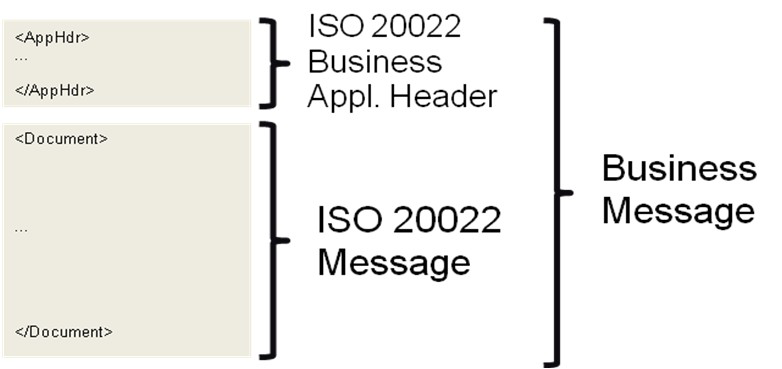
Read the diagram as text
- AppHdr: The first bracket names the Business Application Header. It describes the business message and its addressing.
- Document: The second bracket names the actual ISO 20022 message. For a payment instruction this contains the payment details.
- Business message: The large bracket includes both pieces. A header alone does not tell you whether a payment was made.
Based on official sources
Find the two components that make up the business message in this ISO example.
Read the original at full size here
Use touch, a trackpad, or the arrow keys in the image area.
Cross-Border Payments and Reporting Plus () is Swift's set of usage rules for cross-border ISO 20022 messages. The public pages we found say it uses version head.001.001.02 of the header. The idea matters. A network can read the label to route a message without opening it. A wrong label can get a good message refused. It can also send it to the wrong place, even when everything inside is right.
Keep three limits in mind. The header is not a payment status. A pacs.002 reports what happened to a payment. It is not settlement: no money moves because of it. It is not a . No account changes because of it.
Disclosure: Swift's for the header is open to members only. This lesson uses public pages and search excerpts. It does not quote the CBPR+ rules for each element.
Check yourself. Does a head.001 on its own move any money? No. It is the cover note. Whatever the business message behind it asks for is a separate matter.
PICTURE IT
The label on the parcel
Picture a parcel with a label on the outside. The label says who sent it, who should get it and what kind of thing is inside. The people who sort parcels read the label and never open the parcel.
THE REAL JOB A header message called head.001 travels in front of a business message and names the sender, the receiver, the message behind it and its own reference, while reporting on no payment.
- The sender builds the label
- The receiver reads it first
- The message is routed on its rules
- A fault is fixed on the label and sent again
HOW THE PICTURE MAPS
| In the picture | In the payment |
|---|---|
| The label on the outside | The header, a message called head.001, with no amount and no status |
| The parcel inside | The business message, which carries any instruction or report |
| The sender and the address on the label | The From and To elements, here Nordbank and Bank AlfaWho: Bank Alfa |
| The sorter who reads the label first | The receiving system, and Maya Chen when something goes wrongWho: Maya Chen |
WHERE THIS PICTURE STOPS
- A label shows only a few facts. It does not show the parts of a real header that may be left out. Which parts a service requires is its own rule.
- A paper label is simple to read. Swift's guideline for this header is open to members only, so this page quotes no element rule.
HOOK
A label, not a parcel, not a verdict.
REMEMBER IT THIS WAY
A contrast: two neighbours told apart by one test.
Ask whether it holds an instruction: the business message does, while a head.001 is only the label.
| In the trick | What it stands for |
|---|---|
head.001 | the header that names sender, receiver and message type |
| business message | the payment, status or report that carries the content |
A header can carry a related header that points at an earlier message, so the label may refer to more than one message.
TELL A FRIEND
A head.001 is the cover note in front of a message. It is not a payment and it is not a status.
OFTEN MIXED UP WITH pacs.002 — interbank payment status. A header called head.001 carries no payment outcome. A pacs.002 reports what happened to one payment, including a rejection.
SEE THE PAYMENT MOVE
PICTURE THE JOURNEY
A holiday cottage reserved through two agencies and a middle companyOpen to read the picture, how it matches the payment and where it stops.
PICTURE IT
A holiday cottage reserved through two agencies and a middle company
Picture a small trading firm that wants to rent a holiday cottage abroad for a visiting partner. The cottage has an owner who lives there. The firm and the owner never deal with each other. Each uses a local agency, and both agencies keep a balance with one large middle company.
The firm fills in a form and asks its agency to pay the rent. The agency checks that the form can be read. It checks that the firm may order it and that the money is there. It also checks that no name is on a list of people and firms nobody may deal with. Then it marks the form as accepted. That mark means only that the agency will work on it. The agency then takes the rent from the firm's balance and gives a receipt. The rent has left the firm, but the owner has not been paid.
The agency sends the request over a shared network, with one reference number on it. The network checks that the form is laid out correctly and passes it on. It holds no money. The middle company reads the request and checks it again, for itself. If it is satisfied, it lowers the firm's agency balance and raises the owner's agency balance, in its own book. That entry is the moment the rent really changes hands.
The middle company passes the request to the owner's agency. That agency runs its own checks too, because a pass at the first agency does not bind it. If all is well, it adds the rent to the owner's account and can tell the owner. A confirmation can travel back, and a tracking page shows the last known state for the reference number. The firm's agency may also send a noon sheet and a closing sheet. They list the entries on the firm's balance. They show that the rent left. They do not show that the owner was paid.
Some turns are possible. If an agency or the middle company rejects the form before the entry, the firm's rent is released or given back. Nothing has to be undone between the agencies. If the entry was made but the owner's agency cannot use the rent, the rent comes back as a second, separate entry the other way. If the firm later asks for the rent back, that is only a request, and the owner's agency can refuse. If no news comes, the agency checks the tracking page before it sends anything again. The middle company may also keep a handling fee, so the owner receives a little less than the quoted rent.
THE REAL JOB It lets a company pay a supplier at another bank, with checks along the way and a record at each end.
HOW THE PICTURE MAPS
| In the picture | In the payment |
|---|---|
| The firm fills in a form asking its agency to pay the rent | Asha Traders sends its bank a customer payment request, pain.001Who: Asha Traders |
| The agency checks the form, the firm's authority, the money and the banned list | Bank Alfa validates and screens the instruction before it releases anythingWho: Bank Alfa |
| The agency marks the form accepted, meaning it will work on it | The accepted status report, pain.002, says processing will start, not that anyone is paid |
| The agency takes the rent from the firm's balance and gives a receipt | Bank Alfa debits the customer account; where offered, an entry notice, camt.054, reports itWho: Bank Alfa |
| The shared network carries the request and holds no money | Swift FINplus carries the interbank payment message pacs.008 and holds no account |
| One reference number follows the reservation, while each form has its own number | The unique end-to-end transaction reference (UETR) follows the payment; messages have their own ids |
| The middle company checks the request again, for itself | Meridian Bank checks and screens for itself; an earlier pass does not bind itWho: Meridian Bank |
| The middle company moves the balances in its own book, then passes the request on | Meridian Bank debits Bank Alfa's account, credits Nordbank's, then forwards the paymentWho: Meridian Bank |
| The owner's agency runs its own checks, then adds the rent to the owner's account | Nordbank validates, screens and credits the account of Northstar ComponentsWho: Nordbank |
| The owner receives a note that the rent has arrived | If subscribed, Northstar Components sees the credit in an entry notice from its own bankWho: Northstar Components |
| A tracking page shows the last known state for the reference number | Swift payment Tracker records the outcome that Nordbank reports; it settles nothing |
| The firm's agency may send a noon sheet and a closing sheet of entries | Bank Alfa reports the entries in an intraday report, camt.052, and a statement, camt.053Who: Bank Alfa |
| A check rejects the form before the entry, and the firm's rent is released | A reject before settlement: Bank Alfa restores the customer debit and no return is needed |
| The rent comes back as a second entry the other way | A return after settlement: pacs.004 starts a new, separate settlement the other way |
| The firm asks the owner's agency to give the rent back | A recall request, camt.056; the supplier's bank may refuse |
| No news arrives from the agencies | No status: trace with the tracking reference before any resend |
| The middle company keeps a handling fee, so the owner gets a little less | Charges deducted in transit: the supplier receives less than the invoice |
WHERE THIS PICTURE STOPS
- In the picture the middle company is one firm with its own book. In this journey the correspondent settles in commercial bank money on its own books, and other payments settle through other correspondents or shared payment systems.
- In the picture the firm could phone the owner and get the rent back. A settled payment is not undone. Money returns only as a new return that settles on its own. A recall is only a request, and the supplier's bank can refuse it. A yes to a recall is not the money itself.
- The picture shows one list check per agency. In the journey each bank decides for itself, so an earlier pass does not bind a later bank. A hold is the control working, and a legal block follows the law that applies, not an automatic return.
- A confirmed reservation is followed by a stay on a later day. A payment has no such later step. Once the supplier's bank credits the account, the journey ends, although a hold can still make the credit unavailable.
- The picture has one reference number and no message ids. In the journey the unique end-to-end transaction reference (UETR) follows the payment, each message also has its own id, and a missing status proves nothing.
- The picture shows one route with one middle company. Real routes can have more banks, and the branches in this journey are alternative outcomes, not events that all happen to one payment. A separate journey teaches the cover method, where the instruction and its funding travel apart.
HOOK
Messages ask and report. A book transfer moves the money between banks.
REMEMBER IT THIS WAY
A sequence: the real steps, in order.
Say the journey as four verbs in order: ask, book, credit, report.
| In the trick | What it stands for |
|---|---|
| ask | Asha Traders sends its bank a customer payment request, pain.001 |
| book | Meridian Bank debits Bank Alfa's account, credits Nordbank's, then forwards the payment |
| credit | Nordbank validates, screens and credits the account of Northstar Components |
| report | Bank Alfa reports the entries in an intraday report, camt.052, and a statement, camt.053 |
TELL A FRIEND
The customer's bank checks and debits first, then the banks pass messages and a middle bank changes its books. Messages and reports only describe what happened; that book entry moves the money between banks.
OFTEN MIXED UP WITH Reporting on a payment. That topic teaches how to read one status message and its . This journey lays every status, notice and report beside the one entry that moves the money.
PRACTISE AND KEEP
IMPLEMENTATION RESOURCES
2 RESOURCES
EVIDENCE AT ARM'S REACH
Apply the base message definition first, then the scheme or infrastructure profile that governs this topic.
An XSD checks XML structure. A usage guideline adds profile rules, conditional fields, code restrictions, and business controls. XSD-valid does not mean scheme-compliant.
PRO PASS
head.001 field matrix
Sources for this topic — 11 sources
- Scheme-specific rule
Business application header (BAH) ↗ — ISO 20022 Registration Authority · Business application header (BAH) catalogue page: head.001 is a standalone definition combined with a business message; versions .02, .03 and .04 are listed (search excerpt, page not opened)
Several BAH versions exist (head.001.001.01 through .03); each usage community, such as CBPR+, spells out which version applies.
- Scheme-specific rule
ISO 20022 Business Application Header Frequently Asked Questions ↗ — ISO 20022 Registration Authority · Business Application Header FAQ, version 1.1 of 2020, written for version 2: the header can be combined with any other message definition; root element AppHdr (search excerpt, page not opened)
Search excerpt, page not opened: found by WebSearch on 2026-10-12. The FAQ is version 1.1 of 2020 and was written for version 2 of the header; read the catalogue page for version 3.
- Market practice
Business Application Header (head.001) — Swift training ↗ — Swift · Swift training page on the Business Application Header, version 2, as used by Cross-Border Payments and Reporting Plus (CBPR+) (search excerpt, page not opened)
Read as web-search excerpts on the access date; the page itself was not opened. Only the catalogue entry was seen. It gives no validation rules for a wrong service name.
- Market practice
Iberclear guide to the head.001 Business Application Header ↗ — Iberclear · Iberclear guide to version 2 of the header: From and To identified by a bank code or a legal entity code, mandatory message reference, message definition and creation date, optional business service (search excerpt, page not opened)
Search excerpt, page not opened: found by WebSearch on 2026-10-12. Market practice for one community, not the standard. Other communities set their own rules.
- Market practice
Lynx usage guideline: business application header head.001 ↗ — Payments Canada · Payments Canada guideline restricting head.001.001.02: From names the sending messaging endpoint, which may differ from the transport-header sender (search excerpt, page not opened)
Known from a web-search excerpt only (page not opened). The excerpt said From names the sending messaging endpoint that created the business message and To names the endpoint designated to process it, and that the sending endpoint might differ from the sending address in the transport header. A national profile, so only the general meaning of From and To is used.
- Scheme-specific rule
Format Frequently Asked Questions (Fedwire Funds Service ISO 20022) ↗ — Federal Reserve Financial Services · Fedwire ISO 20022 format FAQ: envelope, header and business message. See the separate Format Documentation FAQ for the version-3 explanation.
Verified from web-search excerpts on the access date, across several queries and two related Federal Reserve FAQ pages; the pages were not opened. Use only the label scheme-specific-rule from an excerpt-only source.
- Scheme-specific rule
Cross-Border Payments and Reporting Plus (CBPR+) usage guidelines ↗ — Swift (CBPR+ working group) · Check which header version and which element rules apply in the selected Swift service's MyStandards usage guidelines (member-only; element rules not quoted here)
Full guidelines require MyStandards access. Public guidance had set 14 November 2026 as the date after which fully unstructured addresses would be removed for in-scope CBPR+ traffic. The explicit message exceptions included admi.024, camt.025, camt.052, camt.053, camt.054 and camt.060. Swift has since deferred that requirement and set no replacement date. The current fact
swift-cbpr-unstructured-address-removalcarries the position. - Simplified educational illustration
Payments Signal editorial teaching models — Payments Signal
What this simplifies: The case uses Maya Chen, Bank Alfa and Nordbank as fictional actors and describes no payment journey, because a header is not a payment. Element paths are from the base definition of header version 2 as checked directly against the official XSD, not from a usage guideline. We found no public text of the Cross-Border Payments and Reporting Plus (CBPR+) element rules, of which header version each service pins beyond the sources named, or of how a network refuses a faulty header.
Used wherever diagrams, scenarios, figures, or example values are didactic constructions rather than sourced facts; every such use carries a simplifications disclosure. All people, companies, banks, and list entries in examples are fictional.
- Scheme-specific rule
Fedwire Funds Service ↗ — Federal Reserve Financial Services · Fedwire Funds Service; see the Federal Reserve Format Documentation FAQ Q3 for the header version.
The Fedwire Funds Service completed its ISO 20022 implementation on 14 July 2025.
- Official requirement
ISO 20022 Catalogue of messages ↗ — ISO 20022 Registration Authority · ISO Message Archive, Business Application Header V02 (head.001.001.02): official XSD opened and checked. Exact file: https://www.iso20022.org/message/19186/download. Structure and cardinalities only; not a usage guideline.
Each message set is described by a Message Definition Report; earlier versions remain available in the ISO 20022 messages archive.
- Scheme-specific rule
Format/Technical Documentation and MyStandards Frequently Asked Questions (Fedwire Funds Service ISO 20022) ↗ — Federal Reserve Financial Services · Federal Reserve Format Documentation FAQ Q3, opened: Fedwire uses .03; .02 cannot carry a complete copy of the original BAH in Related for retrievals.
Search excerpt, page not opened: found by WebSearch on 2026-10-12. The full usage guideline sits behind a MyStandards access request and was not reached.
Deepest material on this page: L4 — Standards & sources. Where a topic stops short of implementation depth, that is a deliberate coverage decision, not an oversight — see coverage.